June 26, 2026
Scenario Projection: Two Industrial Strategies Diverging at Speed
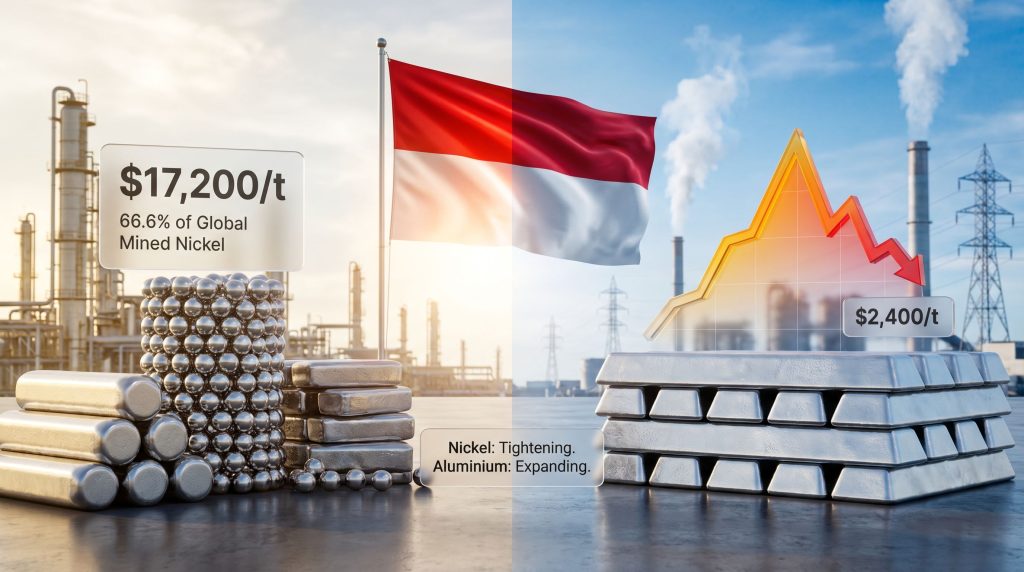
When a single nation controls more than two-thirds of global supply for a critical industrial metal, and simultaneously engineers one of the fastest aluminium production ramp-ups in modern history, the consequences for global commodity markets are profound and uneven. The Indonesia nickel and aluminium outlook through 2027 is not a single story — it is two fundamentally different industrial strategies operating under one flag, producing sharply divergent price trajectories and risk profiles that demand separate analytical frameworks.
Understanding Indonesia's dual-metal ambition requires moving beyond headline output numbers and examining the underlying policy architecture, the processing technology choices being made, the geopolitical vulnerabilities embedded in Chinese-dominated capital flows, and the energy infrastructure paradox at the heart of both industries.
When big ASX news breaks, our subscribers know first
How Indonesia Became the World's Dominant Nickel Producer
A decade ago, Indonesia was a meaningful but not dominant force in global nickel supply, contributing roughly 6% of world mined output in 2015. By 2025, that figure had climbed to an extraordinary 66.6%, a transformation without modern parallel in a major industrial metal.
The policy trigger was the 2020 raw ore export ban, which compelled downstream capital investment at scale. Rather than shipping unprocessed laterite ore to overseas refiners, Indonesia effectively forced the construction of domestic processing capacity. The result was the rapid emergence of large-scale Indonesian Processing Zones, populated primarily by Chinese-backed operators deploying two distinct refining technologies:
- Rotary Kiln Electric Furnace (RKEF) processing, which converts laterite ore into nickel pig iron and ferronickel, primarily serving the stainless steel sector.
- High Pressure Acid Leach (HPAL) processing, which extracts battery-grade nickel as mixed hydroxide precipitate (MHP), serving the electric vehicle supply chain.
The distinction between these two processing routes is commercially critical and often underappreciated. RKEF output feeds the stainless steel market, where nickel demand is large but price-sensitive and relatively mature. HPAL output targets the battery-grade Class 1 nickel market, where demand is growing at an accelerating rate and buyers are willing to pay a significant premium over LME benchmark pricing. Indonesia's expansion of HPAL capacity, furthermore, represents not just volume growth, but a deliberate migration up the value curve toward higher-margin battery material supply.
The Global Nickel Supply Landscape in 2025
| Producer | Est. Global Supply Share (2025) | Primary Processing Route | Cost Position |
|---|---|---|---|
| Indonesia | ~66.6% mined | HPAL / RKEF | Low–Medium |
| Philippines | ~8–10% | Laterite ore export | Low |
| Russia | ~6–7% | Sulphide smelting | Medium–High |
| New Caledonia | ~3–4% | Ferronickel / matte | High |
The concentration risk embedded in this table deserves emphasis. No other industrial metal of comparable economic significance is as dependent on a single producing nation. This asymmetry functions as a structural price lever that Indonesia is now actively learning to operate. For a broader view, the Indonesian nickel market trends point toward continued concentration risk shaping global pricing for years ahead.
How Quota Management Is Reshaping the Nickel Price Outlook
The most analytically significant development in the Indonesia nickel and aluminium outlook for 2026 is not production volume — it is deliberate supply restriction at the upstream end. Jakarta has implemented government-mandated quota reductions across key operating licences as a market management tool, and the effects are already propagating through global price discovery mechanisms.
The clearest example is PT Weda Bay Nickel, whose permitted annual ore extraction was reduced from 42 million tonnes to 12 million tonnes — a contraction exceeding 70% in a single licensing action. Aggregated across the broader licence base, industry analysts estimate the combined effect represents an approximately 11% contraction in domestic mine supply, creating upstream scarcity that is structurally distinct from the organic demand-supply cycles that typically drive LME pricing.
The strategic logic here is sophisticated. By restricting ore availability, the Indonesian government protects the margin position of its downstream processing sector. If ore prices rise due to scarcity, HPAL and RKEF operators benefit from ore-to-metal spread compression in reverse — meaning downstream processors gain relative to upstream miners, reinforcing Jakarta's policy objective of retaining maximum value onshore.
Goldman Sachs has revised its nickel price forecast upward by approximately 16% in response to these supply dynamics, projecting an average price of $17,200 per tonne for 2026. This compares to periods in 2023 and early 2024 when nickel traded below $14,000/t amid unrestricted Indonesian output growth.
The price sensitivity of the nickel market to Indonesian quota decisions is now arguably greater than its sensitivity to LME positioning or traditional demand-side indicators — a structural inversion that has important implications for how traders and downstream buyers model their forward exposure.
Scenario modelling for nickel pricing through 2027:
- Quota discipline maintained: Prices structurally supported above $16,000/t, marginal cost floor rises, junior mining projects outside Indonesia become more viable.
- Quota reversal or licensing expansion: Oversupply conditions return, prices risk falling back toward the $13,000–$14,000/t range that characterised 2023–2024.
- Geopolitical disruption to Chinese capital flows: Processing capacity investment slows, HPAL commissioning timelines extend, short-term supply tightness intensifies.
Why Nickel Demand Will Structurally Outpace the Stainless Steel Baseline
Stainless steel currently accounts for approximately 70% of global nickel demand, and this segment's price sensitivity and moderate growth trajectory have historically anchored nickel price behaviour. However, the forward demand story is increasingly being written by battery chemistry, not by flat-rolled steel.
NMC 811 and NMC 622 cathode chemistries — both high-nickel formulations — deliver the energy density required for long-range electric vehicles, and demand for these materials is forecast to grow by more than 200% through to 2040. Global nickel demand across all segments is projected to increase by roughly 60% by 2040, with battery applications as the dominant growth engine. The broader battery metals investment landscape reflects this structural shift, with capital increasingly flowing toward battery-grade supply chains.
Nickel Demand by End-Use Segment
| End-Use Segment | Approximate Demand Share (2025) | Growth Trajectory to 2040 |
|---|---|---|
| Stainless steel | ~70% | Moderate growth |
| EV batteries (NMC) | ~12–15% | Very high (+200%+ projected) |
| Aerospace and industrial alloys | ~5–7% | Stable |
| Other battery chemistries | ~3–5% | Moderate-high growth |
A less commonly understood nuance in this data is that battery-grade nickel and stainless steel-grade nickel are not interchangeable. Class 1 nickel and MHP from HPAL operations command premium pricing over Class 2 ferronickel and nickel pig iron used in stainless. This creates a two-tier nickel market with divergent price dynamics operating simultaneously — a complexity that blended demand forecasting often obscures.
Indonesia's Aluminium Boom: A Supply Architecture Being Built at Unprecedented Speed
While nickel is being managed through supply restriction, Indonesia's approach to aluminium runs in precisely the opposite direction. Following the 2023 bauxite export ban — the policy equivalent of the earlier nickel ore ban — Chinese-operated alumina refining capacity inside Indonesia scaled with remarkable speed, with output rising from an estimated 3.3 million tonnes in 2022 to approximately 59 million tonnes of alumina by 2025.
Indonesia's nickel boom provides an instructive template here: the downstream consequence of the bauxite ban is a smelting investment wave projected to push Indonesian primary aluminium output from 800,000 tonnes in 2025 to approximately 2.8 million tonnes by 2027 — a near-tripling within a two-year window that represents one of the most rapid aluminium capacity expansions in modern industrial history.
According to S&P Global, Indonesia must adopt a balanced, integrated approach to its aluminium supply chain and learn from the lessons of its nickel experience — a sentiment echoed widely by commodities analysts.
Indonesian Aluminium Production Trajectory
| Year | Estimated Output | Global Share Estimate |
|---|---|---|
| 2022 | ~500,000 t | ~1% |
| 2025 | ~800,000 t | ~1.5% |
| 2027 (forecast) | ~2,800,000 t | ~4–5% |
| 2030 (target) | ~3,000,000+ t | ~5%+ |
Underpinning this expansion is a captive power infrastructure built almost entirely on coal-fired generation. Approximately 81% of the 22.9 GW of industrial power capacity supporting Indonesian smelter operations is coal-fired — a structural dependency that creates direct friction with ESG requirements being imposed by downstream buyers in Western markets, and with Indonesia's own stated climate commitments.
The Surplus Risk: Could Indonesia's Aluminium Strategy Mirror Nickel's Oversupply Episode?
The parallel between Indonesia's current aluminium trajectory and its nickel trajectory between 2018 and 2023 is analytically uncomfortable. Chinese-backed nickel processing capacity scaled aggressively during that period, driving global nickel prices from above $20,000 per tonne to below $14,000 per tonne by 2023 — destroying returns for producers outside Indonesia and creating severe balance sheet stress across the global nickel mining sector.
Analysts including those at Goldman Sachs have identified a structurally similar surplus risk forming in aluminium, with forecasts suggesting prices could decline toward $2,400 per tonne by 2027 if Indonesian capacity additions coincide with output growth from other producing nations and demand absorption falls short. For context on how leading producers are positioning themselves, the aluminium industry leaders are closely monitoring Indonesia's expansion as a potential market-altering force.
The critical asymmetry between Indonesia's two metal strategies is that nickel is being actively managed through supply restriction while aluminium is being accelerated through investment incentives. Without deliberate production pacing mechanisms, the aluminium expansion risks generating a self-defeating price environment in which the revenue returns from expanded volume fail to compensate for the price depression that the volume itself creates.
The counterargument worth taking seriously is that aluminium demand growth from electric vehicles, construction, and packaging may absorb new Indonesian supply faster than surplus scenarios imply. Aluminium's role in EV lightweighting — structural panels, battery enclosures, and motor housings — creates a demand linkage with the EV transition that could provide a demand floor absent from more bearish scenarios. However, this demand pathway is more moderate in growth intensity than the battery-grade nickel story, and the timeline for absorption remains genuinely uncertain.
The next major ASX story will hit our subscribers first
Comparing the Two Strategies: A Structural Framework
| Dimension | Nickel Strategy | Aluminium Strategy |
|---|---|---|
| Core policy lever | Ore export ban + quota restrictions | Bauxite export ban + smelter incentives |
| Market direction | Supply tightening, price support | Supply expansion, price pressure risk |
| 2026 price outlook | ~$17,200/t (Goldman Sachs) | Elevated, declining trajectory |
| 2027 price risk | Upside if quotas hold | Downside if surplus materialises (~$2,400/t) |
| Chinese investment role | Dominant in RKEF and HPAL | Dominant in alumina refining |
| Environmental exposure | Coal-dependent power | Coal-dependent power (81% of capacity) |
| EV demand alignment | High (battery-grade MHP) | Moderate (structural and packaging) |
The table reveals a fundamental strategic asymmetry. Indonesia has effectively learned from the consequences of its own nickel oversupply episode and is applying supply discipline to the nickel market while simultaneously running an unconstrained volume strategy in aluminium. Whether this reflects deliberate sequencing — using aluminium to build industrial infrastructure while protecting nickel pricing — or simply different stages of policy maturity is an open question with meaningful implications for how each market resolves through 2027.
Geopolitical Fault Lines and the Coal Dependency Paradox
Both strategies share a vulnerability that deserves independent analytical attention. Escalating US-China trade tensions introduce feedstock supply risks for Indonesian processing operations that are overwhelmingly dependent on Chinese technical inputs, capital equipment, and operational expertise. In addition, a meaningful deterioration in the bilateral relationship could slow commissioning timelines, increase capital costs, and introduce processing throughput uncertainty — particularly for HPAL facilities, which are technically demanding and have historically experienced extended ramp-up periods.
The global metals tariff impact is already reshaping trade flows across base metals, and Indonesia's processing sector is not immune to this broader geopolitical reconfiguration. The Iran conflict's secondary effects on non-ferrous metals logistics and energy input costs add a further layer of external risk.
The coal dependency issue is not merely an ESG concern — it is a commercial risk with a tightening timeline. EV supply chain buyers, particularly major automotive OEMs operating under European regulatory frameworks, are progressively requiring low-carbon certification for battery-grade materials. As Goldman Sachs has noted, Indonesia's policy-driven supply shifts are already altering global price dynamics, and the added pressure of carbon certification requirements could further differentiate producers. Indonesia has articulated a transition pathway incorporating renewable energy integration into industrial parks, but the capital requirements, timeline, and political will required to execute this transition at the scale needed remain unresolved.
Key Indicators to Watch Through 2027
For investors, downstream manufacturers, and commodity analysts tracking the Indonesia nickel and aluminium outlook, the following leading indicators will most reliably signal which scenario pathway is materialising:
- Indonesian nickel ore quota announcements — any expansion of permitted output would be the earliest signal of a price-negative scenario.
- HPAL capacity utilisation rates — indicating whether battery-grade nickel supply is actually scaling as projected or facing technical commissioning delays.
- LME nickel price relative to the $17,200/t Goldman Sachs base case — divergence in either direction provides real-time scenario feedback.
- Indonesian aluminium smelter commissioning timelines — slippage in the 2027 output ramp could meaningfully reduce the surplus risk.
- LME aluminium price behaviour as the 2027 surplus window approaches — early price weakness would signal market anticipation of the oversupply scenario.
- Chinese investment flow data into Indonesian processing — acceleration signals output growth, deceleration suggests capital constraint or policy friction.
Frequently Asked Questions: Indonesia Nickel and Aluminium Outlook
What percentage of global nickel does Indonesia produce?
Indonesia accounted for approximately 66.6% of global mined nickel supply in 2025, a dramatic rise from roughly 6% a decade earlier, making it the undisputed dominant force in global nickel production.
Why are Indonesian nickel prices expected to rise in 2026?
Government-imposed production quota reductions, including the reduction of PT Weda Bay Nickel's permitted output from 42 million tonnes to 12 million tonnes, have tightened domestic ore availability by an estimated 11%. This has raised the marginal cost floor for global nickel production, supporting Goldman Sachs' revised forecast of approximately $17,200 per tonne for 2026.
How much will Indonesia's aluminium output grow by 2027?
Indonesian primary aluminium production is forecast to rise from roughly 800,000 tonnes in 2025 to approximately 2.8 million tonnes by 2027, driven by the wave of smelter investment triggered by the 2023 bauxite export ban.
Will Indonesia's aluminium expansion cause a global price crash?
Analyst scenarios, including those from Goldman Sachs, suggest that if Indonesian supply additions coincide with output from other producers and demand growth proves insufficient, global aluminium prices could fall toward $2,400 per tonne by 2027. This outcome is not certain and depends heavily on demand absorption from EVs and construction activity.
What is the biggest risk to Indonesia's nickel price outlook?
The primary downside risk is a reversal of quota discipline, whether through political pressure, licensing changes, or Chinese capital-driven capacity expansion resumption, which could reintroduce the oversupply conditions that drove nickel prices below $14,000/t during 2023 and 2024.
How does coal dependency affect Indonesia's metals sector?
Approximately 81% of the 22.9 GW of captive industrial power capacity supporting Indonesian smelting operations is coal-fired. This creates significant ESG exposure, potential commercial friction with EV supply chain buyers requiring low-carbon certified materials, and a longer-term transition cost burden that has not yet been fully priced into either industry's investment economics.
Disclaimer: This article contains forward-looking statements, price forecasts, and scenario projections sourced from publicly available analyst research. All figures involving future price trajectories, production forecasts, and market scenarios are subject to material uncertainty and should not be construed as investment advice. Readers should conduct independent due diligence before making any investment or commercial decisions based on information contained herein.
Want to Identify the Next Major ASX Discovery Before the Market Reacts?
As Indonesia's nickel quota management and aluminium expansion reshape global commodity price dynamics, Discovery Alert's proprietary Discovery IQ model delivers real-time alerts on significant ASX mineral discoveries — instantly translating complex commodity signals into actionable investment opportunities for both short-term traders and long-term investors. Explore historic examples of major mineral discoveries and their market returns, then begin your 14-day free trial at Discovery Alert to position yourself ahead of the next significant market move.