July 28, 2026
When Regulatory Silence Becomes a Supply Shock
Most commodity disruptions trace back to something tangible: a mine closure, a weather event, a sudden demand collapse. The Indonesia nickel export bottleneck unfolding through mid-2026 is a different animal entirely. It stems not from a shortage of ore in the ground, nor from a collapse in processing capacity, but from the absence of a regulatory definition. When a government directive to retain rare-earth elements domestically collided with export channels that had no established framework for testing or threshold compliance, the result was a bottleneck generated by bureaucratic silence rather than geological scarcity.
This distinction matters enormously for investors and supply chain analysts trying to model resolution timelines. A geological constraint has a cost curve. A regulatory vacuum has a political calendar.
When big ASX news breaks, our subscribers know first
What the Indonesia Nickel Export Bottleneck Actually Is in 2026
A New Constraint, Not a Continuation of the Ore Ban
It would be easy to misread the current situation as a natural extension of Indonesia's long-standing protectionist mineral policies. That interpretation, however, is incorrect. The 2020 ore export ban targeted raw, unprocessed material to force value-added processing onshore. The 2026 disruption operates further down the value chain, affecting intermediate products that have already undergone significant processing within Indonesia.
The specific trigger is a presidential directive instructing that rare-earth elements found as co-products or by-products in nickel processing streams be redirected toward domestic industrial use rather than exported. The policy intent is clear. What is absent is the technical enforcement architecture: no published thresholds defining what concentration of rare-earth content in a nickel export product triggers a restriction, and no confirmed interagency protocol for testing shipments against such thresholds.
Without those definitions, customs agencies have defaulted to the only defensible administrative position available to them: delay. For a broader view of how these regulatory pressures intersect with the Indonesian nickel industry challenges, the structural context is essential reading.
"The current export disruption does not represent a continuation of Indonesia's historic ore export ban. It is an entirely new regulatory gap operating further down the processing chain, affecting products that took years of domestic investment to develop."
Which Products Are Caught in the Crossfire
Two nickel product streams are bearing the brunt of the delays:
- Nickel pig iron (NPI): The primary feedstock for stainless steel production, and historically the backbone of Indonesia's nickel export economy.
- Mixed hydroxide precipitate (MHP): The critical upstream input for battery-grade nickel sulfate, produced through high-pressure acid leaching (HPAL) technology and increasingly central to EV battery supply chains.
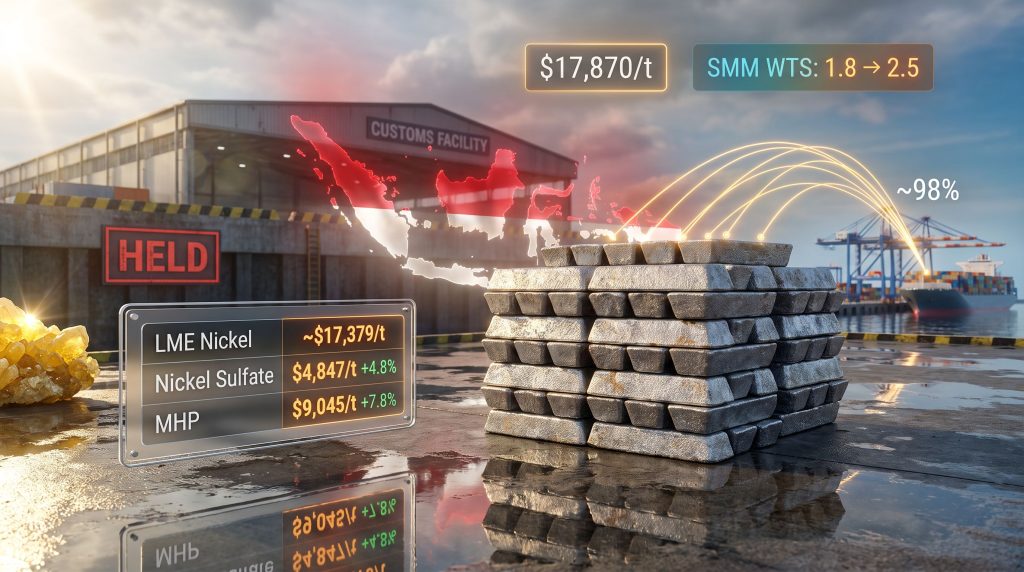
Both products pass through Chinese processing and manufacturing infrastructure at a rate that concentrates global supply risk into a single bilateral corridor. China absorbed approximately 98% of Indonesia's ferronickel exports in the first five months of 2026, meaning any sustained delay in Indonesian export clearance has an outsized and asymmetric effect on the world's largest nickel-consuming economy.
How Indonesia Built the World's Most Controlled Nickel Export Architecture
A Decade of Incremental Policy Tightening
Indonesia's regulatory approach to nickel has never been static. The current bottleneck is the latest chapter in a decade-long policy progression aimed at capturing more of the nickel value chain domestically. Furthermore, Indonesia's role in the energy transition has made these policy decisions increasingly consequential for global supply chains.
| Year | Policy Action | Market Impact |
|---|---|---|
| 2014 | First nickel ore export ban introduced | Prompted early downstream investment in NPI smelting |
| 2017 | Temporary reintroduction of lower-grade ore exports | Short-term supply relief for Chinese smelters |
| January 2020 | Full ore export ban reinstated | Accelerated domestic HPAL and NPI capacity build-out |
| 2024-2025 | RKAB quota system tightened | Annual mining volumes constrained to roughly 260-270 million wet metric tonnes |
| 2026 | Rare-earth content rules create new export delays | Simultaneous export-side and supply-side bottleneck emerges |
The RKAB Quota Mechanism: Indonesia's Internal Supply Lever
The RKAB system, Indonesia's work plan and budget approval mechanism for mining companies, functions as an annual throttle on ore production volumes. Approved allocations for 2026 sit in the range of 260-270 million wet metric tonnes, a figure that analyst assessments suggest falls materially short of what domestic smelters require to operate at full capacity.
The anticipated relief pathway involves a quota review lifting permitted volumes toward 300-350 million wet metric tonnes. However, this review operates on its own timeline, entirely independent of the rare-earth content rule resolution. Investors expecting a single policy announcement to clear both constraints simultaneously are misreading the structure of the problem.
Why Downstream Dominance Created Upstream Fragility
One of the underappreciated consequences of Indonesia's processing build-out is that it created a system highly sensitive to regulatory friction at the export interface. When a country processes raw ore domestically and then exports intermediate products, any ambiguity in the rules governing those exports propagates across the entire downstream chain.
The very integration that was intended to add resilience has consequently introduced a new vulnerability: a regulatory gap at the export stage now affects products that took years of capital investment to produce. According to research from UNU-WIDER, Indonesia's nickel boom has created structural dependencies that make export-side regulatory ambiguity particularly disruptive.
Two Independent Pressure Points Squeezing Indonesia's Nickel Sector
Pressure Point One: Export-Side Regulatory Ambiguity
The Indonesia nickel export bottleneck has several interlocking components that make it resistant to quick resolution:
- Indonesia's presidential directive to channel rare-earth elements into domestic industry lacks supporting regulations defining how that directive applies to specific nickel product streams.
- Presidential Chief of Staff Dudung Abdurachman publicly acknowledged that companies had reported export disruptions, but provided no timeline for finalising the underlying content rules.
- NPI and MHP shipments are being held pending interagency testing and clarification, with no confirmed enforcement threshold yet established.
- China's near-total dominance as a destination market for Indonesian ferronickel means the disruption concentrates into the world's most consequential nickel trade corridor.
Pressure Point Two: Ore Quota Constraints Below Smelter Demand
Simultaneously and independently, the RKAB quota system is constraining ore volumes below what domestic processing capacity can absorb:
- 2026 approved quotas of approximately 260-270 million wet metric tonnes are estimated to fall short of aggregate domestic smelter demand.
- Quota review scenarios targeting 300-350 million wet metric tonnes represent a plausible relief pathway but carry no confirmed timing.
- Separate output cuts by HPAL producers, driven by cost economics rather than ore availability, compound the supply-side pressure without any causal link to the regulatory bottleneck.
"These two pressure points are structurally independent. Resolving the rare-earth content rules would not automatically increase ore quotas. Raising RKAB allocations would not resolve export documentation delays. Investors should model these as separate timelines requiring separate policy actions."
How Sulfuric Acid Costs Are Amplifying the Processing Squeeze
The Hidden Cost Escalation in HPAL Operations
HPAL technology, which produces MHP from laterite nickel ores, is not merely processing-intensive. It is chemically dependent on sulfuric acid as its primary leaching reagent, and sulfuric acid is manufactured from granular sulfur, a commodity with its own supply geography.
Granular sulfur prices escalated from below $600 per tonne to approximately $1,000 per tonne as conflict in the Middle East disrupted established shipping routes for sulfur cargoes. This cost escalation created a direct margin compression problem for Indonesian HPAL operators.
The response from a meaningful portion of the sector was rational but consequential: rather than absorb losses processing MHP at depressed LME nickel prices, several HPAL producers chose to reduce output volumes. This production discipline is:
- Tightening MHP availability in physical markets.
- Supporting intermediate product prices even as the LME benchmark has weakened.
- Creating a divergence between exchange-traded nickel prices and the prices being paid and received in physical supply chains.
There is no near-term substitution pathway for sulfuric acid in HPAL processing. The constraint is not one that engineering ingenuity can quickly resolve. It requires either a normalisation of sulfur shipping costs or a sustained increase in LME nickel prices sufficient to restore acceptable processing margins.
Why This Decouples Intermediate Prices From the LME Benchmark
The combination of HPAL output cuts and export documentation delays has created a situation where the prices of nickel's intermediate forms are moving in a different direction from the exchange-traded headline price. This decoupling is not a market inefficiency to be arbitraged away quickly.
It reflects a genuine structural divergence between two different information environments: the LME, which responds to geopolitical sentiment and macro positioning, and the physical intermediate market, which responds to actual available tonnes. In addition, the evolving Indonesian nickel price trends illustrate how these divergences have been building over time.
The LME Nickel Price Disconnect: What the Numbers Are Telling Investors
Exchange Price vs. Physical Intermediate Market
| Product | Q2 2026 Price | Q2 Price Change | Relationship to LME |
|---|---|---|---|
| LME 3-Month Nickel | ~$17,379/t (26 July close) | Weakened on geopolitical sentiment | Benchmark reference |
| Nickel Sulfate | $4,847/t | +4.8% in Q2 | Trading above implied LME equivalent |
| Mixed Hydroxide Precipitate | $9,045/t | +7.8% in Q2 | Strongest divergence from LME |
The LME three-month nickel contract closed at $17,379 per tonne on 26 July 2026, up 0.85% on the day, before retreating as Middle East ceasefire talks generated short-term optimism in broader commodity markets. Critically, those peace talks carried no implication whatsoever for nickel supply or demand. The retreat was a sentiment movement, not a fundamental one.
Meanwhile, nickel sulfate prices rose 4.8% in Q2 to $4,847 per tonne, and MHP prices climbed 7.8% to $9,045 per tonne over the same period. The physical market was tightening while the futures market was weakening on unrelated geopolitical news.
The SMM Willingness-to-Sell Indicator: A Less Visible but Critical Signal
SMM's upstream Willingness-to-Sell indicator stood at 1.8 as of late July 2026. This reading signals that Indonesian and Chinese producers are not actively willing to sell at prevailing prices, a posture consistent with either output cuts or a belief that prices will move higher.
The indicator becomes actionable at levels above 2.5. If the Willingness-to-Sell reading crosses that threshold while LME nickel simultaneously trades above $17,870 per tonne, it would confirm that production cost economics, rather than geopolitical sentiment, are the dominant force pricing nickel across both physical and exchange markets.
"Senior analysts at Benchmark Mineral Intelligence have assessed that Q2 price gains in intermediate nickel products reflected tighter upstream supply conditions, elevated sulfur input costs, and unresolved policy uncertainty rather than any structural improvement in overall nickel demand. A softer Q3 outlook remains conditional on supply-side constraints easing, which as of late July 2026 had not occurred."
The next major ASX story will hit our subscribers first
The $17,870 Per Tonne Threshold: Why This Number Matters
Bernstein's 75th-Percentile Cash Cost Estimate as a Structural Signal
Investment bank Bernstein has identified $17,870 per tonne as the 75th-percentile cash cost estimate for global nickel production. This figure carries significance beyond a simple cost-curve reference point. If LME nickel sustains closes above this level for five consecutive trading days, the implication is that:
- Production cost economics are being transmitted into exchange-traded prices.
- The higher operating costs facing Indonesian HPAL producers, including elevated sulfuric acid inputs, are being reflected in the global benchmark.
- The divergence between intermediate product prices and LME nickel is closing from the LME side upward, rather than from the physical side downward.
Bernstein's 2026 average LME nickel price forecast sits at $17,357 per tonne, placing it just below the critical threshold. The gap between that forecast and the 75th-percentile cost estimate is narrow enough that sustained physical supply tightness could close it.
Two Indicators to Monitor Through the Remainder of 2026
- LME three-month closing price: The daily signal for whether cost-side fundamentals are gaining influence over geopolitical sentiment in benchmark pricing.
- SMM upstream Willingness-to-Sell indicator: The daily physical market signal published each Shanghai trading session. A reading above 2.5 combined with LME above $17,870/t would confirm cross-market cost transmission.
Scenario Modelling: Three Pathways for the Indonesia Nickel Export Bottleneck Through 2026
Base Case: Quota Relief Without Regulatory Resolution
The most probable scenario assumes Indonesia's RKAB review lifts production quotas toward 300-350 million wet metric tonnes, partially easing the supply-side constraint. However, rare-earth content rules remain unfinished through Q3, sustaining export documentation friction for NPI and MHP. LME nickel holds near Bernstein's forecast of $17,357 per tonne. Intermediate product prices retain their Q2 gains without extending materially.
Bull Case: Prolonged Regulatory Stalemate With Elevated Sulfur Costs
If rare-earth content rules remain unresolved beyond 30 September while granular sulfur prices hold near $1,000 per tonne, the physical supply squeeze intensifies. Nickel sulfate and MHP prices extend Q2 gains beyond the 4.8% and 7.8% already recorded. LME nickel approaches and potentially sustains closes above the $17,870 per tonne threshold as cost-side fundamentals gain pricing influence. The nickel market recovery outlook will be shaped significantly by how quickly these pressures resolve.
Bear Case: Regulatory Clarity Restores Export Flow
Interagency rare-earth content thresholds are finalised and publicly gazetted. Export delays for NPI and MHP are cleared within 30-60 days of publication. Sulfur shipping normalises as Middle East tensions ease. LME nickel weakens as physical supply relief reduces the intermediate product premium that has been supporting prices.
What the Bottleneck Means for EV Battery Supply Chains
MHP as the Linchpin Between Indonesian Processing and Battery-Grade Nickel
MHP is not merely an export product. It is the critical upstream feedstock that refiners convert into battery-grade nickel sulfate for use in high-nickel cathode chemistries including NMC and NCA batteries. Any sustained disruption to MHP export flows from Indonesia has downstream consequences that extend well beyond stainless steel markets into the EV industry's most material-intensive component.
The battery raw materials market faces a structural constraint in this context: Indonesian HPAL-produced MHP remains one of the lowest-cost pathways to battery-grade nickel at scale. Until alternative supply sources, whether from Canada, Australia, or recycled material, achieve comparable cost positions, disruptions to Indonesian supply carry global EV implications. For further context, Reuters reporting on Indonesia's mineral export bottlenecks provides useful detail on the regulatory landscape.
What Non-Chinese Consumers Face
Chinese stainless steel and battery material processors face the most direct exposure to Indonesian export disruptions. However, non-Chinese consumers are not insulated. If prolonged delays redirect Indonesian product flows or suppress overall processed nickel availability, price effects will propagate into markets beyond the primary China corridor, affecting battery manufacturers and cathode producers across Japan, South Korea, Europe, and North America.
FAQ: Indonesia Nickel Export Bottleneck Explained
What is the primary cause of Indonesia's nickel export bottleneck in 2026?
The bottleneck originates from the absence of finalised rules governing acceptable rare-earth element concentrations in exported mineral products. A presidential directive requiring rare-earth elements be retained for domestic use has not been supported by published enforcement thresholds, leaving customs agencies to hold NPI and MHP shipments pending interagency testing and clarification.
Which nickel products are most directly disrupted?
Nickel pig iron, the principal feedstock for stainless steel, and mixed hydroxide precipitate, the primary upstream input for battery-grade nickel sulfate, are the two most affected product streams.
How does this differ from Indonesia's 2020 ore export ban?
The 2020 ban targeted raw, unprocessed laterite nickel ore to incentivise domestic processing investment. The 2026 bottleneck affects processed and semi-processed intermediate products that were specifically created by that earlier policy push, representing an entirely new and distinct regulatory constraint operating further along the value chain.
Why does China's 98% share of Indonesian ferronickel imports matter so much?
This concentration means that export disruptions from Indonesia flow almost entirely into the world's largest nickel-consuming economy. It eliminates the buffer that geographic diversification would otherwise provide and makes any sustained Indonesian export delay a global supply shock transmitted through a single trade corridor.
What would confirm that production costs are driving LME pricing?
Five consecutive LME three-month closes above $17,870 per tonne, combined with an SMM Willingness-to-Sell indicator above 2.5, would confirm that cost-side fundamentals are the dominant pricing force across both physical and exchange markets.
How are HPAL producers responding to higher sulfuric acid costs?
Several Indonesian HPAL operators have reduced output volumes rather than continue processing at margin-negative or margin-compressed economics. This output discipline is contributing to tighter MHP availability and is a key reason why intermediate product prices have risen even as the LME benchmark has softened.
Key Takeaways: What Investors and Supply Chain Analysts Need to Know
- The Indonesia nickel export bottleneck is regulatory in origin, not geological. Resolution depends on a political and administrative calendar, not on resource availability or mining engineering.
- Two independent pressure points — export documentation delays and RKAB ore quota constraints — are operating simultaneously. Each requires a separate policy resolution pathway.
- Intermediate product prices, particularly MHP at $9,045 per tonne (+7.8% in Q2) and nickel sulfate at $4,847 per tonne (+4.8% in Q2), are diverging upward from a weakening LME benchmark, signalling that physical supply chains are tighter than exchange-traded prices suggest.
- Sulfuric acid cost escalation from below $600 to approximately $1,000 per tonne has reduced HPAL output, compounding supply tightness independent of the regulatory export delay.
- The $17,870 per tonne LME threshold and the SMM Willingness-to-Sell indicator above 2.5 are the two most actionable signals to monitor through Q3 2026.
- EV battery supply chains relying on Indonesian MHP as a feedstock pathway carry the highest downstream exposure to prolonged regulatory uncertainty.
This article is intended for informational purposes only and does not constitute financial advice. Commodity price forecasts, scenario projections, and analyst assessments referenced herein involve inherent uncertainty and should not be relied upon as guarantees of future market outcomes. Readers should conduct independent research before making any investment decisions.
Further analysis of Indonesia's nickel policy evolution and its role in global critical mineral supply chains is available at Crux Investor, which publishes ongoing institutional-grade coverage of nickel market dynamics.
Want to Stay Ahead of the Next Major Mineral Discovery Before the Market Moves?
Discovery Alert's proprietary Discovery IQ model delivers real-time alerts on significant ASX mineral discoveries — cutting through complex commodity data to surface actionable opportunities the moment they emerge on the exchange. Start your 14-day free trial today and explore Discovery Alert's discoveries page to see how historic mineral finds have generated substantial returns for well-positioned investors.