
July 28, 2026
The Anatomy of a Supply Shock: Why Exchange Inventories Are the First to Feel the Pain
Most commodity markets carry a buffer. Warehouse stocks, strategic reserves, and producer inventories act as shock absorbers when supply chains fracture. But when that buffer shrinks to a single day's worth of global consumption, the market is no longer managing risk — it is exposed to it directly.
That is precisely where the global aluminium market finds itself in mid-2026. The LME aluminium stocks lowest level this century reading recorded on July 24, 2026 is not simply a data anomaly. It reflects a convergence of geopolitical disruption, structural supply concentration, and physical demand that has quietly outpaced exchange-deliverable supply for five consecutive months.
Understanding what this means requires more than reading the headline figure. It requires examining how exchange inventory systems work, why the composition of remaining stocks matters as much as the volume, and what different recovery trajectories imply for prices, premiums, and procurement strategies across aluminium-intensive industries. Furthermore, the global metals tariff impact from recent trade policy shifts adds another layer of complexity to an already strained market.
When big ASX news breaks, our subscribers know first
How the LME Warehouse System Functions as a Physical Supply Barometer
The London Metal Exchange operates a network of licensed warehouses distributed across multiple continents. Primary aluminium deposited into this system can be delivered against exchange-traded contracts, making LME-registered inventory the most independently verified pool of immediately available physical metal in the world.
Within this system, two categories of stock carry distinct market implications:
- On-warrant stocks are aluminium units that remain fully eligible for trading and physical delivery. Any buyer holding a warrant certificate can claim the corresponding metal.
- Cancelled warrants represent metal that has already been earmarked for withdrawal. Once a warrant is cancelled, that metal effectively exits the tradeable pool, even before it physically leaves the warehouse.
The ratio of cancelled warrants to total inventory is widely treated as a leading indicator of supply tightening. When cancellations rise as a share of total stocks, it signals that physical buyers are actively pulling metal out of the system — behaviour that typically precedes further inventory drawdowns and upward pressure on physical premiums.
The critical insight here is that cancelled warrants represent demand that has already been exercised. By the time the metal physically departs the warehouse, the tightening signal has already been transmitted.
A Statistical Breakdown: Just How Low Have LME Aluminium Stocks Fallen?
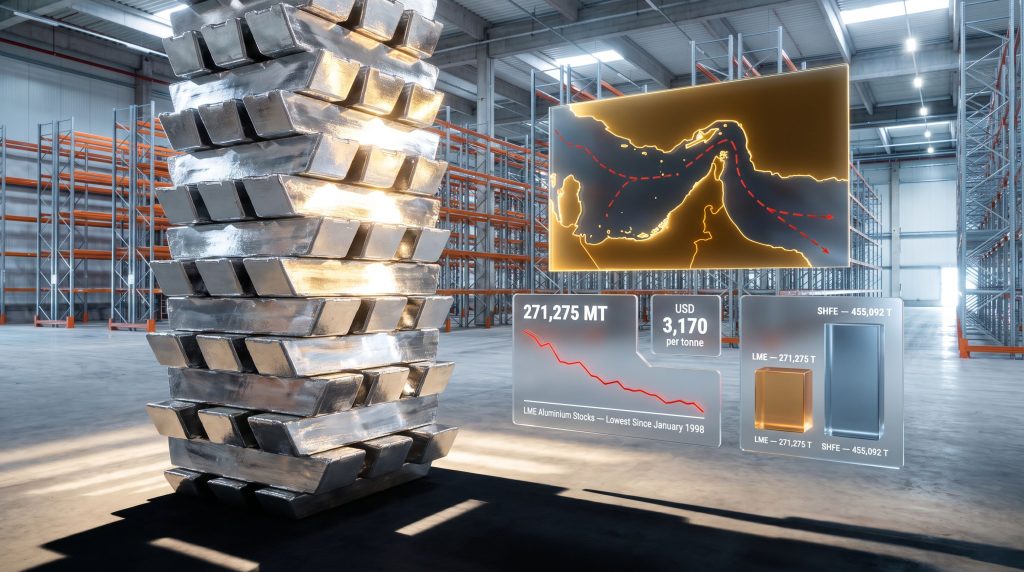
The numbers recorded on July 24, 2026 represent an extraordinary reading by any historical standard. Total LME aluminium inventories fell to 271,275 metric tonnes on that date, marking the lowest level since the exchange began maintaining records in January 1998. On-warrant stocks stood at 245,350 metric tonnes, their lowest point since April 2025.
To place this in consumption terms: global aluminium demand runs at approximately 90 million metric tonnes per year, or roughly 246,575 tonnes per day. The remaining LME inventory is equivalent to less than one full day of global consumption.
| Metric | Figure | Context |
|---|---|---|
| Total LME aluminium inventories (July 24, 2026) | 271,275 metric tonnes | Lowest since records began in January 1998 |
| On-warrant stocks (July 24, 2026) | 245,350 metric tonnes | Near recent multi-month lows |
| Equivalent global daily consumption | Less than 1 day | Highlights extreme physical tightness |
| Decline since late January 2026 | More than 40% | Reflects accelerating drawdown pace |
| SHFE aluminium inventories (late July 2026) | 455,092 metric tonnes | Declining since mid-June but comparatively stable |
| LME benchmark 3-month price (July 24, 2026) | USD 3,170 per tonne | Up 0.3% on the day |
The 2022 episode that briefly alarmed markets — when on-warrant stocks set what was then a record low — now appears modest by comparison. The July 2026 figure does not just extend that trend; it resets the historical benchmark entirely across nearly three decades of exchange data.
The pace of decline is also noteworthy. A drawdown exceeding 40% in under six months is not the gradual erosion of seasonal demand fluctuations. It reflects a structural imbalance between physical demand and exchange-available supply that standard market models have struggled to anticipate. Consequently, the industrial metals demand outlook has become increasingly difficult to model with conventional tools.
The Gulf Region's Outsized Role in Global Aluminium Supply
To understand the current inventory crisis, it is necessary to understand the geographic concentration of aluminium smelting capacity. The Gulf region accounts for approximately 9% of global primary aluminium production capacity — a share that appears manageable in aggregate but becomes critical when disrupted simultaneously.
Gulf smelters operate with a specific vulnerability that distinguishes them from smelters in other regions: they are entirely dependent on imported alumina, the intermediate material refined from bauxite that is fed into electrolytic reduction cells to produce primary aluminium. Unlike smelters in China, Australia, or Canada, Gulf facilities have no domestic bauxite or alumina supply. Uninterrupted maritime access is not a convenience — it is an operational prerequisite. In addition, shifts in aluminum and alumina markets globally have made sourcing alternatives increasingly difficult.
The sequence of disruptions that unfolded from late March 2026 compounded this vulnerability on two fronts simultaneously:
- Direct smelter damage: Iranian attacks in late March 2026 targeted two of the Gulf's largest aluminium smelting operations, affecting production capacity directly.
- Shipping lane disruption: Ongoing instability around the Strait of Hormuz has constrained both the inbound movement of alumina shipments and the outbound movement of finished aluminium to export markets.
The result is a pincer effect that has reduced the Gulf's contribution to international aluminium supply from both the production and logistics sides simultaneously. Industrial buyers who previously relied on Gulf-origin metal as a dependable supply source have been forced to seek alternatives — and the most immediately accessible alternative is LME-registered exchange inventory.
The Russian Metal Complication: Why Headline Inventory Figures Overstate Availability
One of the less-discussed dimensions of the current inventory situation is that the headline figure of 271,275 tonnes does not represent a uniformly accessible pool of metal. LME monthly stock origin reports confirm that the majority of remaining inventory is Russian-origin aluminium.
Under current LME rules, Russian aluminium produced before April 13, 2024 remains technically eligible for trading and delivery. However, the operative word is technically. A meaningful segment of the buyer market continues to avoid Russian-origin material for reasons that fall outside formal exchange rules:
- Corporate sanctions compliance frameworks that impose restrictions beyond minimum regulatory requirements.
- Reputational risk management policies adopted by manufacturers with ESG commitments or Western government contracts.
- End-customer supply chain requirements that explicitly exclude Russian-origin materials.
The practical consequence is a two-tier availability structure within the exchange system itself. The functionally accessible pool of LME aluminium — the metal that the full range of buyers can actually acquire without compliance complications — is materially smaller than the 271,275-tonne headline figure suggests. For buyers operating under strict sourcing policies, the effective availability picture is significantly more constrained than the published data implies.
This is a critical nuance that aggregate inventory figures cannot capture. Market participants who rely solely on total LME stock readings as a measure of physical availability may be systematically underestimating the degree of tightness in the market.
LME vs. SHFE: Two Exchanges Telling Different Stories
The divergence between LME and Shanghai Futures Exchange inventory trajectories offers an important lens through which to interpret the current disruption.
| Exchange | Inventory Level (Late July 2026) | Trend Direction | Regional Context |
|---|---|---|---|
| London Metal Exchange (LME) | 271,275 tonnes | Sharply declining | Gulf supply constraints and active consumer drawdowns |
| Shanghai Futures Exchange (SHFE) | 455,092 tonnes | Declining since mid-June | Comparatively stable; driven by domestic Chinese dynamics |
China industrial demand trends remain largely insulated from the Middle East disruptions that have hammered Gulf supply chains. SHFE inventory movements are primarily governed by domestic demand cycles, seasonal patterns, and Chinese smelter output decisions — none of which are directly exposed to Hormuz shipping risk.
The fact that SHFE stocks are declining but remain comparatively elevated is instructive. It suggests the current supply shock is regionally concentrated rather than globally systemic — at least for now. However, any acceleration in SHFE drawdowns, whether driven by domestic demand strength or reduced Chinese export availability, could transform a regional supply shock into a genuinely global one.
The next major ASX story will hit our subscribers first
Four Scenarios Shaping the Aluminium Market Outlook
The trajectory of LME aluminium inventories over the next six to twelve months will be shaped primarily by developments in the Middle East and the pace of Gulf supply chain recovery. Four plausible scenarios bracket the range of outcomes:
| Scenario | Probability | Projected LME Inventory Outcome | Price Outlook |
|---|---|---|---|
| Rapid Hormuz normalisation | Low-to-moderate | Recovery to 400,000+ tonnes | Bearish near-term pressure |
| Prolonged disruption (6-12 months) | Moderate | Fall below 200,000-tonne threshold | Strongly bullish |
| Partial recovery with firm demand | Moderate | Stabilisation at 250,000-300,000 tonnes | Neutral-to-bullish |
| Full supply restoration and surplus realisation | Low (near-term) | Rebuild above 500,000 tonnes | Bearish medium-term |
The 200,000-tonne threshold deserves particular attention. Falling below this level would place LME aluminium inventory in genuinely unprecedented territory, removing what little buffer remains in the exchange-deliverable system. At sub-200,000-tonne levels, the physical premium market would likely experience significant repricing as buyers compete for a shrinking available pool. Historically, such conditions have triggered reactive purchasing behaviour from industrial consumers, which itself accelerates the drawdown dynamic.
What a Prolonged Disruption Means for Downstream Industries
Aluminium-intensive sectors carry unequal exposure to the current supply stress. The industries most vulnerable to sustained physical tightness include:
- Automotive manufacturing, where aluminium intensive vehicle architectures depend on consistent flat-rolled and cast product availability.
- Aerospace and defence, where high-specification aluminium alloys source from a concentrated base of qualified suppliers.
- Packaging and beverage can production, which operates on thin margins and high-volume aluminium consumption with limited substitution options.
- Construction, where architectural aluminium systems are specification-driven and cannot readily substitute alternative materials mid-project.
Supply chain managers operating on lean or just-in-time inventory models carry the highest exposure. Furthermore, supply chain disruption from ongoing geopolitical tensions means procurement strategies that treat spot LME availability as a reliable fallback source are increasingly vulnerable in an environment where that fallback is approaching exhaustion.
Physical Premiums: The Price Signal That Moves Before the Benchmark
The LME benchmark three-month price of USD 3,170 per tonne as of July 24, 2026 may not yet fully capture the physical tightness embedded in the current supply environment. The more sensitive real-time signal is the physical delivery premium — the surcharge paid above the LME benchmark price to secure immediate physical metal delivery.
Physical premiums behave as a leading indicator of supply stress, typically repricing ahead of the benchmark because they reflect actual transactional conditions between buyers and sellers of physical metal rather than financial contract positions. According to recent aluminium price data, the benchmark price movements have not yet fully reflected the severity of current physical tightness.
Regional premium dynamics to monitor include:
- European premiums, which are most directly exposed given European buyers' historical dependence on Gulf-origin aluminium and LME warehouse access as a backstop supply source.
- US Midwest premiums, which face compounding pressure from both LME tightness and tariff-related supply chain adjustments that have restructured North American aluminium trade flows.
- Asian premiums, which are partially buffered by SHFE availability but would face significant upward pressure if SHFE drawdowns accelerate or Chinese domestic demand tightens further.
Monitoring physical premium trajectories provides an earlier and more accurate signal of supply market tightening than watching the LME benchmark price alone. For procurement professionals and commodity traders, premium tracking is an essential complement to exchange price monitoring.
Is the Aluminium Market Underpricing Geopolitical Supply Risk?
The persistence of medium-term surplus forecasts for 2027 and 2028 alongside the most extreme LME inventory reading in recorded history raises a fundamental question about analytical assumptions embedded in market consensus models.
Surplus projections rest on assumptions about supply chain normalisation timelines that the current inventory trajectory actively challenges. A five-month uninterrupted drawdown at a pace exceeding 40% is not consistent with a market on the verge of supply restoration. It suggests that the structural disruption embedded in Gulf supply chains may be more persistent, and more deeply embedded, than consensus forecasts currently model.
The Strait of Hormuz concentration risk also highlights a broader analytical gap. Global aluminium supply chains have developed a meaningful dependence on a single geographic chokepoint through which both critical raw materials and finished metal must pass. This concentration risk is rarely assigned explicit probability weight in standard surplus-deficit modelling, yet the current episode demonstrates how rapidly it can materialise into physical inventory consequences.
For industrial buyers, the implication is strategic as much as tactical. Diversification of supply origin, evaluation of long-term offtake agreements with producers outside the Gulf, and reassessment of strategic stockpiling policies are all rational responses to an environment where exchange inventory can no longer be treated as a reliable backstop.
The LME aluminium stocks lowest level this century reading is not the end of the story. It is, however, a data point that forces a recalibration of assumptions about physical availability, geopolitical risk weighting, and the adequacy of current procurement strategies across every sector that depends on aluminium as an industrial input.
Disclaimer: This article contains forward-looking scenarios and market analysis based on available data as of late July 2026. Commodity markets are subject to rapid change, and no scenario projection should be interpreted as investment advice. Readers should conduct independent research and consult qualified financial or commodity advisers before making procurement or investment decisions.
Want to Stay Ahead of the Next Major Commodity Supply Shock?
Discovery Alert's proprietary Discovery IQ model scans ASX announcements in real time, delivering instant alerts on significant mineral discoveries — from aluminium-adjacent bauxite plays to copper, lithium, and beyond — so subscribers can identify actionable opportunities before the broader market catches on. Explore historic examples of exceptional discovery returns and begin a 14-day free trial at Discovery Alert to position yourself ahead of the next major market move.