August 5, 2026
Indonesia's strategic dominance in global resource processing has fundamentally reshaped how nations approach critical minerals energy transition and supply chain security. While extraction sites capture headlines, the real control mechanisms operate through processing capacity concentration, where raw ores transform into usable materials. This transformation stage represents the true chokepoint in global commodity flows, with profound implications for energy transition, technological advancement, and geopolitical stability.
The concentration of refining capabilities has reached unprecedented levels across strategic minerals essential to modern economies. According to the International Energy Agency's Global Critical Minerals Outlook 2025, this processing bottleneck affects 19 of the 20 most critical minerals, creating systemic dependencies that traditional supply chain models struggle to address. Understanding these dynamics becomes particularly crucial when examining the nickel market and Indonesia's role in reshaping global supply architectures.
Indonesia's Strategic Position in Global Nickel Markets
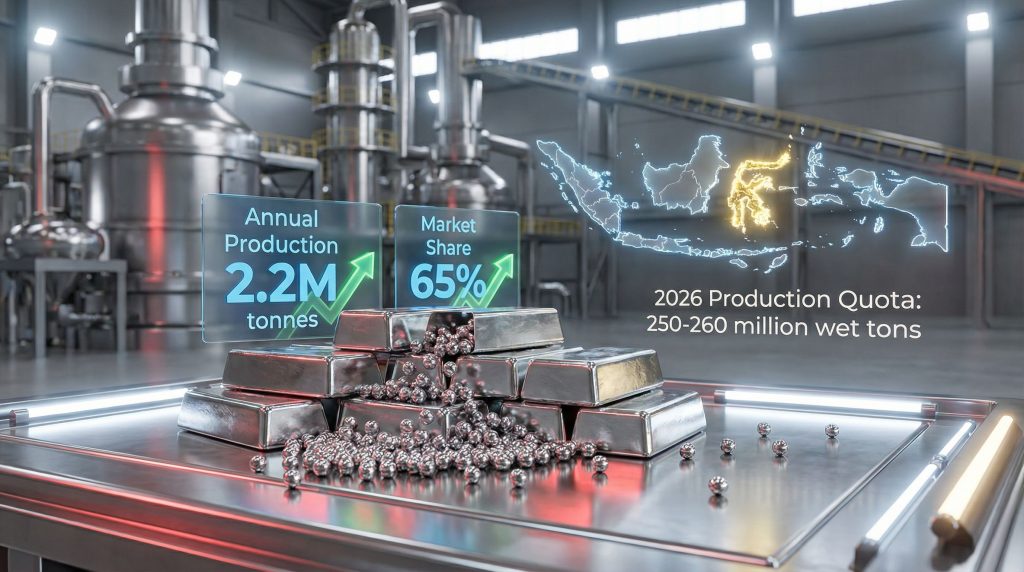
Indonesia has fundamentally transformed the global mining landscape through a combination of geological advantages, strategic policy implementation, and massive infrastructure investment. The country currently controls approximately 60-65% of global refined nickel production, representing roughly 2.0-2.2 million tonnes of nickel metal content annually from a global total of 3.4 million tonnes.
Geographic and Geological Advantages
The foundation of Indonesia's dominance lies in its exceptional geological endowment. The country holds approximately 21 million tonnes of proven nickel reserves, representing 40-42% of global proven reserves. Sulawesi province alone contains an estimated 60% of Indonesia's identified nickel resources, making it the world's largest single nickel ore region.
These deposits consist primarily of lateritic nickel ores, formed through tropical weathering of nickel-bearing rocks over millions of years. Furthermore, this geological characteristic creates a fundamental processing advantage, as lateritic ores can be processed through High Pressure Acid Leaching (HPAL) or Rotary Kiln Electric Furnace (RKEF) technology to produce Nickel Pig Iron (NPI) or mixed hydroxide precipitate (MHP). Traditional mining nations like Russia and Canada primarily process sulfide ores through conventional pyrometallurgical routes, which have different cost and quality profiles.
Infrastructure Development Timeline
Indonesia's processing capacity expansion represents one of the most dramatic industrial buildouts in modern mining history:
- 2018: Approximately 300,000 tonnes per annum (tpa) refined capacity
- 2024: Over 1.8 million tpa capacity (six-fold increase)
- Smelter facilities: Growth from 2 facilities in 2014 to 47 operational facilities by 2024
This infrastructure development was strategically coordinated with industrial park creation, featuring dedicated power generation, port facilities, and integrated supply chains. The Morowali Industrial Park in North Sulawesi exemplifies this approach, housing 16 operational smelters producing approximately 800,000 tpa of nickel metal content, supported by 450+ MW of dedicated power generation.
Energy Infrastructure Advantages
Indonesia's structural cost advantage stems significantly from abundant renewable energy resources. The country has allocated over 2,000 MW of dedicated geothermal and hydroelectric capacity to nickel processing regions. High-temperature electric furnaces operating at 1,500°C+ require consistent, large-scale power supplies, making energy access a critical competitive factor.
| Energy Cost Comparison | Indonesia | Russia | Canada |
|---|---|---|---|
| Energy Cost ($/MWh) | $35-45 | $60-80 | $70-90 |
| Processing Cost ($/lb finished Ni) | $4.50-5.50 | $5.00-6.00 | $6.00-7.00 |
This energy advantage translates directly into processing economics. Lateritic ore processing requires approximately 8-10 MWh of electrical energy per tonne of finished nickel, making energy costs a significant component of total production costs.
When big ASX news breaks, our subscribers know first
The Economics Behind Indonesia's Nickel Revolution
The financial architecture underlying Indonesia's nickel transformation involved unprecedented capital mobilisation and strategic foreign investment attraction. Foreign Direct Investment (FDI) into Indonesia's nickel sector totalled approximately $45-50 billion during 2018-2024, representing the largest sectoral investment in Indonesia's mining history.
Foreign Investment Patterns
Chinese firms accounted for approximately 60-70% of this investment, with the remainder distributed among Japanese, Korean, and domestic Indonesian companies. This investment pattern reflects strategic resource acquisition priorities, particularly for China's downstream battery and stainless steel manufacturing sectors.
Individual smelter facilities require capital investments between $800 million and $2.5 billion depending on capacity and technological sophistication. Projects with $1.5 billion capital expenditure achieve payback periods of 6-8 years under normal nickel pricing ($8-10/lb), compared to 10-12 years for equivalent capacity in other major producing nations.
Cost Structure Analysis
Indonesia's competitive positioning derives from multiple cost advantages:
- Labour costs: $2-3/hour versus $8-12/hour (Russia) and $25-35/hour (Canada)
- Capital costs: $400-600k per tonne of annual capacity versus $700-900k (Russia) and $800-1,100k (Canada)
- Energy costs: Structural advantages through renewable resources
- Proximity to markets: Reduced transportation costs to major Asian demand centres
Joint Venture Structures
The investment model typically involves Chinese majority ownership (approximately 75%) with Indonesian state participation through entities like PT Antam. These structures facilitate technology transfer while maintaining Indonesian regulatory compliance and profit-sharing arrangements.
Zhejiang Hongwanglong's Tsingshan Nickel project in Morowali exemplifies this model, with over 500,000 tpa capacity supported by $2.8 billion investment. The project operates as a joint venture with Indonesian partners, ensuring local participation while leveraging Chinese technical expertise and capital.
How Did the 2020 Export Ban Reshape Global Markets?
Indonesia's decision to implement a comprehensive export ban on unprocessed nickel ore in January 2020 represents a pivotal moment in modern resource nationalism. This policy fundamentally restructured global nickel supply chains and demonstrated the power of supply-side market control, serving as an export ban case study for other resource-rich nations.
Policy Implementation and Market Response
The export ban created immediate market disruption, with London Metal Exchange (LME) nickel prices increasing 15% within one week of implementation. The market reaction demonstrated the critical role of Indonesian supply in global nickel markets:
- Pre-ban (January 2020): $13,500-14,000/tonne
- Post-ban immediate reaction (February 2020): $15,500-16,200/tonne
- Peak shortage response (2021): $20,000+/tonne
- Current pricing (2025-2026): $15,500-17,500/tonne range
Export Volume Transformation
The policy shift dramatically altered Indonesia's export profile:
| Year | Nickel Ore Exports (Million Tonnes) | Refined Nickel Exports (Tonnes) |
|---|---|---|
| 2019 | 28.4 | 230,000 |
| 2020 | 3.2 | 350,000 |
| 2021 | <1.0 | 720,000 |
| 2022 | 0 | 1,200,000 |
| 2024 | 0 | 2,000,000+ |
This transformation demonstrates successful value-addition strategy implementation, shifting from raw material exports to processed product exports with significantly higher unit values.
Strategic Policy Objectives
The export ban served multiple strategic objectives beyond immediate revenue enhancement:
- Technology transfer acceleration: Foreign investors were compelled to establish processing facilities within Indonesia
- Employment generation: Direct employment in the nickel sector reached 200,000+ workers by 2024
- Industrial development: Creation of integrated industrial parks with supporting infrastructure
- Downstream industry development: Establishment of stainless steel and battery precursor manufacturing capabilities
Market Dynamics and Production Concentration
The concept of "paper surplus" has become critical to understanding current nickel market dynamics. While approved production capacity appears to indicate substantial surplus, actual utilisation rates reveal significant constraints on real supply availability.
Approved Capacity versus Actual Production
Indonesia's quota allocation system creates a disconnect between theoretical capacity and actual production. The 2026 production quota reduction from 379 million wet tons (2025) to 250-260 million wet tons (2026) represents a 34% decrease, signalling a fundamental shift from volume maximisation to value optimisation.
| Metric | Indonesia | Global Total | Market Share |
|---|---|---|---|
| Annual Production (2024) | 2.2M tonnes | 3.4M tonnes | 65% |
| Proven Reserves | 21M tonnes | 50M tonnes | 42% |
| Processing Capacity | 1.8M tonnes | 2.8M tonnes | 64% |
| Active Smelters | 47 facilities | 73 facilities | 64% |
Regional Production Hub Development
Indonesia's production concentration occurs primarily in strategically developed industrial zones:
- Morowali Industrial Park: 16 operational smelters, ~800,000 tpa capacity
- Weda Bay Industrial Park: 6 major smelters, ~300,000 tpa capacity
- Sulawesi Mining Corridor: Integrated transportation and processing infrastructure
These hubs feature dedicated infrastructure including deep-water ports, power generation facilities, and integrated supply chains, creating significant barriers to entry for potential competitors.
Indonesian Supply Management and Market Control
Indonesia's transition to sophisticated supply management represents an evolution from simple export controls to comprehensive market influence. The implementation of annual production quotas through the RKAB (Mining Business Plan) system provides government control over global supply levels.
Regulatory Framework Evolution
Recent policy changes demonstrate increasingly sophisticated market management:
- One-year RKAB cycles: Replacing three-year planning periods for greater flexibility
- New smelter construction moratoriums: Controlling capacity expansion pace
- Downstream value-addition requirements: Mandating further processing stages
- Environmental compliance standards: Implementing sustainability requirements
Indonesia's decision to reduce mining quotas represents a fundamental shift from volume maximisation to value optimisation, demonstrating sophisticated understanding of supply-demand dynamics and pricing power.
Market Response Mechanisms
The quota system creates multiple layers of market influence:
- Price elasticity management: Supply adjustments influence global pricing
- Competitor response constraints: Limited alternative sources restrict market reaction
- Long-term contract implications: Buyers must secure supply through Indonesian channels
- Strategic stockpile pressures: Consumer nations face supply security challenges
Geopolitical Implications and Chinese Integration
While Indonesia controls physical production, Chinese firms maintain significant operational control through ownership structures and technical expertise. This creates a complex geopolitical dynamic where Indonesian resource sovereignty intersects with Chinese industrial strategy, particularly relevant given the broader US‑China trade war impact on global supply chains.
Chinese Investment and Operational Control
Approximately 75% of Indonesian nickel processing capacity operates under Chinese majority ownership, integrating Indonesian production into broader Asian supply chains. This ownership structure reflects several strategic factors:
- Technology transfer requirements: Chinese firms provide HPAL and RKEF expertise
- Capital mobilisation: Chinese state-backed financing enables rapid capacity development
- Market access: Integration with Chinese downstream manufacturing
- Operational efficiency: Chinese operational management and technical support
Strategic Resource Leverage
Indonesia's control over nickel supply provides significant geopolitical leverage:
- Trade policy coordination: Bilateral negotiations with major consuming nations
- Technology partnership requirements: Mandatory joint ventures for foreign investment
- Environmental compliance: International sustainability standard implementation
- Regional industrial development: ASEAN economic integration opportunities
The next major ASX story will hit our subscribers first
What Are the Long-Term Market Scenarios?
Multiple scenarios could reshape Indonesia's market position over the next decade, each with distinct implications for global supply chain security and pricing dynamics. These developments are particularly significant within the broader context of mining industry evolution.
Scenario 1: Sustained Market Leadership (2026-2030)
Under this scenario, Indonesia maintains dominant market position through:
- Continued production growth: Within quota constraints but expanding value-addition
- Enhanced downstream capabilities: Development of battery precursor and stainless steel production
- Maintained cost advantages: Sustained energy and operational cost benefits
- Technology advancement: Continued improvement in processing efficiency
Scenario 2: Market Share Erosion Through Competition
Alternative supply development could challenge Indonesian dominance:
- New World project development: Australian and Canadian production expansion
- Recycling technology advancement: Secondary supply growth
- Alternative technology adoption: Nickel-free battery chemistry development
- Geopolitical diversification: Consumer nation strategic mineral policies
Scenario 3: Supply Chain Diversification Pressures
Geopolitical tensions could force supply chain restructuring:
- Consumer nation strategic policies: Government-mandated supply diversification
- Trade relationship instability: Disruption of Indonesian-Chinese cooperation
- Alternative processing development: Non-Asian refining capacity development
- Strategic stockpiling: Government reserve accumulation
Energy Transition Implications and Investment Considerations
Indonesia's nickel market dominance directly impacts global energy transition timelines and costs. The concentration of nickel market and Indonesia's role creates vulnerabilities for electric vehicle production, energy storage deployment, and renewable energy infrastructure development.
Battery Supply Chain Dependencies
Electric vehicle manufacturers face significant exposure to Indonesian nickel supply:
- Production planning constraints: Vehicle production tied to nickel availability
- Cost volatility impact: Nickel price fluctuations affect EV pricing
- Supply chain security: Strategic sourcing requirements for automotive industry
- Technology adaptation: Pressure for nickel-reduced battery chemistries
Investment Risk and Opportunity Framework
Multiple investment approaches emerge from Indonesia's market position:
Direct Investment Opportunities:
- Joint venture partnerships: Participation in Indonesian processing capacity
- Infrastructure development: Supporting logistics and power generation
- Technology provision: Equipment and expertise supply to Indonesian operations
Indirect Exposure Strategies:
- Downstream processing technology: Companies providing smelting equipment
- Alternative source development: Projects developing non-Indonesian capacity
- Recycling infrastructure: Secondary supply development opportunities
Risk Assessment Considerations:
- Political stability: Indonesian government policy continuity
- Environmental compliance: Sustainability requirement evolution
- Currency and commodity volatility: Financial hedging requirements
- Regulatory change: Export policy and quota system modifications
Future Monitoring and Strategic Recommendations
Successful navigation of Indonesia's nickel market dominance requires sophisticated monitoring of multiple indicators and development of adaptive strategies. However, shifting demand patterns add complexity to these planning considerations.
Critical Monitoring Indicators
Market participants should track several key metrics:
- Monthly production quota utilisation rates: Actual versus approved production levels
- New project announcements: Capacity development outside Indonesia
- Technology advancement: Progress in nickel alternatives and recycling
- Regulatory policy changes: Indonesian government supply management evolution
- Chinese investment patterns: Ownership and operational control trends
Strategic Recommendations for Market Participants
For Consuming Industries:
- Supply chain diversification: Develop alternative source relationships
- Long-term contracting: Secure supply through Indonesian channels
- Technology hedging: Invest in nickel-reduced alternatives
- Strategic stockpiling: Build inventory buffers against supply disruption
For Investors:
- Due diligence focus: Understand Indonesian regulatory environment
- Partnership strategies: Develop relationships with Indonesian entities
- Risk management: Implement hedging strategies for commodity and currency exposure
- Technology investment: Consider investments in processing alternatives
Indonesia's transformation of the global nickel market demonstrates the power of strategic resource management combined with industrial policy coordination. Consequently, the country's success in capturing value through downstream processing while maintaining supply control creates a template for resource nationalism in the 21st century. However, this concentration also creates systemic risks for global supply chains and energy transition objectives, requiring sophisticated risk management and strategic planning by all market participants.
The nickel market and Indonesia's role will remain central to global commodity discussions, particularly as environmental concerns continue to shape production standards and sustainability requirements. In addition, the interplay between Indonesian supply management and global demand evolution will determine pricing dynamics and supply security for years to come.
Disclaimer: This analysis contains forward-looking statements and market projections based on current information. Commodity markets involve significant risks, and investors should conduct independent research and consult qualified professionals before making investment decisions. Past performance does not guarantee future results, and geopolitical developments may substantially impact market conditions.
Ready to Capitalise on Indonesia's Nickel Market Dominance?
Indonesia's control over 65% of global nickel processing creates unprecedented opportunities for investors tracking strategic mineral developments. Discovery Alert's proprietary Discovery IQ model delivers instant notifications when ASX-listed companies announce significant nickel discoveries or processing partnerships, ensuring you can identify actionable opportunities before broader market recognition drives prices higher.