May 21, 2026
The landslide in Indonesia Morowali nickel hub represents a critical example of the unique challenges facing mining operations in tropical environments. Mining operations in tropical regions face unique geological and environmental pressures that significantly increase operational risks. The intersection of heavy rainfall, complex soil compositions, and rapid industrial development creates a perfect storm for structural failures in mining infrastructure. Understanding these dynamics becomes crucial as global demand for critical minerals drives expansion into challenging geological territories.
Indonesia's position as a dominant force in global nickel production exemplifies these challenges. The archipelago nation's tropical climate, characterised by intense monsoon seasons and volcanic soil compositions, presents engineering obstacles that differ substantially from traditional mining environments in arid or temperate regions.
Indonesia's Dominance in Global Nickel Markets
Indonesia commands approximately 30-35% of global nickel production capacity, making it the world's largest nickel producer by a significant margin. According to the U.S. Geological Survey Mineral Commodity Summaries for 2024 and 2025, Indonesian nickel ore production exceeded 800 million tonnes annually, with refined nickel output representing a substantial portion of global supply.
The Morowali Industrial Park (IMIP) operates as the largest nickel-processing hub in resource-rich Indonesia, hosting over 50 tenants primarily focused on manufacturing nickel products for stainless steel and electric vehicle battery materials. This concentration of processing capability creates both economic advantages and supply chain vulnerabilities.
Strategic Supply Chain Positioning
The facility's location in Sulawesi province provides direct access to high-grade nickel laterite ore deposits, minimising transport costs and processing delays compared to facilities requiring imported ore. This geographical advantage has attracted significant Indonesia mining investment, with Chinese steelmaker Tsingshan Holding Group among the major shareholders.
The vertical integration at Morowali converts raw nickel ore into multiple downstream products including:
• Nickel matte with 70-80% Ni content
• Ferronickel alloy products for stainless steel applications
• Battery-grade nickel sulfate for lithium-ion batteries
This processing capability makes the facility critical to both traditional stainless steel manufacturers and the rapidly expanding electric vehicle battery supply chain globally.
When big ASX news breaks, our subscribers know first
Technical Complexities of Tailings Management in Tropical Climates
Nickel laterite ore processing generates substantial waste materials, typically producing 4-8 tonnes of tailings per tonne of refined nickel, depending on ore grade and processing methodology. In tropical mining operations across Indonesia, facilities must contend with 2,000-4,000mm of annual rainfall, significantly increasing water accumulation challenges in tailings facilities.
Laterite Processing and Waste Generation
The High Pressure Acid Leaching (HPAL) process commonly used for laterite nickel processing involves several stages that produce different waste streams:
Primary Processing Stage:
- Ore is crushed and processed through acid leaching, producing a nickel-rich solution
- Solid residue from this stage becomes the primary tailings material
- Composition includes iron oxyhydroxides, silica, and residual unreacted minerals
Tailings Storage Requirements:
- Materials are typically stored in engineered impoundments with perimeter containment dams
- Decant towers enable water recovery and recycling
- Underdrain systems manage seepage and prevent foundation saturation
- Geotextile liners prevent interaction with underlying soils
Water Management Complexities
Effective tailings management in tropical environments requires multi-stage dewatering systems. Primary drainage occurs through the tailings mass itself, while secondary drainage utilises underdrain systems, and tertiary treatment addresses discharge water quality.
In high-rainfall tropical zones, drainage system capacity must exceed peak seasonal water inputs to prevent dangerous saturation conditions. The recent landslide in Indonesia Morowali nickel hub was suspected to have been caused by soft soils, indicating water saturation as a primary contributing factor.
Furthermore, implementing waste management solutions becomes crucial for operational safety and environmental compliance.
Risk Amplification Factors in Indonesian Mining
Monsoon Season Impact Assessment
Indonesia's Sulawesi island experiences distinct wet and dry seasons, with monsoon months from November through March receiving 200-400mm of rainfall per month in some areas. The timing of the recent incident in February falls within this peak water stress period for tailings structures.
Tropical soils in Indonesia exhibit substantially different behaviour during wet seasons, including:
• Increased pore water pressure in clay-rich soils
• Reduced effective stress on underlying soil layers
• Potential for lateral earth pressure increases exceeding original design assumptions
• Accelerated erosion at impoundment perimeters during high-flow conditions
Infrastructure Development Versus Safety Standardisation
The rapid expansion of Morowali's operations reflects broader industry trends where competitive pressures to meet production quotas may inadvertently defer routine maintenance or comprehensive structural assessments. The facility's growth to accommodate 50+ tenants in a compressed timeframe creates coordination challenges for shared infrastructure management.
Indonesian mining regulations establish safety requirements through Law No. 4 of 2009 on Mineral and Coal Mining, but enforcement in remote Sulawesi areas depends on limited government inspection capacity. The Indonesian government maintains approximately 500-600 full-time mining safety inspectors for thousands of active mining operations nationwide.
Immediate Operational Consequences of Infrastructure Failures
Production Disruption Analysis
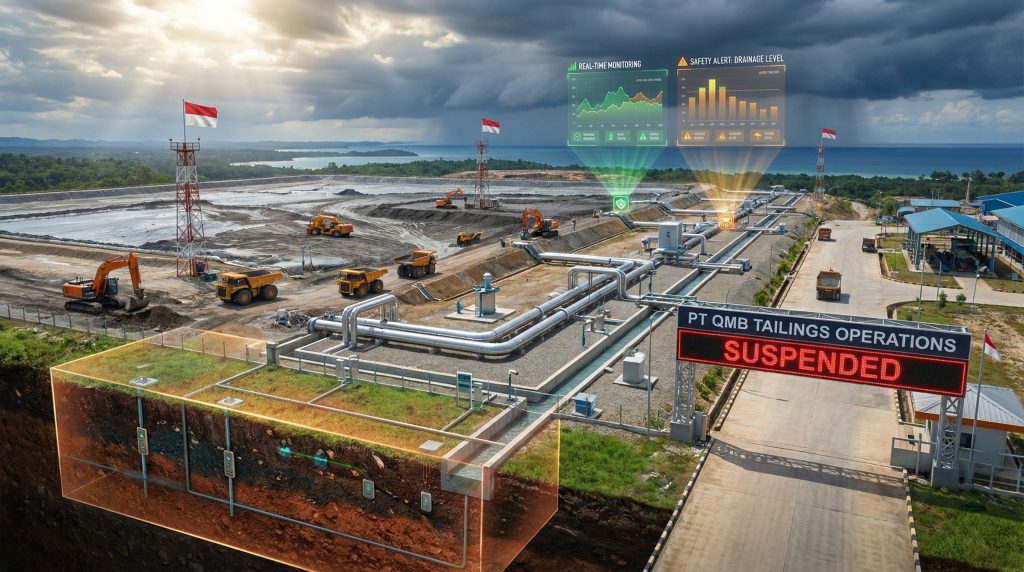
The recent landslide in Indonesia Morowali nickel hub resulted in immediate cessation of operations at the tailings zone managed by PT QMB, an IMIP tenant. The incident swept away excavators and bulldozers, requiring equipment recovery operations before normal activities can resume.
QMB's tailings operations are foundational to its downstream nickel product manufacturing. The facility cannot resume tailings management until comprehensive investigation validates structural integrity and design adequacy. This creates cascading effects since other IMIP tenants may experience indirect disruption if shared services are affected.
Historical Context of Recurring Incidents
The February 2026 incident represents the second major tailings failure at the same facility within 11 months. In March 2025, QMB was forced to suspend almost all production after a deadly landslide buried four workers under nickel mine waste. Combined incidents within this timeframe resulted in five deaths attributed to tailings failures at the same facility.
This pattern suggests either inadequate initial remediation, systemic design flaws that were not comprehensively addressed, or operational practices that reverted to pre-incident standards despite investigations.
Investigation and Recovery Timeline Implications
Geotechnical Assessment Requirements
Standard practice following tailings dam failures involves comprehensive investigation protocols:
Technical Investigation Phases:
- Geotechnical core sampling and soil analysis (2-4 weeks)
- Hydrological assessment of water balance systems
- Structural engineering review of design specifications
- Operational practice documentation review
- Independent third-party verification (increasingly required internationally)
Remediation Timeline Considerations:
- Investigation completion typically requires 2-8 weeks depending on scope
- Remediation of failed structures can require 3-12 months
- Regulatory approval for operational restart adds additional timeline uncertainty
Global Supply Chain Vulnerability Assessment
Market Concentration Risk
A single major processing disruption in Indonesia can significantly impact global nickel availability. The International Energy Agency's 2024 Critical Minerals Report indicates that nickel supply concentration in Southeast Asia, particularly Indonesia, creates geopolitical supply vulnerabilities for battery material production.
The interconnected nature of modern supply chains means that production delays at facilities like Morowali can affect:
• Electric vehicle manufacturers dependent on battery-grade nickel sulfate
• Stainless steel producers requiring ferronickel inputs
• Global commodity pricing through supply uncertainty
Strategic Implications for Battery Material Security
As electric vehicle adoption accelerates globally, supply security for battery materials becomes increasingly critical. Indonesia's dominance in nickel processing creates both opportunities and risks for manufacturers seeking reliable material sources.
The vertical integration strategy pursued at facilities like Morowali reflects broader trends where resource-rich nations attempt to capture more value by processing raw materials domestically rather than exporting ore. However, this acceleration has created infrastructure challenges that outpace safety standardisation.
The next major ASX story will hit our subscribers first
Advanced Monitoring and Prevention Technologies
Real-Time Risk Assessment Systems
Modern mining operations increasingly employ sophisticated monitoring technologies to prevent catastrophic failures:
Geotechnical Monitoring Arrays:
- Real-time soil stability sensors measuring pore water pressure
- Automated settlement monitoring systems
- Weather-integrated risk assessment protocols
- Equipment positioning systems with buffer zone enforcement
Operational Safety Protocols:
- Establishment of dynamic worker safety zones based on current conditions
- Emergency evacuation procedures with predetermined triggers
- Regular structural assessment schedules tied to seasonal conditions
Consequently, data-driven monitoring systems are becoming essential for maintaining operational safety in challenging environments.
International Safety Standard Evolution
The recurring incidents at Indonesian facilities highlight the need for enhanced international safety standards specifically adapted to tropical mining environments. Traditional tailings management approaches developed for temperate climates require significant modification for high-rainfall, soft-soil conditions.
This evolution aligns with broader mining industry evolution trends towards more sophisticated safety protocols and technological integration.
Chinese Investment Influence on Safety Standards
Technology Transfer Considerations
Chinese companies' significant investments in Indonesian nickel processing, including Tsingshan Holding Group's stake in IMIP and GEM's joint venture leadership in QMB, bring both opportunities and challenges for safety standardisation.
The adaptation of Chinese mining technology to Indonesian geological conditions requires careful consideration of:
• Differences in soil composition and rainfall patterns
• Regulatory compliance requirements across jurisdictions
• Safety protocol standardisation between international operations
• Technology transfer effectiveness in tropical environments
Future Implications for Indonesian Mining Development
Regulatory Evolution Prospects
The pattern of incidents at facilities like Morowali may drive enhanced safety legislation and international compliance pressure. Investment in safety infrastructure requirements will likely increase as global attention focuses on supply chain resilience and worker safety.
Moreover, sustainability transformation trends are driving stricter environmental and safety standards across the industry.
Industry Consolidation Dynamics
Smaller operators may face viability concerns as safety compliance costs increase. Market concentration trends could accelerate as larger operators with better safety infrastructure gain competitive advantages over facilities with substandard safety systems.
What Are the Key Risk Factors for Tropical Mining Operations?
Risk management in tropical mining environments requires comprehensive assessment of multiple interconnected factors:
| Risk Factor | Current Challenge | Mitigation Strategy |
|---|---|---|
| Soil Stability | Soft tropical soils with high water content | Enhanced geotechnical monitoring and drainage systems |
| Equipment Safety | Heavy machinery operations in unstable areas | Remote operation technologies and dynamic buffer zones |
| Regulatory Oversight | Rapid expansion outpacing safety compliance | Strengthened inspection frameworks and international standards |
| Water Management | Monsoon rainfall exceeding drainage capacity | Multi-stage dewatering and weather-integrated protocols |
Technical Specifications for Enhanced Safety
Drainage System Design Requirements
Effective tailings management in tropical environments requires drainage systems designed for extreme conditions:
Capacity Planning:
- Primary drainage through tailings mass: minimum 150% of historical peak rainfall
- Secondary underdrain systems: continuous operation capability during 30-day rainfall events
- Emergency spillway capacity: 200-year flood event protection
Material Selection:
- Geotextile specifications for tropical degradation resistance
- Underdrain aggregate sizing for long-term performance
- Corrosion-resistant infrastructure for high-humidity environments
Geotechnical Foundation Standards
Tailings dam design in soft soil conditions requires:
• Foundation treatment through deep soil mixing or replacement
• Staged construction allowing consolidation between lifts
• Comprehensive instrumentation for real-time stability monitoring
• Conservative safety factors accounting for tropical soil variability
"The intersection of global demand for critical minerals with challenging tropical mining environments requires unprecedented attention to safety infrastructure development. Traditional approaches to tailings management must evolve to address the unique risks present in high-rainfall, soft-soil conditions."
The landslide in Indonesia Morowali nickel hub serves as a stark reminder that rapid industrial expansion must be balanced with adequate safety infrastructure. Furthermore, additional incidents, as reported by international mining publications, continue to highlight the systemic nature of these challenges.
In addition, this incident underscores the critical importance of implementing robust safety standards that account for the unique challenges of tropical mining environments. The path forward requires enhanced collaboration between international operators, local regulators, and global supply chain stakeholders to ensure that the pursuit of critical minerals does not compromise worker safety or environmental integrity.
Disclaimer: This analysis contains forward-looking assessments regarding mining industry trends, regulatory developments, and technological solutions. Actual outcomes may vary based on geological conditions, regulatory changes, technological advances, and market dynamics. Investment and operational decisions should be based on comprehensive due diligence and professional engineering assessment rather than general industry analysis.
Looking to Capitalise on Critical Mineral Discoveries Before They Hit the Headlines?
Discovery Alert's proprietary Discovery IQ model delivers instant notifications when significant ASX mineral discoveries are announced, particularly in high-demand sectors like battery metals and critical minerals where supply chain disruptions can create substantial market opportunities. Start your 14-day free trial today and position yourself ahead of the market with real-time insights that transform complex mining data into actionable investment opportunities.