May 10, 2026
The transformation of Indonesia's mining sector represents one of the most dramatic shifts in global commodity markets over the past decade. Understanding how a reclusive ex glencore trader became indonesia's nickel king requires examining the intricate web of relationships between local traders, international processors, and government policy makers who collectively determine the flow of this critical mineral. What began as a fragmented collection of small-scale operations has evolved into a sophisticated network capable of controlling nearly three-quarters of the world's nickel supply.
This evolution reflects broader trends in resource nationalism, technology transfer, and the strategic importance of battery metals in an electrified economy. The rise of domestic intermediaries has fundamentally altered power dynamics that previously favored multinational mining corporations, creating new chokepoints and opportunities in global supply chains.
What Drives Indonesia's Transformation into a Nickel Processing Powerhouse?
Export Ban Strategy and Industrial Policy Evolution
Indonesia's strategic pivot from raw material exporter to manufacturing hub began with decisive policy interventions in the mid-2010s. The 2014 ore export ban marked the beginning of a systematic effort to capture value-added processing activities domestically rather than shipping unprocessed ore to international markets. This policy represented a fundamental shift from maximising export volumes to maximising export values.
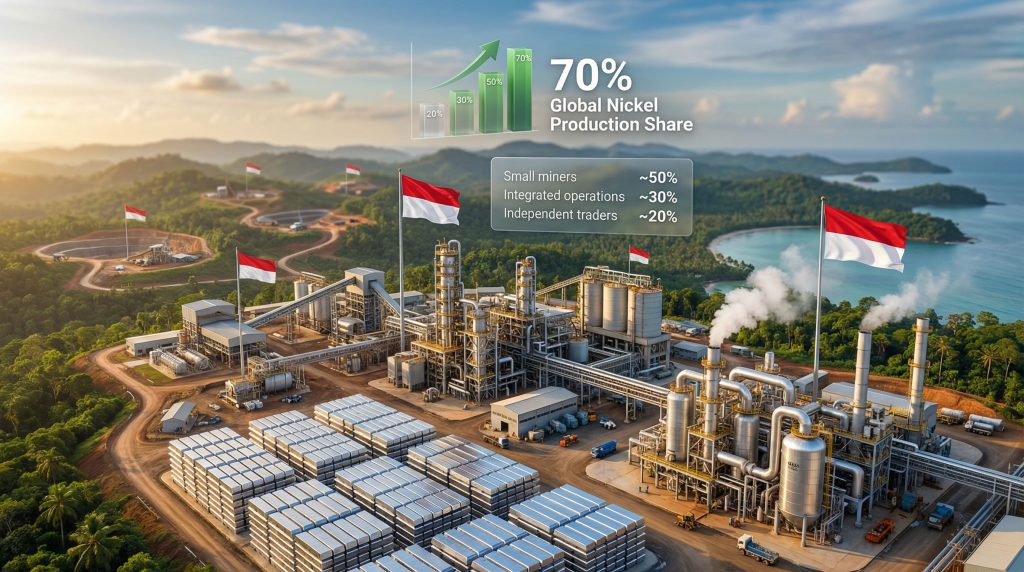
The government's approach evolved through multiple phases of implementation. Initially introduced in 2014, export restrictions were partially relaxed before being reimposed with greater enforcement mechanisms. According to government data, Indonesia's nickel industry expanded from less than one-tenth its current size in the early 2000s to controlling approximately 70% of global nickel production by 2024.
Government incentives for domestic processing included:
• Tax holidays for new smelting facilities
• Preferential land acquisition terms for industrial parks
• Streamlined permitting processes for value-added operations
• Infrastructure investment in power generation and port facilities
Technology Transfer and Chinese Investment Patterns
The technological transformation of Indonesia's nickel sector centred on two critical innovations brought by Chinese conglomerates. Nickel pig iron production methods enabled cost-effective processing of Indonesia's abundant low-grade ore deposits for stainless steel manufacturing. This technology, pioneered by Tsingshan Holding Group, allowed Indonesian operations to undercut traditional high-grade ore processors in Australia and New Caledonia.
More significantly, high-pressure acid leaching technology revolutionised the industry by making battery-grade nickel production economically viable from Indonesia's lower-grade ore deposits. This breakthrough eliminated the cost advantage previously held by higher-grade deposits and positioned Indonesia as a critical supplier to the global electric vehicle industry.
Chinese foreign direct investment flows into Indonesian nickel processing exceeded $15 billion between 2015 and 2024, according to investment promotion board data. Furthermore, the Zijin mining expansion strategy exemplifies how Chinese firms established integrated operations combining:
• Smelting facilities with annual capacity exceeding 1 million tons
• Power generation infrastructure to support energy-intensive processing
• Port facilities for international product shipment
• Housing and community infrastructure for Chinese technical personnel
When big ASX news breaks, our subscribers know first
How Do Local Trading Networks Control Indonesia's Nickel Supply Chain?
Market Fragmentation and Consolidation Dynamics
Indonesia's nickel supply chain exhibits a unique structure that creates significant opportunities for intermediary traders. Small-scale mining operations account for approximately 50% of national production, yet these operators often lack the resources, expertise, or relationships necessary to supply major smelters directly. This fragmentation creates structural demand for consolidation services.
According to CRU Group analysis, more than 100 small mining operations currently operate across Indonesia's nickel-producing regions. These operations typically exhibit characteristics that complicate direct relationships with processors:
• Inconsistent ore quality between different mining sites
• Variable production schedules dependent on weather and equipment availability
• Limited financial resources for inventory management and quality control
• Opaque ownership structures that complicate contract enforcement
Table: Indonesian Nickel Market Structure
| Market Segment | Share of Production | Key Characteristics | Primary Challenges |
|---|---|---|---|
| Small-scale miners | ~50% | Local ownership, variable quality | Inconsistent supply, limited resources |
| Integrated operations | ~30% | Chinese-owned smelters | High capital requirements |
| Independent traders | ~20% | Intermediary consolidation | Regulatory compliance, relationship management |
Supply Chain Intermediation Strategies
Successful trading operations in Indonesia's nickel sector provide multiple value-added services that justify significant profit margins. Ore quality standardisation involves blending materials from multiple mining sites to meet specific smelter requirements, reducing rejection rates and processing delays that can cost smelters millions of dollars in downtime.
Inventory management across geographically dispersed mining locations allows traders to maintain consistent supply even when individual mines experience production disruptions. Consequently, this service becomes particularly valuable during monsoon seasons when smaller operations may suspend activities for weeks at a time.
Price arbitrage opportunities emerge from regulatory restrictions that create pricing differentials between domestic Indonesian markets and international benchmarks. Traders with strong government relationships can navigate export licensing requirements to capture these spreads whilst ensuring smelters receive competitively priced ore.
The scale of these operations is substantial. Industry estimates suggest that independent traders handle approximately $3 billion in annual ore transactions, representing roughly one-third of Indonesia's domestic nickel ore market excluding vertically integrated conglomerates.
What Role Do Former International Traders Play in Local Market Development?
Skills Transfer from Global Trading Houses
The migration of experienced traders from international commodity houses to Indonesian independent operations has accelerated market sophistication and efficiency. The story of how a reclusive ex glencore trader became indonesia's nickel king demonstrates how former employees of firms like Glencore bring risk assessment methodologies developed in global markets, including:
• Counterparty credit analysis techniques for evaluating small-miner reliability
• Hedging strategies to manage price volatility exposure
• Contract structuring expertise for complex multi-party arrangements
• Regulatory compliance frameworks adapted to Indonesian requirements
These professionals also possess network development capabilities that prove essential in navigating Indonesia's complex business environment. Multilingual capabilities become particularly valuable when serving as intermediaries between Chinese processing companies and Indonesian mining operations. Language fluency in Mandarin, Indonesian, and English enables effective communication across all stakeholder groups.
Capital deployment strategies learned at international trading houses emphasise vertical integration through strategic acquisitions. This approach involves reinvesting trading profits into upstream mining assets, securing supply sources whilst building equity positions that appreciate with commodity price cycles.
Strategic Alliance Building with Processing Companies
Former international traders bring sophisticated relationship management approaches to Indonesian markets. Rather than pursuing purely transactional relationships, experienced traders focus on long-term partnership development with major processing companies.
Partnership structures typically evolve through multiple phases:
• Initial supply relationships based on competitive pricing and reliable delivery
• Volume expansion as trust and operational efficiency develop
• Joint venture arrangements for mine development and expansion projects
• Equity partnerships in processing facilities or mining concessions
The progression from supplier to strategic partner often involves co-investment in mining assets, allowing processors to secure long-term ore supplies whilst enabling traders to access development capital for expansion. These arrangements have become increasingly common as Chinese smelters seek to ensure feedstock security amid growing competition for quality ore.
How Does Political Transition Impact Resource Sector Governance?
Regulatory Environment Under New Leadership
The transition from President Joko Widodo to President Prabowo Subianto in October 2024 has significantly altered Indonesia's mining sector governance approach. However, whilst Widodo focused on rapid industrial expansion with relatively permissive oversight, Prabowo has emphasised revenue generation and regulatory enforcement.
Increased royalty rates now demand higher payments from mining operations to fund ambitious infrastructure projects. The new administration has also enhanced enforcement against illegal mining activities, which officials claim cost the country billions of dollars in lost revenue annually.
Environmental compliance requirements have become more stringent, particularly for smelting operations. The government has initiated punitive action against companies at major industrial parks for environmental violations, signalling a shift toward stricter oversight of processing facilities.
The government is seeking to improve resource sector governance through enhanced transparency requirements and more rigorous compliance enforcement, representing a significant departure from previous administrative approaches.
Patronage Network Realignment
Political transitions in Indonesia historically involve realignment of business relationships as new administrations reward supporters and distance themselves from previous power networks. The current transition has created uncertainty for mining sector participants who built relationships during the Widodo era.
Patriot bonds represent one mechanism through which the new administration has sought to demonstrate business community loyalty. These sovereign wealth fund obligations require private sector participation in government financing initiatives at below-market rates, effectively functioning as a tax on established business operators.
Land seizure enforcement has accelerated under the new administration, with task forces led by defence ministry officials targeting mining operations alleged to have violated forestry permits. These actions have affected multiple mining concessions, creating compliance risks for operators who previously faced limited enforcement.
Political analyst Kevin O'Rourke of Reformasi Information Services characterised the current environment as "a rearranging of the patronage networks" where "there's an impetus to reward friends and punish enemies." This dynamic has created significant uncertainty for mining sector participants regarding relationship management and compliance requirements.
What Are the Geopolitical Implications of Indonesia's Nickel Dominance?
Global Supply Chain Vulnerabilities
Indonesia's control of approximately 70% of global nickel production creates significant strategic dependencies for Western economies pursuing electric vehicle adoption and renewable energy deployment. This concentration rivals China's dominance in rare earth processing and lithium refining, adding another critical mineral chokepoint to global supply chains.
The impact on electric vehicle battery manufacturing cannot be overstated. Nickel comprises a critical component of high-energy-density battery chemistries preferred for long-range electric vehicles. Supply disruptions from Indonesia could significantly impact production schedules for major automotive manufacturers throughout North America and Europe.
Strategic metal dependencies have become particularly acute as Western governments pursue aggressive electrification targets. The European Union's 2035 internal combustion engine ban and California's similar timeline assume continued access to Indonesian nickel supplies for battery production. Alternative sources remain limited and significantly more expensive.
Indonesia has transitioned from being a marginal cost-setter to being a deliberate price floor architect, fundamentally altering global nickel market dynamics and shifting power from consumers to producers in ways that mirror OPEC's influence over petroleum markets.
Competition with Established Producers
Traditional nickel producers in Australia and New Caledonia have faced severe competitive pressure from Indonesian operations. Mine closures in these regions reflect the cost advantages achieved through Chinese technology transfer and Indonesian government support for domestic processing.
Australian nickel operations, previously considered among the world's lowest-cost producers, now struggle to compete with Indonesian integrated facilities that benefit from:
• Lower labour costs for both mining and processing operations
• Government subsidies for infrastructure and energy
• Technology economies of scale achieved through Chinese investment
• Proximity advantages to Asian end-use markets
In addition to these challenges, the mining consolidation trends across global markets reflect broader competitive pressures facing traditional producers.
New Caledonian operations face additional challenges from political instability and aging infrastructure that require significant capital investment to remain competitive. The closure of several major facilities has reduced global nickel supply diversity and increased dependence on Indonesian production.
How Do Market Dynamics Favour Ore Suppliers Over Processors?
Supply-Demand Imbalances in Domestic Markets
Current market conditions strongly favour ore suppliers over processing companies due to structural imbalances created by rapid smelter expansion and government production quotas. Smelter capacity expansion has outpaced mine development, creating acute shortages of quality ore feedstock.
Government production quotas designed to manage environmental impacts and ensure sustainable development have inadvertently restricted ore availability. These limitations have created price premiums for consistent quality ore supply that enable well-positioned traders to command significant margins.
According to CRU Group analysis, ore market conditions have become increasingly favourable since 2022, with supply shortages translating into elevated pricing that approaches record levels. This dynamic has fundamentally shifted bargaining power from smelters to ore suppliers.
Financial Stress in Processing Sector
Chinese smelting operations in Indonesia face mounting financial pressure despite favourable government policies and technological advantages. At least four Chinese firms with Indonesian plants have reduced output or idled facilities due to ore cost inflation and weak product pricing.
Default risks among processing companies have increased significantly as companies struggle to service debt obligations whilst managing elevated input costs. Some operations have failed to meet payment obligations to creditors and suppliers, creating ripple effects throughout the supply chain.
Working capital challenges in the volatile price environment have forced some processors to reduce inventory levels and shorten payment terms, further strengthening the negotiating position of ore suppliers who can demand more favourable contract terms.
This financial stress contrasts sharply with the profitability enjoyed by ore suppliers, who benefit from both rising prices and relatively stable production costs. The divergence has created opportunities for traders to acquire distressed processing assets or negotiate equity stakes in exchange for guaranteed ore supply.
The next major ASX story will hit our subscribers first
What Investment Strategies Emerge from Indonesia's Nickel Transformation?
Asset Acquisition Timing and Market Cycles
Successful investors in Indonesia's nickel sector have demonstrated sophisticated market timing in asset acquisitions. Pre-2021 mine purchases during low price periods enabled substantial capital appreciation as nickel prices subsequently reached multi-year highs.
The investment approach emphasises reinvestment of trading profits into upstream assets, creating a self-reinforcing cycle of market control and capital accumulation. This strategy mirrors approaches used by international commodity trading houses but adapted to local market conditions and regulatory requirements.
Geographic diversification across Indonesian islands provides operational resilience and regulatory risk mitigation. Spreading assets across multiple jurisdictions reduces exposure to localised political developments or environmental compliance issues.
Investment timing has proven critical, with acquisitions made during the 2015-2020 period generating substantially higher returns than more recent purchases. Early movers capitalised on limited competition and favourable acquisition pricing before international investors recognised the sector's transformation potential.
Furthermore, projects like the Tamarack Nickel-Copper Project demonstrate the continued evolution of global nickel supply chains and competitive dynamics.
Risk Management in Politically Sensitive Sectors
Operating in Indonesia's resource sector requires sophisticated political relationship maintenance strategies due to the significant government role in permitting, taxation, and operational oversight. Successful operators invest substantial resources in cultivating relationships across multiple levels of government.
Regulatory compliance across multiple jurisdictions becomes particularly complex given Indonesia's federal structure and overlapping authority between national, provincial, and local governments. Companies must navigate environmental permitting, mining licences, tax obligations, and community development requirements simultaneously.
Environmental permit management has become increasingly important under the current administration's enhanced enforcement approach. Companies face significant financial exposure from violations that previously received limited scrutiny, requiring upgraded compliance systems and professional environmental management.
Risk mitigation strategies increasingly emphasise community engagement and sustainable development practices that align with government policy priorities. These approaches help insulate operations from regulatory challenges whilst building local political support.
However, broader global trade tensions continue to influence investment decisions and regulatory frameworks across international markets.
How Will Future Market Evolution Affect Stakeholder Positions?
Technology Development and Processing Innovation
Future market dynamics will likely be influenced by ongoing next-generation battery chemistry requirements that could alter nickel demand characteristics. Lithium iron phosphate batteries, which contain no nickel, have gained market share in certain applications due to cost advantages and safety considerations.
However, efficiency improvements in HPAL operations continue to strengthen Indonesia's competitive position by reducing processing costs and expanding the range of ore grades that can be economically processed. These technological advances extend Indonesia's resource base and improve project economics.
Alternative nickel sources under development in Canada, Australia, and other jurisdictions face significant challenges competing with Indonesian integrated operations. New projects must demonstrate substantial cost advantages or strategic value to justify development in the current competitive environment.
The potential for breakthrough technologies in nickel recycling could eventually reduce primary metal demand, but current recycling rates remain insufficient to meaningfully impact market balances in the near to medium term.
Regulatory Trajectory Under Continued Government Focus
Enhanced transparency requirements for the mining sector are likely to continue under the current administration's governance reform agenda. These changes could affect smaller operators who have historically maintained minimal public disclosure but benefit larger, professionally managed operations.
Potential consolidation of small-scale operations may emerge from increased regulatory compliance costs and enhanced enforcement activities. This trend could benefit established traders and processors who possess the resources and expertise necessary to meet evolving requirements.
International pressure for supply chain due diligence continues to intensify as Western governments and corporations face scrutiny regarding environmental and social impacts of battery metal sourcing. For instance, the recent critical minerals order demonstrates how policy developments influence market dynamics.
The trajectory toward greater government control and enhanced revenue generation suggests continued evolution in taxation, royalty structures, and operational requirements that will favour well-capitalised, professionally managed operations over smaller, informal participants.
Frequently Asked Questions
Why has Indonesia become dominant in global nickel production?
Indonesia leveraged vast low-grade ore deposits through Chinese investment in processing technology, combined with government policies that banned raw ore exports to encourage domestic value-addition. The introduction of high-pressure acid leaching technology made battery-grade nickel production economically viable from Indonesia's abundant lower-grade deposits.
What challenges do international companies face in Indonesian nickel markets?
International companies encounter complex regulatory environments, fragmented ownership structures among small miners, and the need for local partnerships to navigate cultural and linguistic barriers. Many small-scale producers have opaque ownership and unreliable operational records, creating significant counterparty risks.
How do political changes affect resource sector investments?
New administrations often realign patronage networks, adjust royalty rates, and enforce different compliance standards, requiring investors to rebuild political relationships. The current government has increased mining royalties and enhanced enforcement against environmental violations and illegal mining activities.
What advantages do local traders have over international competitors?
Local traders possess linguistic capabilities, cultural understanding, and established relationships that enable effective intermediation between Chinese processors and Indonesian miners. They can also navigate complex regulatory requirements and provide consolidation services that international firms find difficult to replicate.
How significant is Indonesia's nickel market control globally?
Indonesia controls approximately 70% of global nickel production, creating strategic dependencies for Western electric vehicle and battery industries. This concentration rivals China's dominance in other critical minerals and represents a significant geopolitical factor in clean energy supply chains.
The question of how a reclusive ex glencore trader became indonesia's nickel king ultimately illustrates the broader transformation of global commodity markets and the strategic importance of battery metals in an increasingly electrified economy.
Disclaimer: This analysis incorporates market data, expert opinions, and publicly available information current as of December 2025. Commodity markets involve significant risks, and past performance does not guarantee future results. Investors should conduct independent research and consider professional advice before making investment decisions. Political and regulatory developments in emerging markets can significantly impact investment outcomes.
Further Reading:
For additional insights into Indonesia's resource sector transformation, readers may explore research from established mining industry sources and detailed analysis of environmental impacts from investigative journalism examining the sector's complex environmental and social dynamics.
Looking to Capitalise on Indonesian Nickel Market Opportunities?
Discovery Alert's proprietary Discovery IQ model delivers real-time alerts on significant ASX mineral discoveries, including emerging opportunities in battery metals and critical minerals sectors. Stay ahead of market developments as global supply chain dynamics create new investment opportunities across Australian nickel, copper, and lithium explorers. Begin your 30-day free trial today to position yourself advantageously in the evolving critical minerals landscape.