July 12, 2026
Indonesia's position as the world's dominant nickel processor has created critical dependencies that few industry observers fully appreciated until recent regional conflicts exposed significant vulnerabilities. The modern electric vehicle revolution has established unprecedented demand for specialised battery metals, yet this sophisticated manufacturing network relies heavily on critical minerals transition pathways that stretch across continents and through geopolitically sensitive regions. The Indonesia nickel sulphur shortage represents a complex industrial challenge where basic raw material dependencies threaten advanced manufacturing processes.
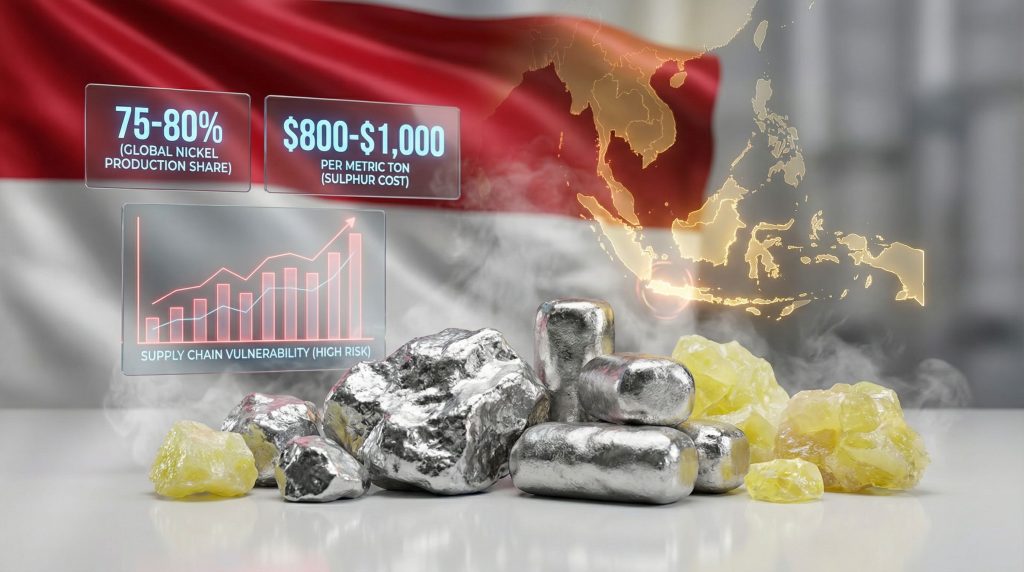
Indonesia's processing facilities depend on the Middle East for approximately 75-80% of their sulfur requirements, creating a concentration risk that has materialised into significant operational constraints. This dependency stems from both geographical logistics and the specific grade requirements of High-Pressure Acid Leaching (HPAL) operations that dominate Indonesian nickel processing.
Understanding Indonesia's Critical Supply Chain Dependencies
The nickel importance in global battery production becomes evident when examining supply chain vulnerabilities. Indonesia's processing facilities require substantial sulfur inputs, yet alternative sources typically involve longer shipping distances, smaller available volumes, and potentially different sulfur specifications that may require process adjustments.
The Middle East contributes roughly 25% of global sulfur supply, positioning the region as a significant source for Indonesian processors. However, established shipping routes, competitive pricing, and sulfur quality specifications required for battery metal production have created this concentrated dependency. Alternative sources exist globally, but they face logistical and specification challenges.
| Source Region | Indonesia Import Share | Key Characteristics | Supply Risk Level |
|---|---|---|---|
| Middle East | 75-80% | Established routes, competitive pricing | Critical |
| Other Regions | 20-25% | Longer distances, smaller volumes | Moderate |
Sulfur pricing has experienced dramatic escalation, rising from approximately $500 per metric ton to $800-$1,000 per ton for spot deliveries to Indonesia. This 60-100% price increase reflects both supply tightness and logistical challenges of sourcing alternative supplies during regional conflicts. Some traders report individual cargoes reaching the $1,000 threshold, indicating acute shortage conditions.
The geographic concentration creates multiple risk vectors beyond direct supply interruption. Maritime insurance costs increase during regional conflicts, extending shipping schedules and reducing vessel availability. Furthermore, port congestion at alternative loading facilities constrains supply flexibility, while currency fluctuations add additional cost pressures to an already strained supply chain.
The Technical Foundation of Nickel Processing Vulnerabilities
High-Pressure Acid Leaching represents the cornerstone technology for converting Indonesian lateritic nickel ore into Mixed Hydroxide Precipitate (MHP), the critical feedstock for electric vehicle battery materials. This process requires substantial quantities of sulfuric acid, typically produced on-site from elemental sulfur to ensure consistent quality and reduce transportation costs.
The chemical pathway from sulfur to battery-grade nickel involves multiple conversion steps that create cumulative dependencies. Sulfur combustion produces sulfur dioxide, which undergoes catalytic conversion to sulfur trioxide before hydration creates sulfuric acid. This acid then dissolves nickel, cobalt, and other metals from lateritic ore under high pressure and temperature conditions.
Cost Structure Analysis reveals the magnitude of sulfur's impact on HPAL economics:
• Historical baseline: Sulfur typically represented 25% of total HPAL operating costs
• Current impact: Sulfur now accounts for 30-35% of operating expenses
• Relative increase: A 40% expansion in cost share allocation
• Margin compression: Facilities previously operating above nameplate capacity have reduced output to design specifications
The increase from 25% to 30-35% cost share represents more than simple price inflation. It reflects the operational reality that sulfur cannot be easily substituted or eliminated from the HPAL process without fundamental technology changes. Moreover, unlike energy costs that can potentially be hedged, sulfur represents a fixed stoichiometric requirement based on the chemical composition of the ore being processed.
The sulfur shortage has transformed what was once a predictable input cost into a primary determinant of facility profitability, forcing operational adjustments that ripple through global battery material supply chains.
Indonesian facilities had been operating above nameplate capacity due to favourable margins and strong demand for MHP in the electric vehicle sector. However, the sulfur cost increases have forced producers to reduce output to design specifications, representing a normalisation of operations rather than emergency shutdowns. This adjustment eliminates the production buffer that had been contributing to global supply growth.
MHP serves as a critical intermediate product in the battery metals investment landscape. Chinese processors typically convert Indonesian MHP into nickel sulfate, which then undergoes further refinement into battery-grade nickel compounds used in lithium-ion cells. Consequently, any disruption to MHP production affects downstream processing capacity and potentially influences global electric vehicle production schedules.
Strategic Responses from Indonesian Producers
Indonesian nickel processors have implemented a systematic approach to managing sulfur supply constraints, prioritising inventory extension over emergency sourcing or production shutdowns. Major facilities operated by Chinese-backed companies including Huayou Cobalt, Lygend Resources, and Tsingshan Group have reduced output by at least 10% since supply disruptions intensified.
Production Management Framework:
- Immediate response: Reduce throughput to extend existing sulfur inventories
- Inventory optimisation: Prioritise production of highest-margin MHP grades
- Alternative sourcing: Explore non-Middle Eastern sulfur suppliers despite logistical challenges
- Process adaptation: Investigate direct sulfuric acid imports requiring regulatory permits
The production curtailments represent a measured response rather than panic-driven shutdowns. Facilities that had been operating above design capacity during periods of high margins and strong demand have normalised output to nameplate levels. This approach preserves equipment integrity while extending the operational window available for supply chain diversification.
Arif Perdana Kusuma, chairman of FINI (Indonesia's nickel smelters association), confirmed that no HPAL refiners have been forced to completely halt MHP production due to sulfur disruptions. However, inventory levels at several facilities are approaching critical thresholds, with current stocks at some locations sufficient only until May 2026 or potentially earlier.
Alternative sourcing efforts face multiple constraints beyond simple availability. Non-Middle Eastern sulfur suppliers typically offer smaller volumes per shipment, requiring more complex logistics coordination. In addition, shipping distances from alternative sources increase transportation costs and extend delivery timelines, reducing the flexibility needed for responsive supply chain management.
Import Permit Challenges:
• Direct sulfuric acid imports require Indonesian government permits
• Regulatory approval processes may extend supply adjustment timelines
• Logistical infrastructure for corrosive acid handling differs from elemental sulfur
• Transportation costs increase due to specialised handling requirements
Some producers are exploring direct sulfuric acid imports as an alternative to on-site production from elemental sulfur. However, this approach requires import permits from Indonesian authorities and specialised handling infrastructure. Sulfuric acid transportation involves corrosive material protocols and dedicated storage facilities that may not exist at all processing locations.
The strategic response diversity among producers suggests different risk tolerances and operational flexibilities. Larger, more integrated operations may have greater capacity to invest in alternative sourcing relationships, while smaller facilities might prioritise production optimisation over supply chain diversification during the adjustment period.
Market Structure Implications for Global Battery Supply Chains
Indonesia's dominance in nickel processing creates systemic vulnerabilities that extend far beyond individual facility operations. The country represents a critical node in global battery material supply chains, with MHP production concentrated in industrial zones that serve Chinese downstream processors and ultimately global electric vehicle manufacturers.
The sulfur supply disruption occurs against a backdrop of tightening Indonesian nickel policy. The government has reduced 2026 nickel mining quotas to 250-270 million wet metric tons, down from 379 million in 2025, representing a 30%+ reduction in allowable extraction volumes. This quota adjustment, combined with sulfur-driven processing constraints, creates dual supply pressures on global nickel availability.
Supply Chain Risk Assessment:
| Risk Factor | Pre-Crisis Baseline | Current Impact | Potential Escalation |
|---|---|---|---|
| Sulfur Cost ($/tonne) | $500 | $800-$1,000 | Further price increases |
| MHP Production Capacity | Above nameplate | Nameplate levels | Below nameplate if prolonged |
| Operating Cost Share | 25% | 30-35% | 40%+ if supply worsens |
Chinese nickel sulfate producers represent the primary downstream market for Indonesian MHP, creating a direct transmission mechanism for any Indonesian supply disruptions. These facilities typically maintain inventory buffers, but extended MHP supply tightness could eventually affect Chinese production schedules and global battery material availability.
The electric vehicle industry's rapid expansion has created unprecedented demand for battery-grade nickel compounds. Indonesian MHP production supports a substantial portion of this demand growth, making any production disruptions particularly significant for automotive manufacturers planning vehicle launch schedules and production ramp timelines.
Geographic concentration risks in critical mineral processing can transform regional supply disruptions into global industrial challenges, highlighting the interconnected nature of modern manufacturing supply chains.
Market participants are reassessing the strategic value of supply chain diversification versus cost optimisation. The Indonesia nickel sulphur shortage demonstrates how single-point failures can cascade through seemingly resilient industrial systems, potentially accelerating investment in alternative processing locations or backup supply relationships.
Furthermore, price discovery mechanisms in nickel markets may need adjustment to reflect increased supply chain volatility. Traditional hedging instruments and long-term supply contracts may require modification to account for input material risks that were previously considered minor operational variables.
Long-term Strategic Implications for Critical Mineral Security
The Indonesia nickel sulphur shortage exposes fundamental questions about critical mineral supply chain design in an era of increasing geopolitical complexity. The incident demonstrates how dependencies on seemingly basic inputs can create vulnerabilities in sophisticated industrial processes, particularly when geographic concentration intersects with regional instability.
Indonesian policymakers face strategic decisions about supply chain resilience versus cost efficiency. The current crisis may accelerate development of domestic sulfur sources or strategic stockpile programs for critical processing inputs. Alternative processing technologies that reduce sulfur dependency could also receive increased research and development attention.
Strategic Stockpile Considerations:
• Sulfur inventory levels sufficient for 90-180 days of operations
• Diversified supplier relationships across multiple geographic regions
• Emergency import protocols for sulfuric acid during supply disruptions
• Technology development for sulfur-efficient or alternative processing methods
The regulatory framework for critical mineral processing may evolve to address input material vulnerabilities. Import permit streamlining for emergency sulfuric acid purchases could reduce response times during future supply disruptions. For instance, strategic mineral classifications might expand beyond final products to include critical processing inputs.
Global electric vehicle manufacturers are likely reassessing their supply chain risk management frameworks. The incident highlights how disruptions in seemingly unrelated regions can affect automotive production schedules, potentially driving investment in alternative battery chemistries or geographically diversified mineral processing capacity.
Investment patterns in mining and processing infrastructure may shift toward regions with lower geopolitical risk or greater input material security. However, this transition requires substantial capital deployment and extended development timelines that limit near-term supply diversification options.
What Are the Future Scenarios for Supply Chain Recovery?
Future Scenario Analysis:
- Best case: Regional conflicts resolve and Middle Eastern sulfur supply normalises within 6-12 months
- Base case: Gradual supply diversification over 18-24 months with periodic disruptions
- Stress case: Extended regional instability requiring fundamental supply chain restructuring
The Indonesia nickel sulphur shortage serves as a case study in modern supply chain complexity. It demonstrates how global industrial systems can become vulnerable to disruptions in seemingly basic raw materials, particularly when geographic concentration creates single-point failure risks. The green raw materials transition must account for these vulnerabilities in future planning.
Risk Management Framework for Stakeholders:
• Producers: Multi-source supplier strategies and strategic inventory management
• Downstream processors: Supplier diversification and alternative feedstock development
• End-users: Supply chain transparency and risk assessment protocols
• Investors: Enhanced due diligence on input material dependencies and geopolitical exposure
The crisis underscores the importance of understanding indirect dependencies in critical mineral supply chains. While Indonesia's nickel processing dominance is well-recognised, the sulfur dependency that enables this processing capacity received limited attention until supply disruptions materialised. Consequently, commodity price impacts must be evaluated within broader supply chain contexts.
Future developments in battery technology, alternative processing methods, and supply chain diversification will likely be influenced by lessons learned from this supply disruption. The incident provides a real-world demonstration of how geopolitical events can cascade through industrial supply chains, affecting industries far removed from the original disruption source.
Moreover, recent reports indicate that Indonesian nickel producers are experiencing significant pressure from the sulfur supply constraints, while industry analysts suggest that Indonesia's battery supply chain faces structural challenges that extend beyond immediate shortages.
This analysis is based on available industry data and reported information. Supply chain dynamics and market conditions can change rapidly during crisis periods. Investors and industry participants should conduct independent research and risk assessment before making strategic decisions based on evolving supply chain conditions.
Ready to Capitalise on Critical Mineral Supply Chain Disruptions?
Discovery Alert's proprietary Discovery IQ model delivers real-time alerts on significant ASX mineral discoveries, turning complex market disruptions like Indonesia's sulfur shortage into actionable investment insights. Visit Discovery Alert's dedicated discoveries page to understand how major mineral discoveries can generate substantial returns, then begin your 14-day free trial today to position yourself ahead of supply chain volatility.