June 5, 2026
When One Country Controls Half the World's Nickel, Every Policy Decision Becomes a Global Price Event
Few commodity markets illustrate the fragility of concentrated supply chains as vividly as nickel. For most of the past decade, the global nickel industry expanded under a single dominant assumption: Indonesian supply was effectively limitless, and prices would remain structurally suppressed by a flood of new laterite ore production. That assumption is now being stress-tested in real time.
The Indonesia nickel supply cuts and nickel prices relationship has moved to the centre of every serious commodity analyst's framework in 2026. When a single jurisdiction controlling somewhere between 50% and 66% of global nickel mine supply decides to reduce its authorised output by nearly a third, the consequences reverberate across smelters, battery factories, and procurement desks on multiple continents. Understanding why this is happening, what it means for price trajectories, and how the market might evolve through 2027 requires more than reading spot price charts. It demands a structural view of how nickel flows from ore in the ground to cathode in an EV battery.
When big ASX news breaks, our subscribers know first
Indonesia's Quota Reduction: The Numbers Behind the Shift
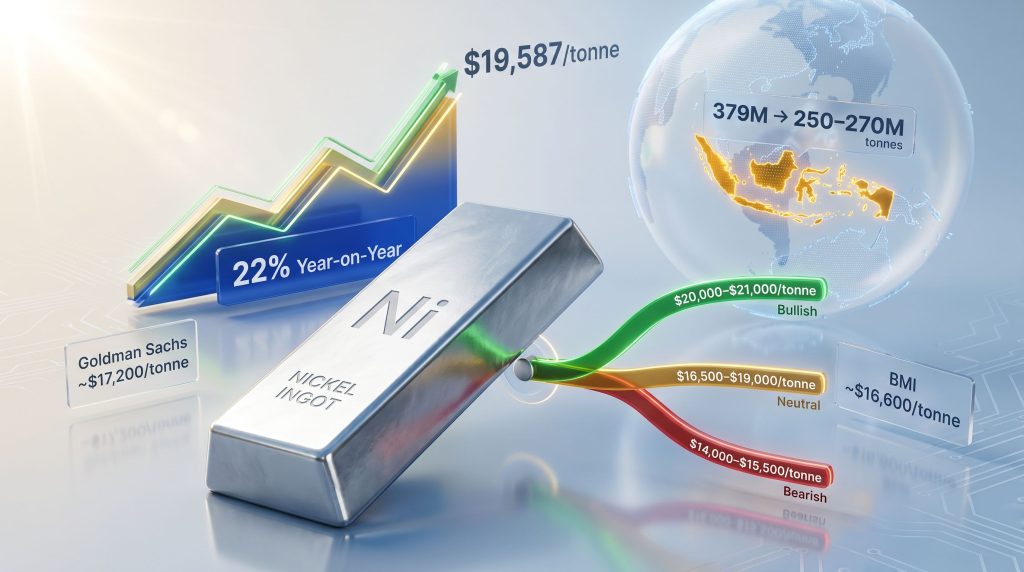
The scale of Indonesia's policy shift deserves direct attention before any analysis can begin. In 2025, Indonesia's approved nickel ore production quota reached 379 million tonnes. The revised authorisation for 2026 targets a range of 250 to 270 million tonnes, representing a reduction of more than 100 million tonnes in permitted extraction volume. Expressed as a percentage, this is a 30% to 34% contraction in authorised output from the world's most consequential nickel-producing nation.
This is not a routine annual adjustment. Quota systems in extractive industries typically fluctuate within margins of 5% to 15% based on royalty considerations, environmental compliance reviews, or processing alignment. A cut of this magnitude signals a deliberate strategic repositioning, and the Indonesian nickel industry challenges this creates are already reverberating through global supply chains.
The Three Policy Objectives Driving the Reduction
Indonesia's decision to tighten mining quotas reflects three distinct but interconnected priorities:
- Price floor defence: Years of aggressive production expansion contributed to a prolonged nickel price depression that damaged government royalty revenues and reduced returns for both state and private operators. Quota discipline is intended to structurally support a higher price baseline.
- Reserve life extension: High-grade laterite nickel ore is a finite geological resource. The saprolite and limonite horizons that feed Indonesian NPI smelters and HPAL circuits are not replenishable on any commercially relevant timescale. Reducing extraction velocity extends the productive life of Indonesia's highest-value deposits.
- Downstream processing alignment: Indonesia's industrial policy has consistently prioritised domestic value-added manufacturing over raw ore export. Limiting ore output creates economic pressure that incentivises investment into domestic smelting, refining, and battery precursor production rather than shipping unprocessed material offshore.
A less-discussed but increasingly relevant fourth driver is the growing ESG scrutiny applied to Indonesian nickel supply chains. Land clearing, high-energy processing operations, and waste tailings management at laterite sites have drawn criticism from global battery manufacturers seeking verifiable environmental credentials. The quota reduction, while not framed explicitly as an environmental measure, indirectly addresses some of these concerns by reducing extraction intensity.
Nickel Price Performance: What the Data Shows
The market response to Indonesia's supply recalibration has been measurable and significant. The following table summarises the key price data points defining the current cycle:
| Metric | Value |
|---|---|
| LME Nickel 1.5-Year High (Late January 2026) | ~$18,950/tonne |
| Nickel Price Peak (May 6, 2026) | $19,587/tonne |
| Nickel Price (Early June 2026) | ~$18,620–$18,800/tonne |
| Year-on-Year Price Increase | ~22% |
| Short-Term Price Increase (Recent Weeks) | ~10% |
| Goldman Sachs 2026 Average Price Forecast | ~$17,200/tonne |
| BMI Research 2026 Average Price Forecast (Revised) | ~$16,600/tonne |
The Indonesian nickel price trends reflect more than simple supply subtraction arithmetic. Spot market participants are pricing in forward supply risk, not just current availability gaps. LME nickel's approach toward the $19,000 to $20,000 per tonne threshold incorporates both the immediate ore shortfall at Indonesian smelters and the structural uncertainty introduced by a policy regime that has demonstrated willingness to restrict output at scale.
Why Sulphur Supply Is Compounding the Squeeze
An underappreciated compounding factor in the current tightening cycle is sulphur supply disruption. Sulphur is a critical chemical input for hydrometallurgical nickel processing, particularly in the high-pressure acid leach circuits that produce battery-grade Class 1 nickel. When sulphur availability tightens simultaneously with ore quotas, the production cost structure for refined battery-grade material escalates beyond what ore prices alone would suggest.
This dual input pressure is squeezing processing margins and adding a secondary layer of supply constraint that is not immediately visible in headline production figures. Furthermore, nickel price momentum has been further shaped by these compounding dynamics, reinforcing the upward price trajectory observed since late 2025.
BMI Research revised its 2026 average nickel price forecast upward to approximately $16,600 per tonne, citing Indonesian quota constraints as the primary driver of the upward revision. Goldman Sachs maintains a projection closer to $17,200 per tonne, reflecting tighter supply conditions while accounting for persistent demand-side uncertainty.
The Paradox of Rising Prices Within a Surplus Market
One of the most analytically challenging features of the current nickel market is the coexistence of rising prices and a projected global surplus exceeding 200,000 tonnes in 2026. This apparent contradiction is resolved by understanding a critical distinction that most mainstream coverage fails to articulate clearly.
The nickel market operates across two distinct layers that do not move in lockstep:
- Ore-level supply is tightening due to quota restrictions. This affects NPI smelters and HPAL circuits that depend on Indonesian laterite feedstock.
- Refined nickel supply remains in surplus, partly because of the large inventory buffer built up during Indonesia's production expansion phase from 2020 to 2024.
The price signal being transmitted through LME nickel reflects ore-level scarcity rather than refined metal scarcity. This is a nuanced but consequential distinction for both investors and procurement managers. A rising nickel price driven by ore constraints does not necessarily indicate that Class 1 refined nickel for EV batteries is in short supply. It means that the cost structure for producing that refined nickel is increasing, which eventually transmits through to battery-grade material pricing but with a lag.
Wood Mackenzie and S&P Global both maintain that the nickel market will remain in structural surplus until approximately 2030, arguing that the volume of Indonesian capacity installed during the prior expansion cycle creates a persistent inventory buffer that limits how high sustained prices can reach even in a quota-constrained environment.
Scenario Modelling: Three Pathways for Nickel Through 2027
Scenario 1: Bullish Pathway — Quota Discipline Holds
If Indonesia enforces production limits consistently and smelters cannot source sufficient replacement ore from alternative origins, the supply tightening becomes genuinely structural. Under this scenario, nickel sustains above $18,500 per tonne through the second half of 2026, with potential to test $20,000 to $21,000 per tonne if EV demand simultaneously accelerates.
The critical caveat is enforcement consistency. Quota systems in resource-rich developing economies are historically subject to informal production, permit irregularities, and pressure from domestic industry groups seeking relief. The bullish scenario requires a level of policy discipline that Indonesian nickel policy has not always maintained.
Scenario 2: Base Case — Partial Tightening with Elevated Volatility
Under the most probable near-term scenario, quota cuts reduce available ore but the Philippines partially compensates as a secondary supplier. A global nickel surplus persists at reduced levels of roughly 100,000 to 150,000 tonnes. Nickel trades within a $16,500 to $19,000 per tonne range through 2026, with volatility clustering around policy announcements and LME inventory data releases. This is broadly consistent with current analyst consensus and represents the most defensible price expectation for planning purposes.
Scenario 3: Bearish Pathway — HPAL Expansion Offsets Quota Impact
New HPAL projects reaching commissioning could add up to 600,000 tonnes of refined nickel equivalent to global supply by late 2026. Combined with a technology-driven reduction in nickel intensity per EV unit driven by LFP battery adoption, this scenario pushes nickel back toward $14,000 to $15,500 per tonne. The bearish scenario has lower near-term probability but elevated medium-term risk through 2027 and 2028. HPAL projects are capital-intensive and subject to commissioning delays, but the development pipeline is large enough to materially alter the supply balance within 18 to 24 months.
Downstream Consequences: Who Feels the Supply Squeeze?
Stainless Steel: The Largest Demand Segment Under Pressure
Stainless steel consumes approximately 70% of total global nickel demand, making it the anchor of the entire market. NPI, which is produced almost exclusively in Indonesia and China using Indonesian laterite ore, is the primary feedstock for the stainless steel sector. Tighter ore quotas directly increase NPI production costs, which flow through to stainless steel mill input prices.
Chinese stainless steel producers, who represent the world's largest consumers of Indonesian NPI, face margin pressure that may manifest as either reduced output volumes or upward pressure on finished steel pricing in downstream industrial markets. Consequently, China's investment in Indonesian nickel has become an increasingly scrutinised factor in how these pressures are ultimately managed across the supply chain.
EV Battery Supply Chains: The Class 1 Nickel Challenge
High-nickel battery chemistries including NMC (nickel manganese cobalt) and NCA (nickel cobalt aluminium) require Class 1 refined nickel, not NPI. The HPAL sector is the primary production pathway for battery-grade material, and HPAL circuits depend on the same laterite ore feedstock that Indonesian quotas are restricting. EV manufacturers and battery cell producers therefore face a bifurcated risk profile:
- Cost risk: Higher ore input costs transmit through HPAL processing economics to battery-grade nickel sulphate pricing.
- Security risk: Long-term procurement contracts for battery-grade nickel must increasingly account for quota policy uncertainty.
The LFP counterfactor is significant. Lithium iron phosphate battery chemistry contains no nickel and is gaining share among mass-market EV segments, particularly in China. This partially insulates some portions of the EV market from nickel price volatility, but premium long-range vehicle segments continue to depend on high-nickel chemistries for energy density reasons. In addition, the role of Indonesian nickel in energy transition supply chains ensures this dynamic will remain central to battery manufacturing strategy for years to come.
The Philippines: A Partial Substitute, Not a Replacement
With Indonesian ore volumes constrained, the Philippines, the world's second-largest nickel ore producer, is positioned to partially fill the supply gap. However, Philippine ore grades, logistics infrastructure, and export capacity differ meaningfully from Indonesian supply parameters. Philippine nickel laterite deposits tend to have different moisture content and grade profiles than Indonesian material, affecting processing compatibility for smelters calibrated to Indonesian feedstock. Substitution is technically and logistically constrained, making the Philippines a meaningful but partial buffer rather than a like-for-like replacement.
The next major ASX story will hit our subscribers first
Geopolitical Dimensions: Why Supply Origin Now Carries a Risk Premium
A dimension of the nickel market that has gained substantial strategic weight in recent years is the geopolitical concentration of processing infrastructure. A significant share of Indonesian refining capacity, particularly NPI smelters and HPAL plants, operates under Chinese corporate ownership or financing structures. This concentration creates supply chain security concerns for Western governments and manufacturers seeking to build EV and clean energy industries on sovereign or allied supply foundations.
The United States, European Union, and key allied nations have responded through policy frameworks including the U.S. Inflation Reduction Act, the EU Critical Raw Materials Act, and various bilateral mineral security agreements. These mechanisms are designed to incentivise development of nickel supply outside Chinese-controlled processing networks, with politically stable, rule-of-law jurisdictions in North America and allied nations receiving particular attention from policy architects and project developers alike.
Polymetallic nickel projects situated in jurisdictions like Alaska, which can simultaneously produce copper, cobalt, and platinum group elements alongside nickel, carry additional strategic value precisely because they address multiple critical mineral supply gaps within a single development footprint.
| Supply Source | Geopolitical Risk | ESG Profile | Price Competitiveness | Supply Reliability |
|---|---|---|---|---|
| Indonesia (NPI/HPAL) | High | Moderate–Low | High | Moderate |
| Philippines (Ore) | Moderate | Moderate | Moderate | Moderate |
| Russia (Refined) | Very High | Low | Variable | Low |
| North America (Development) | Low | High | Developing | High (long-term) |
| Australia (Existing) | Low | High | Moderate–High | High |
Key Takeaways for Investors and Procurement Strategists
The Indonesia nickel supply cuts and nickel prices dynamic in 2026 delivers three distinct signals that warrant careful interpretation:
- The short-term price signal is real and grounded in genuine ore scarcity. A 30%+ quota reduction at the world's dominant producer is creating measurable input shortages at smelters, and the 22% year-on-year price gain reflects legitimate supply tightening rather than speculative positioning alone.
- The structural surplus remains the medium-term constraint. A global nickel surplus exceeding 200,000 tonnes in 2026 and a potential HPAL capacity addition pipeline of up to 600,000 tonnes create a meaningful ceiling on how far or how long the current price rally can extend. Treating the present environment as the beginning of a sustained bull market ignores this structural counterweight.
- Geopolitical risk is now a permanent pricing variable. The concentration of nickel processing in Chinese-controlled Indonesian infrastructure creates a risk premium for Western supply chains that will not disappear regardless of spot price movements. Projects capable of supplying battery-grade or strategically important nickel from politically stable jurisdictions carry a differentiation premium that is increasingly recognised in procurement decisions and policy frameworks.
This article contains forward-looking analysis, price projections, and scenario modelling based on publicly available analyst forecasts and market data. It does not constitute financial or investment advice. Investors should conduct independent research and consult qualified advisers before making any investment decisions. Commodity price forecasts involve material uncertainty and actual outcomes may differ significantly from projections referenced herein.
Want to Stay Ahead of the Next Major Nickel Discovery on the ASX?
Discovery Alert's proprietary Discovery IQ model scans ASX announcements in real time, instantly identifying significant mineral discoveries across nickel and more than 30 other commodities — translating complex geological data into clear, actionable investment insights for both short-term traders and long-term investors. Explore how historic mineral discoveries have generated substantial returns and begin your 14-day free trial at Discovery Alert to position yourself ahead of the market.