May 12, 2026
The Indonesian coal industry faces a critical juncture as government-imposed quota restrictions threaten widespread operational shutdowns across the archipelago. Indonesian coal quota cuts risk mine shutdowns on an unprecedented scale, with production targets slashed to approximately 600 million tonnes annually. Furthermore, this dramatic reduction from record 2024 output levels represents more than simple market intervention; it constitutes a fundamental restructuring of Indonesia's mining sector that could eliminate hundreds of operators.
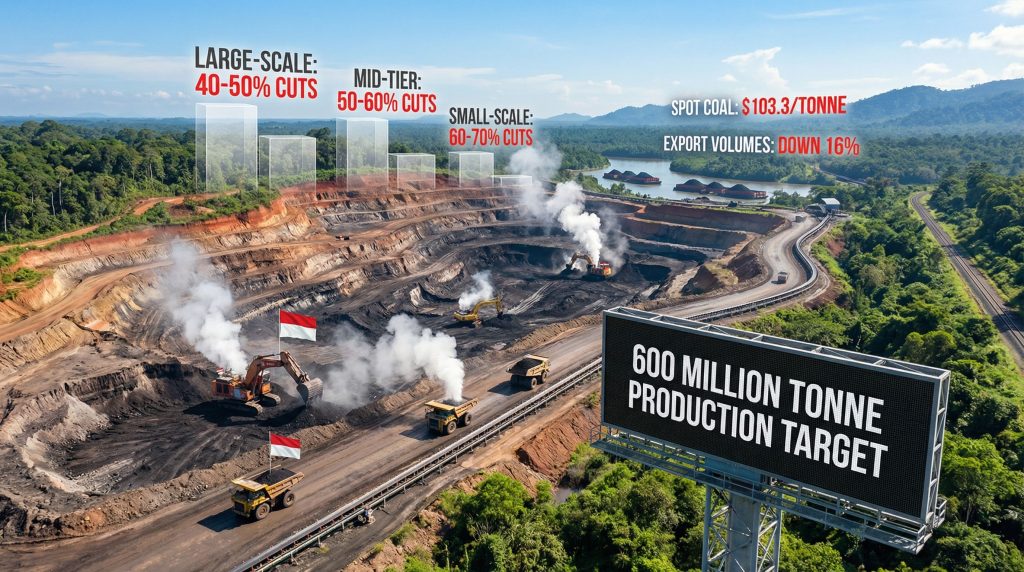
The convergence of regulatory tightening, financial pressure, and market dynamics creates a perfect storm for Indonesian coal producers, particularly smaller-scale operations lacking the financial resilience to absorb substantial revenue reductions. Industry stakeholders warn that production cuts ranging from 40% to 70% across different operations may force widespread shutdowns, potentially triggering the largest consolidation event in Indonesia's coal mining history.
Understanding Indonesia's Production Target Framework and Market Context
The 600 Million Tonne Strategic Objective
Indonesia's government has established an annual coal production ceiling of approximately 600 million tonnes, marking a deliberate departure from the record-breaking output achieved in 2024. This target represents more than a simple production adjustment; it constitutes a strategic intervention designed to rebalance global coal markets where supply capacity consistently exceeds demand by significant margins.
The policy framework operates through the Rencana Kerja dan Anggaran Biaya (RKAB) system, which requires mining companies to submit detailed annual work plans establishing production quotas for government approval. This centralised control mechanism enables precise output management while maintaining operational oversight across Indonesia's geographically dispersed mining regions.
Coal prices have experienced three consecutive years of decline amid reduced demand from China, the world's largest consumer, while Indonesian production surged to unprecedented levels. The government's intervention acknowledges that market forces alone have proven insufficient to achieve price stabilisation in an oversupplied commodity environment.
Global Coal Market Oversupply Dynamics
Current market analysis reveals a structural imbalance where global coal supply capacity approaches 9.1 billion tonnes annually, while demand projections indicate consumption of approximately 8.78 billion tonnes for 2026. This 320 million tonne excess capacity creates persistent downward pressure on pricing, particularly affecting higher-cost producers and those dependent on spot market sales rather than long-term contracts.
Indonesian coal currently trades at approximately $103.3 per tonne, representing a significant decline from recent peak levels. The sustained price weakness reflects not only oversupply conditions but also shifting energy transition policies in major consuming nations that prioritise renewable energy development over fossil fuel consumption growth.
Moreover, the commodity prices impact on mining company performance demonstrates how sustained price weakness creates cascading financial pressures throughout the industry. Consequently, operators face increasingly difficult decisions regarding operational continuity.
RKAB Approval Process and Compliance Requirements
The RKAB submission and approval system serves as the primary mechanism for implementing production quotas across Indonesia's coal mining sector. Companies must demonstrate technical capability, financial viability, and environmental compliance as prerequisites for quota allocation. The government reviews each submission against national production targets, regional distribution objectives, and individual operator capacity assessments.
Approximately 300 mining operations have failed to submit required 2026 quota applications, creating a critical compliance gap that could result in immediate shutdown orders or substantial financial penalties. This non-compliance status indicates either operational difficulties preventing proper documentation or strategic decisions to cease operations rather than accept reduced production allocations.
Understanding mining permitting essentials becomes crucial for operators attempting to maintain compliance during this regulatory transition. In addition, companies must navigate increasingly complex administrative requirements while managing reduced production capacities.
When big ASX news breaks, our subscribers know first
Analysing Production Cut Severity Across Mining Operations
Quota Reduction Analysis by Operational Scale
The Indonesian Coal Miners Association has documented production cuts ranging from 40% to 70% across different mining operations, with the severity of reductions often correlating inversely with operational scale and financial stability. Large-scale operations with diversified revenue streams and established long-term contracts typically receive more favourable quota allocations compared to smaller operators dependent on spot market sales.
| Operational Category | Typical Quota Reduction | Primary Risk Factors | Survival Probability |
|---|---|---|---|
| Integrated mining conglomerates | 30-45% | Contract fulfillment pressure | High |
| Regional coal producers | 45-60% | Financial leverage exposure | Moderate |
| Small-scale operators | 55-75% | Viability threshold breach | Low |
The association has warned that these quota reductions could trigger massive layoffs and defaults on loans to miners, while companies may prove unable to meet pre-agreed supply contracts. This cascading effect threatens not only direct mining operations but also the broader network of service providers, transportation companies, and regional economies dependent on coal production activity.
Regional Impact Distribution
East Kalimantan, Indonesia's primary coal-producing region, faces particular vulnerability due to the concentration of mining operations and limited economic diversification. The region's heavy reliance on coal production means that widespread mine shutdowns could create significant unemployment and reduce regional government revenues derived from mining royalties and taxation.
Transportation infrastructure constraints further compound regional challenges, as mines in remote locations face higher logistics costs and limited alternative routing options. Operations dependent on single transportation corridors become particularly vulnerable to infrastructure disruptions or capacity limitations that could render production uneconomical even within approved quota limits.
Furthermore, the broader mining industry evolution suggests that regional specialisation in single commodities creates systemic vulnerabilities during market transitions. Consequently, East Kalimantan's coal dependency exposes the region to severe economic disruption.
Non-Compliance Crisis Among Smaller Operators
The failure of approximately 300 mining operations to submit required quota applications suggests a deeper crisis of confidence within the sector's smaller operators. These companies may lack the financial resources to continue operations under significantly reduced production quotas or face insurmountable technical challenges in meeting updated regulatory requirements.
Non-compliant operators risk immediate shutdown orders, substantial financial penalties, and potential permanent licence revocation. The government's enforcement approach indicates a willingness to accept substantial sector consolidation as an acceptable outcome of quota implementation, particularly if it eliminates marginal producers contributing to oversupply conditions.
Operational Factors Accelerating Mine Closure Risk
Forest Area Permit Enforcement Intensification
Beyond production quotas, Indonesian authorities are implementing large fines on operations deemed to have breached their forestry permits, creating an additional layer of compliance pressure that could force immediate shutdowns regardless of quota status. Forest Area Borrow-to-Use Permits (IPPKH) require mining companies to demonstrate environmental compliance and rehabilitation commitments as conditions for operational authorisation.
"The government's simultaneous enforcement of forestry permit compliance and production quotas creates compounding pressure on mining operations, with non-compliance in either area potentially triggering immediate shutdown orders."
Approximately 300 mining operations face dual exposure to both quota non-submission and potential forestry permit violations, suggesting these companies may lack the technical or financial resources necessary to maintain regulatory compliance under current standards. The Indonesian government has informed operators of these production quota cuts while intensifying permit enforcement simultaneously.
Transportation Infrastructure Constraints
Indonesia's coal mining sector faces increasing transportation bottlenecks that could render certain operations uneconomical regardless of production quotas. Key infrastructure constraints include:
- River transport limitations affecting coal barge movements in major waterways
- Bridge capacity restrictions limiting overland transport options
- Port congestion creating delays and additional logistics costs
- Road weight limitations in certain regions restricting truck transport capacity
These infrastructure constraints disproportionately affect smaller mining operations lacking dedicated transportation infrastructure or long-term logistics contracts. Operations dependent on spot market transportation pricing face additional cost pressures that could push total production costs above viable thresholds.
Export Levy Implementation Threats
The Indonesian government is looking to apply an export levy to coal, which would further undermine profitability for operators already struggling with reduced quotas and operational constraints. While specific levy rates remain undetermined, even modest export taxation could render marginal operations uneconomical, particularly those with high production costs or unfavourable transportation logistics.
Export levy implementation would create additional pressure on companies with significant debt service requirements or those struggling to meet existing supply contract obligations. The combination of reduced production quotas and export taxation could create a viability crisis for operators lacking sufficient financial reserves to absorb multiple simultaneous revenue pressures.
Financial Implications and Economic Viability Assessment
Revenue Impact Analysis
Coal prices have experienced sustained downward pressure, with current spot pricing at $103.3 per tonne representing a significant decline from recent peak levels. The combination of production quota cuts and continued price weakness creates a dual revenue squeeze that threatens the financial viability of many Indonesian coal operations.
Companies face particular challenges in meeting debt service obligations while maintaining sufficient cash flow for operational requirements. The Indonesian Coal Miners Association has specifically warned of potential defaults on loans to miners as quota-reduced revenues prove insufficient to meet existing financial commitments.
However, the tariff market impacts create additional uncertainty for companies dependent on export markets. Moreover, trade policy changes could further constrain revenue opportunities for surviving operators.
Operating Cost Structure Pressures
Indonesian coal miners face a complex cost structure where fixed expenses including labour, equipment depreciation, and debt service continue regardless of production volume reductions. This creates a negative operating leverage effect where percentage decreases in production translate to magnified impacts on profitability margins.
Key cost pressure factors include:
- Fixed labour costs for essential personnel regardless of production levels
- Equipment lease payments continuing during reduced operation periods
- Environmental compliance costs remaining constant or increasing
- Debt service obligations unrelated to current production capacity
Contract Fulfillment and Penalty Risks
Many Indonesian coal producers have entered into long-term supply contracts with specific volume commitments that may become impossible to fulfil under reduced production quotas. The association has warned that companies may also be unable to meet their pre-agreed supply contracts, creating potential breach penalties and customer relationship damage that could persist beyond the current quota period.
Contract fulfillment challenges create additional financial pressure through potential penalty payments, customer compensation requirements, and lost future business opportunities. Companies with high contract-to-quota ratios face particularly acute risks of legal liability and relationship damage that could impair long-term viability even if quota restrictions are eventually relaxed.
Cross-Sector Mining Policy Coordination
Nickel Industry Precedent Analysis
Indonesia's approach to coal quota management follows similar intervention strategies implemented across other mineral sectors, particularly nickel production where the government has previously imposed significant output restrictions to support pricing objectives. This cross-commodity approach suggests a coordinated national mining policy focused on maximising export revenue through supply management rather than volume optimisation.
The nickel sector experience provides insight into potential coal quota outcomes, including sector consolidation, improved pricing for surviving producers, and enhanced downstream processing industry development. However, coal market dynamics differ significantly from nickel markets, particularly regarding demand elasticity and substitute energy source availability.
Downstream Processing Industry Protection
Indonesia's quota strategy serves dual objectives of price stabilisation and domestic downstream industry protection. By constraining raw coal exports, the government creates incentives for value-added processing within Indonesia, supporting job creation in higher-skilled manufacturing sectors while reducing reliance on commodity price volatility.
This policy alignment suggests that coal quota restrictions may persist even if global prices recover, as the government prioritises industrial development objectives over short-term export revenue maximisation. Mining companies should anticipate continued quota constraints as part of a broader economic diversification strategy.
Furthermore, the ongoing decarbonisation trends in global mining create additional pressure for downstream processing development. Consequently, Indonesia's policy framework attempts to capture more value from mineral resources before global demand transitions accelerate.
Integrated Resource Management Framework
The government's simultaneous implementation of quota systems across multiple mineral sectors indicates a sophisticated understanding of global commodity market dynamics and willingness to sacrifice short-term production for long-term strategic positioning. This integrated approach suggests that coal quota policies will remain aligned with broader mineral sector management objectives rather than responding solely to coal-specific market conditions.
Strategic Scenarios for Operational Continuity
Immediate Compliance and Adaptation Strategy
Mining operations pursuing continued operation under quota restrictions must demonstrate capability in several critical areas:
- RKAB plan revision and optimisation to maximise efficiency within allocated quotas
- Cost structure rationalisation to maintain profitability at reduced production levels
- Contract renegotiation to align supply commitments with available production capacity
- Working capital management to maintain financial stability during revenue transitions
Companies successfully implementing compliance strategies typically possess strong balance sheets, diversified revenue streams, and established relationships with long-term contract customers willing to accept modified supply arrangements.
Temporary Suspension and Preservation Options
Some operators may choose temporary suspension strategies designed to preserve assets and workforce capabilities while avoiding the high fixed costs of continued operation during unfavourable market conditions:
- Equipment mothballing with regular maintenance to ensure rapid restart capability
- Core workforce retention through reduced schedules or alternative assignment
- Infrastructure preservation including road access and utilities maintenance
- Permit maintenance to retain operational authorisation for future restart
Temporary suspension requires careful financial planning to cover preservation costs while avoiding permit lapses or equipment deterioration that could prevent economic restart when market conditions improve.
Permanent Closure and Asset Recovery
Mining operations facing insurmountable financial challenges under quota restrictions may pursue permanent closure strategies focused on maximising asset recovery and minimising ongoing liabilities:
- Equipment liquidation through auction or direct sale to continuing operators
- Land rehabilitation to meet environmental closure requirements
- Workforce transition support including severance and retraining assistance
- Debt restructuring to minimise creditor exposure and personal liability
Permanent closure decisions require careful evaluation of rehabilitation costs, equipment recovery values, and ongoing liability exposure that could persist long after mining operations cease.
The next major ASX story will hit our subscribers first
Risk Assessment Matrix for Indonesian Coal Operations
Multi-Factor Vulnerability Analysis
Indonesian coal quota cuts risk mine shutdowns through multiple interconnected factors that determine operational viability under quota restrictions. Mining operations face varying shutdown risks based on the interaction of several critical factors:
| Risk Category | High-Risk Indicators | Mitigation Strategies | Timeline for Action |
|---|---|---|---|
| Financial leverage | Debt-to-equity >70% | Emergency refinancing | 30-60 days |
| Quota severity | Reductions >60% | Efficiency optimisation | Immediate |
| Permit compliance | IPPKH violations | Legal regularisation | 90 days maximum |
| Transportation access | Single corridor dependence | Alternative routing | 6-12 months |
| Contract exposure | Fixed volume commitments | Renegotiation or penalties | 30-90 days |
Small-Scale Operator Vulnerability
Small-scale mining operations face disproportionate shutdown risk due to limited financial reserves, higher per-unit costs, and reduced negotiating power with customers and creditors. These operators typically lack the economies of scale necessary to maintain profitability under significantly reduced production quotas.
Critical vulnerability factors for small operators include:
- Limited access to capital markets for refinancing or working capital
- Higher transportation costs due to smaller shipment volumes
- Spot market dependence creating price volatility exposure
- Single-asset concentration preventing risk diversification
Regional Concentration Risk in East Kalimantan
East Kalimantan's concentration of coal mining operations creates systemic risks where widespread shutdowns could trigger regional economic collapse, transportation infrastructure underutilisation, and cascading failures among service providers and supporting businesses.
Regional risk factors include limited economic diversification, transportation infrastructure optimisation for coal logistics, and government revenue dependence on mining royalties and taxation. Policymakers may consider targeted support mechanisms for East Kalimantan operations to prevent broader regional economic disruption.
Additionally, reports indicate that Indonesia slashes coal quotas risking mine closures across multiple regions, with East Kalimantan facing the most severe concentration risks due to its mining dependency.
Market Dynamics Supporting Production Restriction Strategy
Global Coal Supply-Demand Imbalance
Current global coal market conditions strongly support Indonesia's production restriction strategy, with supply capacity significantly exceeding consumption demand across all major market segments. The persistent oversupply situation creates minimal risk that Indonesian quota reductions will trigger supply shortages or dramatic price increases that could undermine the policy's effectiveness.
2026 demand forecasts indicate global coal consumption of approximately 8.78 billion tonnes against supply capacity approaching 9.1 billion tonnes, creating a substantial excess capacity buffer that allows major producers to implement supply management without risking market disruption.
China and India Demand Evolution
Demand patterns from major consuming nations continue evolving in ways that support supply restriction strategies. China's coal consumption has shown reduced growth rates as the economy transitions toward services and renewable energy sources, while India's demand growth remains insufficient to absorb global excess capacity.
These consumption trend shifts suggest that Indonesian quota restrictions align with fundamental market trajectory changes rather than attempting to artificially constrain naturally growing demand. This alignment increases the probability of successful price stabilisation outcomes.
Energy Transition Impact Assessment
Long-term coal demand faces persistent downward pressure from accelerating energy transition policies across major consuming economies. Renewable energy cost reductions and climate policy implementation create structural headwinds for coal consumption that support supply management strategies focused on optimising revenue from declining long-term demand.
Indonesian quota policies acknowledge these structural trends while maximising economic benefits during the transition period. This strategic approach positions Indonesia to maintain market share leadership while global coal demand gradually declines over the coming decades.
Investment and Stakeholder Response Strategies
Capital Allocation Adjustment Requirements
Investment strategies must account for the new reality of government-managed coal production quotas that fundamentally alter traditional mining investment analysis. Investors should prioritise operations with strong balance sheets, diversified geographic exposure, and established long-term contract portfolios that provide revenue stability during quota periods.
Key investment criteria should include:
- Quota allocation track record demonstrating government relationship management
- Cost position analysis to identify operators capable of profitability under constraints
- Financial flexibility assessment for companies needing working capital adjustment
- Permit compliance status to avoid regulatory shutdown risks
Supply Chain Diversification Imperatives
Coal consumers and industrial users must accelerate supply chain diversification efforts to reduce dependence on Indonesian production that may remain subject to quota constraints indefinitely. Alternative supply sources, energy source substitution, and inventory management strategies become critical for maintaining operational continuity.
Diversification strategies should consider geographic risk distribution, transportation logistics optimisation, alternative energy source evaluation, and long-term contract structuring that accommodates quota-related supply variability.
Alternative Energy Investment Acceleration
Indonesian coal quota policies create additional incentives for accelerated investment in renewable energy infrastructure and energy storage technologies that reduce coal dependence. These policy developments support investment thesis for clean energy alternatives while creating headwinds for coal-dependent industrial processes.
Investment opportunities include renewable energy development in coal-dependent regions, energy storage solutions for industrial applications, and efficiency technologies that reduce overall energy consumption requirements.
Broader Economic and Social Implications
Employment Impact and Workforce Transition
Indonesian coal quota implementation threatens significant employment disruption across mining regions, with potential job losses extending beyond direct mining operations to transportation, equipment services, and local businesses dependent on mining-related economic activity.
Workforce transition challenges include:
- Geographic concentration of affected workers in mining regions
- Skill transferability limitations for specialised mining occupations
- Limited alternative employment in coal-dependent regional economies
- Retraining requirements for workers transitioning to other industries
Government support mechanisms and private sector workforce development initiatives become critical for managing social disruption associated with large-scale mine closures.
Government Revenue and Fiscal Policy Implications
Reduced coal production directly impacts Indonesian government revenues through lower royalty payments, corporate taxation, and export-related fees. However, policymakers appear willing to accept short-term revenue reduction in exchange for improved long-term pricing and sustainable industry development.
Fiscal considerations include budget adjustment requirements for mining-dependent regions, alternative revenue source development, and strategic reserve management to buffer economic transition effects. The government may implement additional taxation on surviving operators to partially offset revenue losses from reduced production volume.
Environmental and Sustainability Outcomes
Coal production quotas create positive environmental outcomes through reduced deforestation pressure, decreased transportation emissions, and accelerated land rehabilitation in closed mining areas. These benefits support Indonesia's broader environmental policy objectives while contributing to international climate commitment fulfillment.
Environmental improvements include ecosystem restoration opportunities, reduced water resource pressure, and improved air quality in mining regions. However, these benefits must be balanced against potential social disruption and economic adjustment challenges in coal-dependent communities.
Frequently Asked Questions About Indonesian Coal Quota Implementation
How quickly could mine shutdowns occur?
Mine shutdowns could occur rapidly for operations failing to meet quota submission deadlines or permit compliance requirements. The government has demonstrated willingness to impose immediate closure orders for non-compliant operators, suggesting that administrative shutdowns could happen within weeks of enforcement action initiation.
Companies with submitted but reduced quotas face gradual production adjustment over the implementation period, while those failing to submit face immediate shutdown risk pending quota regularisation or permanent closure decisions.
Will quota cuts significantly impact global coal prices?
Indonesian quota cuts are unlikely to trigger dramatic global coal price increases due to substantial excess capacity in other producing regions. However, modest price stabilisation or gradual improvement may occur as Indonesian supply constraints combine with natural demand variation to reduce oversupply pressures.
Price impact will depend on demand evolution from major consumers and production responses from other exporting nations capable of increasing output to offset Indonesian reductions.
What support exists for affected mining communities?
Mining companies and government agencies are developing workforce transition programmes, alternative economic development initiatives, and social support mechanisms for communities affected by mine closures. These programmes typically include retraining opportunities, small business development support, and infrastructure investment in non-mining economic sectors.
Success of community transition efforts will largely determine long-term social stability in coal-dependent regions experiencing significant economic disruption from quota implementation.
Could quota policies be reversed if economic impacts prove severe?
Government officials retain discretion to adjust quota allocations based on market condition changes, economic impact assessment, and policy objective achievement. However, the strategic nature of quota implementation suggests that significant upward revisions would only occur in response to substantial market disruption or supply emergency conditions.
Companies should plan operations based on current quota levels rather than anticipating policy reversal, while maintaining capability to respond to potential future adjustments.
This analysis is based on current market conditions and policy announcements. Mining investments carry significant risks, and stakeholders should conduct independent due diligence before making financial decisions. Quota policies may change based on economic conditions and government policy priorities.
Ready to capitalise on emerging opportunities in the evolving coal sector?
Discovery Alert's proprietary Discovery IQ model delivers real-time notifications on significant ASX mineral discoveries, instantly empowering subscribers to identify actionable opportunities ahead of the broader market. Begin your 14-day free trial today and secure your market-leading advantage whilst global commodity markets undergo these dramatic structural shifts.