August 3, 2026
Understanding Industrial Automation Architecture in Complex Operations
Industrial facilities worldwide face an unprecedented challenge: modernising decades-old control systems while maintaining uninterrupted production. This transformation requirement has intensified as companies navigate volatile commodity markets, cybersecurity threats, and evolving regulatory frameworks. The complexity increases exponentially when considering that many industrial operations depend on distributed control systems (DCS) that have reliably managed critical processes for several decades.
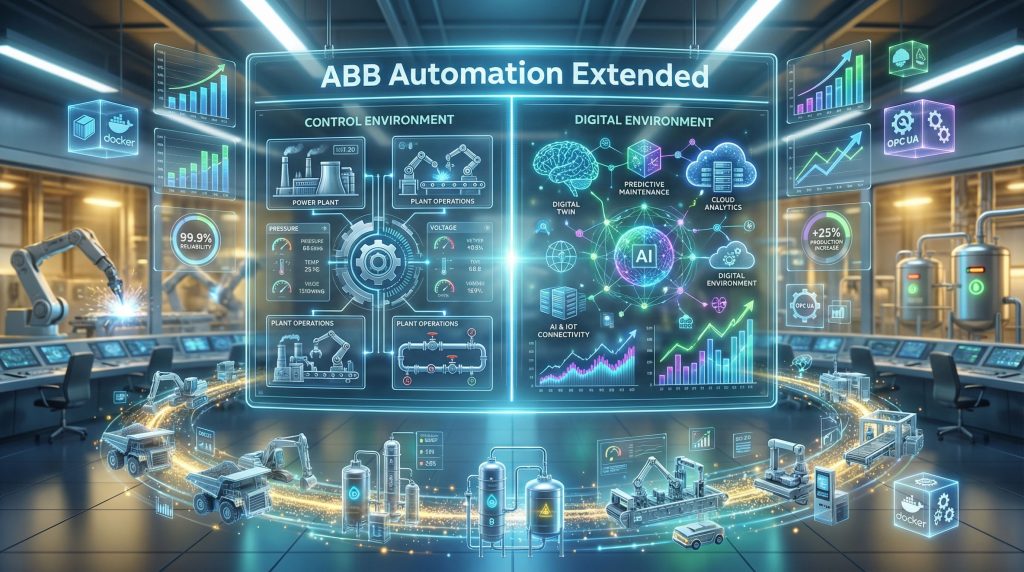
ABB's Automation Extended Programme represents a sophisticated approach to this modernisation challenge, offering a pathway that preserves operational continuity while introducing advanced digital capabilities. Rather than replacing existing infrastructure, this programme creates a dual-environment architecture that separates mission-critical control functions from innovative digital applications. Furthermore, this approach supports mining industry innovation whilst maintaining operational reliability.
When big ASX news breaks, our subscribers know first
How Dual-Environment Architecture Transforms Industrial Control
The foundation of ABB's Automation Extended Programme lies in its separation of concerns methodology, which divides industrial automation into two interconnected yet distinct operational layers. This architectural approach addresses the fundamental tension between reliability requirements and innovation demands in industrial settings.
Control Environment: Mission-Critical Foundation
The control environment operates as a software-defined domain specifically engineered for deterministic process management. This layer maintains compatibility with existing DCS infrastructure while providing the reliability standards essential for continuous industrial operations. In addition, understanding mining permitting insights becomes crucial when implementing such systems. Key characteristics include:
- Deterministic execution protocols ensuring predictable system responses
- Legacy system integration capabilities preserving existing investments
- Real-time performance standards meeting industrial timing requirements
- Fail-safe operational modes maintaining safety during anomalous conditions
According to the International Society of Automation (ISA), distributed control systems represent computer-based architectures designed to control processes across industries including power generation, chemical processing, and mineral extraction. These systems typically provide centralised monitoring capabilities while maintaining decentralised control functions, a design philosophy that ABB's Automation Extended Programme enhances rather than replaces.
Digital Environment: Advanced Capability Layer
The digital environment functions as a securely connected overlay enabling advanced technological integration without compromising core control integrity. This layer facilitates artificial intelligence implementation, machine learning algorithms, and Internet of Things connectivity through containerised applications. Moreover, AI in mining operations has become increasingly sophisticated within these frameworks.
Advanced capabilities within this environment include:
- Edge intelligence processing for localised decision-making
- Real-time analytics engines providing operational insights
- Cloud-native service integration enabling scalable computing resources
- Predictive maintenance algorithms optimising equipment lifecycle management
The Cloud Native Computing Foundation defines cloud-native approaches as methods that exploit cloud computing delivery model advantages, particularly through containerisation technologies such as Docker and Kubernetes orchestration systems.
Mining Industry Applications and Operational Benefits
The mining sector presents unique operational challenges that make ABB's Automation Extended Programme particularly valuable. Research from ABB's Mining's Moment survey reveals that 77% of mining leaders identify integrated electrification, automation, and digitalisation as key enablers of sustainable industry transformation.
Remote Operations Enhancement
Mining operations frequently occur in geographically isolated locations where traditional manual oversight presents logistical and safety challenges. The programme addresses these constraints through:
| Operational Challenge | Traditional Approach | Extended Automation Solution |
|---|---|---|
| Site accessibility | Regular personnel deployment | Autonomous monitoring systems |
| Equipment oversight | Manual inspection schedules | Continuous condition monitoring |
| Emergency response | On-site intervention teams | Predictive anomaly detection |
| Knowledge transfer | Extensive training programmes | Contextual information systems |
Predictive Maintenance Revolution
Traditional maintenance approaches rely on predetermined schedules that may result in unnecessary interventions or unexpected failures. Consequently, data-driven operations have become essential for modern mining facilities. ABB's Automation Extended Programme enables condition-based maintenance strategies through continuous asset monitoring and predictive analytics.
Benefits include:
- Reduced unplanned downtime through early failure detection
- Optimised maintenance scheduling based on actual equipment condition
- Extended asset lifecycles through proactive intervention strategies
- Resource allocation efficiency focusing maintenance efforts where needed
Technical Architecture and Implementation Components
OPC UA Communication Backbone
The Open Platform Communications Unified Architecture serves as the foundational communication protocol within ABB's Automation Extended Programme. The OPC Foundation defines OPC UA as a platform-independent standard ensuring secure and reliable data exchange between automation devices and information technology systems.
Core OPC UA capabilities include:
- Platform-independent communication across diverse hardware environments
- Standardised data models enabling interoperability
- Transport-layer encryption protecting data transmission
- Application-level access control managing system security
The International Electrotechnical Commission recognises OPC UA through the IEC 62541 series of standards, which specify publisher-subscriber and client-server messaging models alongside comprehensive information modelling capabilities.
Cloud-Native Architecture Implementation
Containerisation technologies form a critical component of the programme's digital environment. Docker containerisation provides lightweight, executable software packages containing all necessary runtime components, while Kubernetes orchestration manages container deployment, scaling, and operations across distributed infrastructure.
Modular Engineering Methodology
The programme employs standardised modules aligned with International Organisation for Standardisation guidelines, particularly IEC 61131-3 standards for programmable controllers. This modular approach provides:
- Rapid deployment capabilities reducing implementation timeframes
- Cross-platform compatibility supporting diverse hardware environments
- Simplified maintenance procedures through standardised components
- Cost-effective scaling options enabling incremental expansion
Addressing Contemporary Industrial Challenges
Market Volatility Response Mechanisms
Industrial operations face increasing market volatility requiring adaptive control systems capable of rapid response to changing conditions. Furthermore, AI-powered efficiency boost systems are becoming essential for maintaining competitiveness. ABB's Automation Extended Programme provides several mechanisms for addressing market dynamics:
Dynamic Production Optimisation:
- Real-time demand forecasting integration
- Resource allocation flexibility based on market signals
- Supply chain resilience protocols managing disruption impacts
- Automated production scheduling adjustments
Cybersecurity Architecture
The National Institute of Standards and Technology Cybersecurity Framework emphasises network segmentation and system separation as critical control measures for industrial environments. ABB's Automation Extended Programme separation-of-concerns architecture creates multiple security layers:
- Isolated control environment protection maintaining operational security
- Secure digital environment connectivity enabling innovation without risk
- OPC UA security protocols including message-level encryption and user authentication
- Containerised application isolation preventing cross-system vulnerabilities
The Cybersecurity and Infrastructure Security Agency identifies legacy industrial control systems as particularly vulnerable to exploitation, making the programme's security architecture especially relevant for modernisation efforts.
Workforce Transformation Support
Industrial sectors face significant workforce challenges including skills gaps, knowledge transfer requirements, and training complexity. The programme addresses these challenges through:
- Intuitive operator interfaces reducing learning curve requirements
- Contextual information delivery providing relevant operational data
- Decision support systems augmenting operator capabilities
- Knowledge retention mechanisms preserving institutional expertise
Implementation Strategy and Risk Mitigation
Progressive Integration Approach
ABB's Automation Extended Programme follows a three-phase implementation methodology designed to minimise operational disruption while maximising modernisation benefits.
Phase 1: Assessment and Planning
- Comprehensive existing system evaluation
- Integration pathway design and optimisation
- Risk assessment protocols identifying potential challenges
- Timeline development balancing speed with safety
Phase 2: Digital Environment Deployment
- Secure connectivity establishment between environments
- Advanced application installation and configuration
- Performance monitoring system setup
- User training programme initiation
Phase 3: Enhanced Capabilities Activation
- Artificial intelligence algorithm deployment
- Predictive analytics system activation
- Internet of Things device integration
- Autonomous function enablement
Risk Management Protocols
The programme incorporates comprehensive safeguards ensuring operational continuity throughout the modernisation process:
- Control environment isolation maintaining core system integrity
- Rollback capabilities enabling rapid recovery if issues arise
- Continuous performance monitoring detecting anomalies immediately
- Gradual capability expansion reducing implementation risk
According to Peter Terwiesch, President of ABB's Automation business area, "the programme delivers modernisation without disruption by bringing future-ready capabilities into systems that customers know and trust, with security and interoperability as core design principles."
The next major ASX story will hit our subscribers first
Sustainability and Future Operations
Energy Efficiency Optimisation
ABB's Automation Extended Programme enables sophisticated energy management capabilities supporting sustainability objectives:
- Dynamic energy consumption management optimising power usage patterns
- Process efficiency maximisation reducing waste and resource consumption
- Carbon footprint minimisation through operational optimisation
- Renewable energy integration supporting clean energy transition goals
Autonomous Operations Evolution
The programme creates pathways toward fully autonomous industrial operations through progressive capability enhancement:
Advanced Automation Capabilities:
- Self-optimising process control systems
- Predictive maintenance automation reducing human intervention
- Intelligent resource allocation based on real-time conditions
- Scenario-based decision making supporting complex operations
Digital Twin Integration:
Virtual system replicas enable risk-free testing and optimisation, supporting continuous improvement without operational disruption. These digital representations facilitate scenario simulation, predictive modelling enhancement, and comprehensive system analysis.
Artificial Intelligence Integration
Future developments within the programme framework include sophisticated AI-driven capabilities:
- Complex pattern recognition identifying subtle operational indicators
- Autonomous problem resolution addressing issues without human intervention
- Continuous learning systems improving performance over time
- Strategic planning automation supporting long-term operational optimisation
Industry-Specific Considerations
Mining Operations Customisation
Mining environments present unique challenges requiring specialised implementation approaches:
- Environmental condition adaptation managing extreme temperatures, humidity, and dust
- Equipment-specific integration accommodating diverse machinery types
- Safety protocol compliance meeting stringent industry regulations
- Regulatory requirement adherence satisfying local and international standards
Scalability and Future-Proofing
Successful implementation requires comprehensive planning for future expansion and technology evolution:
- Technology evolution preparation ensuring compatibility with emerging standards
- Investment protection strategies preserving capital investments over time
- Operational flexibility maintenance supporting changing business requirements
- Capacity planning accommodating growth without system redesign
Disclaimer: This analysis is based on publicly available information and industry documentation. Implementation results may vary based on specific operational requirements, existing infrastructure, and local conditions. Organisations considering modernisation programmes should conduct thorough assessments and consult with qualified automation specialists before implementation.
Ready to Capitalise on the Next Mining Technology Breakthrough?
Industrial automation advances like ABB's programme represent the sophisticated technology driving modern mining operations, but the real opportunities for investors lie in identifying companies adopting these innovations early. Discovery Alert's proprietary Discovery IQ model delivers instant notifications when ASX-listed mining companies announce significant technological breakthroughs and mineral discoveries, enabling subscribers to capitalise on actionable investment opportunities before the broader market catches on.