July 10, 2026
Industrial Chemistry Revolution Transforming Metal Extraction
Modern mining operations face unprecedented pressure to balance profitability with environmental responsibility while securing strategic material supplies for national security. The convergence of these forces has accelerated adoption of hydrometallurgical processing, where water-based chemical solutions replace traditional high-temperature furnaces to extract metals from ore. This technological shift represents more than operational efficiency gains – it fundamentally restructures how mining companies approach complex ore bodies, polymetallic deposits, and environmentally sensitive jurisdictions.
Unlike pyrometallurgical methods that rely on extreme heat and energy-intensive smelting, hydromet technology in mining leverages controlled chemical reactions at significantly lower temperatures. The approach enables selective metal recovery while reducing carbon emissions by approximately 67-80% compared to conventional smelting operations. For mining companies evaluating processing alternatives, hydrometallurgy offers modular, scalable solutions particularly suited to remote deposits where transportation costs to distant smelters would otherwise compromise project economics.
When big ASX news breaks, our subscribers know first
Understanding Hydrometallurgical Processing Fundamentals
Chemical Dissolution Mechanisms in Metal Recovery
Hydrometallurgical processes operate through controlled aqueous chemistry rather than thermal destruction of mineral matrices. The technology employs targeted leaching agents – typically sulfuric acid, hydrochloric acid, or alkaline solutions – to selectively dissolve specific metals while leaving gangue minerals intact. This selective dissolution occurs at temperatures ranging from ambient conditions to approximately 250°C under pressure, dramatically lower than the 1,200-1,600°C operating ranges required for traditional smelting.
The chemical principles underlying hydromet technology in mining centre on thermodynamic favourability of dissolution reactions. Engineers design flowsheets to exploit pH-dependent solubility differences, oxidation-reduction potential variations, and complexation chemistry to achieve separation objectives. Furthermore, high-pressure acid leaching (HPAL) systems utilise elevated pressure and temperature to accelerate normally slow kinetic processes, enabling economical processing of refractory laterite ores.
Multi-Stage Purification and Recovery Systems
Following initial leaching, hydrometallurgical circuits employ sophisticated purification sequences to concentrate target metals and remove impurities. Solvent extraction stages use organic compounds to selectively bind specific metals from pregnant leach solutions, enabling separation of closely related elements like nickel and cobalt. In addition, ion exchange processes provide additional purification through selective binding of target ions onto specialised resin matrices.
The final recovery stage typically employs electrowinning, where electrical current drives deposition of pure metals onto cathodes, or chemical precipitation using pH adjustment or reducing agents. These processes can achieve metal purities exceeding 99.9%, often surpassing specifications achievable through traditional smelting routes.
Process control parameters critical to hydrometallurgical success include:
• Temperature management within ±5°C for optimal reaction kinetics
• pH control typically within 0.1-0.2 units to maintain selective dissolution
• Residence time optimisation ranging from hours to weeks depending on ore type
• Oxygen partial pressure control in pressure oxidation circuits
• Reagent dosing precision to minimise consumption while maintaining recovery
Strategic Metals Benefiting from Hydrometallurgical Innovation
Primary Target Metals and Performance Metrics
Hydromet technology in mining demonstrates particular effectiveness for specific metal categories based on their chemical properties and market requirements. Nickel processing represents the largest application by tonnage, with global nickel demand projected to more than double by 2035 driven by both traditional stainless steel applications and emerging battery technologies.
Current market dynamics reveal Indonesian nickel operations – which flooded global markets through rapid capacity expansion – now face operational challenges with approximately 40% of facilities operating at losses when nickel prices reach $15,000 per ton. This market disruption creates opportunities for higher-grade, lower-cost operations utilising advanced hydrometallurgical processing.
Recovery Rate Comparison Across Processing Methods:
| Metal Type | Hydrometallurgical Recovery | Traditional Smelting Recovery | Energy Reduction Achieved |
|---|---|---|---|
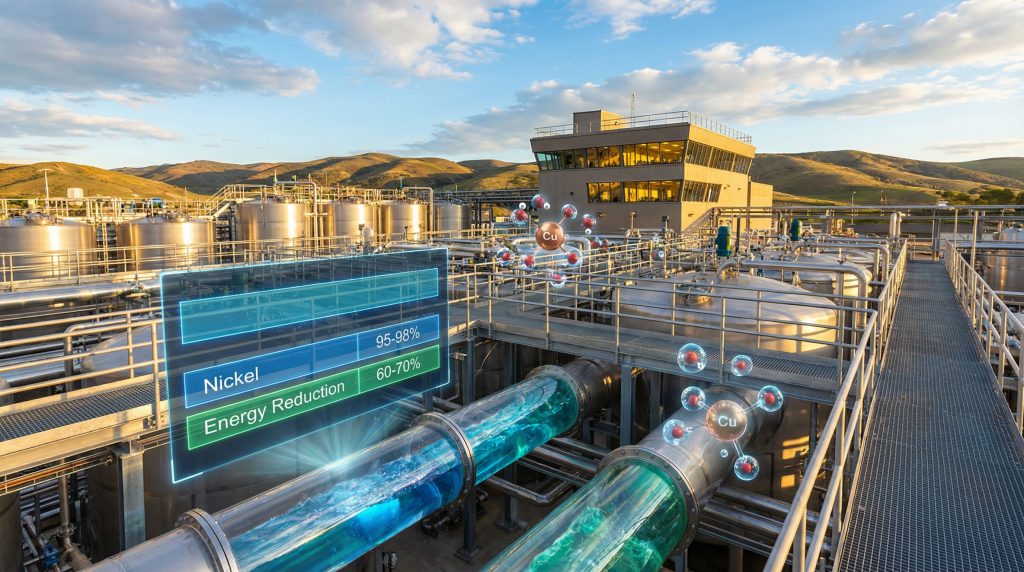
| Nickel | 95-98% | 90-95% | 60-70% |
| Cobalt | 97-99% | 85-90% | 50-60% |
| Gold | 95-99% | N/A | 80-90% |
| Copper | 90-95% | 88-93% | 40-50% |
Demand Fundamentals and Growth Trajectories
Stainless steel applications continue dominating nickel consumption at over 60% of total demand, exhibiting steady 3-5% annual growth rates correlated with major economy GDP expansion. However, battery metal applications demonstrate accelerated growth at 15-20% annually despite recent moderation from earlier projections.
This dual demand structure provides stability through traditional applications while capturing upside from energy transition requirements. For instance, the integration of direct lithium extraction methods enables high-purity metals meeting battery-grade specifications to command significant premiums over commodity-grade materials.
Cobalt processing benefits particularly from hydrometallurgical methods due to the metal's sensitivity to impurities in battery applications. Traditional smelting struggles to achieve the low iron, sulphur, and other impurity levels required for lithium-ion battery cathodes, while hydrometallurgical routes routinely achieve specifications below 10 parts per million for critical contaminants. Consequently, the battery recycling breakthrough innovations further highlight the importance of hydrometallurgical processing in the circular economy.
Competitive Advantages Over Traditional Pyrometallurgical Processing
Environmental Performance and Regulatory Compliance
Hydromet technology in mining delivers measurable environmental advantages crucial for securing operating permits in developed jurisdictions. Sulphur dioxide emissions – a primary concern with sulphide ore smelting – can be reduced by up to 99% through hydrometallurgical processing since sulphur remains in solid phases rather than volatilising into gas streams.
Carbon footprint reduction represents another significant advantage, with hydrometallurgical plants typically generating 20-33% of the CO₂ emissions produced by equivalent smelting operations. This reduction stems from elimination of fuel combustion for high-temperature processing and reduced electricity consumption for heating applications.
Water management capabilities provide additional regulatory advantages. Modern hydrometallurgical facilities achieve 80-95% water recycling rates through closed-loop circuit design, crucial for operations in water-scarce regions or jurisdictions with strict discharge limitations.
Economic Efficiency and Capital Requirements
Capital expenditure analysis consistently favours hydrometallurgical solutions for new projects, with construction costs typically 40-60% below equivalent smelter capacity. This advantage stems from several factors:
• Modular plant design enabling phased construction and capacity additions
• Lower-temperature operation requiring less specialised refractory materials
• Reduced infrastructure requirements for gas handling and emission control
• Simplified utility systems without high-temperature process support
Operating cost advantages vary by jurisdiction but prove particularly significant in regions with high energy costs. Hydrometallurgical processes typically consume 40-80% less energy than pyrometallurgical equivalents, providing substantial operational savings in markets with expensive electricity or carbon taxation regimes.
Supply chain consolidation represents an often-overlooked economic advantage. Traditional processing routes frequently require shipping concentrates to distant smelters, then moving intermediate products to refineries before reaching final consumers. Furthermore, hydrometallurgical facilities can integrate the entire processing sequence, producing refined metals ready for direct industrial use.
Global Implementation and Successful Applications
Major Industrial Operations Demonstrating Viability
Voisey's Bay operations in Canada represent successful large-scale hydrometallurgical processing of nickel-copper-cobalt sulphide ores. The facility processes over 50,000 tonnes annually of nickel in concentrate through pressure leaching circuits, demonstrating commercial viability at industrial scale.
Olympic Dam's copper processing in South Australia employs hydrometallurgical circuits for treating complex polymetallic ores containing copper, uranium, gold, and silver. The operation showcases selective metal recovery capabilities while managing challenging metallurgy that would prove difficult through pyrometallurgical routes.
Chilean copper operations, including Escondida's oxide leaching circuits, process over 300,000 tonnes of copper annually through sulphuric acid leaching and solvent extraction-electrowinning (SX-EW) technology. These operations demonstrate the scale and effectiveness of hydrometallurgical methods in arid climates.
Emerging Market Applications and Development Projects
African mineral processing increasingly incorporates hydrometallurgical methods for local value addition. The Cabanga Nickel Project in Tanzania represents a significant development utilising advanced hydrometallurgical processing for a high-grade nickel sulphide deposit. With measured reserves of 43.9 million tonnes grading 1.98% nickel, the project demonstrates economic viability even during current nickel market conditions.
European recycling operations employ hydrometallurgical methods for recovering platinum group metals from automotive catalysts. These facilities process spent catalytic converters to recover rhodium, platinum, and palladium – demonstrating applications beyond primary ore processing.
Battery recycling initiatives across North America increasingly rely on hydrometallurgical processing to recover lithium, nickel, cobalt, and manganese from end-of-life battery materials. These operations achieve higher recovery rates and produce materials meeting specifications for new battery manufacturing.
Technical Challenges and Implementation Barriers
Operational Complexity and Skill Requirements
Hydrometallurgical operations demand sophisticated understanding of solution chemistry, requiring specialised technical expertise often unavailable in traditional mining regions. Process optimisation requires continuous monitoring and adjustment of multiple parameters simultaneously – pH, temperature, residence time, reagent concentrations, and oxidation potential – creating operational complexity exceeding conventional mineral processing.
Equipment corrosion presents ongoing challenges as aggressive chemical environments attack processing equipment. Material selection becomes critical, with specialised alloys, ceramics, and polymer linings required for long-term operation. Moreover, maintenance requirements typically exceed those for mechanical processing equipment, demanding higher technical skill levels from operations personnel.
Reagent management involves handling potentially hazardous chemicals in significant quantities. Sulphuric acid consumption can reach 150-400 kg per tonne of ore processed, requiring sophisticated storage, handling, and safety systems. Supply chain reliability for specialised reagents can constrain operations, particularly in remote locations.
Market and Economic Constraints
Higher engineering costs characterise hydrometallurgical projects due to complex flowsheet development and extensive testwork requirements. Comprehensive metallurgical testing programmes can cost $5-15 million for major projects, compared to $1-3 million for conventional processing routes.
Regulatory approval complexity increases with chemical processing applications, requiring environmental impact assessments addressing solution storage, tailings management, and emergency response procedures. However, permitting timelines often extend 2-3 years beyond conventional mining applications.
Competition with established infrastructure presents market entry barriers where existing smelters offer processing services below replacement cost. Sunk capital in traditional processing facilities creates resistance to adopting alternative technologies even where technical advantages exist.
The next major ASX story will hit our subscribers first
Critical Mineral Supply Chain Security Applications
Strategic Resource Security and Domestic Processing
Hydromet technology in mining addresses critical vulnerabilities in Western mineral supply chains by enabling domestic processing of strategic materials. Rare earth element processing currently concentrates in China, which controls over 85% of global refining capacity despite holding only 37% of known reserves. Hydrometallurgical methods offer pathways for establishing alternative processing capacity in consuming countries.
Defence applications benefit from supply chain security through domestic processing capabilities. The U.S. Development Finance Corporation increasingly supports hydrometallurgical projects through political risk insurance and direct financing, recognising strategic importance of alternative supply sources.
Critical mineral stockpiling becomes more effective when combined with domestic processing capability. Stockpiled concentrates provide limited strategic value without processing infrastructure, while vertically integrated hydrometallurgical facilities enable rapid mobilisation during supply disruptions.
Battery Material Supply Chain Optimisation
Lithium extraction from both brine and hard rock sources increasingly employs hydrometallurgical methods optimised for battery-grade specifications. Direct lithium extraction (DLE) from brines uses selective sorption or membrane technologies to concentrate lithium without evaporation ponds, reducing environmental impact while accelerating production timelines.
High-purity nickel and cobalt production for cathode materials requires specifications unachievable through traditional smelting. Battery applications demand nickel with less than 10 ppm iron content and cobalt with minimal nickel contamination – routinely achieved through hydrometallurgical processing but challenging for pyrometallurgical routes.
Recycling applications demonstrate particular promise for hydrometallurgical processing. End-of-life lithium-ion batteries contain multiple target metals in complex matrices poorly suited to pyrometallurgical recovery. Furthermore, hydrometallurgical flowsheets can selectively recover lithium, nickel, cobalt, and manganese while handling plastic separators and electrolyte components.
Future Technology Developments and Innovation Trends
Technological Innovation and Process Automation
Artificial intelligence integration enables real-time optimisation of complex hydrometallurgical circuits through machine learning algorithms that adjust operating parameters based on ore characteristics, reagent performance, and downstream requirements. Advanced process control systems can optimise multiple variables simultaneously while maintaining product specifications and minimising reagent consumption.
Advanced materials development focuses on improving equipment longevity through novel corrosion-resistant alloys, ceramic linings, and polymer composites. These materials extend maintenance intervals while reducing operating costs, particularly important for remote operations where skilled maintenance personnel may be unavailable.
Biotechnology applications show promise for metal extraction through bioleaching processes using specialised bacterial cultures. While currently limited to specific applications like copper and gold recovery, research continues into expanding biological methods for other metals, potentially reducing reagent consumption and environmental impact.
Market Growth Projections and Investment Opportunities
Global hydrometallurgy market expansion reflects increasing demand for environmentally responsible processing methods and high-purity metal products. Market analysts project compound annual growth rates of 6-8% through 2030, driven by battery material requirements and environmental regulations restricting traditional smelting operations. This growth aligns with broader industry evolution trends shaping the mining sector's future.
Regional capacity development concentrates in jurisdictions prioritising supply chain security and environmental compliance. North American and European markets show particular growth as governments provide financial incentives for domestic processing capability development.
Public-private partnerships increasingly structure hydrometallurgical project development, combining government strategic objectives with private sector technical expertise and capital. Development finance institutions provide political risk insurance, concessional financing, and grant support to projects meeting strategic mineral processing objectives.
Note: Market projections and financial estimates should be verified against current market conditions and may not reflect future performance. Investment decisions should consider comprehensive due diligence and professional financial advice.
Technical and Financial Evaluation Framework for Mining Companies
Feasibility Assessment Criteria and Testing Requirements
Metallurgical testwork programmes for hydrometallurgical evaluation require comprehensive analysis exceeding conventional processing assessments. Bench-scale testing typically progresses through bottle roll tests, atmospheric leaching studies, pressure oxidation testing, and continuous pilot plant campaigns lasting 3-6 months.
Ore variability assessment becomes critical as hydrometallurgical processes exhibit greater sensitivity to mineralogical variations than mechanical processing methods. Geometallurgical programmes must characterise acid consumption, leaching kinetics, and impurity behaviour across the entire ore body rather than relying on composite samples.
Environmental baseline studies require expanded scope to address solution management, residue disposal, and emission characteristics specific to hydrometallurgical processing. Water quality monitoring, acid rock drainage potential, and reagent fate and transport studies form essential components of permitting applications.
Infrastructure requirements differ significantly from conventional mining operations. Reliable power supply becomes critical for continuous processing, while chemical storage and handling infrastructure requires specialised engineering and safety systems. Additionally, transportation logistics must accommodate bulk reagent delivery and refined product shipment rather than concentrate handling.
Financial Modelling and Investment Analysis
Capital cost estimation requires detailed engineering to account for specialised equipment, materials of construction, and safety systems unique to hydrometallurgical processing. Cost estimation accuracy typically improves from ±40% at scoping study level to ±15% following pilot plant validation and detailed engineering.
Operating cost modelling must incorporate reagent consumption, utilities, maintenance, and specialised labour requirements. Energy costs typically favour hydrometallurgical operations, while reagent expenses can represent 15-25% of operating costs compared to minimal reagent use in pyrometallurgical alternatives.
Revenue optimisation analysis should evaluate product specification premiums achievable through hydrometallurgical processing. Battery-grade materials, high-purity metals, and byproduct recovery opportunities can significantly improve project economics compared to commodity-grade concentrate production.
Risk assessment frameworks must address technology risk, market risk, and operational risk factors specific to hydrometallurgical processing. Technology risk diminishes with proven flowsheet demonstration, while market risk relates to product specification requirements and competitive positioning against established processing routes.
Financing considerations increasingly favour projects demonstrating environmental advantages and strategic mineral production. Development finance institutions, export credit agencies, and strategic partners may provide favourable financing terms for projects supporting supply chain security objectives.
Disclaimer: Financial projections and investment analyses are subject to commodity price volatility, regulatory changes, and technical risks. Historical performance does not guarantee future results. Investors should conduct independent due diligence and consult financial professionals before making investment decisions.
Industry Transformation and Strategic Implementation
Sustainable Mining Operations and Competitive Positioning
The integration of hydromet technology in mining represents a fundamental shift toward sustainable metal production methods that align with evolving environmental regulations and corporate responsibility mandates. Companies adopting these technologies early position themselves advantageously as carbon pricing mechanisms and emission regulations increasingly impact traditional high-energy processing methods. This transformation reflects the broader sustainable mining transformation occurring across the industry.
Circular economy integration becomes achievable through hydrometallurgical processing capabilities that enable efficient recycling of end-of-life products. The ability to process both primary ores and secondary materials through similar flowsheets creates operational flexibility and revenue diversification opportunities unavailable to traditional smelting operations.
Long-term viability in carbon-constrained operating environments favours hydrometallurgical processing as governments implement carbon taxation and emission reduction mandates. Operations achieving 60-80% energy reductions compared to conventional processing methods gain substantial competitive advantages in jurisdictions with aggressive climate policies.
Technology transfer and intellectual property considerations become increasingly important as hydrometallurgical innovations create competitive moats through patent protection and specialised expertise. Companies developing proprietary flowsheets can licence technology to third parties, creating revenue streams beyond direct mining operations.
Market differentiation through environmental credentials and product quality specifications enables premium pricing for metals produced via hydrometallurgical routes. ESG-conscious consumers and manufacturers increasingly demand responsibly produced materials, creating market opportunities for producers demonstrating lower environmental impact.
The strategic importance of hydromet technology in mining extends beyond operational efficiency to encompass supply chain security, environmental stewardship, and technological sovereignty. As global mineral demand continues expanding while environmental constraints tighten, hydrometallurgical processing provides essential capabilities for maintaining competitive mining operations in an evolving regulatory and market landscape.
Modern mining companies evaluating processing alternatives must consider hydrometallurgical options as integral components of long-term strategic planning rather than merely technical alternatives. The convergence of environmental regulations, supply chain security requirements, and market demands for high-purity materials creates compelling arguments for adopting these innovative processing technologies across appropriate applications. Furthermore, the implementation of data-driven mining operations enhances the effectiveness of hydrometallurgical systems through improved process control and optimisation.
This analysis is provided for educational purposes and should not be construed as investment advice. Market conditions, technology developments, and regulatory requirements continue evolving rapidly in the mining sector.
Ready to Capitalise on Hydrometallurgical Processing Opportunities?
Discovery Alert's proprietary Discovery IQ model delivers real-time alerts on significant ASX mineral discoveries, instantly identifying companies implementing cutting-edge processing technologies like hydrometallurgy that could transform their operations and valuation. Begin your 30-day free trial today and position yourself ahead of the market to capture actionable opportunities before they become widely recognised.