June 11, 2026
Industrial Chemistry Transformation Reshaping Global Metal Production Economics
The intersection of resource nationalism and supply chain vulnerabilities creates profound structural shifts that ripple through interconnected industrial systems. When major chemical suppliers restructure their export priorities, the downstream effects cascade through sectors ranging from copper extraction to agricultural fertilizer production, fundamentally altering competitive dynamics and operational economics across continents. These developments reflect broader industry evolution trends affecting global resource markets.
When big ASX news breaks, our subscribers know first
Understanding China's Strategic Chemical Market Realignment
The global sulfuric acid landscape faces unprecedented transformation as China's exit from sulfuric acid market operations takes effect in May 2026. This strategic withdrawal represents far more than a temporary policy adjustment, signaling a fundamental reconfiguration of international chemical trade flows that will reshape industrial cost structures across multiple sectors.
The timing coincides with domestic agricultural intensification periods, where sulfuric acid allocation becomes critical for fertilizer production supporting China's food security objectives. This resource conservation approach reflects broader geopolitical considerations affecting sulfur feedstock availability and domestic industrial priorities.
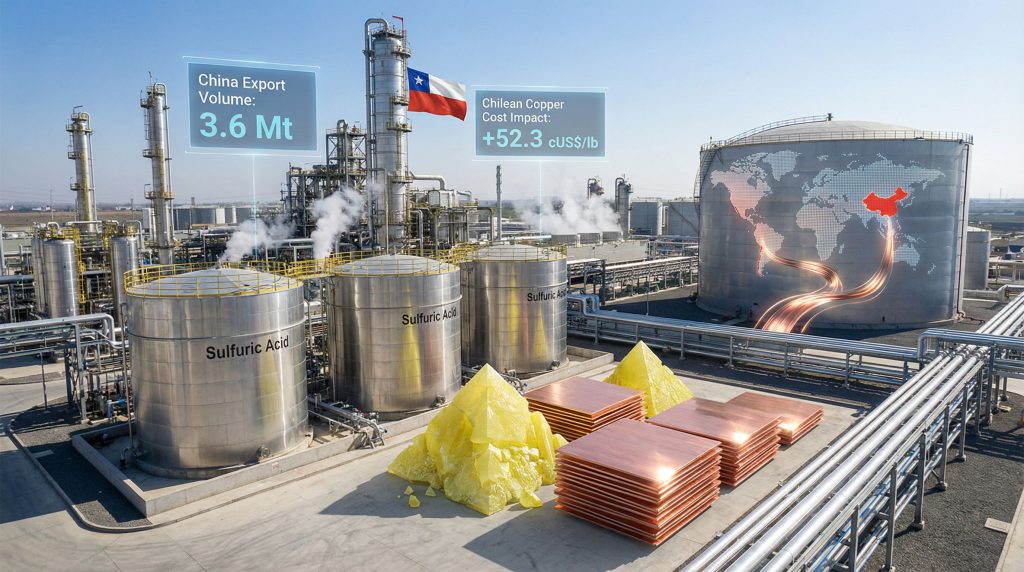
The magnitude of this shift cannot be understated. China previously operated as the dominant marginal supplier in global tradeable sulfuric acid markets, with annual exports exceeding 3.6 million tonnes in recent years. The sudden removal of this capacity creates immediate supply constraints that cannot be easily compensated through existing alternative sources.
Global Supply Dynamics Under Unprecedented Stress
The mathematics underlying this supply disruption reveal the scale of market transformation facing industrial users worldwide. China's 3.6 million tonne export capacity represented approximately 15-20% of globally tradeable volumes, creating an immediate and substantial supply gap that alternative suppliers cannot quickly fill.
Regional Supply Gap Analysis:
| Region | Export Capacity (Mt) | Growth Potential (%) | Logistical Constraints |
|---|---|---|---|
| Peru | 0.8-1.2 | +25-30% | Port infrastructure limits |
| Japan/Korea | 1.0-1.4 | +10-15% | Domestic demand priority |
| Chile | 1.6-1.9 | +65% domestic demand | Import dependency rising |
The structural implications extend beyond simple volume replacement. Chinese suppliers previously offered competitive pricing and flexible contract terms that enabled just-in-time procurement strategies across multiple industries. The loss of this market liquidity forces industrial users toward longer-term contract commitments with higher price volatility and reduced supply security.
Market participants now face a fundamental shift from abundant supply conditions to constrained availability, where sulfuric acid transforms from a readily available industrial input to a strategic resource requiring careful procurement planning and inventory management. Furthermore, these developments align with broader tariffs impact on markets creating additional complexity for global supply chains.
Critical Industrial Sectors Facing Operational Vulnerabilities
Chilean Copper Industry Under Cost Pressure
Chilean copper operations represent the most exposed sector to these supply constraints, with lixiviation processes consuming approximately 8.2 million tonnes annually against domestic production capacity of only 5.1 million tonnes. This 3.1 million tonne structural deficit previously relied heavily on Chinese imports, creating immediate operational vulnerabilities for the world's largest copper-producing nation.
The geographic concentration of risk amplifies these challenges. Northern Chilean mining operations, which account for over 70% of national copper production, depend on intensive heap leaching and in-situ extraction processes that require substantial sulfuric acid inputs. The region's remote location and limited transportation infrastructure create additional logistical complexities for securing alternative supply sources.
Cost Impact Scenarios for Chilean Copper Operations:
- Low-intensity operations: 4.4-8.7 cUS$/lb additional production costs
- Medium-intensity lixiviation: 15.2-26.2 cUS$/lb cost escalation
- High-consumption heap leach: Up to 52.3 cUS$/lb impact on unit economics
Industry analysis indicates that each US$50/tonne increase in sulfuric acid pricing can elevate copper production costs between 4.4 and 26.2 cUS$/lb, depending on operational consumption intensity. In extreme scenarios involving high-grade ore processing with intensive acid requirements, cost impacts can reach 52.3 cUS$/lb, potentially pushing marginal operations beyond economic viability thresholds.
The operational implications extend beyond immediate cost pressures. Mining companies must now evaluate fundamental changes to processing methodologies, potentially shifting from acid-intensive lixiviation toward flotation-based concentration for previously heap-leached ores. This transition requires substantial capital investment and may reduce overall metal recovery rates, necessitating comprehensive supply chain crisis insights to navigate these challenges effectively.
Global Fertilizer Production Economics
Phosphate fertilizer manufacturing faces parallel supply pressures, with sulfuric acid representing 60-70% of production costs in phosphoric acid manufacturing processes. The United States, importing over $200 million in sulfuric acid annually, faces particular exposure given its position as a major agricultural exporter requiring reliable fertilizer production capacity.
The timing of these supply constraints coincides with critical agricultural seasons across multiple growing regions, potentially impacting global food production economics. Fertilizer manufacturers must now secure long-term acid supply contracts at premium pricing, costs that ultimately flow through to agricultural producers and food consumers.
Regional fertilizer production hubs in the American Midwest and Southeast face logistical challenges in securing alternative sulfuric acid supplies from distant sources. Transportation costs from Pacific Rim suppliers add significant expense compared to previous Chinese import arrangements, fundamentally altering the competitive positioning of different production facilities.
Alternative Supply Sources Adapting to Market Transformation
Peruvian Smelting Operations Capitalize on Opportunity
Peruvian copper smelting facilities have emerged as primary beneficiaries of the supply constraint, with spot pricing power increasing substantially as global buyers compete for limited export availability. However, infrastructure constraints limit rapid capacity expansion, with existing port and transportation systems supporting maximum 1.2 million tonnes of additional annual export capacity.
The expansion potential requires substantial infrastructure investment in port facilities, storage capacity, and transportation networks. Environmental permitting processes for increased smelting activity add regulatory complexity that may delay meaningful capacity additions for 18-24 months beyond current planning horizons.
Peruvian producers are implementing strategic contract restructuring, moving away from short-term spot sales toward longer-term supply agreements with premium pricing mechanisms. This approach provides revenue stability while ensuring sustained market positioning as global supply chains adapt to the new competitive landscape.
Northeast Asian Industrial Complex Limitations
Japanese and Korean sulfuric acid producers face their own domestic demand pressures that limit export availability for global markets. Chemical industry capacity utilisation rates exceeding 95% constrain these suppliers' ability to meaningfully offset Chinese export reductions.
The regional industrial complex prioritises domestic steel, chemical, and electronics manufacturing requirements, leaving limited surplus capacity for international markets. Trade policy considerations also influence export decisions, as regional governments evaluate strategic chemical supply security amid broader geopolitical tensions.
Technical limitations in existing production facilities prevent rapid capacity expansion without substantial capital investment and regulatory approval processes. The specialised nature of sulfuric acid production requires specific catalyst systems, corrosion-resistant equipment, and environmental management capabilities that cannot be quickly replicated or expanded.
Strategic Risk Management Approaches Across Mining Operations
Contract Restructuring and Supply Diversification Strategies
Major mining operators are implementing comprehensive supply security strategies that fundamentally reshape traditional procurement approaches. Extended contract terms of 12-24 months replace historical 3-6 month agreements, providing greater supply certainty at the cost of reduced pricing flexibility.
Tactical Risk Mitigation Measures:
- Strategic inventory builds targeting 90-120 day coverage vs. traditional 30-45 day levels
- Supplier diversification across minimum three regional sources
- Alternative transportation route development for supply security
- Process optimisation initiatives targeting 15-25% consumption reduction
The strategic inventory approach requires substantial working capital commitment and specialised storage infrastructure capable of handling corrosive chemical products. Mining companies are investing in tank farms, loading facilities, and environmental containment systems that were previously unnecessary under just-in-time procurement models.
Contract negotiations now include force majeure protection clauses, price escalation mechanisms tied to regional sulfur availability indices, and minimum supply guarantee provisions. These risk management provisions add complexity and cost to supply agreements but provide operational security in constrained market conditions.
Technology Investment Acceleration
The crisis accelerates investment in acid-efficient processing technologies that reduce overall consumption requirements. Bioleaching systems offer 40-60% lower acid consumption compared to traditional chemical lixiviation, though implementation requires different operational expertise and longer processing cycles.
Advanced Processing Technology Options:
- Heap leach optimisation: Advanced irrigation systems reducing acid waste by 20-30%
- Alternative extraction methods: Flotation-based processing for previously lixiviated ores
- Process automation: Real-time monitoring systems optimising acid utilisation efficiency
- Recovery enhancement: Improved leaching kinetics reducing overall acid requirements
Mining engineering teams are evaluating fundamental processing methodology changes, potentially shifting high-consumption heap leach operations toward flotation concentration followed by smelting routes. This transition requires substantial capital investment but reduces exposure to acid supply volatility, aligning with broader critical minerals strategy considerations.
Research and development investments focus on breakthrough technologies including atmospheric leaching processes, biotechnology applications, and alternative chemical extraction methods. These longer-term solutions require 3-5 year development horizons but offer potential competitive advantages for early adopters.
The next major ASX story will hit our subscribers first
Operations Facing Competitive Disadvantage in New Market Structure
High-Consumption Lixiviation Operations Under Pressure
Mining facilities processing lower-grade ores with intensive acid requirements face disproportionate cost pressures that may fundamentally alter their economic viability. Operations consuming more than 15 kg acid per tonne of ore processed experience cost escalations that approach or exceed profit margins at current copper pricing levels.
The competitive disadvantage becomes particularly acute for aging heap leach operations with established infrastructure optimised for high-consumption processing methods. Converting these facilities to alternative processing routes requires substantial capital investment that may not generate adequate returns given remaining asset life cycles.
Geographic concentration creates additional vulnerability for operations in remote locations with limited transportation infrastructure. Northern Chilean facilities face higher baseline transportation costs for alternative acid sources, compounding the operational cost pressures from higher input pricing.
Regional Infrastructure Constraints
Mining operations dependent on specific logistical infrastructure face structural disadvantages in securing alternative supply sources. Facilities designed around pipeline distribution systems, specialised unloading equipment, or dedicated transportation routes cannot easily adapt to different supplier arrangements.
The infrastructure limitations extend beyond individual mining operations to regional industrial complexes. Shared storage facilities, transportation networks, and distribution systems optimised for Chinese import volumes require substantial reconfiguration to accommodate alternative supply arrangements.
Port capacity constraints in key receiving regions create additional bottlenecks that limit alternative supplier access. Specialised chemical handling facilities, tank storage capacity, and transportation integration represent infrastructure investments that require extended development timelines.
Investment Pattern Transformation Across Global Mining
Technology Investment Prioritisation
Mining investment patterns are experiencing fundamental reorientation toward acid-efficient processing technologies and supply chain security infrastructure. Capital allocation decisions increasingly factor acid availability into project economics, potentially favouring developments with lower consumption intensity or integrated supply arrangements.
Priority Investment Categories:
- Process efficiency systems: Real-time monitoring and optimisation technology
- Alternative processing routes: Flotation and pyrometallurgical capacity additions
- Supply chain infrastructure: Strategic storage and transportation facilities
- Research and development: Breakthrough extraction and processing methodologies
Project evaluation criteria now include comprehensive acid supply risk assessments alongside traditional technical and economic parameters. Mining companies are developing sophisticated supply chain risk models that quantify exposure to input commodity volatility and incorporate these factors into investment decision frameworks.
The technology investment acceleration creates opportunities for equipment suppliers, engineering contractors, and technology development companies specialising in resource-efficient processing methods. This sector transformation drives innovation cycles that may ultimately reduce industry-wide acid dependency.
Geographic Production Shift Considerations
Mining development patterns increasingly factor acid availability into site selection and project design decisions. Regions with integrated smelting and acid production capabilities gain competitive advantages in attracting new mining investments and expansions.
Projects located near existing smelting operations or industrial chemical production facilities benefit from reduced transportation costs and supply security. This geographic clustering effect may accelerate regional mining district development around established chemical industrial complexes.
The supply security consideration influences exploration and development priorities, potentially favouring ore deposits with processing characteristics that minimise acid consumption requirements. Higher-grade deposits suitable for flotation concentration gain relative attractiveness compared to lower-grade resources requiring intensive lixiviation, particularly considering china demand trends affecting global mineral markets.
Long-Term Market Structure Evolution Patterns
Pricing Mechanism Fundamental Changes
The traditional spot-based sulfuric acid market is transitioning toward longer-term contract structures with sophisticated price escalation mechanisms. Regional sulfur availability indices, transportation cost adjustments, and force majeure protection clauses become standard contract provisions.
Emerging Contract Structure Elements:
- Base pricing tied to regional producer indices rather than global spot markets
- Transportation cost pass-through mechanisms reflecting logistical complexity
- Supply security premiums for guaranteed delivery commitments
- Volume flexibility provisions balancing buyer and seller operational requirements
The market evolution creates opportunities for financial instruments including acid price hedging contracts, supply insurance products, and regional price differential derivatives. These risk management tools enable mining companies to stabilise cost structures while providing revenue predictability for acid producers.
Contract negotiations become increasingly sophisticated, requiring specialised procurement expertise and supply chain risk management capabilities. Mining companies are developing internal trading and risk management functions comparable to those used for managing copper price exposure.
Regional Production Architecture Reconfiguration
Global sulfuric acid production architecture is undergoing fundamental geographic redistribution as demand centres develop local supply capacity to reduce import dependency. Regional supply chains emerge around major consumption clusters, potentially reducing long-distance trade flows.
The reconfiguration accelerates development of integrated mining-smelting-chemical complexes that capture operational synergies and supply security benefits. These industrial clusters offer competitive advantages through reduced transportation costs, operational coordination, and shared infrastructure utilisation.
Investment flows toward regional acid production capacity create opportunities for industrial development in mining regions previously dependent on imports. The infrastructure development generates broader economic benefits including employment, tax revenue, and industrial diversification.
Strategic Guidance for Industry Stakeholders
Immediate Operational Recommendations
For Mining Operations:
- Implement immediate inventory optimisation targeting 90+ day supply coverage
- Establish supply contracts with minimum three regional suppliers for diversification
- Launch process efficiency initiatives targeting 20% consumption reduction within 12 months
- Evaluate alternative processing technology pilots for acid-intensive operations
For Investment Decision-Making:
- Enhance due diligence procedures to include comprehensive acid supply risk assessments
- Apply premium valuations to operations with integrated or secured acid supply arrangements
- Prioritise technology investments in acid-efficient processing methods and automation systems
- Implement geographic diversification strategies emphasising regions with stable supply infrastructure
Long-Term Strategic Development
For Corporate Strategy:
- Develop internal trading and risk management capabilities for chemical input procurement
- Investigate backward integration opportunities including sulfur sourcing and acid production partnerships
- Establish research and development programmes focused on alternative extraction and processing methodologies
- Create strategic alliances with technology providers and engineering contractors specialising in efficient processing systems
For Industry Policy Considerations:
- Evaluate strategic stockpile programmes for critical industrial chemicals supporting mining operations
- Develop trade agreement provisions addressing industrial chemical supply security
- Implement investment incentive programmes for domestic acid production capacity development
- Fund research initiatives for breakthrough processing technologies reducing acid dependency
The sulfuric acid supply transformation represents a permanent shift requiring comprehensive strategic adaptation across the global mining industry. However, as highlighted by the Commonwealth Bank's warning, the implications extend beyond mining to broader economic sectors. Furthermore, analysis indicates that China's sulphuric acid ban could significantly impact mining and food supply chains, emphasising the interconnected nature of these industrial dependencies.
Organisations implementing proactive supply security measures, operational efficiency improvements, and technological innovations will establish competitive advantages in the restructured market environment. The crisis accelerates broader trends toward supply chain regionalisation, process optimisation, and technology advancement that will define mining industry competitiveness for the next decade.
This analysis represents industry research and strategic assessment based on publicly available information and market data. Readers should conduct independent due diligence and consult qualified professionals before making investment or operational decisions. Market conditions and supply arrangements are subject to ongoing change and volatility.
Looking for Investment Opportunities in Mining Supply Chain Disruptions?
Discovery Alert's proprietary Discovery IQ model delivers instant notifications on significant ASX mineral discoveries, empowering subscribers to identify actionable opportunities ahead of the broader market during times of industrial transformation. Explore historic examples of exceptional discovery returns and begin your 14-day free trial today to position yourself ahead of evolving market conditions.