May 21, 2026
Marine ecosystems face unprecedented pressure from emerging industrial activities that could fundamentally alter oceanic biodiversity patterns. As technological capabilities expand deeper into previously inaccessible environments, the intersection of resource extraction demands and ecological preservation presents complex challenges requiring comprehensive risk assessment frameworks. The industrial deep-sea mining biodiversity impact represents one of the most significant emerging threats to oceanic ecosystems, as the deep ocean contains both critical mineral resources and irreplaceable biological communities that evolved over millions of years in stable, low-disturbance conditions.
Immediate Ecosystem Disruption from Industrial Deep-Sea Mining
Industrial deep-sea mining biodiversity impact manifests through multiple interconnected mechanisms that create cascading ecological disruption across vast oceanic regions. Physical habitat destruction represents the most direct threat, as extraction operations remove polymetallic nodules that serve as critical structural foundations for abyssal communities. Furthermore, the polymetallic nodules importance extends beyond simple substrate provision, as these formations grow at rates of merely 1-10 millimeters per million years and provide essential hard substrate attachment surfaces in environments otherwise dominated by soft sediments.
Recent industrial trials in the Clarion-Clipperton Zone documented extraction rates of approximately 3,300 tonnes of nodules recovered in limited operational hours, operating at depths of 4,300 meters. This extraction velocity creates an irreversible temporal mismatch between removal rates and natural formation processes, effectively eliminating habitat structures that required geological timescales to develop.
Species Displacement and Territorial Disruption
Deep-sea organisms demonstrate extreme habitat specialization that makes displacement functionally equivalent to extinction in most cases. The abyssal zone below 4,000 meters hosts approximately 90% of all deep-sea fauna species, with significant microhabitat dependencies on nodule formations. These structures concentrate:
• Encrusting megafauna including sponges, corals, and hydroids
• Sessile meiofauna utilizing interstitial spaces
• Mobile fauna dependent on nodules for refugia from predation
• Specialized bacterial communities creating unique biogeochemical gradients
The removal of nodules eliminates habitat heterogeneity permanently at human timescales, as deep-sea fauna typically exhibit extremely limited dispersal capacity across environmental gradients. Migration distances in abyssal environments rarely exceed 10-100 meters for mobile megafauna, while sessile organisms possess no capacity for relocation.
Sediment Disturbance Cascade Effects
Collector operations generate sediment plumes extending hundreds of kilometers beyond direct extraction zones, creating multi-layered environmental disruption through particle suspension and redistribution. Ambient deep-sea sediment concentrations typically remain below 1 mg/L, while mining operations elevate particle loads to 10-100 mg/L across affected regions.
This sediment suspension disrupts multiple ecological processes simultaneously:
• Filter-feeding organism stress through clogging of feeding apparatus
• Benthic smothering effects burying seafloor communities under sediment layers
• Light penetration reduction affecting photosynthetic processes in upper water columns
• Biogeochemical cycle interruption altering nutrient cycling and carbon sequestration
When big ASX news breaks, our subscribers know first
Long-Term Ecological Recovery Assessment
Recovery timelines for industrial deep-sea mining biodiversity impact extend far beyond conventional environmental restoration frameworks. However, the mine reclamation evolution in terrestrial environments provides limited guidance for deep-sea applications. Nodule formation represents a geological process operating over millions of years, whilst the biological communities dependent on these structures evolved under stable, low-disturbance conditions with minimal adaptation to rapid environmental change.
Regeneration Timeframe Analysis
The temporal disconnect between extraction and recovery creates unprecedented challenges for ecosystem restoration. Polymetallic nodules form through complex biogeochemical processes at rates of 1-10 millimeters per million years in most abyssal regions, whilst industrial extraction operates at scales of thousands of tonnes per operational day.
| Recovery Component | Formation Timeline | Restoration Feasibility |
|---|---|---|
| Nodule substrate | 1-10 million years | Impossible at human timescales |
| Bacterial biofilms | 10-50 years | Dependent on substrate availability |
| Sessile megafauna | 50-200 years | Requires intact nodule habitat |
| Mobile fauna populations | 20-100 years | Limited by dispersal capacity |
Species Recolonisation Barriers
Deep-sea environments present unique challenges for species recovery due to extreme isolation between habitats and limited connectivity for organism dispersal. Genetic studies demonstrate 20-30% genetic divergence across distances of 2,000+ kilometres in deep-sea fauna, indicating reproductive isolation and limited gene flow between populations.
The spatial scale of potential mining operations compounds recolonisation difficulties. The Clarion-Clipperton Zone encompasses approximately 6 million square kilometres, with current International Seabed Authority exploration contracts covering significant portions of this biodiversity hotspot. Extraction across multiple sites could create fragmented habitat patches separated by distances exceeding the dispersal capacity of most abyssal organisms.
Genetic Diversity Bottleneck Risks
Population fragmentation from mining activities threatens to create genetic bottlenecks that reduce evolutionary resilience across species. Deep-sea organisms typically maintain small, isolated populations with limited genetic exchange, making them particularly vulnerable to genetic diversity loss.
Xenophyophores, giant single-celled organisms reaching 1-20 centimetres in size and occurring at densities up to 100+ individuals per square metre in the Clarion-Clipperton Zone, exemplify this vulnerability. These organisms show extremely limited dispersal capacity and serve critical ecological functions including:
• Providing physical microhabitats for smaller organisms
• Concentrating trace metals in their cellular structures
• Facilitating bacterial biofilm development
• Contributing to sediment porosity and permeability
Current Research Quantifying Environmental Damage
Recent industrial trials have provided the first quantitative assessment of industrial deep-sea mining biodiversity impact using rigorous scientific methodologies. Before-After-Control-Impact (BACI) analytical frameworks enable statistical separation between mining-induced changes and natural oceanographic variability, providing causal evidence of extraction effects. In addition, the growing deep‐sea mining controversy reflects increasing scientific documentation of these impacts.
Biodiversity Decline Documentation
A comprehensive industrial trial in the Clarion-Clipperton Zone documented significant ecological impacts through standardised monitoring protocols. The analysis revealed:
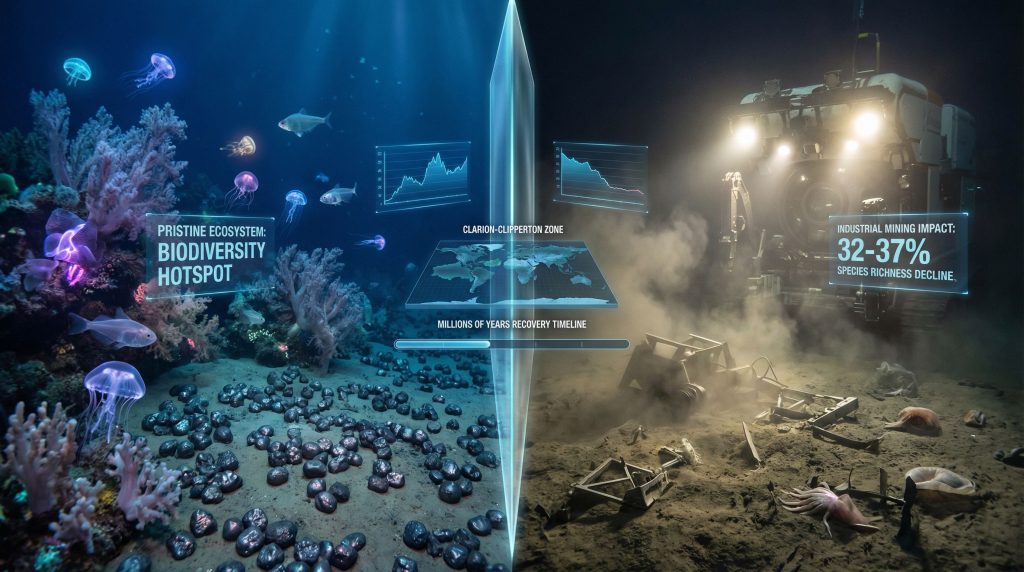
• 32% reduction in species richness within direct extraction zones
• 37% decrease in macrofaunal density in collector footprints
• 15-20% species richness decline in sediment plume-affected areas
• 25% macrofaunal density reduction in extended impact zones
These measurements represent statistically significant departures from baseline conditions, demonstrating clear causal relationships between extraction activities and biodiversity loss. A recent study published in Nature confirmed that the 32% species richness reduction translates to functional diversity loss in deep-sea microbial and metazoan communities, with particular significance for slow-growing organisms that dominate deep-sea biomass despite lower numerical abundance.
Comparative Impact Assessment Methodologies
BACI analysis requires extensive baseline surveys comparing multiple sampling locations before and after impact events. This methodology compares impacted zones against spatially proximate reference areas, reducing confounding variables from large-scale oceanographic fluctuations and providing statistical power for detecting ecologically meaningful changes.
The standardisation of biodiversity metrics across studies enables comparative assessment:
| Metric Type | Measurement Approach | Ecological Significance |
|---|---|---|
| Species richness | Direct taxonomic count per sampling unit | Community diversity baseline |
| Shannon diversity | Species number and abundance distribution | Community structure complexity |
| Simpson dominance | Community concentration measurement | Ecosystem stability indicator |
| Rarefaction curves | Species accumulation across sampling intensities | Comparative diversity assessment |
Temporal Monitoring Protocol Results
Short-term monitoring protocols reveal immediate impacts, whilst long-term ecological responses remain largely unknown due to limited study duration. Comparative data from hydrothermal vent impact studies suggest recovery timescales of 5-10 years for fast-growing fauna and potentially centuries for slow-growing taxa.
The Clarion-Clipperton trial showing 32% species loss in abyssal sediment contexts indicates potentially slower recovery than vent systems due to lower energy and productivity regimes characteristic of abyssal environments.
Environmental Mechanisms Driving Biodiversity Loss
Industrial deep-sea mining biodiversity impact operates through interconnected environmental mechanisms that create both immediate and long-term ecological disruption. Understanding these pathways enables more accurate prediction of cumulative effects across different spatial and temporal scales.
Physical Habitat Transformation
Substrate modification represents the most fundamental mechanism driving biodiversity loss in mining operations. Polymetallic nodules provide rare elevated structures, typically 4-20 centimetres above the seafloor, creating critical habitat heterogeneity in otherwise uniform abyssal plains consisting predominantly of fine silts and clays.
The removal of these nodule structures eliminates:
• Hard substrate attachment points essential for sessile organisms
• Three-dimensional habitat complexity supporting diverse communities
• Microhabitat gradients concentrating organic matter deposition
• Refugia from predation and current disturbance
Sediment redistribution through plume formation buries remaining habitat structures under fine particle layers, creating additional habitat loss beyond direct extraction zones. This process affects areas hundreds of square kilometres from mining operations, amplifying the spatial scale of environmental impact.
Chemical and Biological Disruption Pathways
Deep-sea ecosystems operate under extreme resource limitation, making biogeochemical cycle disruption particularly significant for community stability. Primary productivity at the surface generates organic matter that requires weeks to months for vertical transit to abyssal depths as marine snow, representing the energetic foundation for entire deep-sea communities.
Mining operations interrupt these critical processes through:
Carbon Sequestration Disruption:
• Nodule-associated bacterial biofilms concentrate chemosynthetic carbon fixation
• Sediment suspension reduces primary productivity in affected upper water columns
• Altered benthic carbon burial affects global carbon cycling patterns
Nutrient Cycling Alteration:
• Iron oxide nodule surfaces serve as micronutrient reservoirs
• Sediment resuspension releases redox-sensitive phosphorus and nitrogen
• Modified oxygen gradients affect nitrification and denitrification pathways
Food Web Structure Disruption:
• Nodule-associated organisms represent primary consumers of bacterioplankton
• Mobile fauna dependent on nodule refugia comprise secondary consumers
• Removal cascades through detritivore communities concentrated in nodule microhabitats
Secondary Environmental Stressor Effects
Industrial operations introduce additional environmental stressors beyond direct habitat removal. Acoustic disruption from collector machinery affects deep-sea fauna dependent on sound for mate location and predator avoidance, particularly in frequency ranges of 1-10 kHz substantially altered by equipment operation.
Light pollution from operational equipment disrupts natural bioluminescent ecosystems adapted to complete darkness, whilst thermal alteration from machinery operation modifies temperature gradients in environments where organisms adapted to stable conditions of 1-4°C.
High-Risk Biodiversity Hotspots Under Mining Pressure
Industrial deep-sea mining biodiversity impact concentrates disproportionately in regions containing both maximum commercial mineral resources and highest endemic species concentrations. This spatial overlap creates directional pressure for extraction activities in areas of maximum ecological significance.
Clarion-Clipperton Zone Vulnerability Assessment
The Clarion-Clipperton Zone represents the primary target for commercial deep-sea mining operations, containing an estimated 80% of known polymetallic nodule resources globally across approximately 6 million square kilometres of Pacific Ocean seafloor. This region extends between 115°W-155°W longitude and 5°N-15°N latitude at depths of 4,000-6,000 metres.
Current exploration activity demonstrates intensive commercial interest, with 19 of 31 total International Seabed Authority exploration contracts (61% of licensed activity) concentrated in this zone. This regulatory framework creates potential for overlapping mining operations across vast areas of critical habitat.
Endemic species concentrations in the Clarion-Clipperton Zone include:
• Xenophyophores at densities exceeding 100 individuals per square metre
• Specialised foraminifera comprising over 50% of abyssal biomass by count
• Nodule-associated corals and sponges with growth rates of 0.5-2 millimetres annually
• Deep-sea holothurians processing approximately 50% of abyssal organic matter
Mid-Ocean Ridge System Threats
Hydrothermal vent communities on mid-ocean ridges represent distinct ecosystem types with different vulnerability profiles compared to nodule-associated communities. These systems operate through chemosynthetic rather than heterotrophic energy sources, supporting rapid community turnover with 5-10 year natural disturbance cycles.
Despite faster community dynamics, vent systems face unique mining threats:
• Polymetallic sulphide extraction targeting active and inactive vent sites
• Temperature regime disruption affecting chemosynthetic bacterial communities
• Chemical gradient alteration modifying energy sources for primary productivity
• Larval dispersal disruption affecting recolonisation capacity between vent fields
Seamount Environment Vulnerabilities
Seamount ecosystems combine extreme endemism with slow-growing suspension feeding communities, creating vulnerability profiles similar to nodule-associated systems. These underwater mountain ranges function as isolated habitat islands supporting species found nowhere else, with documented examples of coral species restricted to single seamount features.
Seamount-associated mining targets include:
| Target Resource | Depth Range | Ecosystem Impact |
|---|---|---|
| Cobalt-rich ferromanganese crusts | 800-2,500 metres | Deep-sea coral habitat destruction |
| Polymetallic nodules | 4,000-6,000 metres | Endemic fauna displacement |
| Polymetallic sulphides | 1,000-4,000 metres | Chemosynthetic community disruption |
Sediment Plume Amplification of Environmental Damage
Sediment plume formation represents a critical mechanism through which industrial deep-sea mining biodiversity impact extends far beyond direct extraction zones. These particle suspensions transport environmental disruption across oceanic distances, affecting ecosystems hundreds of kilometres from mining operations.
Plume Formation and Distribution Mechanics
Collector operations generate sediment plumes through multiple pathways including direct seafloor disturbance, sediment discharge from processing equipment, and water column turbulence from machinery operation. Fine sediment particles suspend in deep-sea water masses and transport according to complex oceanographic circulation patterns.
Particle settling velocity calculations demonstrate extended residence times in the water column, with fine clay particles potentially remaining suspended for weeks to months before deposition. Current-driven dispersal patterns follow prevailing deep-water circulation, potentially transporting contamination across international maritime boundaries.
Biological Impact Mechanisms Across Species
Sediment plume effects operate through multiple biological pathways affecting different taxonomic groups:
Filter-Feeding Organism Stress:
• Particle clogging of feeding apparatus in sponges and corals
• Respiratory system obstruction in bivalves and crustaceans
• Reduced feeding efficiency leading to energetic stress
• Potential mortality from excessive particle ingestion
Photosynthetic Disruption:
• Light penetration reduction in upper water columns
• Decreased primary productivity affecting food web foundations
• Altered phytoplankton community composition
• Reduced oxygen production in affected regions
Benthic Smothering Effects:
• Burial of seafloor communities under sediment layers
• Habitat modification through topographic changes
• Chemical gradient alteration in sediment-water interface
• Long-term substrate composition changes
Geographic Scope and Cumulative Impact Assessment
Modelling studies suggest individual mining operations could generate sediment plumes affecting areas of hundreds to thousands of square kilometres, with particle deposition detectable at distances exceeding 100 kilometres from extraction sites. Multiple concurrent operations create potential for overlapping impact zones covering vast oceanic regions.
Cumulative effect projections indicate possible ecosystem-scale disruption across entire abyssal basins if mining operations proceed at commercially viable scales. The spatial extent of sediment impacts may exceed the geographic range of many deep-sea species, potentially affecting entire populations rather than localised subsets.
The next major ASX story will hit our subscribers first
Regulatory Framework Gaps and Oversight Challenges
Current international governance structures demonstrate significant limitations in addressing industrial deep-sea mining biodiversity impact through comprehensive environmental protection mechanisms. The International Seabed Authority operates under mandates balancing commercial development with environmental conservation, creating inherent tensions in regulatory implementation. Furthermore, government intervention mining policies vary significantly between jurisdictions, creating additional regulatory complexity.
Authority Jurisdiction and Enforcement Limitations
The International Seabed Authority possesses regulatory jurisdiction over mineral extraction in international waters beyond national exclusive economic zones, covering approximately 60% of global ocean area. However, enforcement capacity remains limited by technical challenges of monitoring vast oceanic regions and legal complexities of international maritime law.
Current regulatory gaps include:
• Insufficient baseline environmental data requirements for mining applications
• Inadequate long-term monitoring mandates for ecological assessment
• Limited enforcement mechanisms for environmental compliance
• Unclear liability frameworks for transboundary environmental damage
Environmental Standard Development Challenges
The absence of comprehensive biodiversity protection thresholds reflects fundamental scientific uncertainties about deep-sea ecosystem functioning and recovery capacity. Traditional environmental impact assessment frameworks developed for terrestrial mining operations prove inadequate for deep-sea applications due to:
• Extreme temporal scales of ecosystem processes
• Limited understanding of species interactions and dependencies
• Absence of restoration precedents for deep-sea habitat reconstruction
• Difficulty quantifying ecosystem service values in abyssal environments
Scientific Knowledge Integration Deficits
Regulatory development proceeds despite significant knowledge gaps in deep-sea ecology and environmental impact prediction. Current understanding of abyssal ecosystem functioning derives primarily from limited research stations and short-term studies, providing insufficient foundation for comprehensive environmental governance.
Critical knowledge deficits include:
| Knowledge Gap | Research Requirement | Regulatory Implication |
|---|---|---|
| Baseline biodiversity | Multi-year taxonomic surveys | Impact assessment standards |
| Recovery timelines | Long-term monitoring studies | Restoration requirements |
| Cumulative effects | Regional ecosystem modelling | Spatial planning frameworks |
| Species connectivity | Population genetics research | Protected area design |
Alternative Material Sourcing and Circular Economy Options
Assessment of industrial deep-sea mining biodiversity impact requires evaluation of alternative approaches to critical mineral supply that could reduce pressure for oceanic extraction. Multiple pathways exist for meeting battery and renewable energy technology material demands through terrestrial sources, recycling systems, and technological innovation.
Terrestrial Mining Environmental Tradeoffs
Land-based extraction of critical minerals presents different environmental impact profiles compared to deep-sea mining, with documented effects including surface habitat disruption, water contamination, and community displacement. However, terrestrial mining operations occur in environments with established restoration techniques and regulatory frameworks.
Comparative environmental assessment reveals:
Terrestrial Advantages:
• Established restoration and reclamation technologies
• Regulatory oversight with enforcement mechanisms
• Community stakeholder engagement processes
• Ecosystem recovery precedents and timelines
Deep-Sea Risks:
• Unknown recovery potential and timelines
• Limited regulatory oversight and enforcement
• Irreversible habitat modification
• Cumulative impacts across oceanic scales
Recycling and Urban Mining Potential
Electronic waste streams represent significant alternative sources for critical minerals, with global e-waste generation exceeding 50 million tonnes annually and containing substantial quantities of copper, cobalt, nickel, and rare earth elements. Advanced separation and purification technologies enable recovery of high-purity materials from complex electronic assemblies.
Urban mining opportunities include:
• Battery recycling from electric vehicles and energy storage systems
• Electronic device recovery through extended producer responsibility programmes
• Infrastructure material recapture from decommissioned renewable energy installations
• Industrial catalyst regeneration recovering precious metals from chemical processes
Technological Innovation and Substitution Research
Emerging battery chemistry innovations demonstrate potential for reduced critical mineral dependency in energy storage applications. Sodium-ion, iron-air, and organic flow battery technologies offer alternatives to lithium-ion systems with reduced cobalt, nickel, and lithium requirements.
Material substitution research focuses on:
| Application | Current Materials | Alternative Technologies |
|---|---|---|
| Battery cathodes | Cobalt, nickel | Iron phosphate, sodium compounds |
| Permanent magnets | Rare earth elements | Ferrite, hybrid designs |
| Catalysts | Platinum group metals | Base metal alternatives |
| Conductors | Copper | Carbon-based materials |
Long-Term Scenario Modelling and Risk Assessment
Industrial deep-sea mining biodiversity impact assessment requires consideration of multiple future scenarios incorporating different scales of extraction activity, technological development, and environmental response patterns. Scenario modelling enables identification of critical thresholds and potential tipping points in oceanic ecosystem stability.
Ecosystem Collapse Risk Analysis
Deep-sea ecosystems demonstrate characteristics that may predispose them to abrupt state changes rather than gradual degradation under extraction pressure. Research indicates that "the extreme isolation and slow recovery rates of deep-sea communities create vulnerability to irreversible ecosystem collapse", according to biodiversity conservation scientists. Identification of ecological tipping points requires understanding of system connectivity, keystone species dependencies, and threshold levels for irreversible ecological damage.
Critical risk factors include:
• Population connectivity thresholds below which genetic isolation prevents recovery
• Habitat fragmentation levels that disrupt essential ecological processes
• Keystone species abundance required for ecosystem function maintenance
• Biogeochemical cycle disruption affecting ocean-scale carbon and nutrient cycling
Climate Impact Amplification Potential
Deep-sea mining operations may interact with climate change processes through multiple pathways, potentially amplifying environmental impacts beyond additive effects. Ocean acidification, temperature increases, and circulation changes could reduce ecosystem resilience to mining disturbance.
Climate interaction mechanisms include:
Carbon Cycle Feedback:
• Reduced oceanic carbon sequestration capacity from sediment disruption
• Methane release potential from disturbed seafloor sediments
• Altered carbon burial rates in abyssal environments
Ocean Chemistry Changes:
• Accelerated acidification in mining-affected regions
• Modified oxygen minimum zones from circulation changes
• Chemical pollutant mobilisation from sediment disturbance
Economic and Social Consequence Projections
Long-term impacts from deep-sea mining extend beyond ecological systems to affect human communities dependent on marine resources and ecosystem services. Commercial fisheries, tourism industries, and indigenous communities maintaining traditional marine resource relationships face potential consequences from oceanic ecosystem disruption.
Socioeconomic impact pathways include:
| Sector | Impact Mechanism | Potential Consequences |
|---|---|---|
| Fisheries | Food web disruption | Reduced catch volumes |
| Tourism | Ecosystem degradation | Loss of marine recreation value |
| Indigenous communities | Cultural resource damage | Traditional practice disruption |
| Research | Scientific site loss | Reduced understanding opportunities |
Environmental Monitoring System Enhancement Requirements
Addressing industrial deep-sea mining biodiversity impact requires substantial advancement in environmental monitoring capabilities, integrating multiple technological approaches and establishing comprehensive assessment frameworks. In addition, data‐driven mining operations technologies offer potential for improved environmental monitoring and impact assessment. Current monitoring systems prove inadequate for the spatial and temporal scales of potential mining impacts.
Technology Integration and Autonomous Systems
Continuous environmental surveillance across oceanic scales necessitates deployment of autonomous monitoring networks capable of long-term operation in extreme deep-sea environments. Robotic systems offer potential for persistent data collection without continuous human intervention.
Advanced monitoring technologies include:
• Autonomous underwater vehicles for mobile ecosystem assessment
• Seafloor sensor arrays for continuous environmental parameter monitoring
• Satellite remote sensing integration for surface water quality assessment
• Artificial intelligence pattern recognition for early environmental change detection
Multi-Scale Assessment Framework Development
Comprehensive environmental monitoring requires integration across multiple spatial and temporal scales, from local extraction sites to regional ecosystem connectivity. Hierarchical assessment frameworks enable detection of impacts at appropriate scales for different ecological processes.
Local Scale Monitoring:
• Site-specific biodiversity assessment using standardised taxonomic protocols
• Sediment chemistry and contamination tracking
• Individual organism health and reproductive success metrics
• Microhabitat structure and complexity measurement
Regional Scale Assessment:
• Population connectivity analysis through genetic methods
• Ecosystem service quantification and valuation
• Cumulative impact modelling across multiple sites
• Oceanographic circulation and transport pattern monitoring
Global Scale Integration:
• International coordination for transboundary impact assessment
• Climate interaction and feedback mechanism detection
• Comparative ecosystem health across ocean basins
• Long-term trend analysis and early warning system development
Adaptive Management and Precautionary Implementation
Environmental uncertainty surrounding deep-sea mining impacts necessitates adaptive management approaches incorporating threshold-based intervention systems and precautionary principle implementation. Automatic cessation triggers based on environmental indicators could prevent irreversible ecological damage.
Adaptive management protocols should include:
• Real-time environmental threshold monitoring with automatic operation suspension
• Restoration requirement standards for mandatory ecological rehabilitation
• Independent scientific advisory integration in operational decisions
• Stakeholder engagement processes including affected communities and scientists
Disclaimer: This analysis presents current understanding of deep-sea mining environmental impacts based on available scientific literature and limited industrial trial data. Long-term ecological effects remain largely unknown due to the novel nature of deep-sea extraction activities. Environmental impact projections involve significant uncertainty, and actual outcomes may differ substantially from current scientific predictions. Regulatory frameworks continue evolving, and future policy developments may alter the risk-benefit analysis presented in this assessment.
Are You Ready to Capitalise on Critical Mineral Discoveries?
As deep-sea mining debates intensify and environmental regulations tighten around oceanic extraction, savvy investors are positioning themselves to benefit from terrestrial critical mineral discoveries that could meet growing battery and renewable energy demands. Discovery Alert's proprietary Discovery IQ model delivers instant notifications on significant ASX mineral discoveries, helping subscribers identify actionable investment opportunities in the critical minerals sector before the broader market reacts. Begin your 14-day free trial today to gain a market-leading advantage in the evolving landscape of sustainable resource extraction.