July 21, 2026
Industrial Energy Economics Drive Global Competitiveness Challenges
Energy-intensive manufacturing industries worldwide face unprecedented cost pressures as traditional electricity pricing models strain under economic realities. The relationship between power costs and industrial viability has reached critical thresholds in multiple jurisdictions, forcing policymakers to reconsider regulatory frameworks that balance utility cost recovery with manufacturing competitiveness. This dynamic particularly affects sectors where electricity represents the dominant operational expense, creating scenarios where production economics can shift dramatically based on energy policy decisions.
South Africa's ferrochrome industry exemplifies these broader industrial challenges, where the electricity tariff proposal for ferrochrome industry represents regulatory intervention attempts to address fundamental misalignments between energy costs and global market positioning. The sector's recent performance data reveals the severe impact of electricity tariff structures on production capacity utilisation and employment sustainability.
When big ASX news breaks, our subscribers know first
Understanding South Africa's Ferrochrome Production Crisis
Production Collapse Reveals Industry Vulnerabilities
Recent production data from the Glencore-Merafe Chrome Venture demonstrates the dramatic impact of electricity cost pressures on ferrochrome operations. Attributable ferrochrome production declined from 301,000 tonnes in 2024 to just 112,000 tonnes in 2025, representing a 63% year-on-year decrease. The fourth quarter of 2025 proved particularly challenging, with production falling to a mere 147 tonnes, effectively representing operational suspension across most smelting capacity.
This production collapse contrasts sharply with chrome ore mining operations, which maintained relatively stable output. Chrome ore production experienced only a 1.7% decline from 948,000 tonnes in 2024 to 932,000 tonnes in 2025, indicating that mining operations remain economically viable while downstream beneficiation faces severe constraints.
| Production Metric | 2024 | 2025 | Change |
|---|---|---|---|
| Ferrochrome Output | 301,000 tonnes | 112,000 tonnes | -63% |
| Chrome Ore Production | 948,000 tonnes | 932,000 tonnes | -1.7% |
| Q4 2025 Ferrochrome | ~40,000 tonnes (est.) | 147 tonnes | -99.6% |
Economic Paradox in Beneficiation Strategy
The industry now confronts a fundamental economic reversal that challenges decades of beneficiation policy. Industry analysis indicates that raw chrome ore exports have become more profitable than downstream smelting operations, despite ferrochrome traditionally commanding five times higher value than unprocessed ore. This shift represents a critical departure from South Africa's strategic objective of maximising value-added mineral processing.
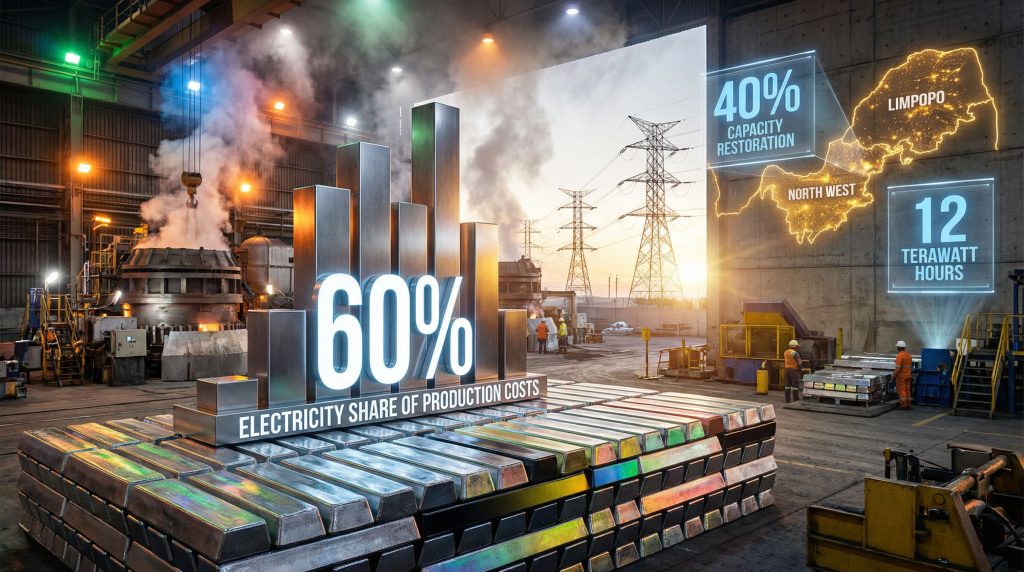
The economic dynamics reflect electricity costs now representing approximately 60% of total ferrochrome production expenses, fundamentally altering the cost structure that historically favoured domestic smelting. However, these developments are closely linked to broader tariff economic implications affecting global trade patterns and industrial competitiveness.
This cost burden has rendered many operations uneconomical despite strong global demand for ferrochrome products. Furthermore, the situation highlights broader challenges in mining industry evolution where traditional cost structures face disruption.
Regional Employment and Infrastructure Impact
The production crisis affects operations concentrated in two provinces: the Lion smelter in Limpopo province and the Wonderkop and Boshoek smelters in North West province. The Lion facility, characterised as a "lower-energy" design, represents the focus for potential operational restoration, while the North West operations require more extensive solutions for economic viability.
The broader supply chain implications extend beyond direct smelting operations to supporting logistics infrastructure, maintenance contractors, and related mining activities. Chrome ore mining operations continue to supply both domestic smelting (when operational) and export markets, providing some buffer against complete sectoral collapse.
New Regulatory Framework for Electricity Tariff Relief
Memorandum of Understanding Structure
Eskom has formalised a memorandum of understanding with both the Glencore-Merafe Chrome Venture and Samancor Chrome, establishing a framework to prevent additional smelting capacity closures and avoid widespread employment reductions. The agreement represents a novel approach to industrial electricity pricing that attempts to balance cost recovery requirements with manufacturing competitiveness.
The MOU framework emphasises a self-funded mechanism that eliminates direct government subsidy requirements, positioning the intervention as a tariff adjustment rather than a fiscal support program. This approach aligns with regulatory principles that emphasise cost-reflective pricing while accommodating industrial competitiveness considerations.
Three-Phase Implementation Timeline
The proposal operates within a 90-day implementation framework structured across three distinct phases:
Phase 1 (Days 0-30):
- Multi-stakeholder task team formation
- Baseline capacity and cost assessment
- Regulatory pathway identification
- Initial stakeholder consultation
Phase 2 (Days 30-60):
- Detailed tariff structure modelling
- Cost-benefit analysis development
- Extended stakeholder engagement
- Technical feasibility confirmation
Phase 3 (Days 60-90):
- Final proposal compilation
- NERSA regulatory submission
- Implementation planning
- Performance monitoring framework establishment
The comprehensive timeline reflects the complexity of addressing electricity tariff proposal for ferrochrome industry requirements whilst maintaining regulatory compliance and stakeholder alignment.
Stakeholder Alignment and Expectations
Trade union Solidarity has expressed optimism regarding negotiated solutions, suggesting that mutually beneficial agreements remain achievable despite the challenging economic environment. This labour union support indicates alignment between employment protection objectives and operational viability requirements.
The multi-party approach involves coordination between Eskom as the electricity supplier, ferrochrome producers as industrial customers, labour representatives, and the National Energy Regulator of South Africa (NERSA) as the approval authority. This comprehensive stakeholder engagement aims to address competing interests whilst maintaining regulatory integrity.
Economic Impact Assessment and Production Restoration
Capacity Reactivation Projections
The tariff proposal targets 40% capacity restoration as an initial benchmark for operational viability. This restoration would involve furnace reactivation across the participating smelting operations, with priority given to the Lion smelter's lower-energy design that offers improved economic prospects under revised tariff structures.
Successful implementation would enable suspension of planned retrenchment processes, preserving employment levels whilst restoring production capacity that has remained idle due to cost constraints. The restored capacity would serve both domestic stainless steel supply chains and export markets where South African ferrochrome maintains quality and specification advantages.
Supply Chain Restoration Benefits
Renewed ferrochrome production would activate supporting economic activities throughout the supply chain:
- Chrome ore utilisation: Increased demand for the 932,000 tonnes of annual chrome ore production
- Logistics activation: Transportation, handling, and storage infrastructure utilisation
- Technical services: Maintenance, engineering, and operational support service demand
- Regional economic impact: Multiplier effects in North West and Limpopo provincial economies
| Economic Impact Area | Current Status | Projected Improvement |
|---|---|---|
| Furnace Utilisation | <5% active | 40% target restoration |
| Employment Risk | Retrenchment planned | Suspension of job cuts |
| Chrome Ore Demand | Export-focused | Domestic beneficiation priority |
| Regional GDP Impact | Declining contribution | Stabilisation and growth |
Global Market Positioning Considerations
South African ferrochrome production competes in global markets where cost competitiveness determines market share and customer retention. The country's position as a major ferrochrome producer depends on maintaining production economics that compete effectively with Chinese, Turkish, and other international suppliers.
The proposed tariff adjustment aims to restore South Africa's cost competitiveness whilst preserving quality advantages and established customer relationships. In addition, these developments must be considered alongside broader tariffs and investment patterns affecting global manufacturing competitiveness.
Regulatory Framework Evolution and Policy Implications
NERSA's Expanding Industrial Mandate
The ferrochrome tariff proposal represents a potential precedent for NERSA's approach to industrial electricity regulation. Traditional cost-reflective tariff methodology faces challenges when applied to trade-exposed, energy-intensive industries that compete in global markets with different energy cost structures.
The regulatory evolution involves balancing multiple objectives:
- Cost recovery: Ensuring Eskom's financial sustainability
- Industrial competitiveness: Maintaining manufacturing sector viability
- Employment protection: Supporting job creation and retention
- Economic development: Advancing beneficiation and value-addition strategies
Broader Industrial Policy Alignment
South Africa's beneficiation strategy emphasises downstream mineral processing as a cornerstone of industrialisation and employment creation. The ferrochrome industry serves as a test case for policy implementation effectiveness, where energy costs directly impact the viability of value-added manufacturing.
The proposal aligns with several government policy objectives:
- Beneficiation advancement: Supporting downstream mineral processing
- Job creation and retention: Preventing industrial employment losses
- Export competitiveness: Maintaining manufactured goods export capacity
- Regional development: Supporting mining-dependent provincial economies
Potential Extension to Other Sectors
Successful implementation could establish precedent for similar interventions in other energy-intensive industries:
- Aluminium smelting: Operations facing comparable electricity cost challenges
- Steel production: Energy-intensive primary metals processing
- Chemical manufacturing: Process industries with high electricity consumption
- Mining beneficiation: Various mineral processing operations
Technology Innovation and Energy Efficiency Solutions
SmeltDirect Technology Deployment Potential
Advanced smelting technology offers significant energy consumption reduction opportunities, with SmeltDirect technology potentially reducing power requirements by 70%. However, capital investment decisions depend on operational certainty and tariff stability that would justify substantial technology upgrade expenditures.
The technology adoption pathway requires:
- Regulatory certainty: Stable tariff framework to support investment payback
- Capital availability: Financing for technology upgrade investments
- Technical implementation: Engineering and installation capacity
- Performance validation: Demonstrated efficiency and reliability improvements
Renewable Energy Integration Strategy
Long-term sustainability involves developing private renewable energy procurement strategies that reduce dependence on grid electricity whilst providing cost-competitive power supply. This approach aligns with global trends toward industrial renewable energy adoption and carbon footprint reduction requirements.
For instance, renewable energy transformations across the mining sector demonstrate viable pathways for industrial energy transition. Consequently, the electricity tariff proposal for ferrochrome industry must consider both immediate relief and long-term energy transformation strategies.
Renewable integration considerations include:
- Solar and wind PPA development: Private power purchase agreements
- Battery storage requirements: Grid independence and reliability
- Hybrid system design: Combining grid connection with private generation
- Carbon compliance: EU Carbon Border Adjustment Mechanism preparation
Innovation Investment Dependencies
Industry participants emphasise that technology investment decisions require operational certainty that extends beyond immediate tariff relief. Capital investment in both efficiency improvements and renewable energy systems depends on regulatory stability and long-term cost predictability.
The next major ASX story will hit our subscribers first
Risk Assessment and Implementation Challenges
Regulatory Approval Uncertainties
NERSA's approval process involves technical evaluation, public consultation, and regulatory determination procedures that introduce timeline and outcome uncertainties. The 90-day implementation target requires expedited regulatory processing that may face procedural and analytical challenges.
Key approval risks include:
- Technical justification requirements: Cost-reflectivity analysis and methodology approval
- Public consultation processes: Stakeholder input and objection resolution
- Precedent considerations: Implications for other industrial tariff applications
- Legal and procedural compliance: Adherence to regulatory framework requirements
Market and Economic Variables
Ferrochrome market conditions, exchange rate fluctuations, and global demand patterns affect the economic viability of restored operations regardless of electricity tariff adjustments. Success requires favourable market conditions that complement reduced energy costs.
However, broader economic factors including oil price rally trends may influence overall industrial cost structures and competitiveness dynamics.
External risk factors include:
- Global ferrochrome demand: Stainless steel market growth and geographic distribution
- Currency exchange rates: Rand strength affecting export competitiveness
- Raw material costs: Chrome ore prices and availability
- Competitive dynamics: International supplier cost structures and market strategies
Operational Readiness Requirements
Furnace reactivation involves technical, maintenance, and workforce readiness considerations that extend beyond electricity cost resolution. Successful capacity restoration requires comprehensive operational preparation and supply chain coordination.
Strategic Implications for Industrial Competitiveness
Long-Term Sustainability Framework
The electricity tariff proposal for ferrochrome industry represents an interim solution that must evolve toward long-term sustainability through technology adoption, renewable energy integration, and operational efficiency improvements. Success requires coordinated advancement across multiple improvement areas rather than relying solely on tariff adjustment.
Sustainable competitiveness factors include:
- Energy efficiency: Technology adoption and process optimisation
- Cost structure optimisation: Comprehensive operational improvement
- Market positioning: Customer relationship management and quality differentiation
- Policy stability: Predictable regulatory and economic environment
Mining Sector Precedent Implications
The ferrochrome experience provides lessons applicable to other mining and beneficiation operations facing similar energy cost challenges. Success would demonstrate viable pathways for maintaining industrial competitiveness whilst failure would indicate fundamental structural challenges in South African manufacturing.
The broader implications extend to:
- Industrial policy effectiveness: Government intervention capability and success
- Regulatory framework evolution: NERSA's role in industrial competitiveness
- Economic diversification: Manufacturing sector contribution to economic development
- Employment sustainability: Job creation and retention in mining-dependent regions
Furthermore, legislative negotiations and agreements between Eskom and ferrochrome producers demonstrate collaborative approaches to industrial energy challenges.
Disclaimer: This analysis is based on publicly available information and industry reports. Production figures and financial projections involve uncertainties and may differ from actual outcomes. Investment and business decisions should consider comprehensive due diligence and professional advice.
Ready to Capitalise on Mining Industry Developments?
Discovery Alert's proprietary Discovery IQ model delivers real-time notifications on significant ASX mineral discoveries, helping subscribers identify actionable opportunities as industrial shifts create new investment landscapes. Start your 30-day free trial today to position yourself ahead of evolving market conditions and secure your competitive advantage in mining investments.