
May 17, 2026
The industrial grinding industry relies heavily on sophisticated commissioning protocols to ensure optimal equipment performance and operational reliability. When a new grinding mill commissioned successfully enters service, these comprehensive procedures involve multiple technical phases, from pre-commissioning infrastructure preparation through final performance validation. Modern grinding mills, particularly those processing precious metals and minerals, require specialised approaches that balance mechanical precision with operational efficiency.
Understanding these commissioning methodologies becomes increasingly critical as mining operations expand capacity and implement advanced grinding technologies. The technical complexity of contemporary mill systems demands rigorous testing protocols and systematic validation procedures to achieve design specifications and maintain long-term operational excellence.
Understanding Pre-Commissioning Infrastructure Requirements
Pre-commissioning infrastructure development forms the foundation for successful mill implementation. Critical foundation specifications typically require concrete strength standards ranging from C30 to C45 grade, ensuring adequate structural support for high-capacity grinding operations. These specifications become particularly important for installations processing significant volumes, such as facilities handling over 10 million tonnes annually.
Alignment tolerances represent another crucial infrastructure element, with precision standards often requiring measurements within 0.1 mm/m tolerance levels. This precision ensures proper mechanical alignment and reduces vibration-related issues during operation. Furthermore, electrical integration with distributed control systems requires comprehensive DCS/PLC connectivity protocols, enabling seamless communication between mill components and central control systems.
Safety interlock verification and emergency shutdown procedures constitute essential pre-commissioning requirements. These systems must undergo thorough testing to ensure immediate response capabilities during emergency situations. The integration of these safety systems with primary operational controls requires careful coordination and extensive validation testing.
Recent installations demonstrate the importance of comprehensive pre-commissioning preparation. The successful commissioning of Grinding Mill No. 8 at Hydrometallurgical Plant No. 3, with its 700,000 tonnes per annum capacity for gold-bearing ore processing, exemplifies systematic infrastructure preparation enabling efficient mill deployment.
When big ASX news breaks, our subscribers know first
Critical System Integration Checkpoints
System integration checkpoints ensure all mill components function cohesively before full operational deployment. However, lubrication system pressure testing and flow rate validation represent fundamental verification steps, typically involving pressure ranges from 0.8 to 1.2 MPa for low-pressure circuits and 6.2 to 6.6 MPa for grinding pressure applications.
Hydraulic circuit calibration requires precise parameter verification across multiple operating conditions. These systems control critical mill functions including roller positioning, pressure application, and separator adjustments. Proper calibration ensures consistent grinding performance and product quality throughout operational cycles.
In addition, vibration monitoring baseline establishment provides essential reference data for ongoing maintenance protocols. Initial vibration measurements create benchmarks for detecting mechanical changes or potential component wear. Temperature sensor calibration across bearing assemblies ensures accurate thermal monitoring, preventing overheating and mechanical failures.
Key integration verification points include:
- Hydraulic system response validation under varying load conditions
- Lubrication flow distribution verification across all bearing points
- Control system communication testing between mill components
- Emergency shutdown sequence verification and timing validation
- Power supply stability testing under full load simulation
These checkpoints require systematic documentation and validation before proceeding to operational testing phases. Comprehensive system integration reduces commissioning delays and prevents costly operational issues.
Empty Run Duration Standards and No-Load Testing
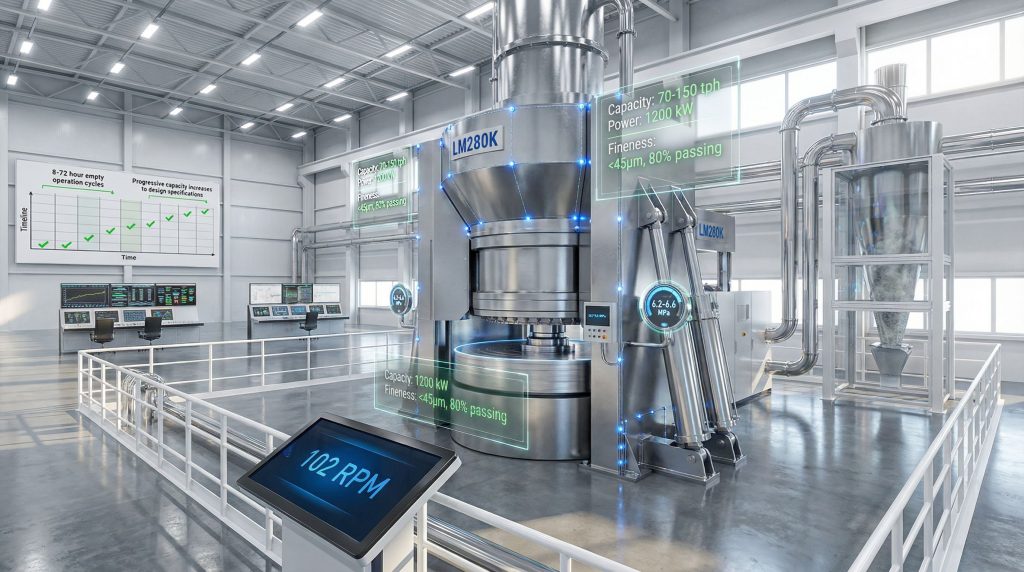
No-load testing protocols establish equipment reliability through controlled empty operation cycles. Industry-standard empty run durations typically range from 8 to 72 hours, depending on mill capacity and complexity. These extended testing periods allow mechanical components to settle and identify potential issues before material introduction.
Progressive speed ramping procedures gradually increase operational speed from startup levels to design RPM specifications. This graduated approach reduces mechanical stress and enables bearing temperature stabilisation monitoring. For instance, proper thermal behaviour documentation during empty runs provides critical baseline data for ongoing operational monitoring.
Performance validation metrics during no-load testing include:
| Parameter | Measurement Focus | Acceptable Range |
|---|---|---|
| Vibration Amplitude | Mechanical stability | Within design tolerances |
| Power Consumption | Electrical efficiency | Baseline establishment |
| Bearing Temperature | Thermal behaviour | Gradual stabilisation |
| Hydraulic Response | System functionality | Consistent pressure maintenance |
Mechanical stress distribution analysis during empty runs reveals potential alignment issues or component irregularities. This analysis enables corrective adjustments before introducing processing materials, preventing damage to expensive grinding components.
Component thermal behaviour documentation establishes normal operating temperature ranges for various mill sections. These baseline measurements become essential for predictive maintenance programmes and early detection of mechanical problems during operational phases.
Graduated Feed Introduction and Hot Commissioning
Hot commissioning procedures involve systematic material introduction to verify grinding performance under actual operating conditions. Initial material loading typically begins at reduced rates, often starting with 10 tonnes per hour using limestone or equivalent test media. This conservative approach allows operators to monitor system responses and make necessary adjustments.
Progressive capacity increases advance toward design specifications, with many installations targeting 70 tonnes per hour or higher depending on mill configuration and application requirements. Recent commissioning activities demonstrate significant capacity achievements, with facilities increasing annual processing from 10 million tonnes to 10.8 million tonnes through new mill implementations.
Product sampling protocols during hot commissioning verify fineness targets and quality parameters. These protocols typically involve continuous sampling during capacity ramp-up phases, ensuring consistent product quality across varying feed rates. Furthermore, classifier RPM optimisation, often targeting approximately 102 RPM for vertical mill configurations, enables precise product fineness control.
Quality control parameters during hot commissioning include:
- Particle size distribution analysis targeting specific fineness requirements
- Reject rate monitoring and optimisation adjustments
- Material residence time optimisation for consistent grinding
- Energy consumption per tonne calculations for efficiency validation
- Product consistency verification across varying feed characteristics
The graduated approach enables systematic optimisation of operational parameters while maintaining equipment protection. This methodology has proven effective in recent installations processing gold-bearing ore, where precise grinding control directly impacts recovery efficiency.
Specialised Mill Technology Commissioning Approaches
Different mill technologies require customised commissioning strategies based on their operational characteristics and design specifications. Vertical roller mill systems demand specific attention to roller pressure distribution and material flow patterns. These systems typically achieve fineness targets of less than 45 micrometers with 80% passing specifications for standard applications.
Advanced vertical mill configurations can achieve even finer specifications, with some installations targeting less than 32 micrometers with 85% passing rates. Consequently, the commissioning of these systems requires careful attention to classifier speed optimisation and air flow management to achieve consistent product quality.
Ball mill configuration standards involve different commissioning considerations, particularly regarding grinding media charge ratios. These systems typically operate with 30 to 35% mill volume filled with grinding media, with critical speed calculations maintaining 75 to 85% of theoretical critical speed for optimal grinding efficiency.
Ultrafine grinding systems present unique commissioning challenges, particularly those targeting particle sizes with D97 less than or equal to 5 micrometers. These applications benefit from AI in mining operations and require specialised attention to:
- Noise level compliance maintaining operational limits below 75 dB
- Air classification efficiency optimisation for precise product separation
- Dust collection system integration preventing environmental contamination
- Product quality consistency across extended operational periods
Recent mill installations demonstrate successful commissioning approaches across various technologies. The advanced grinding mill technology implementation represents effective commissioning methodology for high-capacity ore processing applications, contributing to overall facility capacity expansion.
Performance Verification and Design Validation
Performance verification protocols validate equipment achievement of design specifications through comprehensive testing procedures. Standard verification approaches include 72-hour continuous operation trials demonstrating sustained performance under full operational conditions. These extended trials verify throughput capabilities across varying feed characteristics and operational parameters.
Design throughput confirmation requires systematic testing across feed variability ranges, ensuring consistent performance regardless of ore characteristics or operational conditions. However, product quality consistency verification involves continuous monitoring and sampling to demonstrate specification achievement throughout testing periods.
Energy efficiency benchmarking compares actual performance against design specifications and industry standards. This analysis identifies optimisation opportunities and validates equipment efficiency claims. Recent installations demonstrate successful capacity achievement, with new grinding mill commissioned enabling facility processing increases from 10+ million tonnes to 10.8 million tonnes annually.
Operational training integration during performance verification ensures proper knowledge transfer and procedural understanding. This training covers:
- Operator certification on control systems and operational procedures
- Maintenance procedure documentation and implementation protocols
- Emergency response protocol training and validation exercises
- Performance optimisation technique transfer and application methods
The systematic approach to performance verification has proven effective in recent commissioning projects, with industry leaders noting that new grinding mill commissioned contributes significantly to improving production performance across mining operations.
The next major ASX story will hit our subscribers first
Historical Case Studies and Proven Methodologies
Historical commissioning projects provide valuable insights into effective implementation strategies and common challenges. Recent successful implementations include high-capacity installations processing significant ore volumes through systematic commissioning approaches, driven by industry evolution trends.
The Hydrometallurgical Plant No. 3 project demonstrates effective multi-stakeholder coordination in mill commissioning. This installation involved local equipment manufacturing at Navoi Machine-Building Plant, with construction coordination through Zarafshan Construction Unit and Northern Administration Unit. This integrated approach enabled efficient project execution and successful capacity achievement.
Key lessons from successful commissioning projects include:
- Phased startup approaches reduce mechanical stress and equipment wear during initial operation periods
- Comprehensive pre-commissioning checks prevent costly delays and operational issues
- Operator training integration improves long-term performance and reduces operational problems
- Documentation protocols enable future optimisation and maintenance planning
- Multi-stakeholder coordination ensures efficient project execution and knowledge transfer
Mining sector implementations demonstrate the importance of systematic approaches to commissioning complex grinding equipment. Projects focusing on precious metal extraction require particular attention to grinding precision and recovery optimisation, as grinding efficiency directly impacts overall project economics.
The successful commissioning approach used in recent installations processing gold-bearing ore demonstrates effective methodology for high-value applications where processing precision significantly impacts operational profitability.
Real-Time Monitoring and Optimisation Systems
Modern mill installations incorporate sophisticated monitoring systems enabling ongoing performance optimisation and predictive maintenance. Real-time data-driven operations continuously monitor vibration analysis trends, power consumption patterns, and product quality parameters throughout operational cycles.
Vibration analysis trending provides predictive maintenance capabilities, enabling early detection of mechanical issues before critical failures occur. Power consumption monitoring facilitates efficiency optimisation, identifying operational parameters that maximise throughput while minimising energy usage per tonne processed.
Product quality feedback loops enable automatic parameter adjustments maintaining consistent output specifications. These systems continuously monitor fineness distribution and adjust classifier speeds, airflow rates, and other operational parameters to maintain product quality targets.
Advanced monitoring implementations include:
| Monitoring System | Function | Benefit |
|---|---|---|
| Vibration Analysis | Predictive maintenance | Early fault detection |
| Power Monitoring | Energy optimisation | Cost reduction |
| Quality Control | Product consistency | Specification maintenance |
| Throughput Tracking | Performance validation | Capacity optimisation |
Maintenance protocol integration with monitoring systems enables scheduled inspection intervals based on actual operating hours and equipment condition rather than arbitrary time schedules. This approach optimises maintenance costs while maintaining equipment reliability.
Regulatory Compliance and Safety Standards
Regulatory compliance requirements significantly impact commissioning timelines and procedures. Safety standard verification involves comprehensive testing of occupational health and safety protocols, environmental emission compliance systems, and workplace noise level certification procedures.
Environmental emission compliance testing ensures grinding operations meet regulatory standards for dust control and air quality maintenance. These requirements often necessitate sophisticated dust collection systems and air filtration technologies integrated with primary grinding equipment. Furthermore, safety training insights demonstrate the critical importance of proper safety protocol implementation.
Noise level certification for workplace standards typically requires operational compliance below 75 dB in occupied areas. This requirement influences equipment selection and facility design, often requiring acoustic enclosures or specialised noise reduction technologies.
Quality management system integration involves implementing comprehensive documentation and traceability protocols. These systems must demonstrate compliance with international standards while enabling efficient operational management and continuous improvement processes.
Emergency response system validation ensures immediate response capabilities during operational emergencies. These systems require comprehensive testing and coordination with facility-wide safety protocols, including evacuation procedures and emergency shutdown capabilities.
Digital Integration and Future Commissioning Trends
Digital integration advances are transforming mill commissioning methodologies through IoT sensor integration, machine learning algorithms, and remote monitoring capabilities. These technologies enable real-time performance optimisation and predictive maintenance applications that significantly improve operational efficiency.
IoT sensor integration provides continuous monitoring of critical operational parameters, enabling immediate response to changing conditions and early detection of potential issues. Machine learning algorithms analyse operational data patterns to identify optimisation opportunities and predict maintenance requirements.
Remote commissioning support capabilities enable expert guidance during initial startup phases, reducing commissioning time requirements and improving initial performance achievement. In addition, mining process optimisation creates virtual models enabling performance modelling and optimisation before physical implementation.
Sustainability considerations increasingly influence commissioning methodologies through decarbonisation benefits and comprehensive approaches including:
- Energy efficiency optimisation protocols reducing operational power consumption
- Carbon footprint reduction strategies minimising environmental impact
- Water usage minimisation techniques supporting environmental stewardship
- Waste heat recovery system integration improving overall facility efficiency
These technological advances and sustainability focus areas continue reshaping commissioning approaches, enabling more efficient and environmentally responsible grinding operations across the mining industry.
Disclaimer: The technical specifications and performance parameters discussed in this article are based on industry standards and may vary depending on specific equipment manufacturers, operational requirements, and local conditions. Readers should consult qualified engineering professionals and equipment suppliers for project-specific guidance and verification of technical requirements.
Considering Optimising Your Mining Portfolio Through Discovery-Based Opportunities?
Discovery Alert's proprietary Discovery IQ model delivers real-time alerts on significant ASX mineral discoveries, instantly empowering subscribers to identify actionable trading opportunities ahead of the broader market. Begin your 14-day free trial today and secure your market-leading advantage in the evolving mining sector.