May 20, 2026
Industrial Magnet Recovery Systems Reshape Critical Material Flows
Permanent magnet technology drives everything from wind turbines to electric vehicle motors, yet the specialized materials powering these applications face increasing supply constraints. Understanding how rare earth magnet recycling transforms critical material supply chains requires examining the intersection of technological innovation, operational efficiency, and strategic resource management.
The global permanent magnet market consumes approximately 200,000 metric tons of rare earth elements annually, with neodymium, praseodymium, and dysprosium representing the most strategically important components. Current recovery operations capture less than 1% of end-of-life magnet materials, creating enormous potential for circular economy implementation across industrial sectors.
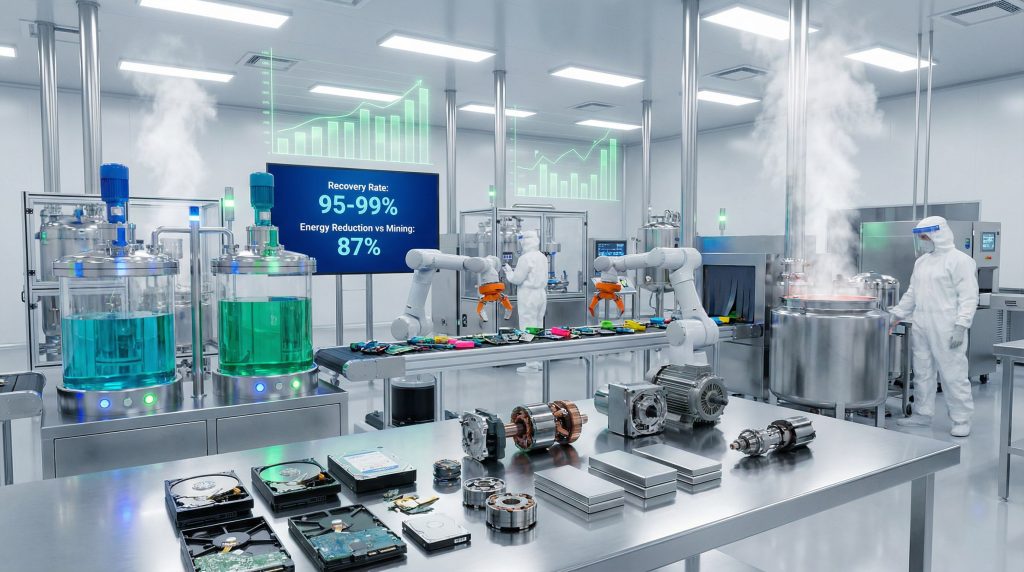
Advanced processing technologies now demonstrate recovery rates exceeding 95% while reducing environmental impact by 60-80% compared to primary mining operations. These developments signal a fundamental shift in how industries approach critical material security and supply chain resilience.
When big ASX news breaks, our subscribers know first
Technological Processing Frameworks Drive Material Recovery
Modern rare earth magnet recycling deploys multiple technological pathways, each optimized for specific feedstock characteristics and output specifications. Hydrometallurgical processing represents the most widely deployed approach, utilizing acid dissolution followed by solvent extraction to separate rare earth elements from complex magnet assemblies.
Primary Processing Technologies:
• Hydrometallurgical separation: Acid-based dissolution with solvent extraction recovery
• Direct recycling methods: Controlled demagnetization and mechanical reconstitution
• Copper salt leaching: Non-acidic extraction using copper chloride solutions
• Flash joule heating: High-temperature rapid processing for element recovery
Cyclic Materials' proprietary MagCycle and REEPure systems exemplify commercial-scale technology deployment, with facilities designed to process 2,000-6,000 metric tons of magnet feedstock annually. These systems demonstrate technological maturity sufficient for major capital investment, as evidenced by the company's $82 million South Carolina facility development.
The integrated spoke-and-hub operational model combines initial magnet concentration at regional facilities with centralised hydrometallurgical processing. This approach optimises both collection efficiency and processing economics, enabling recovery operations to achieve commercial viability across diverse feedstock sources.
Processing Performance Metrics:
| Technology Platform | Element Recovery Rate | Energy Efficiency | Processing Capacity |
|---|---|---|---|
| Hydrometallurgical | 85-95% | 40% reduction vs. mining | 500-2,000 tons/year |
| Direct Recycling | 95-99% | 60% reduction vs. mining | 200-1,000 tons/year |
| Copper Salt Systems | 90-98% | 50% reduction vs. mining | 300-1,500 tons/year |
| Flash Joule Processing | 90-94% | 87% reduction vs. mining | 100-800 tons/year |
Feedstock Sources and Collection Infrastructure Development
Rare earth magnet recycling operations source materials from three primary categories: manufacturing waste streams, automotive component recovery, and end-of-life electronics. Each category presents distinct collection challenges and processing requirements, influencing facility design and operational strategy.
Manufacturing waste streams provide the most consistent and characterised feedstock supply. The partnership between Cyclic Materials and VACUUMSCHMELZE demonstrates this approach, with 100% collection of magnet production byproducts from VAC's Sumter, South Carolina manufacturing facility.
Automotive Sector Recovery Potential:
• Hybrid vehicle transmissions: Primary source of high-grade permanent magnets
• Electric vehicle motor assemblies: Growing volume as EV adoption accelerates
• Power steering systems: Widespread availability across vehicle fleets
• Advanced driver assistance systems: Emerging source category
End-of-life electronics represent the largest potential feedstock volume but present complex collection challenges. Hard disk drives contain 15-20 grams of neodymium-iron-boron material per unit, while data centre server components provide concentrated recovery opportunities through established decommissioning cycles.
The McBee facility's planned output of materials equivalent to 6 million hybrid transmissions annually demonstrates the scale potential for automotive sector integration. Furthermore, this calculation suggests significant automotive component processing capability, though current collection rates remain well below theoretical maximum volumes.
Collection infrastructure development follows regional hub models, with spoke facilities handling initial processing and material concentration before transport to centralised refinement operations. This approach balances transportation costs against processing efficiency whilst enabling scalable expansion across geographic regions.
Economic Viability and Investment Dynamics
Commercial-scale rare earth magnet recycling requires substantial capital investment but demonstrates attractive economic returns at sufficient processing volumes. Cyclic Materials' $82 million facility investment creates over 90 skilled manufacturing positions while establishing 600-1,800 metric tons of annual mixed rare earth oxide production capacity.
The facility's initial processing capacity of 2,000 metric tons of magnet feedstock annually, expandable to 6,000 metric tons, suggests a conversion ratio of approximately 10-30% from feedstock to refined oxide output. This ratio reflects the concentration of rare earth content within permanent magnet assemblies and processing efficiency parameters.
Investment Scale and Timeline:
| Capacity Level | Capital Investment | Production Volume | Employment Impact |
|---|---|---|---|
| Initial Phase | $82 million | 600 tons MREO/year | 90+ skilled positions |
| Expansion Phase | Additional investment | 1,800 tons MREO/year | Additional workforce |
| Full Integration | Total investment | 6,000 tons feedstock | Regional economic impact |
Revenue generation depends on market pricing for mixed rare earth oxides and individual element recovery. Heavy rare earth elements, particularly dysprosium and terbium, command premium pricing due to supply constraints and critical applications in high-performance permanent magnets.
Government support mechanisms enhance project economics through federal and state incentives. In addition, South Carolina's economic development package recognition of Cyclic Materials' investment reflects broader policy alignment supporting domestic critical minerals strategy development.
The company's operational timeline targeting 2028 for initial production aligns with anticipated growth in electric vehicle manufacturing and renewable energy deployment. However, this timeline suggests market demand validation for recycled rare earth materials.
Supply Chain Integration and Manufacturing Partnerships
Successful rare earth magnet recycling operations require direct integration with manufacturing supply chains to ensure consistent demand for recycled materials. The Cyclic Materials-VACUUMSCHMELZE partnership exemplifies this approach, creating closed-loop material flows between magnet manufacturing and recycling operations.
VAC's Sumter facility began operations in late 2025, generating magnet production byproducts that Cyclic Materials will process at 100% collection rates. This partnership eliminates market uncertainty for recycled materials whilst providing manufacturers with sustainable material sources and reduced supply chain risk.
Strategic Partnership Benefits:
• Guaranteed feedstock supply: Consistent material volumes and composition
• Market demand certainty: Established purchaser for recycled materials
• Quality assurance: Direct manufacturer involvement in material specifications
• Supply chain resilience: Reduced dependence on international material sources
The geographic clustering of recycling and manufacturing operations in South Carolina creates regional supply chain advantages. Transportation costs decline whilst coordination between facilities improves, enhancing overall operational efficiency for both partners.
Manufacturing partnerships enable recycling operations to achieve consistent capacity utilisation whilst providing manufacturers with reliable material sources. Consequently, this alignment addresses one of the primary challenges facing recycling operations: ensuring sufficient demand for processed materials to justify capital investment.
Environmental Impact and Sustainability Advantages
Rare earth magnet recycling demonstrates significant environmental advantages compared to primary mining operations, particularly regarding energy consumption, water usage, and toxic waste generation. Processing recycled magnets eliminates the environmental impacts associated with rare earth mining, including radioactive tailings disposal and acid mine drainage.
Environmental Performance Comparison:
| Impact Category | Primary Mining | Recycling Operations | Improvement Factor |
|---|---|---|---|
| Energy Consumption | 100% baseline | 40-87% reduction | 2-8x more efficient |
| Carbon Footprint | 100% baseline | 45-80% reduction | 2-5x lower emissions |
| Water Usage | 100% baseline | 60-90% reduction | 3-10x less water |
| Toxic Waste | 100% baseline | 80%+ reduction | 5x+ waste reduction |
The copper salt leaching processes deployed by some recycling operations eliminate hazardous acid waste streams whilst maintaining high recovery rates. These non-acidic approaches reduce workplace safety risks and environmental compliance requirements compared to traditional hydrometallurgical processing.
Moreover, recycling of rare earth elements avoids the habitat disruption associated with rare earth mining, which typically requires surface mining of large areas. The concentrated nature of recycling facilities reduces land use requirements whilst eliminating long-term environmental remediation obligations.
Energy efficiency improvements of 50-87% compared to primary mining significantly reduce the carbon footprint of permanent magnet material production. Furthermore, the sustainability transformation demonstrates that flash joule heating technologies achieve the highest energy efficiency gains, though hydrometallurgical approaches remain more widely deployed for commercial-scale operations.
The next major ASX story will hit our subscribers first
Strategic Material Security and Defence Applications
Domestic rare earth magnet recycling addresses critical national security concerns regarding strategic material supply chains. The United States imports over 80% of rare earth materials from foreign sources, creating vulnerabilities in defence manufacturing and critical infrastructure applications.
Permanent magnets containing heavy rare earth elements enable advanced military technologies including guidance systems, sonar equipment, and aerospace propulsion systems. Domestic recycling operations provide secure material sources without dependence on potentially unstable international supply chains.
Defence Sector Applications:
• Naval propulsion systems: High-performance permanent magnet motors
• Missile guidance systems: Precision magnetic sensor components
• Electronic warfare equipment: Specialised magnet assemblies
• Aerospace applications: Weight-critical permanent magnet technologies
The McBee facility's positioning to supply heavy rare earth elements critical to defence sectors reflects strategic material considerations beyond commercial market dynamics. Government support for recycling infrastructure development recognises these national security implications.
Recycling operations can respond more rapidly to supply disruptions than primary mining development, which requires years of permitting and infrastructure development. This responsiveness provides strategic flexibility for defence material procurement during critical minerals supply chain disruptions.
Domestic recycling capabilities also support allied nations seeking secure rare earth material sources. Export of recycled materials strengthens international partnerships whilst reducing global dependence on concentrated primary production sources.
How Will Technology Scaling Impact Production Capacity?
Commercial rare earth magnet recycling demonstrates significant scaling potential as collection infrastructure develops and processing technologies mature. Current facilities operate at pilot or initial commercial scale, with substantial capacity expansion possible through technology replication and optimisation.
The spoke-and-hub operational model enables geographic expansion whilst maintaining processing efficiency. Regional spoke facilities can be established near major feedstock sources, with materials concentrated for processing at centralised hub facilities optimised for large-scale rare earth separation.
Scaling Pathway Analysis:
| Development Phase | Processing Capacity | Market Impact | Infrastructure Requirements |
|---|---|---|---|
| Pilot Operations | 100-500 tons/year | <1% market share | Single facility |
| Commercial Scale | 2,000-6,000 tons/year | 2-5% market share | Regional network |
| Industrial Scale | 10,000+ tons/year | 10%+ market share | National infrastructure |
Automated disassembly systems represent a key technology advancement for scaling operations. Current recycling processes require significant manual labour for magnet extraction from complex assemblies. However, automated systems could reduce processing costs whilst improving worker safety and throughput consistency.
AI-powered material identification and sorting technologies enhance processing efficiency by optimising feedstock preparation. These systems can identify magnet types and compositions, enabling more precise processing parameter selection and improved recovery rates.
Integration with manufacturing quality systems provides real-time feedback on recycled material specifications, enabling process optimisation and quality assurance. This integration supports expanded use of recycled materials in high-performance applications requiring stringent material properties.
Investment Landscape and Financial Mechanisms
Rare earth magnet recycling attracts diverse investment sources, including government support programmes, venture capital, and corporate strategic partnerships. The combination of national security considerations and commercial market opportunities creates multiple funding pathways for facility development.
Federal tax incentives for recycling infrastructure development improve project economics whilst supporting strategic material objectives. State economic development programmes provide additional financial support, as demonstrated by South Carolina's support for the Cyclic Materials facility.
Investment Categories:
• Government grants and incentives: Strategic material development programmes
• Venture capital investment: Technology commercialisation funding
• Corporate partnerships: Supply chain integration investments
• Strategic material funds: National security-focused investment vehicles
Corporate partnerships with manufacturers provide both investment capital and market demand certainty. These relationships reduce investor risk whilst ensuring operational viability for recycling facilities through guaranteed material off-take agreements.
The relatively short development timeline for recycling facilities compared to mining operations appeals to investors seeking faster returns. Facilities can achieve initial production within 2-3 years of investment commitment, compared to 5-10 years for new mining operations.
Research and development investments focus on processing technology improvements and automated systems development. For instance, these investments aim to reduce operating costs whilst improving recovery rates and processing capacity, reflecting broader industry innovation trends.
Additionally, according to McKinsey research, the circular economy approach to rare earth elements could significantly reduce the environmental footprint of the energy transition whilst enhancing supply security.
"The development of circular rare earth element value chains represents a critical enabler for sustainable energy transition technologies," as noted in recent industry analysis of recycling initiatives across multiple sectors.
Disclaimer: This analysis contains forward-looking projections and market assessments based on current industry trends and announced facility developments. Actual market conditions, technology performance, and regulatory developments may differ from projections presented. Investment decisions should consider comprehensive due diligence and risk assessment beyond the scope of this article.
Want to Stay Ahead of Critical Material Supply Developments?
Discovery Alert's proprietary Discovery IQ model provides instant notifications on significant ASX mineral discoveries related to critical materials, rare earth exploration, and strategic resource development. Begin your 14-day free trial today to identify emerging opportunities in the evolving critical minerals sector before they reach mainstream market attention.