July 18, 2026
The Geopolitics of Scarcity: How Rare Earth Magnets Became a Foreign Policy Instrument
The global economy has spent decades optimising supply chains for efficiency, concentrating the production of critical materials in the hands of a single dominant supplier. For rare earth permanent magnets, that supplier is China, and China rare earth magnet exports to Japan have become a flashpoint that is now playing out in real time across Japanese factory floors, defence procurement offices, and boardrooms from Tokyo to Stuttgart.
Understanding what is happening between China and Japan in 2026 requires stepping back from the immediate diplomatic headlines and recognising a structural reality: China's leverage over rare earth magnet supply is not simply a function of mining dominance. It extends through ore processing, rare earth separation, alloy production, and final magnet sintering, forming a vertically integrated supply chain that took decades to build and cannot be replicated in years. Furthermore, the broader context of rare earth supply chains makes this dependency particularly consequential for allied nations.
When big ASX news breaks, our subscribers know first
Why Permanent Magnets Occupy a Unique Position in Global Industry
Not all critical materials are equal. Some can be substituted, stockpiled more easily, or sourced from multiple geographies with modest effort. Rare earth permanent magnets, particularly neodymium-iron-boron (NdFeB) types, sit in a different category entirely.
The physics of NdFeB magnets produce an energy density and coercivity that no commercially available alternative has matched at scale. This matters enormously across several intersecting industries:
- Electric vehicle drive motors require high-torque, compact powertrains that depend on NdFeB magnets; there is no commercially deployed substitute for high-performance EV traction motors at volume
- Precision-guided defence systems incorporate permanent magnets in actuators, guidance fins, and radar components where size and magnetic performance are non-negotiable
- Industrial robotics and servo motors rely on the precise, repeatable magnetic characteristics that NdFeB materials provide
- Wind turbine generators, particularly direct-drive offshore designs, use significant quantities of neodymium and dysprosium in their permanent magnet assemblies
- Medical imaging equipment, including MRI machines, uses rare earth magnets in specific subcomponents
One aspect that receives less attention than it deserves is the role of heavy rare earth elements, particularly dysprosium and terbium, in high-temperature magnet applications. NdFeB magnets lose coercivity at elevated temperatures, which is a critical limitation for EV motors and defence systems that operate under thermal stress. Adding dysprosium or terbium restores that thermal stability, but these elements are far scarcer and more geographically concentrated than neodymium itself.
China's dominance in heavy rare earth supply is, if anything, even more pronounced than its position in the broader rare earth market. This layered dependency is something that simplified discussions of the Japan-China dispute tend to overlook. The surge in critical minerals demand has only intensified these structural pressures globally.
The distinction between light and heavy rare earths is critical for investors and policymakers alike. A nation can build upstream neodymium supply relatively more quickly, but dysprosium and terbium remain bottlenecked at the processing and sourcing level for the foreseeable future.
What the April 2026 Customs Data Actually Reveals
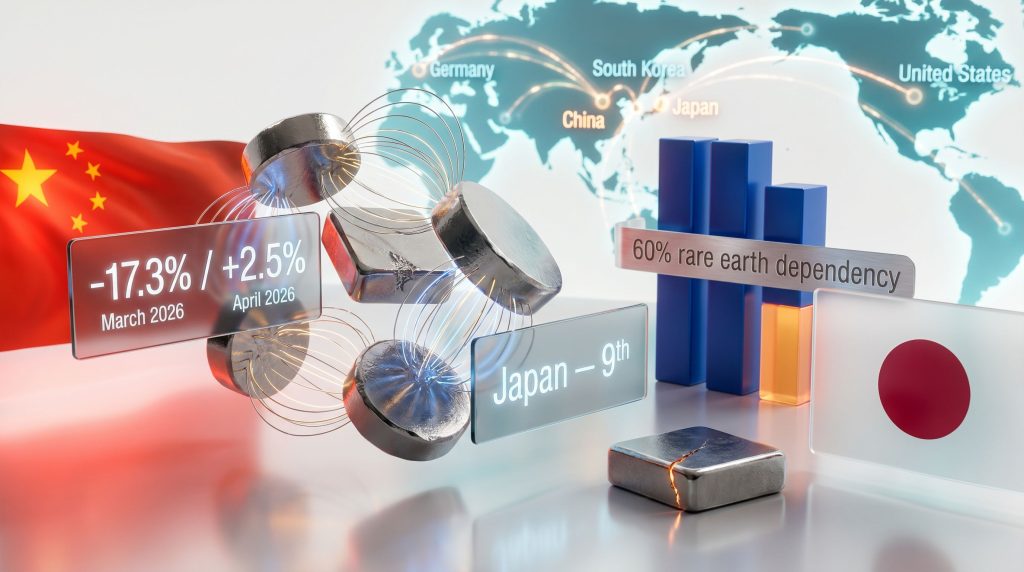
Chinese customs figures released in May 2026 confirmed that permanent magnet exports to Japan rose 2.5% in April compared to March. While any recovery appears positive in isolation, the context strips away much of the relief: this modest rebound followed a 17.3% contraction in March, leaving cumulative shipment volumes well below the baseline Japanese industry had been planning around.
| Metric | March 2026 | April 2026 |
|---|---|---|
| Month-on-month magnet export change to Japan | -17.3% | +2.5% |
| Japan's rank among Chinese magnet buyers | Not disclosed | 9th |
| Top buyer of Chinese permanent magnets | Germany | Germany |
| Second-ranked buyer | South Korea | South Korea |
| Third-ranked buyer | United States | United States |
Japan's placement at ninth among all buyers of Chinese permanent magnets is significant beyond the statistical ranking. It reflects a deliberate reordering of trade flows rather than a logistical anomaly. Simultaneously, China tightened controls on gallium and germanium exports to Japan, materials essential to semiconductor fabrication, suggesting a coordinated multi-front approach rather than isolated sector pressure.
The fact that Germany, South Korea, and the United States occupy the top three positions during a period of Japan-specific pressure illustrates an important strategic dynamic. Beijing can redirect export volumes to reward diplomatic partners and signal to others that access to Chinese critical materials is a function of geopolitical posture, not simply market demand. According to analysis from the Japan Times, these disruptions have sent shockwaves through Japanese industry at a pace few anticipated.
The Diplomatic Timeline: From Taiwan Statements to Supply Chain Disruption
The pathway from political rhetoric to factory shortages unfolded with notable speed. Understanding the sequencing matters for any organisation assessing how quickly supply chain risk can activate:
- November 2025: Japanese Prime Minister Sanae Takaichi publicly described a hypothetical military action against Taiwan as an existential threat to Japan, a framing Beijing interpreted as a direct challenge to its territorial position
- Late November to December 2025: Beijing issued a series of diplomatic warnings and demanded clarification on Japan's position regarding the one-China principle
- January 6, 2026: China's Ministry of Commerce announced a ban on exports of dual-use items with potential military applications to Japan; rare earth elements frequently fall under dual-use classifications in Chinese export control frameworks
- Early 2026: Licensing processes for rare earth materials and magnet shipments to Japanese firms slowed materially, introducing procurement uncertainty
- March 2026: Permanent magnet exports to Japan fell 17.3% month-on-month
- April 2026: A 2.5% partial recovery left Japan ranked ninth among Chinese magnet buyers
- Ongoing: Chinese travel warnings against Japan added reputational and economic pressure beyond materials trade
What is strategically notable about this sequence is the use of dual-use classification ambiguity as a lever. The January ban did not explicitly name rare earth magnets, but because rare earths can be classified as dual-use materials, the practical effect was immediate licensing uncertainty. This disrupted procurement timelines for Japanese buyers without Beijing having to declare an explicit embargo — an approach that is legally defensible, diplomatically deniable, and operationally disruptive in equal measure.
Japan's Industrial Exposure: Sectors Under the Greatest Pressure
Which Industries Face the Most Acute Stress?
Japanese industrial associations have described current supply conditions using language that procurement professionals understand as more than rhetorical: characterising shortages as severe typically means inventory drawdowns are approaching critical thresholds rather than merely describing temporary inconvenience.
The sectors facing the most acute stress include:
- Automotive and EV manufacturing: Japan's automakers, including global leaders in hybrid and electric vehicle production, depend on NdFeB magnets for motor assemblies; just-in-time inventory models amplify disruption speed
- Robotics and factory automation: Japan is home to some of the world's largest industrial robotics companies, all of which depend on permanent magnets for servo motors and precision actuators
- Defence procurement: Precision guidance systems, radar platforms, and autonomous systems rely on magnet performance characteristics for which no short-term alternative exists
- Consumer and medical electronics: Compact motors, speakers, hard disk drive read heads, and medical imaging components all incorporate rare earth magnets
Despite years of deliberate diversification following the 2010 dispute, Japan still sources roughly 60% of its rare earth imports from China, down from near-total dependence prior to 2010. That progress is genuine but incomplete, and the remaining dependency is disproportionately concentrated in high-performance magnet grades where Chinese production advantages are most deeply entrenched.
Lessons From 2010 That Japan Learned, and Those It Did Not
The 2010 China-Japan rare earth episode, triggered by a maritime confrontation near the Senkaku/Diaoyu Islands, became the reference case for critical mineral supply chain risk globally. It prompted governments, manufacturers, and investors worldwide to re-examine single-source dependencies. Notably, China's rare earth campaign against Japan during that period established several of the playbook tactics now being deployed again.
Academic analysis published through CEPR VoxEU has since introduced important nuance into the standard narrative: the evidence for a deliberate, sustained Chinese embargo in 2010 is more ambiguous than often portrayed, and part of the disruption may have been administrative rather than fully intentional. This distinction matters for policy analysis because it affects how reliably Beijing's export control signalling can be predicted and interpreted.
What Japan did accomplish between 2010 and 2026 is worth assessing honestly:
| Strategy Deployed | Outcome Achieved |
|---|---|
| Overseas mining investment, notably in Australia | Partial upstream diversification |
| National rare earth stockpile programs | Buffer against short-term disruptions |
| R&D in magnet-reduction and magnet-free motor designs | Progress in some lower-performance applications |
| Import source diversification | Chinese share reduced from ~100% to ~60% |
| Government-industry emergency coordination | Faster response activation capability |
The Australian dimension deserves specific attention. Japanese investment in Australian rare earth projects after 2010 contributed to the emergence of a nascent Western rare earth supply chain. However, the critical bottleneck has never been mine development alone. Converting ore into separated rare earth oxides, then into metal alloys, and finally into sintered NdFeB magnets requires a processing and manufacturing capability that remains overwhelmingly concentrated in China.
A mine without a downstream processing chain produces tonnes of ore, not a single functional magnet. The substitution challenge is not geological; it is industrial.
The next major ASX story will hit our subscribers first
Coercive Economic Statecraft: A Framework for Understanding What Is Happening
The Japan situation is best understood not as a conventional trade dispute but as a contemporary exercise in coercive economic statecraft — the deliberate use of supply chain dependencies as instruments of foreign policy influence. The broader dimensions of rare earth geopolitics help explain why Beijing's approach is so precisely calibrated. Indeed, China's export restrictions have demonstrated just how quickly these levers can be deployed.
Beijing has access to several categories of leverage in this domain, and the 2026 episode demonstrates how they can be deployed in combination:
- Licensing friction rather than explicit bans, which produces operational disruption while avoiding WTO-challengeable measures
- Dual-use classification ambiguity, which gives administrative cover for selective enforcement
- Trade flow redirection toward compliant partners, which simultaneously rewards and signals
- Parallel pressure across multiple materials including gallium and germanium, which stretches procurement teams across several simultaneous shortages
- Travel warnings and diplomatic signalling, which create reputational costs beyond the materials trade itself
For nations and corporations assessing their own exposure, the Japan case establishes an important threshold: a diplomatic disagreement over statements related to Taiwan translated into targeted critical mineral supply disruptions within weeks. The speed of activation, not just the existence of the vulnerability, is what supply chain planners need to build into their risk models.
Implications for the Global EV and Defence Industrial Base
The ripple effects of Japan's rare earth magnet shortage extend well beyond Japanese borders. Japan's automakers maintain global production networks, and disruptions to domestic magnet supply can affect assembly schedules in plants across North America, Europe, and Southeast Asia.
For the defence industrial base, the implications are more acute. Western defence planners have flagged rare earth magnet dependency as a top-tier supply chain vulnerability in public assessments, and the Japan situation provides a live operational demonstration of how that vulnerability activates. The convergence of magnet restrictions with gallium and germanium controls is particularly significant because it simultaneously pressures EV supply chains, defence electronics, and advanced semiconductor production.
Nations with comparable Chinese rare earth exposure, including several EU member states and key Southeast Asian manufacturing economies, should treat the Japan episode as a live stress test of their own procurement resilience. The US rare earth supply chain faces analogous structural vulnerabilities, underscoring that this is a systemic global challenge rather than a bilateral issue. The EU Critical Raw Materials Act and provisions within US industrial policy frameworks aim to reduce this exposure, but regulatory timelines and capital deployment cycles mean meaningful diversification remains years away for most downstream manufacturers.
The Path Forward: What Resolution Requires
Reducing the structural vulnerability that the Japan situation has exposed requires action on multiple fronts simultaneously:
- Rare earth separation capacity must be built outside China at commercial scale, not just in pilot facilities
- Magnet alloy and sintering capacity requires dedicated industrial investment in Western and allied nations
- Long-term offtake agreements between governments and manufacturers are needed to make upstream investment commercially viable for mining companies operating in higher-cost jurisdictions
- Workforce and technical knowledge development in magnet metallurgy is a constraint that cannot be solved purely with capital; it requires years of institutional capacity building
- Stockpile programs need to be calibrated against realistic supply disruption scenarios, not optimistic procurement assumptions
China rare earth magnet exports to Japan are unlikely to normalise until the underlying diplomatic tensions are resolved or both sides find a face-saving pathway. As the energy transition accelerates demand for NdFeB magnets in EVs and wind turbines, and as defence spending increases globally, the strategic value of magnet supply control will only increase. Nations that treat the current disruption as a temporary bilateral dispute rather than a structural warning signal are likely to find themselves in identical or worse positions when the next geopolitical disagreement tests their supply chains.
Frequently Asked Questions
What caused China to restrict rare earth magnet exports to Japan in 2026?
The restrictions stem from a diplomatic dispute that escalated in November 2025 after Japanese Prime Minister Sanae Takaichi described a hypothetical military action against Taiwan as an existential threat to Japan. Beijing responded with a sequence of economic measures including a January 2026 dual-use export ban, licensing restrictions affecting rare earth materials, and travel warnings.
How significant was the April 2026 recovery in magnet exports?
Chinese customs data showed a 2.5% month-on-month increase in permanent magnet shipments to Japan in April 2026, following a 17.3% contraction in March. The partial recovery leaves cumulative volumes significantly below pre-restriction baselines, and Japan ranked ninth among all buyers of Chinese permanent magnets during April.
Why can't Japan simply find alternative magnet suppliers?
High-performance NdFeB magnet manufacturing is dominated by Chinese producers at every stage of the supply chain, from ore processing through to sintered magnet production. Alternative suppliers exist in Japan itself, as well as in limited capacity elsewhere, but cannot fill the volume gap at the required performance specifications in the short term. Building competitive non-Chinese magnet capacity is a multi-year industrial undertaking.
What is the significance of heavy rare earth elements like dysprosium in this context?
Dysprosium and terbium are added to NdFeB magnets to maintain coercivity at high operating temperatures, which is essential for EV motors and defence applications. China's dominance in heavy rare earth supply is even more concentrated than its position in broader rare earth markets, making thermal-grade magnet supply particularly difficult to diversify.
How does the current situation compare to the 2010 China-Japan rare earth dispute?
The 2010 episode involved broader rare earth export disruptions following a maritime incident, while the 2026 situation uses dual-use licensing controls and selective shipment reductions to apply pressure on specific sectors. Academic analysis suggests the 2010 disruption may have been partly administrative rather than fully intentional, while the 2026 measures appear more deliberately calibrated to specific industrial targets.
Want To Know When The Next Critical Minerals Discovery Hits The ASX?
Discovery Alert's proprietary Discovery IQ model delivers real-time alerts on significant ASX mineral discoveries — including rare earths, dysprosium, and other critical materials driving the global energy transition and defence supply chains — instantly translating complex geological data into actionable investment insights. Explore historic discoveries and their returns, or start your 14-day free trial today to position yourself ahead of the market before the next major find is announced.