May 19, 2026
Understanding Industrial Membrane Separation Technology
Advanced separation processes in extractive metallurgy increasingly rely on selective transport mechanisms that operate at the molecular level. Unlike conventional approaches that depend on bulk phase interactions, membrane-based systems create controlled interfacial environments where target ions can be selectively transported across engineered barriers. This fundamental principle has particular relevance for critical minerals energy transition applications, where traditional processing methods often prove inefficient when dealing with dilute or complex feedstock compositions.
The thermodynamic driving forces in these systems operate through concentration gradients and chemical potential differences. When properly engineered, these forces enable selective extraction of specific metal species from complex matrices containing numerous competing ions. The selectivity emerges from careful design of carrier molecules that exhibit preferential binding affinity for target species while maintaining minimal interaction with unwanted matrix components.
Selective Permeability Principles in Critical Mineral Recovery
Liquid membrane technology for rare earths operates on fundamental principles of selective permeability, where engineered barriers allow certain ions to pass while blocking others. The effectiveness depends on three primary mechanisms: size exclusion, charge selectivity, and chemical affinity transport. These mechanisms work individually or in combination depending on the specific membrane design and target application.
Size exclusion operates when membrane pore structures physically prevent larger molecular species from passing through while allowing smaller target ions to traverse the barrier. Charge selectivity functions through electrostatic interactions where the membrane surface carries specific charges that attract or repel ions based on their electrical characteristics. Furthermore, chemical affinity transport utilizes carrier molecules embedded within the membrane structure that form reversible complexes with target ions.
Current industrial applications demonstrate extraction efficiencies ranging from 60-95% depending on carrier molecule design and operating conditions, as documented by membrane science research institutions. These performance ranges reflect the maturity of laboratory-scale systems while highlighting the optimization challenges faced during scale-up to commercial operations.
Carrier-Mediated Transport Mechanisms
Carrier molecules function as selective shuttles that bind target ions on one side of the membrane interface and release them on the opposite side. The most commonly employed carrier for rare earth applications is Di(2-ethylhexyl)phosphoric acid, known by its technical designation D2EHPA. However, this organophosphorus compound achieves preferential binding of heavy rare earth elements over light rare earth elements through coordination chemistry principles.
The binding selectivity emerges from the molecular structure of D2EHPA, which forms stronger complexes with ions that have higher charge density and smaller ionic radii. Heavy rare earths like dysprosium and terbium exhibit these characteristics more strongly than light rare earths such as lanthanum and cerium. Consequently, this results in distribution coefficients that can vary by orders of magnitude under optimized conditions.
Phosphonic acid derivatives represent an advanced class of carrier molecules that demonstrate enhanced selectivity characteristics. 2-ethylhexyl phosphonic mono-2-ethylhexyl ester, designated PC88A in technical literature, achieves selectivity ratios for heavy rare earths versus light rare earths exceeding 100:1 in optimized laboratory systems.
Mass Transfer Optimization Strategies
Effective membrane systems require optimization of mass transfer rates to achieve commercially viable processing throughput. The overall mass transfer rate depends on several resistances in series: transport from bulk solution to membrane interface, transport across the membrane barrier, and transport from membrane interface to product solution.
Concentration polarization effects at membrane interfaces often become rate-limiting factors in high-throughput applications. These effects occur when transported ions accumulate or deplete near membrane surfaces faster than bulk mixing can restore equilibrium concentrations. In addition, mitigation strategies include increased agitation, reduced membrane thickness, and optimized flow patterns.
Operating temperature significantly influences mass transfer rates, with typical systems showing 2-3x rate improvements when temperatures increase from 25°C to 50°C. However, elevated temperatures also accelerate membrane degradation processes, creating optimization challenges between processing speed and equipment lifetime.
When big ASX news breaks, our subscribers know first
Comparative Analysis of Liquid Membrane Configurations
Three distinct liquid membrane architectures have emerged from decades of research and development efforts: supported liquid membranes, emulsion liquid membranes, and polymer inclusion membranes. Each configuration represents different approaches to addressing fundamental challenges in membrane stability, selectivity, and commercial scalability. Furthermore, understanding these differences becomes critical for selecting appropriate technology pathways for specific applications.
Recent peer-reviewed analysis published in the Journal of Water Process Engineering provides comprehensive evaluation of these systems specifically for rare earth element recovery applications. The research, conducted by investigators from Universiti Tenaga Nasional and Universiti Teknikal Malaysia Melaka, represents one of the first systematic assessments of membrane technology viability for Southeast Asian critical mineral processing applications.
Supported Liquid Membrane Systems
Supported liquid membranes represent the earliest generation of liquid membrane technology, utilizing porous solid substrates to contain liquid carrier phases. The most common substrate materials include polypropylene and polytetrafluoroethylene with pore sizes ranging from 0.2 to 3.0 micrometers and porosity levels between 50-75% void fraction.
The operational principle involves impregnating these porous substrates with organic carrier solutions, typically D2EHPA dissolved in hydrocarbon diluents. Target ions partition into the organic phase at the feed-membrane interface, transport across the membrane via carrier-mediated mechanisms, and transfer into aqueous strip solutions on the product side.
Laboratory studies demonstrate extraction efficiencies of 70-85% for heavy rare earth elements under controlled conditions. However, efficiency drops significantly to 40-60% when processing actual industrial wastewater due to fouling, competing ions, and organic matter interference. This performance degradation represents one of the primary limitations preventing commercial deployment.
Emulsion Liquid Membrane Technology
Emulsion liquid membranes utilize water-in-oil-in-water emulsion systems where target ions transport from external aqueous phases through organic membrane phases into internal aqueous receiving phases. This configuration eliminates solid substrates while creating renewable membrane interfaces through emulsion reformation processes.
The technology requires sophisticated surfactant systems to maintain emulsion stability during processing operations. Non-ionic surfactants such as Span 80 and Tween 80 are typically employed at concentrations between 2-6 weight percent to achieve emulsion half-lives exceeding 8 hours. Moreover, hydrophilic-lipophilic balance values of 4-6 provide optimal stabilization characteristics for water-in-oil-in-water systems.
Droplet size distribution critically affects both extraction efficiency and emulsion stability. Smaller droplets in the 5-10 micrometer range provide higher surface area-to-volume ratios for enhanced mass transfer but exhibit greater susceptibility to coalescence. Conversely, larger droplets of 20-50 micrometers demonstrate improved stability but reduced extraction kinetics.
Polymer Inclusion Membrane Systems
Polymer inclusion membranes represent the most commercially promising liquid membrane technology, incorporating carrier molecules directly into solid polymer matrices. This approach eliminates carrier leaching while maintaining selective transport characteristics of liquid membrane systems.
The membrane fabrication process involves dissolving carrier molecules, polymer base materials, and plasticizers in volatile organic solvents, followed by solvent evaporation to create flexible membrane sheets. Common polymer base materials include polyvinyl chloride and cellulose acetate. For instance, dioctyl phthalate serves as the primary plasticizer for mechanical flexibility.
Carrier loading levels typically range from 20-40 weight percent of the final membrane composition. Higher loading levels improve extraction kinetics but reduce mechanical strength and long-term stability. However, lower loading levels enhance durability but may provide insufficient transport capacity for commercial throughput requirements.
Feedstock Diversification Opportunities
Traditional rare earth processing focuses predominantly on primary mineral concentrates from hard rock mining operations or heavy mineral sands. However, membrane separation technologies enable economic recovery from secondary sources that conventional methods cannot efficiently process due to low concentrations or complex chemical matrices. This capability represents a paradigm shift toward circular economy principles in mining industry trends and innovation.
The significance extends beyond technical feasibility to strategic resource security. Countries lacking primary rare earth deposits could develop processing capacity for secondary sources, reducing dependence on traditional mining regions. Consequently, this simultaneously addresses environmental challenges associated with waste stream management.
Industrial Wastewater Applications
Acid mine drainage represents one of the most promising feedstock sources for membrane-based rare earth recovery. These waste streams typically contain 10-100 parts per million rare earth elements in highly acidic solutions with complex matrices of iron, aluminum, and sulfate ions. While conventional solvent extraction becomes uneconomical at these concentration levels, membrane systems can achieve selective recovery through concentrated carrier phases.
Coal mining operations in Appalachia generate acid drainage containing elevated rare earth concentrations, particularly in regions with uranium-bearing coal seams. Recent geological surveys indicate certain drainage streams contain 50-200 ppm total rare earth oxides. Furthermore, these show heavy rare earth enrichment patterns that could support specialized recovery operations.
Phosphate fertilizer production generates acidic wastewater streams with rare earth concentrations ranging from 20-80 ppm. These streams represent continuous sources with predictable composition, enabling design of dedicated recovery systems integrated with existing treatment infrastructure.
Electronic Waste Leachate Processing
Electronic waste contains some of the highest rare earth concentrations found in secondary sources, particularly in permanent magnet materials and phosphor components. Acid leaching of e-waste generates solutions containing 100-1000 ppm rare earth elements, making them attractive targets for membrane recovery systems.
The complexity of e-waste leachates presents both challenges and opportunities for selective membrane systems. While high concentrations of competing metals like copper, nickel, and cobalt interfere with extraction, properly designed carrier systems can achieve preferential rare earth recovery. Moreover, they can reject these base metals simultaneously.
Urban mining initiatives in developed countries increasingly focus on rare earth recovery from electronic waste due to supply security concerns. Japan's urban mining programmes estimate that domestic e-waste contains rare earth quantities equivalent to several years of national consumption. Consequently, this makes recovery economically attractive even with current technology limitations.
Low-Grade Resource Valorization
Coal ash represents one of the largest potential secondary sources of rare earth elements, with global annual production exceeding 750 million metric tons containing average concentrations of 300-400 ppm rare earth oxides. While conventional processing methods prove uneconomical for these low concentrations, membrane systems could enable selective recovery when integrated with existing ash handling operations.
Geothermal brines contain naturally occurring rare earth concentrations that vary from 1-50 ppm depending on geological source formations. The continuous flow characteristics of geothermal operations enable design of side-stream recovery systems. In addition, these can process a fraction of total brine flow while maintaining primary energy generation operations.
Mining waste streams from historical operations often contain elevated rare earth concentrations that were not economically recoverable using historical technology. Therefore, membrane systems could enable reprocessing of these materials, transforming environmental liabilities into economic assets while supporting mine site remediation efforts.
Performance Benchmarking Against Conventional Methods
Liquid membrane technology for rare earths must demonstrate clear advantages over established solvent extraction processes to achieve commercial adoption. The comparison involves multiple performance dimensions including energy consumption, chemical utilisation efficiency, selectivity characteristics, and overall economic competitiveness. Understanding these comparative advantages becomes critical for identifying optimal application niches where membrane systems provide superior value propositions.
Industrial rare earth processing currently relies almost exclusively on mixer-settler solvent extraction systems using D2EHPA or similar organophosphorus extractants. These systems achieve high recovery rates and product purities but require substantial energy inputs for heating, mixing, and phase separation operations. Furthermore, they generate significant waste streams from spent organic solvents and aqueous phases requiring treatment before discharge.
Energy Consumption Analysis
Conventional solvent extraction systems require substantial heating energy to maintain optimal extraction temperatures, typically 50-70°C for maximum kinetics and selectivity. Large-scale operations consume 15-25 kWh per kilogram of rare earth oxide produced. Moreover, they require significant additional energy for organic phase regeneration and waste treatment processes.
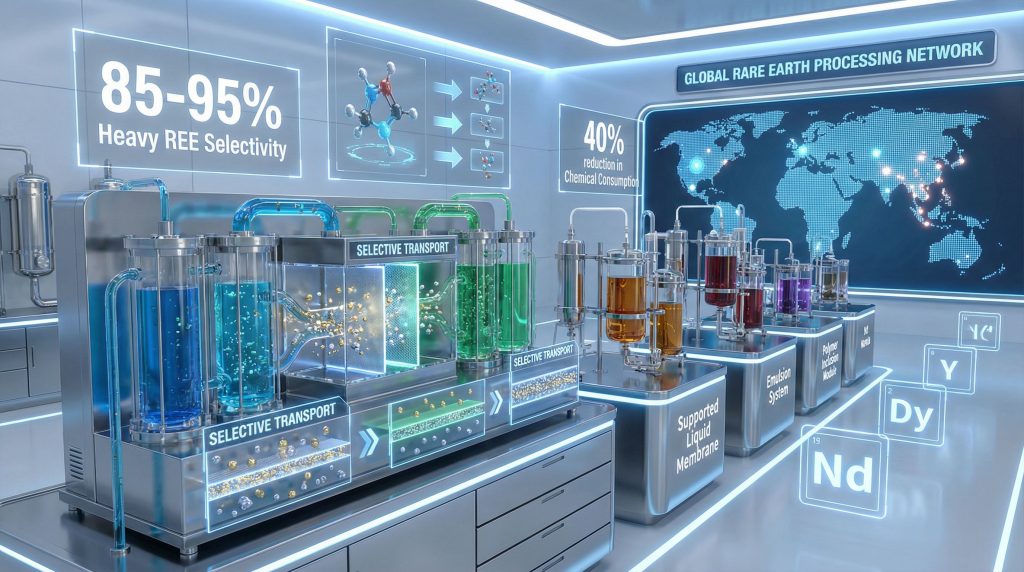
Liquid membrane technology for rare earths operates effectively at ambient temperatures due to enhanced mass transfer characteristics across thin membrane barriers. Elimination of heating requirements reduces energy consumption by 25-35% compared to conventional extraction. In addition, savings emerge from simplified equipment designs that eliminate energy-intensive mixer-settler operations.
Pumping energy requirements differ substantially between the two approaches. Conventional systems require high-flow-rate circulation of both aqueous and organic phases through multiple extraction and stripping stages. However, membrane systems achieve equivalent separation with reduced flow rates and simplified hydraulic circuits, resulting in 40-50% lower pumping energy consumption.
Chemical Consumption Optimisation
Solvent extraction operations consume substantial quantities of organic extractants, diluents, and conditioning chemicals. A typical facility processing 1000 metric tons per year of rare earth oxides requires 200-300 metric tons of organic chemicals annually. This includes makeup for losses, degradation, and contamination.
Membrane systems achieve 60-70% reduction in chemical consumption through several mechanisms. Carrier molecules are immobilised within membrane matrices, eliminating losses to aqueous phases that occur in conventional extraction. Consequently, organic diluent requirements decrease substantially due to reduced organic phase volumes in membrane configurations.
Acid and base consumption for pH control represents a significant operating cost in conventional systems. Membrane processes require more precise pH control but achieve 40-50% reduction in total acid/base consumption. This occurs due to improved efficiency and reduced side reactions that consume reagents unproductively.
Selectivity Performance Comparison
| Performance Metric | Liquid Membranes | Conventional SX | Improvement Factor |
|---|---|---|---|
| Heavy REE Selectivity | 85-95% | 60-75% | 1.3-1.5x |
| Chemical Consumption | 40% reduction | Baseline | 2.5x efficiency |
| Energy Requirements | 30% reduction | Baseline | 1.4x efficiency |
| Processing Time | 2-4 hours | 8-12 hours | 3-4x faster |
| Organic Losses | <0.1%/day | 1-3%/day | 10-30x improvement |
The selectivity advantages of membrane systems become particularly pronounced for heavy rare earth separation, where conventional methods struggle to achieve high discrimination factors. Membrane-based transport mechanisms enable kinetic selectivity effects that complement thermodynamic selectivity. Therefore, this results in enhanced overall performance.
Processing time reductions reflect the elimination of multiple equilibrium stages required in conventional extraction circuits. Membrane systems achieve steady-state operation within 2-4 hours compared to 8-12 hours required for conventional extraction trains to reach equilibrium conditions.
Scale-Up Challenges and Technical Barriers
The transition from laboratory-scale membrane systems to commercial rare earth processing faces numerous technical and economic challenges that have prevented widespread adoption despite promising research results. These barriers encompass membrane durability, fouling resistance, process integration complexity, and capital cost competitiveness with established extraction technology. Furthermore, data-driven mining operations become essential for optimising membrane performance at industrial scales.
Laboratory membrane studies typically utilise synthetic solutions with controlled compositions and minimal interfering components. Industrial applications must process complex real-world feedstocks containing organic matter, suspended solids, competing metal ions, and varying compositions. Consequently, these challenge membrane performance and longevity.
Membrane Fouling Mechanisms
Protein fouling represents one of the most severe challenges for membrane systems processing industrial wastewater. Organic matter present in acid mine drainage, process effluents, and leachate solutions forms tenacious films on membrane surfaces. These films reduce permeability and selectivity over time. Typical fouling rates result in 20-40% performance degradation within 30 days of continuous operation.
Inorganic precipitation fouling occurs when solution chemistry changes during processing cause formation of metal hydroxides, sulfates, or phosphates on membrane surfaces. Iron and aluminum species are particularly problematic, forming dense precipitate layers. Moreover, these block active transport sites and reduce effective membrane area.
Biological fouling emerges in systems processing wastewater containing microorganisms that form biofilms on membrane surfaces. These biological films not only reduce membrane performance but can also degrade membrane materials through enzymatic attack. In addition, acid production from bacterial metabolism contributes to degradation.
Process Integration Complexities
Feed pretreatment requirements for membrane systems often exceed those for conventional solvent extraction due to sensitivity to suspended solids, organic matter, and biological contamination. Pretreatment systems may include filtration, coagulation, pH adjustment, and disinfection steps. However, these add complexity and cost to overall process designs.
Temperature control becomes critical for membrane systems due to thermal sensitivity of polymer materials and carrier molecules. Industrial environments with significant temperature fluctuations require sophisticated control systems. Therefore, these maintain optimal operating conditions and prevent membrane degradation.
Continuous operation parameter optimisation requires advanced process control systems that monitor membrane performance, adjust operating conditions, and predict maintenance requirements. These control systems represent significant capital investments that must be justified through improved performance. Consequently, they require reduced operating costs to be viable.
Regional Implementation Potential
Geographic factors significantly influence the viability of liquid membrane technology for rare earths deployment, encompassing regulatory frameworks, infrastructure availability, labor capabilities, and strategic positioning within global supply chains. Southeast Asia emerges as a particularly promising region due to favourable combinations of these factors. Furthermore, there is growing recognition of supply chain diversification imperatives in the region.
The regional analysis must consider both technical feasibility and geopolitical implications of developing alternative rare earth processing capacity outside China's sphere of influence. Countries with established chemical processing industries and supportive regulatory environments present the most attractive opportunities. For instance, near-term membrane technology implementation shows particular promise.
Southeast Asian Processing Development
Malaysia's strategic position as an established chemical processing hub provides significant advantages for membrane technology deployment. The country's existing petrochemical infrastructure, skilled technical workforce, and proximity to rare earth resources in neighbouring countries create favourable conditions. Therefore, this supports developing membrane-based processing facilities.
Lynas Rare Earths' operations in Kuantan demonstrate Malaysia's capability to support large-scale rare earth processing, though current operations utilise conventional solvent extraction rather than membrane technology. The existing infrastructure, regulatory experience, and supply chain relationships provide a foundation. Consequently, this supports expanding into membrane-based secondary recovery applications.
Malaysia's regulatory framework for chemical processing provides clearer pathways for environmental permitting compared to more restrictive jurisdictions. The government's focus on developing high-technology industries aligns with strategic objectives. Moreover, this positions Malaysia as a regional processing centre for critical minerals.
Regulatory Environment Advantages
Environmental compliance cost reductions represent significant advantages for membrane technology in regions with stringent environmental standards. The reduced chemical consumption, lower waste generation, and elimination of organic solvent losses provide compliance benefits. Furthermore, these translate to direct cost savings in jurisdictions with strict environmental regulations.
Streamlined permitting processes for cleaner technologies enable faster project development timelines compared to conventional extraction facilities. These face more extensive environmental review requirements. Several Southeast Asian countries have established expedited permitting tracks for technologies that demonstrate superior environmental performance. In addition, this includes critical raw materials facility development programmes.
Government incentives for sustainable processing technologies include tax credits, accelerated depreciation allowances, and preferential financing terms. These improve project economics. Thailand's Board of Investment provides specific incentives for industries that utilise environmentally superior technology. For instance, this includes membrane separation systems.
Supply Chain Diversification Benefits
Reduced dependence on Chinese processing capacity represents a strategic imperative for Western countries seeking supply chain resilience for critical minerals. Southeast Asian membrane processing facilities could serve Western markets while providing supply chain diversification benefits. Consequently, this justifies premium pricing or preferential purchasing arrangements.
Regional security of supply improvements benefit neighbouring countries that currently depend entirely on Chinese processing for their rare earth requirements. Development of regional processing capacity using membrane technology could support supply security objectives. Moreover, this builds industrial capabilities simultaneously.
Technology transfer and knowledge development create long-term competitive advantages for countries that successfully deploy membrane processing technology. Early adoption could establish technical leadership positions. Therefore, this supports export of technology and services to other markets.
The next major ASX story will hit our subscribers first
Performance Metrics and Operational Standards
Establishing quantitative performance benchmarks for commercial liquid membrane operations requires comprehensive definition of recovery efficiency targets, purity specifications, environmental impact measurements, and economic viability indicators. These metrics provide objective criteria for evaluating membrane system performance against conventional processing methods. Furthermore, they identify optimisation opportunities for renewable energy mining transformations.
Performance measurement systems must account for variable feedstock compositions, changing market requirements, and evolving environmental standards. The metrics framework should enable comparison across different membrane configurations while providing guidance for technology selection. In addition, it supports process optimisation decisions.
Recovery Efficiency Benchmarks
Target extraction percentages vary significantly across different rare earth element groups due to inherent chemical differences and market value considerations. Light rare earth elements (lanthanum through europium) typically require 85-90% recovery efficiency to justify processing costs. However, heavy rare earth elements command premium pricing that makes 95-98% recovery economically attractive.
Concentration factors from dilute feeds represent critical performance measures for secondary source processing. Liquid membrane technology for rare earths must achieve 10-100x concentration factors to transform waste streams. These contain 10-50 ppm rare earth content into industrial feedstocks containing 1000-5000 ppm concentrations suitable for downstream processing.
Continuous operation uptime requirements for commercial facilities typically exceed 90% annual availability to achieve acceptable return on investment. This requirement necessitates reliable membrane systems with predictable maintenance schedules. Moreover, it requires minimal unplanned downtime from fouling, degradation, or equipment failures.
Environmental Impact Assessments
Wastewater discharge quality improvements through membrane processing provide measurable environmental benefits that support regulatory compliance and corporate sustainability objectives. Membrane systems typically achieve 60-80% reduction in dissolved metals concentrations compared to conventional treatment methods.
Solid waste generation reductions emerge from improved recovery efficiency and elimination of spent organic solvents that require hazardous waste disposal. Membrane processes generate 40-60% less solid waste per unit of rare earth production compared to conventional extraction systems. Furthermore, this significantly reduces environmental impact.
Carbon footprint assessments must consider both direct energy consumption and indirect emissions from chemical production, transportation, and waste treatment. Preliminary life cycle analyses suggest 25-35% carbon footprint reduction for membrane systems compared to conventional processing. However, this depends on specific operating conditions.
Economic Viability Indicators
Processing costs per kilogram of rare earth concentrate provide the most direct economic comparison between membrane and conventional processing methods. Current estimates suggest membrane systems require a $2-5 per kilogram premium over conventional processing. However, this differential decreases with larger facility scales.
Capital payback periods for membrane facilities typically range from 8-15 years depending on feedstock costs, product pricing, and operational efficiency achievements. These timelines exceed conventional extraction projects but may become acceptable under favourable economic scenarios. For instance, new research highlights opportunities for improving economic competitiveness.
Operational margin projections must account for membrane replacement costs, specialised labour requirements, and higher maintenance expenses. Successful commercial deployment requires demonstration of competitive operational margins compared to established solvent extraction technology. Consequently, this ensures long-term economic viability and market adoption.
Ready to discover the next breakthrough in mineral processing technology?
Membrane separation technology represents just one pathway in the evolving landscape of critical minerals processing, where emerging innovations create new investment opportunities in mining and metallurgy sectors. Discovery Alert's proprietary Discovery IQ model provides instant notifications when ASX companies announce significant breakthroughs in processing technologies or mineral discoveries, helping investors identify companies developing next-generation extraction methods before broader market recognition.