June 29, 2026
Understanding Industrial Microorganism Applications in Precious Metal Recovery
Industrial biotechnology has fundamentally transformed resource extraction across multiple sectors, with biological processes now constituting established pathways for accessing previously uneconomic ore bodies. The application of controlled microorganism environments to liberate valuable metals represents a convergence of environmental stewardship and operational efficiency that extends well beyond traditional extraction methodologies.
The significance of bioleaching in platinum group elements extends beyond mere technical innovation, representing a paradigm shift toward sustainable mineral processing that operates under ambient conditions while maintaining commercially viable recovery rates. Furthermore, understanding these biological extraction mechanisms requires examining the complex interplay between microbial metabolic processes, ore mineralogy, and industrial scalability factors that drive modern mining industry evolution.
When big ASX news breaks, our subscribers know first
Microbial Metal Liberation Mechanisms and Chemical Pathways
Bacterial Metabolite Production and Metal Complexation
The fundamental principle underlying bioleaching applications involves the metabolic activity of specialised microorganisms that produce organic acids and other metabolites capable of solubilising metal compounds from their host minerals. These biological systems operate through multiple pathways, including direct enzymatic action on mineral surfaces and indirect processes where bacterial metabolites create favourable chemical conditions for metal dissolution.
Research conducted at the University of Cape Town has demonstrated that certain bacterial consortia can achieve recovery rates consistently in the high 70s percentage range when applied to weathered platinum group element ore bodies. This performance level represents a significant advancement over conventional biological processing methods previously limited to copper and gold applications, highlighting important mineral exploration insights for the industry.
The chemical mechanisms involve the production of organic ligands that form stable complexes with platinum, palladium, and associated metals, effectively transferring them from the solid phase into solution where they can be recovered through downstream processing. In addition, temperature and pH optimisation becomes critical, as these parameters directly influence both microbial activity and metal solubility.
Processing Parameter Optimisation
Industrial implementation requires precise control of multiple variables that determine overall recovery efficiency. However, the complexity of these systems demands careful attention to operational parameters that influence biological activity.
- Temperature ranges of 25-65°C accommodate both mesophilic and thermophilic processing approaches
- pH optimisation typically favours slightly alkaline conditions for maximum metal recovery
- Pulp density between 0.5-4% w/v balances throughput with processing efficiency
- Retention times of 30-60 days provide adequate contact between microorganisms and ore materials
Comparative Performance Analysis Across PGE Types
The selectivity of biological processing systems varies significantly across different platinum group elements, with recovery rates influenced by the specific mineralogical associations and oxidation states present in the ore body. Consequently, understanding these variations becomes essential for optimising processing strategies.
| Metal | Recovery Method | Typical Recovery | Processing Duration | Optimal Conditions |
|---|---|---|---|---|
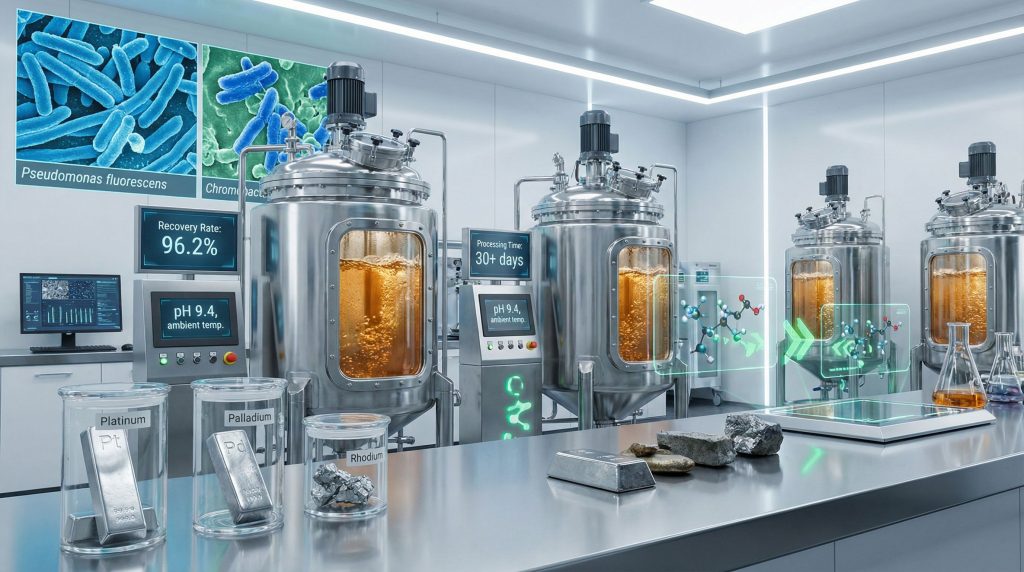
| Platinum | Cyanogenic bacteria | 70-80% | 30-60 days | pH 9.4, ambient temp |
| Palladium | Mixed consortia | 75-85% | 30-45 days | 2-3% pulp density |
| Rhodium | Specialised strains | 65-75% | 45-60 days | Neutral-basic pH |
| Ruthenium | Thermophilic systems | 40-60% | 30-50 days | 50-65°C |
The data indicates that palladium generally exhibits superior recovery characteristics compared to other PGE elements, likely due to its chemical behaviour in biological systems and the specific mineral associations common in weathered ore zones. For instance, these findings align with broader gold market trends showing increased interest in sustainable extraction methods.
Economic Analysis: Biological versus Conventional Processing
Capital and Operating Cost Comparisons
The economic attractiveness of biological processing stems from its substantially reduced energy requirements and simplified infrastructure compared to traditional high-temperature methods. Conventional platinum group element extraction typically involves energy-intensive processes that create significant operational burdens.
Conventional processing requirements include:
- High-temperature processing at 1000-1500°C requiring specialised furnace systems
- Complex flotation circuits with multiple stages and chemical reagent requirements
- Emission control systems adding significant capital and operating costs
- Intensive energy consumption for heating, grinding, and thermal processing
In contrast, bioleaching operations feature reduced complexity and enhanced sustainability. These systems demonstrate the potential decarbonisation benefits that modern mining operations increasingly prioritise.
- Ambient temperature processing reducing energy costs by 60-80%
- Simplified infrastructure based on heap leach or tank systems
- Lower reagent consumption relying primarily on biological nutrients
- Reduced environmental compliance costs through lower emission profiles
Processing Economics for Different Ore Types
The economic viability of biological processing varies significantly based on ore characteristics, with weathered ore bodies typically providing superior economics compared to fresh sulfide deposits. Furthermore, understanding these distinctions helps operators make informed processing decisions.
Weathered Ore Advantages:
- Higher porosity facilitating bacterial penetration
- Pre-oxidised mineral phases reducing processing requirements
- Lower acid consumption due to reduced neutralisation potential
- Simplified downstream processing through improved metal liberation
Fresh Ore Challenges:
- Dense mineral matrices limiting biological access
- Higher sulphur content requiring extended processing times
- Increased bacterial culture maintenance requirements
- Additional pre-treatment steps potentially negating cost advantages
Technical Challenges in Industrial Implementation
Scaling from Laboratory to Commercial Operations
The transition from laboratory-scale success to commercial viability presents multiple technical hurdles that must be systematically addressed through staged development approaches. However, successful implementation requires addressing specific technical challenges.
Contamination Control Systems: The maintenance of optimal bacterial populations in large-scale operations requires sophisticated monitoring and control systems to prevent contamination by competing microorganisms that could reduce processing efficiency.
Process Kinetics Acceleration: While biological processing offers cost advantages, the extended processing times of 30-60 days create inventory carrying costs and capital efficiency challenges that must be balanced against operational savings.
Metal Toxicity Management: As metal concentrations increase during processing, bacterial populations may experience toxicity effects requiring careful management of solution chemistry and potentially bacterial adaptation strategies.
Infrastructure Requirements for Biological Systems
Commercial bioleaching operations require specialised infrastructure components that support both biological and metallurgical processing requirements. Moreover, these systems must integrate seamlessly with existing mining operations.
- Bacterial cultivation and maintenance facilities
- Environmental control systems for temperature and pH regulation
- Solution management systems for leachate collection and processing
- Monitoring equipment for real-time bacterial population assessment
- Downstream processing facilities for metal recovery from pregnant solutions
Environmental Impact Assessment and Regulatory Considerations
Carbon Footprint and Environmental Benefits
The environmental advantages of biological processing extend beyond reduced energy consumption to encompass broader sustainability metrics that align with modern environmental regulations. Consequently, these benefits create competitive advantages in increasingly regulated markets.
Carbon Emissions Reduction: Operating at ambient temperature eliminates the substantial carbon footprint associated with high-temperature pyrometallurgical processing, potentially reducing greenhouse gas emissions by 70-90% per unit of metal produced.
Water Usage Optimisation: Biological systems typically operate with lower water consumption compared to conventional flotation processes, while produced waters often require less intensive treatment due to the absence of high-temperature chemical reactions.
Waste Stream Characteristics: Biological processing produces waste streams with fundamentally different characteristics, typically featuring organic compounds that are more readily biodegradable compared to the heavy metal and chemical residues from conventional processing.
The next major ASX story will hit our subscribers first
Integration Strategies with Existing Processing Infrastructure
Hybrid Processing Approaches
The optimal implementation of biological processing often involves integration with conventional methods rather than complete replacement, creating hybrid systems that leverage the advantages of each approach. For instance, these strategies complement comprehensive mine reclamation insights for sustainable operations.
Pre-treatment Applications: Biological processing can serve as a pre-treatment step for complex ore bodies, removing interfering elements and concentrating target metals before conventional processing stages.
Sequential Processing Systems: Staged approaches process weathered zones biologically while employing conventional methods for fresh ore, optimising overall project economics through selective application of appropriate technologies.
Tailings Reprocessing: Historical tailings from conventional operations often contain residual metals suitable for biological recovery, providing opportunities to generate revenue from previously processed materials.
Market Positioning and Competitive Advantages
Supply Chain Differentiation
The adoption of biological processing methods creates opportunities for supply chain differentiation in an increasingly environmentally conscious marketplace. Furthermore, these advantages translate into tangible commercial benefits.
ESG Investment Appeal: Environmental, social, and governance (ESG) focused investment strategies increasingly favour projects employing sustainable processing technologies, potentially improving access to capital and reducing financing costs.
Technology Licensing Opportunities: Companies successfully implementing biological PGE processing may develop intellectual property suitable for licensing to other operators, creating additional revenue streams beyond direct metal production.
Regulatory Compliance Advantages: Lower environmental impact profiles may facilitate permitting processes and reduce ongoing compliance costs, particularly in jurisdictions with stringent environmental standards.
Future Development Pathways and Technology Evolution
Advanced Biotechnology Applications
The evolution of biological processing technology continues through multiple research and development pathways that promise enhanced performance and broader applicability. However, realising these advances requires sustained investment in research and development.
Genetic Engineering Applications: Advances in biotechnology may enable the development of engineered bacterial strains optimised for specific metal recovery applications, potentially improving recovery rates and reducing processing times.
Process Automation Integration: Modern biotechnology increasingly incorporates sophisticated monitoring and control systems that enable real-time optimisation of bacterial populations and processing conditions.
Hybrid Biological-Electrochemical Systems: Emerging research explores combinations of biological and electrochemical processing that may achieve superior recovery rates while maintaining the environmental advantages of biological systems, as detailed in recent environmental biotechnology studies.
Investment Considerations and Risk Assessment
Technical and Commercial Risk Factors
Investment in biological processing technology involves multiple risk categories that must be carefully evaluated to ensure successful project outcomes. Moreover, understanding these risks enables better decision-making for potential investors.
Technical Risks:
- Scalability uncertainties from laboratory to commercial operations
- Bacterial population stability in large-scale environments
- Recovery rate consistency across varying ore characteristics
- Processing time optimisation under commercial constraints
Market Risks:
- Regulatory acceptance of biologically processed metals
- Market reception of products from novel processing methods
- Competition from conventional processing cost improvements
- Changes in environmental regulations affecting relative economics
Operational Risks:
- Bacterial culture management and contamination control
- Skilled personnel requirements for biological system operation
- Infrastructure reliability and maintenance requirements
- Integration challenges with existing processing facilities
Case Study Applications and Commercial Precedents
Lessons from Copper Industry Implementation
The copper industry provides valuable precedents for PGE biological processing, with bioleaching currently accounting for 15-20% of global copper production. This established track record demonstrates the commercial viability of biological processing at industrial scale while highlighting key success factors.
Furthermore, research into heap bioleaching applications provides additional insights into scaling these technologies for platinum group elements.
Successful Implementation Factors:
- Comprehensive pilot testing programmes validating process parameters
- Staged development approaches minimising initial capital requirements
- Strong partnerships between operators and research institutions
- Long-term commitment to technology development and optimisation
Economic Performance Data: Commercial copper bioleaching operations typically achieve operating cost reductions of 30-50% compared to conventional processing while maintaining metal recovery rates above 80% for suitable ore types.
Pilot Plant Performance Indicators
The progression from laboratory success to commercial viability requires systematic validation through pilot plant operations that bridge the gap between research and industrial implementation. In addition, these indicators provide crucial data for scaling decisions.
- Recovery consistency across varying ore batches and seasonal conditions
- Bacterial population stability under continuous operation scenarios
- Solution management efficiency in scaled processing environments
- Downstream processing integration with metal recovery systems
The biological processing of bioleaching in platinum group elements represents a convergence of environmental sustainability and economic optimisation that addresses multiple challenges facing the modern mining industry. While technical and commercial risks remain, the potential for significant cost reductions combined with superior environmental performance creates compelling investment opportunities for companies willing to pioneer this emerging technology.
However, successful implementation of bioleaching in platinum group elements requires careful consideration of technical, economic, and environmental factors that influence project viability. Consequently, operators must balance these considerations against traditional processing methods to optimise overall project economics.
The integration of biological processing into platinum group element extraction represents a fundamental shift from high-temperature, energy-intensive methods to ambient-condition systems that fundamentally alter the economics of complex ore processing while delivering superior environmental performance.
This analysis is provided for informational purposes and does not constitute investment advice. Investors should conduct their own due diligence and consult with qualified professionals before making investment decisions. The biotechnology applications discussed involve technical and commercial risks that may affect project outcomes.
Looking for investment opportunities in biotechnology mining innovations?
Discovery Alert's proprietary Discovery IQ model delivers real-time alerts on significant ASX mineral discoveries, including companies pioneering revolutionary biotechnology applications in resource extraction. Begin your 14-day free trial today and gain immediate access to actionable insights that keep you ahead of emerging technological trends transforming the mining sector.