June 27, 2026
Industrial mineral extraction technologies have evolved significantly over the past decade, with hydrometallurgical processes emerging as viable alternatives to traditional thermal methods. The development of demonstration facilities represents a critical bridge between laboratory-scale research and commercial production, particularly for strategic materials where supply chain security has become increasingly important. Furthermore, understanding how these facilities validate technical processes while simultaneously de-risking commercial investments provides valuable insight into modern mineral development strategies and supports the broader mining industry evolution.
Engineering Validation Through Sustained Production Testing
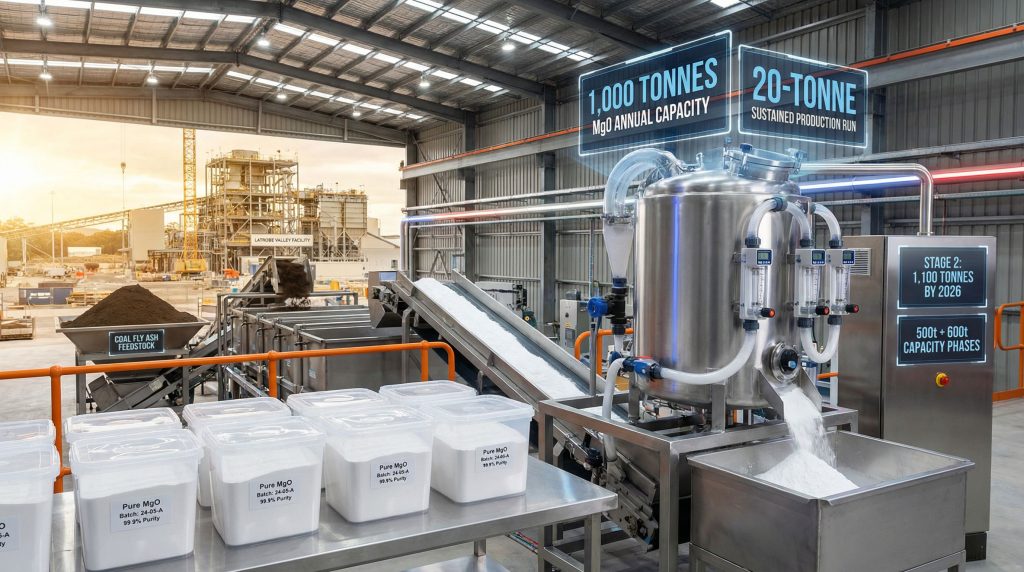
The hydrometallurgical processing of magnesium oxide from brown coal ash represents a breakthrough in waste-to-resource conversion technology. The Latrobe Magnesium demonstration plant milestone achieved sustained production of 20 tonnes of magnesium oxide over a continuous two-week operational period, validating both process stability and product quality specifications. This achievement demonstrates that proprietary extraction techniques can maintain consistent output under real-world operating conditions.
The facility's location in Hazelwood North positions it strategically within Victoria's established industrial infrastructure. Brown coal fly ash, previously considered waste material requiring disposal, serves as the primary feedstock for magnesium extraction. The conversion process utilises proprietary hydrometallurgical techniques that extract magnesium compounds while simultaneously addressing environmental challenges associated with ash disposal through innovative waste management solutions.
Quality assurance protocols implemented during the demonstration phase confirmed that magnesium oxide output meets commercial specifications. Customer sales of demonstration-phase material provide market validation of product quality and commercial viability. This real-world acceptance eliminates concerns about product specifications that often plague early-stage mineral processing ventures.
Process Optimisation and Reliability Metrics
The two-week sustained operation period provided critical data on equipment performance, process reliability, and operational parameters. Engineering teams identified specific enhancements to process performance, operability, and reliability that will be incorporated into commercial-scale facility design. Consequently, these improvements demonstrate how demonstration facilities serve as testing grounds for operational optimisation before major capital investment.
Feedstock preparation and handling methodologies were validated during continuous operations. Brown coal ash composition varies seasonally and by source, requiring robust processing techniques that accommodate feedstock variability. The demonstration phase confirmed that hydrometallurgical extraction maintains consistent magnesium oxide recovery rates despite natural variations in ash composition.
Environmental impact reduction through ash utilisation addresses two challenges simultaneously: magnesium supply and waste disposal. The process converts nearly all waste material into saleable by-products, creating additional revenue streams while minimising environmental footprint. This circular economy approach differentiates the technology from conventional magnesium production methods and supports the broader sustainable mining transformation.
When big ASX news breaks, our subscribers know first
Risk Mitigation Framework for Commercial Scale-Up
Demonstration plant operations substantially reduce technical and financial risks associated with commercial-scale magnesium production. The facility validated equipment performance under sustained operational conditions, allowing identification and resolution of potential bottlenecks before significant capital expenditure on commercial infrastructure. However, Australia's critical minerals reserve strategy provides additional context for strategic mineral development.
Process engineering validation during the demonstration phase established baseline performance metrics for scale-up calculations. Equipment throughput rates, efficiency percentages, and reliability metrics provide engineering data necessary for commercial facility design. This empirical data reduces uncertainty in scale-up factor calculations and equipment sizing decisions.
Cost structure analysis during demonstration operations established benchmarks for operating expenses at commercial scale. Fixed versus variable cost identification enables accurate financial modelling for commercial viability assessment. Revenue validation through confirmed customer sales provides market acceptance confirmation that reduces demand-side risk.
Commercial Plant Design Parameters
Stage 2 commercial development targets 1,100 tonnes per annum of magnesium metal production through integrated retort technology. The facility design incorporates horizontal retorts with 500 tonnes per annum capacity, complemented by vertical retorts providing an additional 600 tonnes per annum output. First magnesium metal production is anticipated in the second half of 2026, following equipment installation and commissioning.
| Production Stage | Annual Capacity | Technology Type | Timeline |
|---|---|---|---|
| Demonstration | 1,000t MgO | Hydrometallurgical | Operational |
| Stage 2 Phase 1 | 500t Mg Metal | Horizontal Retorts | H2 2026 |
| Stage 2 Phase 2 | 600t Mg Metal | Vertical Retorts | H2 2026 |
| Stage 3 Planning | 100,000t Mg Metal | Mega Plant Design | Future |
The progression from demonstration hydrometallurgical magnesium oxide production to commercial metal production via retort technology represents advancement in process integration strategy. Retort selection balances thermal efficiency, production capacity, and operational flexibility requirements for commercial viability. Additionally, Latrobe Magnesium has achieved significant milestones in its demonstration plant operations, validating the technical feasibility of the approach.
Strategic Mineral Supply Chain Vulnerabilities
Global magnesium supply concentration creates significant supply chain risks for Western manufacturers and defence applications. China dominates global magnesium production, creating single-source dependency that affects automotive, aerospace, and electronics manufacturing sectors. This concentration risk has prompted government recognition of magnesium as a strategic mineral requiring supply chain diversification.
Western manufacturing dependency on magnesium sources creates vulnerability during geopolitical tensions or trade disruptions. Strategic mineral classification reflects government understanding of magnesium's importance to national security and industrial capability. In addition, alternative source development has become a priority for supply chain resilience and supports energy transition minerals strategies.
Industrial applications driving magnesium demand growth include:
• Automotive lightweighting: Fuel efficiency requirements drive magnesium alloy adoption in vehicle manufacturing
• Aerospace components: Weight reduction specifications incorporate magnesium alloys for performance optimisation
• Electronics manufacturing: Consumer electronics utilise magnesium alloys in housing and structural components
• Defence applications: Military equipment specifications require domestic magnesium supply for security purposes
International recognition through frameworks like the US-Australia critical minerals partnership provides financing accessibility and strategic validation. The Export-Import Bank of the United States Letter of Interest positions Australian magnesium development within Western supply chain integration strategies.
Economic Transformation Through Waste Monetisation
The Latrobe Valley's transition from coal-fired power generation creates unique opportunities for critical minerals processing. Brown coal fly ash availability increases as power stations cease operations, providing abundant feedstock for magnesium extraction. This regional economic diversification strategy converts environmental liabilities into revenue-generating assets.
Circular economy implementation addresses multiple environmental and economic objectives:
• Waste stream monetisation: Brown coal ash converts from disposal liability to valuable feedstock
• By-product revenue: Processing operations generate multiple saleable materials beyond magnesium
• Environmental remediation: Industrial waste utilisation reduces disposal requirements
• Employment generation: Value-added mineral production creates regional employment opportunities
Low-emissions production processes attract attention from governments and manufacturers seeking environmentally responsible alternatives. The combination of waste utilisation and reduced environmental impact differentiates this approach from conventional magnesium production methods that typically involve significant energy consumption and emissions. Furthermore, the Australian government recognises Latrobe Magnesium's contribution to creating jobs and driving innovation while paving the path for reduced emissions.
Technical Risk Reduction for Investment Decisions
Demonstration plant validation provides empirical evidence that reduces technology risk for commercial-scale investment decisions. Sustained production capability over extended periods demonstrates process reliability under real operational conditions. This validation eliminates concerns about laboratory-to-commercial scaling challenges that often affect mineral processing ventures.
Customer acceptance confirmation through commercial sales validates market demand and product specifications. Revenue generation during the demonstration phase provides proof of commercial viability that strengthens investment cases for scale-up funding. Financial performance indicators established during operations inform cost structure assumptions for commercial facility development.
Operational reliability demonstrated under continuous conditions reduces uncertainty in production forecasting and capacity utilisation planning. Equipment performance data enables accurate maintenance scheduling and replacement cost estimation for commercial operations. These metrics improve financial modelling accuracy for long-term investment planning.
Critical Development Milestones Through 2026
Short-term operational targets focus on retort installation and commissioning for magnesium metal production. Equipment procurement and delivery timelines align with second-half 2026 production targets. Production ramp-up planning incorporates lessons learned during demonstration operations to optimise capacity utilisation.
The transition from magnesium oxide to metallic magnesium represents technological progression that expands market opportunities. Metal production serves automotive, aerospace, and defence applications directly, while oxide products primarily serve industrial and chemical applications. This product diversification reduces market concentration risk.
Long-term strategic development includes Stage 3 mega plant evaluation for 100,000 tonnes per annum capacity. Location assessment criteria consider feedstock availability, infrastructure access, and market proximity. Technology licensing opportunities may provide additional revenue streams as the process gains commercial validation.
International Competitive Positioning Analysis
Geographic proximity to Asia-Pacific manufacturing hubs provides logistical advantages for market access. Australian production offers Western manufacturers supply chain diversification while maintaining competitive transportation costs to major consumption centres. This positioning balances supply security with economic competitiveness.
Integrated waste utilisation creates competitive differentiation compared to conventional magnesium producers. Environmental compliance costs for traditional producers continue increasing, while waste-to-resource conversion provides cost advantages and regulatory benefits. This structural advantage improves long-term competitive positioning.
Process technology advantages include lower energy consumption compared to thermal reduction methods and reduced environmental impact versus electrolytic processes. These technical differentiators become increasingly important as environmental regulations tighten and energy costs rise globally.
The next major ASX story will hit our subscribers first
Investment Risk Assessment Framework
Technical risk mitigation through demonstration plant validation substantially reduces uncertainty for commercial-scale investment. Process reliability, product quality, and operational stability have been demonstrated under real conditions. This empirical validation addresses primary concerns that typically affect early-stage mineral processing investments.
Market risk reduction occurs through confirmed customer sales and international recognition. Government backing through critical minerals frameworks provides additional validation of strategic importance and market demand. These factors reduce demand-side uncertainty that often affects commodity investments.
Financial risk assessment benefits from demonstration phase cost structure validation and revenue confirmation. Operating cost benchmarks established during sustained operations inform commercial viability modelling. Capital efficiency metrics guide scale-up investment planning and equipment selection decisions.
Frequently Asked Questions
How does magnesium oxide production differ from metallic magnesium in terms of applications?
Magnesium oxide serves primarily as an industrial feedstock and intermediate product for chemical applications, refractory materials, and pharmaceutical uses. Metallic magnesium is the final product used directly in manufacturing applications such as automotive components, aerospace alloys, and electronics housing. The progression from oxide to metal production represents value-added processing that expands market opportunities.
What makes brown coal fly ash particularly suitable for magnesium extraction compared to other feedstocks?
Brown coal fly ash contains significant magnesium content in forms that respond well to hydrometallurgical extraction techniques. The material is available in large quantities as a waste product, providing cost advantages over mining dedicated magnesium ores. Additionally, utilising fly ash addresses environmental disposal challenges while creating valuable products.
How do demonstration plant results validate commercial-scale viability?
Sustained production over extended periods demonstrates process stability, equipment reliability, and product quality consistency under real operational conditions. Customer sales confirmation validates market acceptance and commercial specifications. Cost structure data informs financial modelling for commercial-scale investment decisions.
What role does international recognition play in project development?
Recognition through frameworks like the US-Australia critical minerals partnership provides financing accessibility, strategic validation, and market development support. Government backing reduces investment risk and confirms strategic importance for supply chain security initiatives.
Disclaimer: This analysis is based on publicly available information and industry research. Investment decisions should consider all relevant factors and seek professional financial advice. Forward-looking statements involve risks and uncertainties that may cause actual results to differ from projections. Mineral processing operations are subject to technical, environmental, and market risks that may affect commercial outcomes.
Ready to Capitalise on Strategic Mineral Developments?
Discovery Alert's proprietary Discovery IQ model delivers real-time alerts on significant ASX mineral discoveries, instantly empowering subscribers to identify actionable opportunities in critical materials like magnesium ahead of the broader market. Understand why historic discoveries can generate substantial returns by exploring major mineral developments, and begin your 14-day free trial today to position yourself ahead of the market.