
June 10, 2026
Understanding Industrial Natural Gas Recovery Through Advanced Engineering Systems
Modern unconventional resource development has evolved far beyond traditional extraction methods, driven by sophisticated engineering systems that maximize hydrocarbon recovery from previously inaccessible formations. The transformation of shale gas production demonstrates how technological innovation can unlock vast energy resources through precision drilling, advanced completion techniques, and data-driven operations. These developments represent a fundamental shift in how the industry approaches resource assessment and production forecasting.
Contemporary shale operations utilize manufacturing-style approaches that integrate multiple wells from single surface locations, dramatically reducing environmental footprint while maximising reservoir contact. This systematic development methodology has enabled operators to achieve consistent production results across diverse geological settings, challenging traditional assumptions about resource depletion and economic viability thresholds.
When big ASX news breaks, our subscribers know first
How Advanced Drilling Systems Revolutionise Resource Recovery
Precision Completion Technologies Drive Production Optimisation
Modern hydraulic fracturing systems have evolved to incorporate multi-stage optimisation protocols that precisely target specific reservoir intervals. According to recent technical assessments, completion design evolution from 2013 through 2025 has resulted in consistent well productivity averaging 55 bcfge per square mile, with no observable decline in performance metrics despite continued field development.
Extended lateral drilling capabilities now routinely achieve 10,000+ foot horizontal sections, maximising reservoir contact while maintaining wellbore stability. These extended reach capabilities enable operators to access larger drainage areas from individual surface locations, reducing infrastructure requirements and operational costs.
Technical Performance Indicators:
• Average well productivity: 55 bcfge/sq mile maintained since 2014
• Completion effectiveness: Step-change improvement documented post-2013
• Recovery efficiency: Approximately 48% basin-wide ultimate recovery
• EUR stability: Less than 1% revision over extended production periods
Proppant placement precision has advanced through specialised sand delivery systems that optimise fracture conductivity. Furthermore, AI drilling innovations enable targeted placement of proppant materials at specific reservoir depths and pressures, creating sustainable flow pathways that maintain productivity over extended production periods.
Real-Time Geosteering and Formation Evaluation
Contemporary drilling operations integrate real-time formation evaluation systems that continuously monitor geological parameters during drilling operations. These systems enable operators to maintain wellbores within optimal reservoir zones, maximising contact with productive rock while avoiding problematic formations.
The integration of downhole sensors with surface-based analytical systems provides immediate feedback on drilling performance. Consequently, this technology-driven approach allows for course corrections that optimise final well placement and has contributed significantly to the consistency of production results observed across Marcellus shale expansion programmes.
Enhanced Resource Assessment Through Production Analytics
Database-Driven EUR Forecasting Systems
Modern resource assessment methodologies utilise extensive production databases to validate and refine estimated ultimate recovery (EUR) projections. Recent comprehensive analysis incorporating 5,332 individual wells across 1,032 development sites demonstrates the stability and reliability of current forecasting approaches.
The consolidation of approximately 50 additional months of production data into assessment models has resulted in minimal EUR revisions for established plays. This data maturity enables more confident resource planning and investment strategies across diverse geological settings.
Production Data Analytics Framework:
• 5,332 wells analysed across comprehensive study period
• 1,032 development sites providing statistically significant dataset
• 50 months of additional production history incorporated
• Less than 1% EUR revision demonstrating forecast reliability
Resource Density Mapping and Economic Thresholds
Sophisticated mapping technologies enable precise determination of resource density across broad geographical areas. These systems integrate geological data with production performance to identify optimal development locations and sequence timing.
Resource density threshold analysis provides critical economic planning parameters. Areas exceeding 50 bcfge per square mile represent the highest-return development opportunities, containing approximately 257 tcfge of remaining reserves under current economic assumptions.
Economic viability varies significantly by resource density. Areas exceeding 50 bcfge per square mile represent optimal development targets, while regions below 30 bcfge per square mile require enhanced technology or improved commodity pricing for economic development.
Reservoir Pressure and Fluid Property Dynamics
Analysis of highly overpressured reservoir systems reveals unique challenges in EUR estimation. Traditional decline curve analysis methods may overestimate recovery potential in these environments due to pressure-dependent fluid property changes during production.
Research indicates that EUR estimates in overpressured formations can decline by approximately 5% or more as additional production data becomes available. For instance, some individual wells show revisions exceeding 70%, highlighting the importance of extended production history for reliable resource assessment.
Infrastructure Development Enabling Continued Expansion
Strategic Pipeline Network Expansion
Major pipeline infrastructure developments continue to enhance market access for shale gas production. Current takeaway capacity exceeds 30 Bcf per day, with additional projects representing over $15 billion in committed investment through 2027.
Major Pipeline Infrastructure Projects:
| Project Name | Capacity (Bcf/d) | Status | Investment ($B) |
|---|---|---|---|
| Mountain Valley | 2.0 | 2024 Online | 6.6 |
| Regional Connector | 1.65 | 2025 Expected | 3.2 |
| Atlantic Coast | 1.5 | Cancelled | – |
The Mountain Valley Pipeline represents a critical component of regional infrastructure, providing 2.0 Bcf per day of additional takeaway capacity with $6.6 billion in total investment. This infrastructure enhancement directly supports continued field development by ensuring reliable pipeline expansion for affordable energy access.
Regional Connector Pipeline development adds another 1.65 Bcf per day of capacity, scheduled for completion in 2025 with $3.2 billion in committed investment. These combined projects significantly enhance system reliability and market optionality for producers.
Processing and Storage Infrastructure Enhancement
Natural gas processing facilities continue expanding to accommodate increased production volumes and optimise natural gas liquids (NGL) recovery. These facilities incorporate advanced separation technologies that maximise value recovery from gas streams.
Underground storage capacity enhancements provide critical seasonal demand balancing capabilities. Additionally, strategic reserve development enables producers to optimise market timing and manage price volatility more effectively.
Export infrastructure connectivity represents a growing component of market access strategy. Direct pipeline connections to LNG export terminals provide access to international markets and support long-term contract development.
Resource Assessment Evolution and Comparative Analysis
Updated Technically Recoverable Resource Estimates
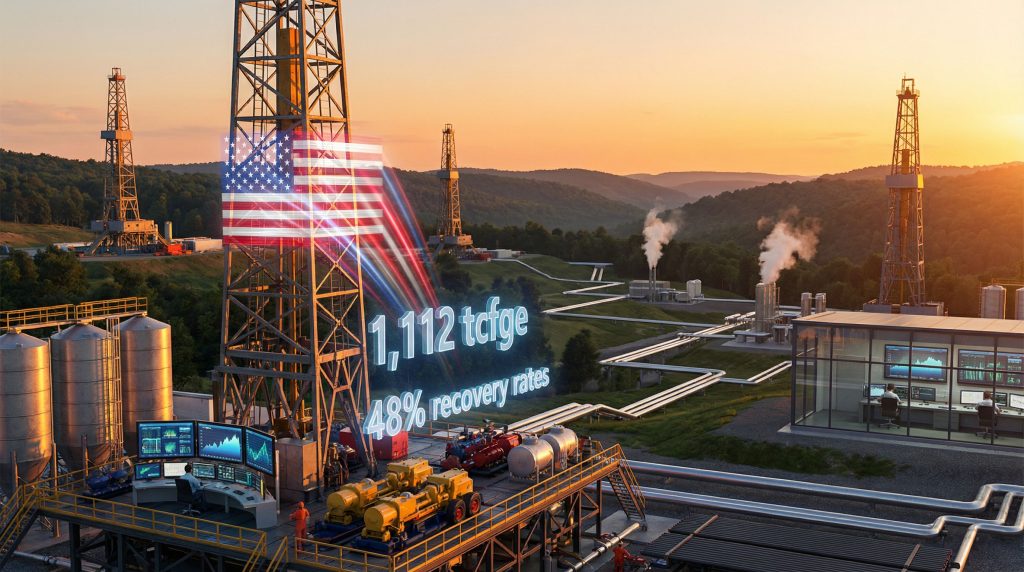
Current resource assessments indicate 1,112 tcfge ultimate technically recoverable resources for the Marcellus formation, representing a substantial increase from previous estimates. However, remaining technically recoverable resources total 919 tcfge, demonstrating significant development potential under current technology assumptions.
Resource Assessment Comparison:
• Current Assessment: 1,112 tcfge ultimate / 919 tcfge remaining
• Previous Assessment: 873 tcfge ultimate / 693 tcfge remaining
• USGS 2019 Estimate: 97 tcf (mean estimate)
• EIA AEO2025: 689 tcfge (doubled from previous assessment)
Recovery Efficiency and Geographic Performance Variations
Basin-wide recovery efficiency calculations suggest approximately 48% ultimate recovery when comparing current assessments with published gas-in-place estimates. Nevertheless, this parameter remains subject to uncertainty due to challenges in accurately estimating original gas-in-place volumes.
Regional performance variations reflect geological heterogeneity and completion optimisation differences. Southwest areas with liquids-rich production demonstrate higher EUR potential, while northeast dry gas regions offer lower-cost development opportunities with competitive economics.
Geographic expansion patterns indicate continued development beyond original play boundaries. Areas previously considered marginal now demonstrate economic viability through technology advancement and operational efficiency improvements.
Federal Agency Assessment Convergence
Recent federal agency estimate revisions demonstrate increasing alignment with industry-derived resource assessments. The Energy Information Administration's 2025 Annual Energy Outlook doubled Marcellus estimates to 689 tcfge, approaching industry-derived values.
USGS methodologies continue to show conservative results compared to production-based assessments, with 97 tcf mean estimates remaining significantly below observed production performance indicators. This divergence likely reflects differences between top-down geological modelling and bottom-up well performance analysis approaches.
Operational Excellence and Development Optimisation
Multi-Well Pad Development and Spacing Optimisation
Contemporary development strategies emphasise multi-well pad configurations that minimise surface disturbance while maximising reservoir drainage. Optimal lateral spacing has evolved from 1,000-foot standards to 500-750-foot intervals, enabling more intensive resource recovery.
Well spacing optimisation requires careful consideration of parent-child well interference effects. Advanced completion sequencing strategies minimise negative interactions between adjacent wells while maximising cumulative recovery from Marcellus shale expansion areas.
Manufacturing-Style Development Approach:
• Multi-well pads: Reduced surface footprint with enhanced recovery
• Optimised spacing: 500-750 foot intervals for maximum drainage
• Completion sequencing: Minimised interference between adjacent wells
• Integrated development: Coordinated timing and completion design
Technology Integration and Automation Systems
Modern drilling operations integrate artificial intelligence systems for automated geosteering and completion optimisation. These systems process real-time data streams to optimise drilling parameters and completion design decisions.
Enhanced recovery techniques represent emerging opportunities for mature well optimisation. Furthermore, secondary recovery methods and recompletion strategies may extend productive life and increase ultimate recovery from existing wellbores.
Water management systems have evolved to emphasise recycling and treatment technologies that reduce freshwater consumption. Closed-loop systems minimise environmental impact while reducing operational costs associated with water sourcing and disposal.
The next major ASX story will hit our subscribers first
Economic Drivers and Investment Considerations
Capital Efficiency and Cost Structure Optimisation
Drilling and completion costs have decreased approximately 40% from peak activity periods through operational efficiency improvements and technology advancement. These cost reductions enhance project economics and expand the range of economically viable development opportunities.
Scale economics in development enable manufacturing-style approaches that reduce per-unit costs through standardisation and optimisation of operational procedures. In addition, multi-well pad development and coordinated completion programmes contribute significantly to cost efficiency.
Cost Optimisation Strategies:
• 40% cost reduction from peak drilling and completion expenses
• Reduced cycle times through operational standardisation
• Increased success rates via technology integration
• Scale economics through coordinated development programmes
Market Fundamentals and Demand Growth
Domestic natural gas consumption trends support continued development through power generation and industrial demand growth. The transition to natural gas-fired power generation provides stable, long-term demand for domestic production.
Export market opportunities through LNG terminal capacity expansion create additional demand outlets and support premium pricing for domestic production. However, natural gas price trends affect long-term investment planning and revenue stability.
Competitive positioning analysis indicates favourable breakeven costs compared to other North American unconventional plays, supporting continued investment allocation to established development areas.
Regulatory Framework Impact on Development Patterns
State-Level Policy Variations and Permitting Efficiency
Pennsylvania's development environment has supported over 13,000 wells through streamlined permitting processes that balance development objectives with environmental oversight requirements. This regulatory efficiency contributes to the state's position as a leading natural gas producer.
West Virginia's resource optimisation approach emphasises balanced regulatory oversight that supports continued development while maintaining environmental protection standards. This framework enables efficient project development and permitting.
Ohio's integrated development strategies coordinate Utica and Marcellus development across multiple formations, maximising resource recovery through comprehensive planning approaches.
Environmental Compliance and Technology Integration
Modern operations integrate advanced emission reduction technologies that exceed regulatory requirements while maintaining operational efficiency. Consequently, leak detection systems and automated monitoring provide continuous environmental oversight.
Air quality monitoring systems incorporate real-time measurement capabilities that ensure compliance with emission standards while optimising operational parameters. These systems provide data transparency and support regulatory compliance objectives.
Surface impact minimisation strategies emphasise pad drilling and pipeline co-location that reduce overall development footprint. These approaches address community concerns while maintaining operational efficiency and supporting decarbonisation benefits.
Development Challenges and Risk Assessment
Technical and Geological Constraints
Formation heterogeneity requires adaptive completion designs that respond to varying reservoir properties across development areas. Standardised approaches must be modified to accommodate local geological conditions.
Parent-child well interference represents a continuing challenge in dense spacing development scenarios. Optimised development sequencing and completion timing help minimise these effects while maximising cumulative recovery.
EUR estimation challenges in overpressured reservoirs continue to present forecasting difficulties. Traditional analytical methods may require modification to accurately predict production performance in these environments.
Market and Infrastructure Risk Factors
Seasonal demand volatility creates market timing challenges that require sophisticated storage and hedging strategies. Price cycle management becomes critical for maintaining project economics.
Transportation capacity constraints can limit market access and create temporary bottlenecks that affect regional pricing. Diversified takeaway route development helps mitigate these risks.
Competition from renewable energy sources creates long-term demand uncertainty that affects investment planning horizons and project evaluation criteria.
Risk Assessment Matrix:
| Risk Category | Impact Level | Primary Mitigation Strategy |
|---|---|---|
| Regulatory Changes | Medium | Geographic portfolio diversification |
| Price Volatility | High | Hedging and cost optimisation |
| Infrastructure Delays | Medium | Multiple takeaway route development |
| Technology Obsolescence | Low | Continuous innovation investment |
Future Development Scenarios and Technology Trajectories
Advanced Recovery Technology Development
Artificial intelligence integration in drilling operations promises further efficiency improvements through automated decision-making and real-time optimisation. These systems may reduce operational costs and improve production consistency.
Enhanced recovery techniques for mature wells represent potential upside opportunities. Secondary recovery methods and advanced completion designs may extend productive life and increase ultimate recovery from existing infrastructure.
Environmental technology integration focuses on carbon capture and methane emission reduction systems that support environmental objectives while maintaining operational efficiency.
Long-Term Resource Development Projections
Full development scenarios assume current technology capabilities and unrestricted access to remaining prospective acreage. Under these assumptions, substantial additional Marcellus shale expansion remains economically viable.
Constrained development cases incorporate potential regulatory limitations and market access restrictions that may limit development pace or geographic scope. These scenarios provide conservative planning frameworks for Marcellus gas development.
Technology breakthrough scenarios consider advanced recovery methods that could expand the economically recoverable resource base beyond current estimates. These possibilities represent upside potential in long-term planning.
Industry Consolidation and Capital Allocation Trends
Operator consolidation trends focus efficiency improvements through scale economics and best-practice standardisation. Larger operators demonstrate advantages in technology integration and capital allocation.
Private equity and institutional investment continues flowing to proven resource areas with established production performance. These capital sources support continued development and infrastructure investment.
Vertical integration strategies connect upstream development with downstream market access, providing enhanced revenue stability and operational control throughout the value chain.
Disclaimer: This analysis contains forward-looking assessments based on current technology and market conditions. Actual results may vary significantly due to technological, regulatory, and market developments. Resource estimates and production forecasts should not be considered guarantees of future performance.
Additional Industry Resources
Readers seeking comprehensive technical analysis of Appalachian shale development can access detailed geological assessments through the National Energy Technology Laboratory and West Virginia Geological & Economic Survey publications. These resources provide extensive technical data on reservoir characterisation, completion optimisation, and regional development patterns that support informed analysis of unconventional resource development opportunities.
Looking for Investment Opportunities in Energy Resource Development?
Discovery Alert's proprietary Discovery IQ model delivers instant notifications on significant ASX mineral discoveries, helping investors identify actionable opportunities as they emerge from complex technical developments. Start your 30-day free trial today and position yourself ahead of the market with real-time insights powered by advanced AI technology.