June 7, 2026
Understanding Industrial-Scale Renewable Energy Integration
The fundamental challenge of powering massive industrial operations through renewable sources alone has historically presented insurmountable technical and economic barriers. Heavy industry operations require unprecedented levels of consistent, high-voltage electricity delivery across vast geographical territories, traditionally making fossil fuel dependency an operational necessity rather than choice. The Fortescue green energy grid represents a groundbreaking approach to completely reimagining industrial power infrastructure.
Recent developments in industrial energy architecture demonstrate how integrated renewable networks can fundamentally replace conventional power infrastructure in the most resource-intensive sectors. Furthermore, this transformation represents a shift from theoretical possibility to practical implementation at unprecedented scale, aligning with broader sustainability transformation initiatives across the industry.
When big ASX news breaks, our subscribers know first
What Makes Fortescue's Green Grid Approach Unique in Heavy Industry?
The technical framework underlying Fortescue green energy grid operations distinguishes itself through comprehensive integration across multiple renewable sources coordinated through sophisticated control systems. Unlike traditional renewable installations serving discrete facilities, this approach encompasses entire industrial ecosystems spanning hundreds of kilometres.
Core Infrastructure Components:
| Component Type | Capacity Range | Primary Function |
|---|---|---|
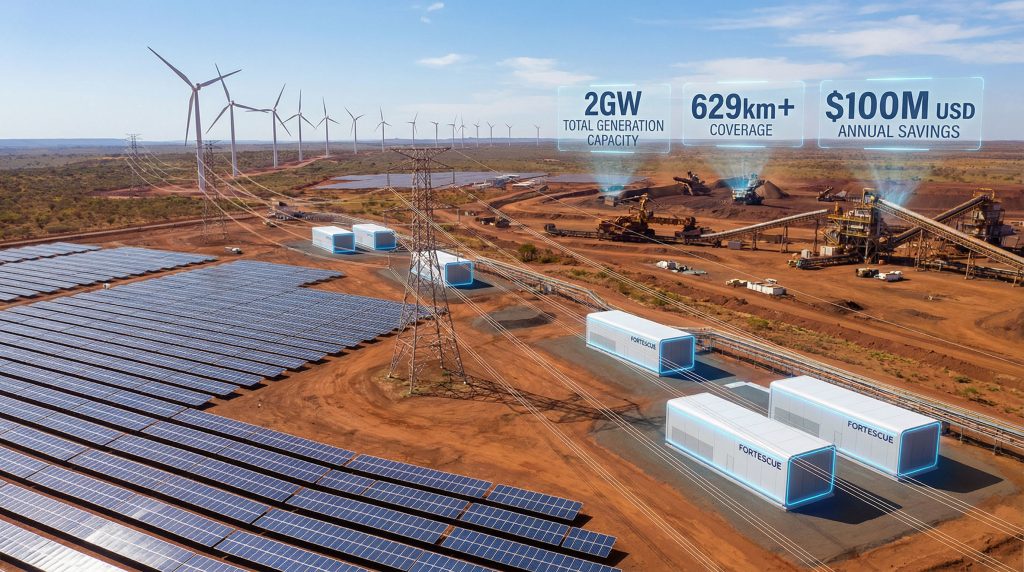
| Solar Generation Arrays | 1,200MW+ planned | Daytime baseload power |
| Wind Power Systems | 600MW+ capacity | Continuous generation complement |
| Battery Storage Networks | 4-5GWh total | Grid stabilisation and 24/7 supply |
| High-Voltage Transmission | 629km+ coverage | Power distribution backbone |
The system operates as a standalone renewable network in Western Australia's Pilbara region, designed to eliminate diesel dependency whilst maintaining industrial-grade power quality standards for continuous operations. This off-grid architecture supports approximately 10,000 personnel across multiple operational sites through coordinated renewable generation.
According to Fortescue's decarbonisation strategy, global energy supply chains face increasing instability, making fossil fuel dependence the largest operational risk factor for industrial mining operations. The company characterises renewable integration as offering both cost control and energy security through eliminating external energy market exposure.
Technical Architecture of Large-Scale Green Energy Networks
Industrial renewable networks require synchronising multiple generation sources across vast distances whilst maintaining power quality standards without traditional fossil fuel backup systems. The scale and complexity exceed typical commercial renewable applications due to continuous 24-hour operational demands and extremely high power consumption requirements, representing key mining innovation trends in the sector.
Geographic and Operational Considerations:
- Location: Pilbara region deployment across remote mining territories
- Workforce Support: Infrastructure serving approximately 10,000 personnel
- Integration Method: Standard equipment replacement cycles minimising additional capital
- Completion Timeline: Full grid completion targeted for end of 2028
The deployment occurs through standard end-of-life replacement cycles for existing equipment, maintaining capital discipline whilst achieving fundamental operational transformation. This approach enables infrastructure renewal and renewable integration simultaneously without requiring massive additional capital expenditures.
Engineering Challenges in Off-Grid Renewable Systems
How Do Mining Operations Achieve 24/7 Renewable Power Supply?
Continuous renewable power for industrial operations requires solving complex coordination challenges across weather-dependent generation sources, variable operational demands, and grid stability maintenance without dispatchable fossil fuel generation capabilities. These challenges are central to current mining electrification trends across the industry.
Critical System Management Variables:
- Load balancing across multiple mining sites with unpredictable power demands
- Weather variability affecting solar generation through cloud cover and seasonal variation
- Wind resource fluctuations impacting consistent generation availability
- Peak demand management during high-intensity mineral processing operations
- Grid frequency and voltage stability without traditional synchronous generators
Phased Implementation Timeline:
Phase 1 (Early 2027): 290MW renewable capacity installation enabling daytime fossil fuel elimination for processing operations with initial grid stability validation.
Phase 2 (Late 2027): Extended battery storage deployment providing 24-hour renewable operational capability through comprehensive backup power systems.
Phase 3 (End 2028): Complete 2GW generation capacity with full industrial ecosystem integration and commercial replication readiness.
Energy Storage Integration Strategy
Modern battery systems deployed in mining operations must provide multiple grid support functions significantly exceeding typical commercial applications. However, this integration forms part of broader energy transition security initiatives.
Storage System Requirements:
- Short-term stabilisation: Frequency and voltage support measured in seconds to minutes
- Extended backup power: Hours to days of continuous supply during generation shortfalls
- Peak demand management: Handling operational spikes without expensive capacity charges
- Rotating reserves: Maintaining sufficient stored energy for operational continuity
The 4-5GWh total battery capacity represents substantially larger storage deployment than conventional renewable installations due to industrial operational demands and the absence of grid connectivity for backup power supply.
Transmission Infrastructure for Remote Industrial Operations
High-voltage transmission networks spanning 629km+ across remote Pilbara locations face unique operational challenges requiring specialised engineering solutions:
Infrastructure Resilience Requirements:
- Environmental durability: Withstanding extreme weather including cyclones and extreme heat
- Maintenance logistics: Service accessibility across vast distances with limited population centres
- Power quality maintenance: Voltage stability over extended transmission distances
- Expansion flexibility: System architecture enabling future capacity additions
The transmission network must coordinate three primary renewable sources (solar, wind, battery storage) whilst maintaining industrial power quality standards across hundreds of kilometres without traditional grid backup systems.
Economic Framework for Industrial Decarbonisation
What Are the Financial Drivers Behind Large-Scale Green Grid Investment?
The economic rationale for comprehensive industrial renewable energy extends beyond environmental compliance to fundamental operational and financial advantages creating permanent cost structure improvements. This represents a significant evolution in the Fortescue green energy grid business model.
Quantified Financial Benefits:
| Timeframe | Financial Impact | Operational Significance |
|---|---|---|
| 2027 | $100M USD annual savings | Immediate fuel cost elimination |
| Long-term | $2-4 USD/tonne reduction | C1 cost structure improvement |
| Strategic | Energy price stability | Market volatility insulation |
Capital Deployment Strategy:
The integration occurs within approved decarbonisation budgets through standard equipment replacement cycles, avoiding large additional capital requirements whilst achieving transformative operational improvements. This approach enables synchronised infrastructure renewal and renewable transition.
Cost Structure Transformation:
- Fuel cost elimination: Complete removal of diesel expenses from operational budgets
- Price predictability: Fixed energy costs enabling accurate long-term financial forecasting
- Competitive positioning: Stable costs during commodity price volatility periods
- Supply chain independence: Elimination of fuel logistics and procurement risks
Risk Management Through Energy Independence
Industrial operations face increasing exposure to volatile global fossil fuel markets creating operational and financial uncertainties. Self-sufficient renewable systems provide comprehensive risk mitigation, particularly important for green metals leadership positioning.
Market Risk Reduction:
- Price stability: Complete insulation from global fuel price fluctuations
- Supply security: Independence from external energy markets and geopolitical disruptions
- Operational predictability: Known energy costs improving financial planning accuracy
- Competitive advantage: Fixed energy expenses during market downturns
The annual $100 million fuel cost savings projected for 2027 represents early-stage benefits from 290MW installed capacity. Full system deployment achieving $2-4 USD per tonne C1 cost reduction creates substantial cumulative advantages for high-volume mining operations producing tens of millions of tonnes annually.
Technology Integration and Optimisation Systems
How Do AI-Driven Systems Optimise Industrial Renewable Networks?
Advanced grid optimisation requires real-time coordination of multiple complex variables across weather forecasting, demand prediction, storage management, and grid stability maintenance without traditional dispatchable generation resources.
System Optimisation Framework:
| Optimisation Parameter | Function | Operational Impact |
|---|---|---|
| Weather Forecasting | Solar irradiance and wind speed prediction | Generation capacity planning and reserve management |
| Demand Prediction | Load forecasting based on production schedules | Battery charging strategy and stability preparation |
| Storage Optimisation | Dynamic charging/discharging algorithms | Peak demand management and cost minimisation |
| Grid Stability | Frequency and voltage regulation | Industrial power quality without fossil backup |
Fortescue's renewable acceleration plans emphasise developing proprietary AI-driven optimisation systems and in-house technologies to support scalability across different geographic locations and industrial applications. This approach creates competitive advantages through technology licensing opportunities and customisation capabilities.
Equipment Electrification Across Industrial Operations
The renewable grid transition encompasses comprehensive electrification across multiple operational categories requiring coordinated system integration:
Operational Electrification Scope:
- Processing facilities: High-voltage supply for ore crushing, grinding, and beneficiation equipment
- Transportation systems: Rail infrastructure and port operations currently diesel-dependent
- Support services: Workforce facilities, logistics, and administrative operations
- Mobile equipment: Progressive transition of haul trucks and mining equipment to electric systems
The comprehensive approach enables complete fossil fuel elimination across all operational aspects rather than partial renewable integration typical of conventional industrial energy projects.
Scalability Through Proprietary Technology Development
The development of proprietary optimisation systems creates opportunities for broader commercial application through technology licensing and "energy as a service" arrangements. Early-stage discussions with potential international partners indicate significant replication potential across different industrial sectors.
Commercial Application Framework:
- Technology licensing: Providing optimisation systems to other industrial operators
- Geographic adaptation: Customising systems for varying renewable resource availability
- Sector diversification: Applications in steel production, chemicals, cement manufacturing
- Service delivery: "Energy as a Service" contracts for complete system management
The next major ASX story will hit our subscribers first
Global Implications for Heavy Industry Decarbonisation
Can This Model Be Replicated in Other Industrial Sectors?
The technical framework demonstrated through Fortescue green energy grid implementation provides replicable solutions for energy-intensive industries facing similar decarbonisation challenges and operational requirements.
Potential Industrial Applications:
- Steel production: High-temperature processing and continuous operational requirements
- Chemical manufacturing: Complex processing with variable energy demands
- Cement production: Energy-intensive grinding and heating operations
- Large-scale manufacturing: Multi-facility operations requiring reliable power supply
Geographic Replication Considerations:
Different regions present varying technical and economic factors affecting renewable integration feasibility:
- Solar irradiance availability and seasonal variation patterns
- Wind resource consistency and diurnal generation characteristics
- Transmission infrastructure requirements and geographical constraints
- Regulatory frameworks supporting large-scale industrial renewable deployment
Commercial Opportunities in Industrial Green Grid Technology
The successful demonstration of complete fossil fuel elimination in heavy industry creates new market opportunities for technology providers and industrial operators seeking similar transformations.
Market Development Pathways:
- Turnkey system providers: Complete renewable grid design and implementation services
- Optimisation technology: AI-driven systems for multi-source renewable coordination
- Energy service models: Long-term contracts for renewable energy management
- Equipment electrification: Specialised systems for industrial renewable integration
Implementation Timeline and Operational Milestones
What Are the Key Development Phases for Industrial Green Grids?
The systematic implementation approach demonstrates how large-scale industrial renewable integration can occur through coordinated phases minimising operational disruption whilst achieving progressive decarbonisation milestones. According to Reuters' analysis of Fortescue's diesel elimination timeline, these phases are critical for operational success.
Development Phase Structure:
Phase 1: Daytime Renewable Operations (Early 2027)
- 290MW renewable capacity installation and commissioning
- Daytime fossil fuel elimination for processing operations
- Initial grid stability validation and optimisation refinement
- Immediate $100 million annual fuel cost savings realisation
Phase 2: Extended Renewable Operations (Late 2027)
- 4-5GWh battery storage deployment and integration
- 24-hour renewable power capability demonstration
- Complete daytime and nighttime fossil fuel independence
- Advanced optimisation system validation
Phase 3: Complete Grid Integration (End 2028)
- Full 2GW generation capacity across solar, wind, and storage
- Complete industrial ecosystem electrification
- $2-4 USD per tonne C1 cost reduction achievement
- Commercial replication model validation
Measuring Success in Industrial Decarbonisation
Performance Evaluation Framework:
| Metric Category | Measurement Approach | Success Indicators |
|---|---|---|
| Energy Independence | Renewable power percentage | 100% fossil fuel elimination |
| Cost Performance | Unit cost reduction per tonne | $2-4 USD/tonne C1 improvement |
| System Reliability | Uptime and stability metrics | Industrial-grade power quality maintenance |
| Scalability Assessment | Replication potential evaluation | Technology transfer readiness |
The comprehensive measurement approach ensures both immediate operational benefits and long-term strategic positioning for broader industrial renewable energy market development.
Future Developments in Industrial Renewable Energy
How Will Green Grid Technology Evolve for Heavy Industry?
Emerging technological developments will enhance industrial renewable capabilities through improved storage systems, advanced forecasting, and integrated optimisation across multiple energy vectors.
Next-Generation Technology Improvements:
- Enhanced storage systems: Higher energy density batteries enabling extended backup capabilities
- Predictive optimisation: Advanced weather forecasting integration with machine learning algorithms
- Grid management evolution: Real-time demand response and autonomous load balancing
- Hydrogen integration: Renewable hydrogen production for extended energy storage applications
Strategic Positioning for Global Energy Transition
Industrial companies implementing comprehensive renewable systems gain substantial competitive advantages positioning them for regulatory compliance, market differentiation, and operational resilience.
Competitive Advantage Framework:
- Regulatory positioning: Compliance with tightening emissions standards ahead of requirements
- Market differentiation: Premium positioning for environmentally-focused supply chains
- Operational resilience: Independence from volatile fossil fuel markets
- Technology leadership: Industry leadership in comprehensive decarbonisation solutions
The successful implementation of large-scale industrial green grids represents a critical milestone demonstrating the technical and economic viability of complete fossil fuel elimination in heavy industry operations, creating pathways for broader industrial sector transformation.
Disclaimer: This analysis is based on publicly available information and company announcements. Readers should conduct independent research and consult with qualified professionals before making investment decisions. Future performance projections involve inherent risks and uncertainties that may differ significantly from actual results.
Ready to Capitalise on Major Industrial Energy Transformations?
Discovery Alert's proprietary Discovery IQ model delivers real-time alerts on significant ASX mineral discoveries and industrial breakthroughs, instantly empowering subscribers to identify actionable opportunities ahead of the broader market. Begin your 14-day free trial today and position yourself to benefit from transformative developments in mining and energy infrastructure before they reach mainstream attention.