
June 7, 2026
The Logistics Reality Behind Africa's Most Compelling Undeveloped Bauxite Deposit
Mineral wealth and commercial viability are two entirely different things. Across Central and West Africa, there are dozens of large-scale mineral deposits that have remained dormant for decades, not because of any geological shortcoming, but because the infrastructure required to move ore from mine to market simply did not exist. The story of the Cameroon rail project linked to Minim Martap bauxite development is, at its core, a story about bridging that gap, and why the sequence of logistics decisions made before first production can determine whether a deposit ever earns a dollar.
Understanding the Minim Martap project requires thinking like a supply chain engineer before thinking like a geologist. The ore body itself is not in question. What is being constructed, negotiated, and sequenced right now is the infrastructure stack that will either unlock or permanently constrain the deposit's commercial potential.
When big ASX news breaks, our subscribers know first
The Geology Is Strong, but the Geography Creates the Problem
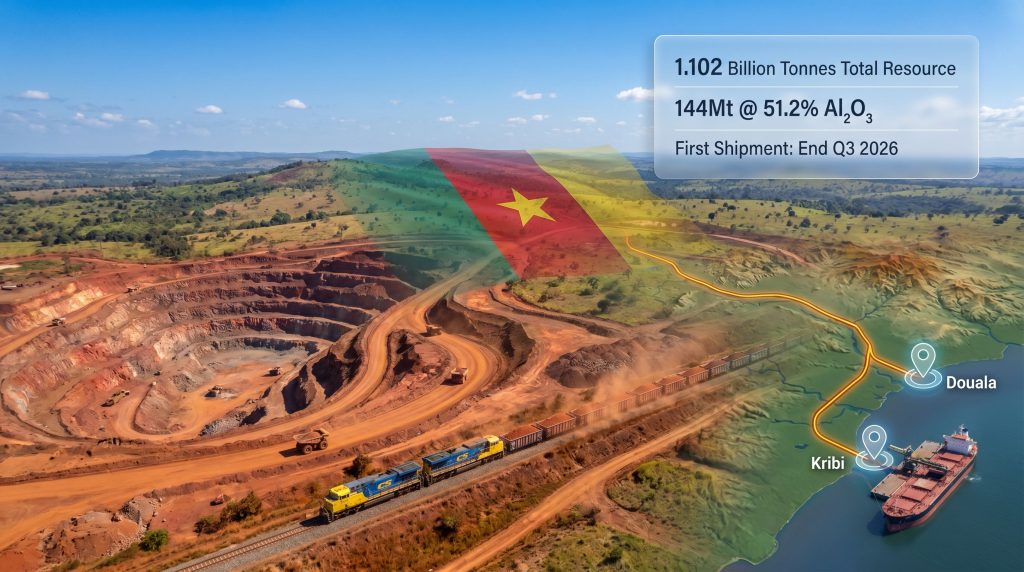
The Minim Martap deposit sits in Cameroon's Adamawa Region, a high-altitude interior plateau that is geographically isolated from the country's coastline and export infrastructure. The deposit holds a total resource of 1.102 billion tonnes, with a defined ore body of 144 million tonnes grading 51.2% alumina (Al₂O₃) and 1.7% silica, according to figures reported by Camalco, the Canyon Resources subsidiary advancing the project.
To put the alumina grade in context, bauxite quality is typically assessed on three key parameters:
- Available alumina content, expressed as a percentage of Al₂O₃
- Reactive silica content, which affects refinery processing costs through increased caustic soda consumption
- Stripping ratio, which influences the cost of extracting ore relative to waste removal
At 51.2% Al₂O₃ and just 1.7% silica, Minim Martap compares favourably against many actively mined deposits globally. Guinea's Sangarédi operation, widely considered a global benchmark for bauxite quality, typically produces material in the 42–45% Al₂O₃ range with variable silica content. The low silica figure at Minim Martap is particularly significant for alumina refiners, as reactive silica drives up the Bayer process costs that sit at the heart of alumina production.
"High-grade, low-silica bauxite is the feedstock that refiners compete for most aggressively. Its value is not just in the ore itself, but in what it saves downstream in caustic soda consumption and processing time. A deposit at 51.2% alumina with 1.7% silica represents a genuinely premium product in the global bauxite trade."
Despite these credentials, the deposit remained undeveloped for years. The reason is straightforward: no mine generates revenue without a route to market.
Why Equity Ownership in Camrail Changes Everything
The single most consequential near-term infrastructure decision made by Camalco is not the Edéa-Kribi memorandum of understanding. It is the expansion of its shareholding in Camrail, Cameroon's primary rail operator, from 9.1% to 26.9%, achieved through an investment of CFA 9.852 billion (approximately USD 17.5 million).
This distinction matters enormously in the context of mining logistics. There are two fundamentally different ways a mine developer can secure rail access:
- Negotiate a freight access agreement as a commercial customer, which provides scheduled access but limited operational influence
- Take an equity stake in the rail operator, which creates board-level influence, scheduling priority, and alignment of incentives over the mine's operating life
The first approach is common in early-stage projects. The second is what serious long-life mining operations pursue when they reach production planning maturity. By moving from a 9.1% to a 26.9% shareholding, Camalco has shifted from being a tenant of Cameroon's rail network to being a co-owner. At that level of equity, the company gains meaningful influence over capacity decisions, maintenance investment, and operational priorities that directly affect mine throughput.
Furthermore, Camalco's carefully considered mine-to-port logistics strategy also included a further commitment of CFA 347.447 million (approximately USD 616,000) into Terminal Bois du Port de Douala S.A., securing a foothold in the port handling infrastructure that will serve as the near-term export gateway.
The Mine-to-Market Logistics Sequence, Step by Step
The operational pathway from mine to vessel is a multi-stage chain, and every link matters. The current infrastructure buildout being executed by Camalco addresses each stage sequentially:
| Stage | Infrastructure Component | Status as at June 2026 |
|---|---|---|
| Mine extraction | On-site equipment, haul roads | Development phase ongoing |
| Inland rail haulage | Camrail network access | 26.9% equity stake secured |
| Port handling at Douala | Terminal Bois du Port de Douala S.A. | Strategic investment completed |
| Rolling stock | Locomotives and ore wagons | Locomotives en route; wagons due July 2026 |
| First export shipment | Vessel loading, Douala | Targeted end of Q3 2026 |
| Long-term deep-water access | Edéa-Kribi rail corridor and Port of Kribi | MoU framework signed; pre-feasibility stage |
The rolling stock timeline is one of the most closely watched variables right now. Seven locomotives are reportedly being shipped to Cameroon with arrival expected before the end of Q2 2026, while wagon deliveries are scheduled for July 2026. This leaves a narrow operational window to achieve the end of Q3 2026 first shipment target.
Any delay in wagon delivery compresses testing, loading trials, and first ore movement into a very short timeframe. In mining infrastructure development, the arrival of physical rolling stock is one of the most reliable signals of genuine production intent. Unlike feasibility studies or memoranda of understanding, locomotives and ore wagons are tangible, purchased, and committed assets. Their arrival shifts a project from planning to operational preparation.
Decoding the Edéa-Kribi MoU: What It Is and What It Is Not
On 4 June 2026, Camalco and Africa Global Logistics (AGL) signed a Memorandum of Understanding in Yaoundé covering the proposed Edéa-Kribi-Lolabé-Campo rail corridor. The signing ceremony was held at the Starland Hotel under the patronage of Cameroon's Transport Minister Jean Ernest Massena Ngallè Bibehe.
Before interpreting this event, it is important to understand what MoUs actually represent in the context of African resource infrastructure.
What the MoU establishes:
- A structured framework for feasibility study discussions
- A shared commercial interest between a logistics operator and a mining developer
- An entry point for negotiations on financing, construction, operations, and maintenance
What the MoU does not represent:
- A final investment decision
- A confirmed project cost or construction timeline
- An agreed concession structure or route alignment
- A financing commitment from any party
"In resource infrastructure, an MoU marks the beginning of the formal commercial conversation, not the conclusion. Multiple African rail projects have operated under MoU frameworks for years before advancing to bankable feasibility stage. The Edéa-Kribi corridor should be understood as a long-term strategic ambition operating on a separate timeline from Camalco's near-term 2026 production plans."
The corridor itself is not a new concept. Cameroon's transport planning authorities were already evaluating a 291.5 km railway expansion framework as early as 2021, which included a 184.5 km Edéa-Kribi-Campo line and a separate 107 km Douala-Limbe-Idenau line. The fact that this corridor has been under consideration for several years without reaching a final investment decision illustrates how complex and capital-intensive such projects are, even with political goodwill present.
Ministerial patronage at the signing ceremony is, however, a notable signal. When a transport minister formally presides over an infrastructure MoU between a mining developer and a logistics company, it indicates that the proposal has passed informal political gatekeeping. This does not constitute government funding, backing, or official project designation, but it does suggest the corridor has high-level attention within the national transport planning framework.
Douala vs. Kribi: The Port Geography Shaping Cameroon's Export Future
Understanding why the Kribi corridor matters requires understanding the structural limitations of Douala, which remains Cameroon's primary commercial port.
| Factor | Port of Douala | Port of Kribi |
|---|---|---|
| Location | Wouri estuary, inland waterway approach | Atlantic coastline, direct deep-water access |
| Vessel size capability | Limited for large bulk mineral carriers | Panamax and Capesize capable |
| Infrastructure maturity | Established and operational | Newer, expanding facility |
| Rail connection | Existing Camrail network | Requires new Edéa-Kribi corridor |
| Role in Camalco's plan | Near-term primary export route (2026) | Long-term strategic export alternative |
Douala's position within the Wouri estuary creates a physical constraint on vessel draft. Large bulk mineral carriers — the class of vessel that makes high-volume bauxite exports economically competitive — require deep-water berths. Douala's estuary geometry limits its capacity to accommodate these vessels, which is precisely why aluminium refiners and shipping operators globally have watched the development of Kribi's deep-water facilities with interest.
The Minim Martap project is therefore working through a two-phase export architecture:
Phase 1 involves routing ore through the existing Camrail network to Douala for initial shipments targeted from late 2026, using the terminal infrastructure in which Camalco has now invested.
Phase 2 envisions the eventual development of the Edéa-Kribi corridor, enabling larger vessel loading at Kribi, reducing per-tonne freight costs, and giving Camalco access to the global bulk freight market in a more competitive cost position.
The next major ASX story will hit our subscribers first
AGL's Strategic Calculus and What It Means for the Corridor
Africa Global Logistics is not a passive signatory to the Edéa-Kribi MoU. The company operates across both rail and port logistics segments in multiple African markets, and bauxite is precisely the type of commodity that makes infrastructure investment attractive: bulk in volume, consistent in flow, and amenable to long-term offtake-style freight contracts.
For AGL, the Edéa-Kribi corridor represents more than a single mining client. A functioning southern Cameroon rail corridor would capture trade flows from multiple industries across the region, with bauxite from Minim Martap serving as the anchor cargo that makes the economics of construction viable. This dynamic — where a single anchor commodity client underwrites broader infrastructure investment — is a well-established model in African resource infrastructure development.
Cameroon's Place in the Global Bauxite Supply Landscape
Bauxite is the raw material from which aluminium is ultimately derived, passing through the Bayer process to become alumina, then smelted via the Hall-Héroult process to produce primary aluminium. The entire chain begins with bauxite quality and supply reliability. Shifts in the bauxite and alumina market are therefore closely watched by producers, refiners, and investors alike.
Global bauxite production is heavily concentrated:
- Australia remains the world's largest producer by volume
- Guinea is the dominant source of high-quality seaborne bauxite, supplying refiners across Asia, Europe, and the Americas
- China, Brazil, and Indonesia are significant contributors at various quality levels
Cameroon has historically been absent from this list. Minim Martap represents the country's most credible pathway into the global bauxite export trade. At 1.102 billion tonnes total resource, the deposit is large enough to sustain production at commercially meaningful rates for multiple decades, provided the logistics infrastructure is delivered.
The concentration of global supply in Guinea is a genuine concern for aluminium refiners. Any disruption to Guinean export flows — whether through regulatory change, infrastructure failure, or geopolitical instability — creates immediate tightness in the seaborne bauxite market. Cameroon, with a different political geography and an emerging export infrastructure framework, offers refiners an alternative sourcing option that reduces single-country exposure.
This diversification premium has been discussed increasingly within aluminium supply chain circles as Guinea's dominance has grown. When compared against the leading bauxite mines currently in operation globally, Minim Martap's ore quality credentials are genuinely compelling. Consequently, major aluminium producers are likely monitoring progress at Minim Martap closely as they assess future sourcing diversification strategies.
Outstanding Risks and Variables That Could Alter the Timeline
No honest assessment of the Cameroon rail project linked to Minim Martap bauxite development can omit the risk factors that remain unresolved.
Operational and Timeline Risks:
- Locomotive delivery before end of Q2 2026 and wagon delivery in July 2026 are prerequisites for the Q3 shipment target, leaving minimal buffer for delays
- Camrail's broader network condition and maintenance capacity could affect throughput reliability once production begins
Infrastructure Development Risks:
- The Edéa-Kribi corridor has no confirmed project cost, route alignment, concession structure, or construction schedule
- Concession negotiations in African infrastructure frequently extend well beyond initial timelines
- Environmental and social impact assessment processes for a 184.5 km rail corridor involve multi-agency review and community consultation
Commercial and Market Risks:
- Global bauxite pricing dynamics will affect project revenue assumptions over the mine's life
- The MoU with AGL does not confirm that corridor financing has been secured
- Freight economics on the Camrail network must be commercially viable relative to competing bauxite sources available to potential customers
Geological and Operational Risks:
- While the ore body is well-defined, mining sequencing and strip ratios across different areas of the 144 million tonne ore body will influence annual production costs
- Silica variability within the deposit, even at a low average of 1.7%, can create processing complications for specific refinery configurations
FAQ: Understanding the Cameroon Bauxite and Rail Development
What is the Minim Martap project and who is developing it?
Minim Martap is a large-scale bauxite deposit in Cameroon's Adamawa Region being developed by Camalco, a subsidiary of Canyon Resources. The deposit holds 144 million tonnes of defined ore at 51.2% alumina and 1.7% silica, with total resources of 1.102 billion tonnes. According to a recent project development update, the project is advancing steadily towards its first shipment target.
Why is the Camrail equity stake more significant than the MoU?
The Camrail shareholding increase from 9.1% to 26.9% converts Camalco from a freight customer into a co-owner with board influence over scheduling, capacity, and operational priorities. This directly affects production economics. The MoU, however, is a pre-feasibility framework with no confirmed construction commitment.
What is the Edéa-Kribi corridor and when will it be built?
It is a proposed 184.5 km rail line intended to connect Cameroon's inland rail network to the deep-water Port of Kribi. An MoU was signed in June 2026, but project cost, route alignment, and construction timeline have not been publicly confirmed.
When is first production expected?
The first bauxite shipment is targeted for the end of Q3 2026, contingent on locomotive delivery before the end of Q2 2026 and wagon delivery in July 2026.
Why does low silica content matter in bauxite?
Reactive silica in bauxite consumes caustic soda during the Bayer refining process, increasing operating costs for alumina refiners. Deposits with low silica, like Minim Martap at 1.7%, are more economically attractive to refiners and typically command better pricing in the seaborne market.
Disclaimer: This article contains forward-looking statements and timeline projections based on publicly reported information. Actual outcomes may differ materially from those described. Nothing in this article constitutes financial advice. Readers should conduct their own independent research before making any investment decisions related to companies or projects discussed herein.
Want to Stay Ahead of the Next Major Mineral Discovery on the ASX?
Discovery Alert's proprietary Discovery IQ model scans ASX announcements in real time, instantly identifying high-potential mineral discoveries across more than 30 commodities — from bauxite to battery metals — and delivering actionable insights directly to subscribers. Explore how historic discoveries have generated extraordinary returns on Discovery Alert's dedicated discoveries page, and begin your 14-day free trial today to secure your market-leading edge.