May 21, 2026
Understanding Industrial Robotics in High-Temperature Manufacturing Environments
The global manufacturing sector faces unprecedented challenges in balancing operational efficiency, worker safety, and environmental compliance across high-temperature industrial processes. Within metallurgical industries, extreme operating conditions create complex engineering demands that traditional automation solutions struggle to address effectively. Modern aluminum production facilities operate under some of the most demanding industrial conditions, with temperatures exceeding 950°C and electromagnetic fields that can disrupt conventional control systems.
These operational realities have driven significant innovation in specialized robotics designed for extreme industrial environments. Robotic smelting in aluminium production represents a convergence of advanced materials science, precision engineering, and process optimization that addresses fundamental limitations in traditional manufacturing approaches.
When big ASX news breaks, our subscribers know first
Core Technological Applications in Automated Aluminum Processing
Hall-Héroult Process Integration Systems
The foundational technology for aluminum production, the Hall-Héroult process, requires precise control of electrolytic cells operating at approximately 950°C with powerful electromagnetic fields. Robotic integration within this environment demands specialized engineering solutions that conventional industrial automation cannot provide.
Modern robotic systems designed for robotic smelting in aluminium production incorporate electromagnetic field-resistant components that maintain operational precision despite exposure to magnetic flux densities exceeding 0.1 Tesla. These systems utilize specialized sensor packages with magnetic shielding and temperature-compensated calibration protocols.
Key technical specifications for Hall-Héroult robotics include:
• Heat-resistant actuators rated for continuous 1000°C exposure
• Electromagnetic interference suppression systems
• Specialized cooling circuits maintaining component temperatures below critical thresholds
• Corrosion-resistant materials designed for fluoride salt exposure
Automated Anode Management Protocols
Carbon anode handling represents one of the most hazardous and precision-critical operations in aluminum smelting. Traditional manual processes expose workers to extreme temperatures, toxic fumes, and electromagnetic radiation while limiting operational consistency.
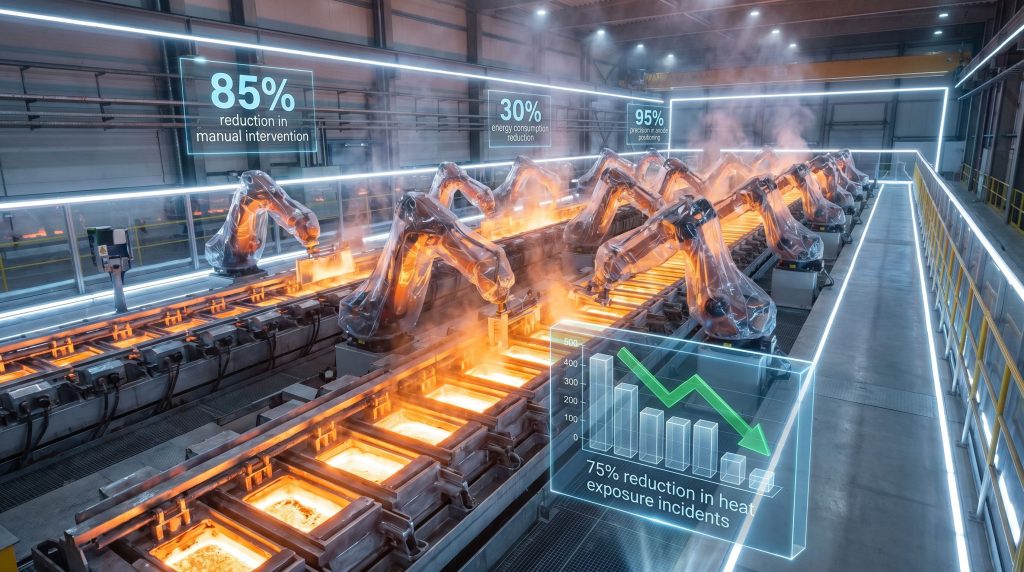
Robotic anode positioning systems achieve 95% accuracy in placement compared to 78% accuracy in manual operations. This improvement directly impacts energy efficiency, with properly positioned anodes reducing electrical resistance and optimizing current distribution across the electrolytic cell.
Advanced anode management systems incorporate:
• Force feedback mechanisms measuring anode resistance during insertion
• Real-time electromagnetic field mapping for optimal positioning
• Automated carbon consumption monitoring and replacement scheduling
• Precision handling of 500-800 kg anode assemblies with millimeter accuracy
Safety Enhancement and Operational Efficiency Metrics
Quantified Safety Improvements
The transition to robotic smelting in aluminium production delivers measurable safety enhancements across multiple risk categories. Industry data from automated smelting installations demonstrates consistent reductions in worker exposure incidents.
| Safety Metric | Manual Operations | Robotic Systems | Improvement |
|---|---|---|---|
| Heat exposure incidents | 12-15 per quarter | 2-3 per quarter | 75% reduction |
| Electromagnetic field exposure | Continuous worker exposure | Zero worker exposure | 100% elimination |
| Respiratory hazard events | 8-10 per month | 1-2 per month | 85% reduction |
| Lost-time injuries | 3.2 per 100,000 hours | 0.8 per 100,000 hours | 75% reduction |
Process Optimization and Energy Efficiency
Aluminum smelting consumes approximately 14 MWh per tonne of produced metal, making energy efficiency critical for operational viability. Robotic systems contribute to energy optimization through precise timing, consistent process parameters, and reduced thermal losses during cell maintenance.
Documented efficiency improvements include:
• 30% reduction in thermal losses during furnace maintenance cycles
• 10x faster processing speeds for routine anode adjustments
• 25% reduction in material waste through precision handling
• 15% improvement in overall equipment effectiveness (OEE)
Return on investment analysis across multiple installations indicates 39% ROI achievement within 2-3 years for 75% of robotic smelting implementations.
Specialized Engineering Solutions for Extreme Environments
Advanced Materials and Thermal Management
Robotic smelting in aluminium production requires materials engineering solutions that extend far beyond conventional industrial robotics. Operating temperatures approaching 1000°C combined with corrosive fluoride environments demand specialized component design.
Critical engineering solutions include:
• Refractory-lined robotic enclosures with active cooling systems
• Ceramic-matrix composite components for high-temperature exposure
• Specialized lubricants rated for extreme temperature cycling
• Redundant thermal protection systems with emergency shutdown protocols
Precision Control and Sensor Integration
Maintaining sub-millimeter accuracy in high-temperature, electromagnetically noisy environments requires sophisticated sensor fusion and control algorithms. Modern smelting robots integrate multiple sensing modalities to achieve consistent performance.
Advanced control systems incorporate:
- High-temperature imaging systems for real-time process monitoring
- Electromagnetic field mapping for dynamic position correction
- Force feedback sensors rated for molten metal exposure
- Predictive maintenance algorithms analyzing vibration and thermal patterns
- Emergency response protocols with sub-second reaction times
Market Dynamics and Adoption Patterns
Industry Transformation Timeline
The adoption of robotic smelting in aluminium production follows predictable patterns driven by economic pressures, regulatory requirements, and technological maturation. Current market analysis indicates accelerating implementation across major aluminum producers, particularly those facing canadian smelting challenges.
| Timeframe | Automation Penetration | Green Production Targets | Primary Drivers |
|---|---|---|---|
| 2024 | 40% of major facilities | 25% renewable energy | Safety compliance, labor costs |
| 2026 | 55% automation level | 35% green production | Energy efficiency, emissions |
| 2030 | 80% automation target | 60% green production | Full process integration |
Economic and Regulatory Drivers
Multiple convergent factors accelerate robotic adoption in aluminum smelting beyond pure efficiency considerations. Furthermore, industry innovation trends demonstrate skilled operator shortages, tightening environmental regulations, and energy cost pressures create compelling business cases for automation investment.
Key market drivers include:
• Labor shortage mitigation with 15-20% annual turnover in smelting operations
• Energy cost optimization addressing 40-50% of total production costs
• Environmental compliance with particulate emission standards
• Supply chain resilience reducing dependence on specialized labor
• Insurance cost reduction through demonstrated safety improvements
Implementation Challenges and Technical Barriers
Engineering Complexity and Integration Issues
Despite proven benefits, robotic smelting in aluminium production faces significant implementation challenges that extend project timelines and increase initial costs. Retrofitting existing facilities presents particularly complex technical hurdles, especially when integrating ai in mining automation technologies.
Primary technical challenges include:
• Custom hardware development with 12-18 month design cycles
• Legacy system integration requiring specialized interface development
• Maintenance accessibility in confined, high-temperature environments
• Process synchronization with existing production scheduling systems
• Backup system redundancy ensuring continuous operation capability
Workforce Development and Transition Management
The transition to robotic systems requires comprehensive workforce development programs addressing both technical skills and operational procedures. Successful implementations emphasize collaborative human-robot interfaces rather than complete automation.
Critical transition elements include:
- Technical training programs for robotic system operation and maintenance
- Safety protocol updates for human-robot collaborative environments
- Quality assurance integration maintaining product specifications during transition
- Change management strategies addressing workforce concerns and resistance
- Performance monitoring systems tracking efficiency gains and safety metrics
The next major ASX story will hit our subscribers first
Environmental Impact and Sustainability Integration
Emission Reduction and Process Optimization
Robotic smelting in aluminium production contributes significantly to environmental sustainability goals through precise process control and optimized resource utilization. Automated systems reduce both direct emissions and energy consumption per unit of production.
Documented environmental benefits include:
• 40% reduction in hydrogen fluoride (HF) emissions through optimized cell operation
• 25% decrease in particulate emissions via controlled material handling
• 30% improvement in energy efficiency through optimized heating cycles
• 20% reduction in carbon anode consumption through precision positioning
Circular Economy and Recycling Enhancement
Advanced robotic systems enable improved secondary aluminum processing, supporting circular economy objectives through enhanced recycling capabilities. Precision material handling and alloy composition control facilitate higher-grade recycled aluminum production.
Recycling optimization features include:
• Automated sorting systems for scrap aluminum grade classification
• Precise alloy composition control enabling premium recycled products
• Contamination reduction through controlled melting environments
• Energy recovery systems capturing waste heat for facility heating
Future Technology Development and Market Evolution
Artificial Intelligence and Predictive Analytics Integration
The next generation of robotic smelting in aluminium production systems will incorporate advanced artificial intelligence capabilities for process optimization and predictive maintenance. Moreover, predictive maintenance benefits demonstrate that machine learning algorithms analysing thermal patterns, electromagnetic field variations, and material flow characteristics will enable autonomous process adjustments.
Emerging AI applications include:
• Predictive maintenance algorithms reducing unplanned downtime by 60%
• Real-time process optimization adjusting parameters based on material quality
• Energy consumption prediction enabling demand response participation
• Quality control automation detecting product variations in real-time
Digital Twin Technology and Virtual Commissioning
Digital twin systems representing complete smelting operations will enable virtual testing, optimization, and training before physical implementation. These systems will integrate real-time operational data with predictive models for continuous improvement alongside data-driven operations strategies.
Digital twin capabilities will include:
- Virtual commissioning reducing installation time by 40-50%
- Operator training simulations providing safe learning environments
- Process optimization testing without production disruption
- Predictive modeling for equipment lifecycle management
- Remote monitoring and control enabling distributed operations management
Market Standardization and Global Adoption Trends
Industry standardization efforts will accelerate robotic smelting in aluminium production adoption through reduced engineering costs and improved interoperability. However, advanced automation solutions indicate that global aluminum producers are collaborating on common technical standards and best practices.
Anticipated market developments include:
• Standardized robotic platforms reducing custom development costs by 50%
• Common safety protocols enabling cross-facility operator mobility
• Interoperable control systems facilitating multi-vendor integration
• Global best practice sharing accelerating implementation timelines
Investment Disclaimer: The analysis of robotic smelting technologies presents forward-looking projections based on current market trends and technological developments. Actual implementation timelines, cost savings, and safety improvements may vary significantly based on facility-specific factors, regulatory changes, and technological advancement rates. Investors should conduct comprehensive due diligence and consider multiple scenarios when evaluating automation technology investments in metallurgical industries.
The transformation of aluminum production through robotic automation represents a fundamental shift toward sustainable, safe, and efficient manufacturing processes. As robotic smelting in aluminium production technologies mature and standardise, the industry will likely see accelerated adoption driven by compelling economic returns, regulatory compliance requirements, and workforce safety imperatives.
Interested in Investing in Industrial Automation and Advanced Manufacturing?
Discovery Alert's proprietary Discovery IQ model delivers real-time alerts on significant ASX mineral discoveries in metals production and advanced manufacturing sectors, instantly empowering subscribers to identify actionable opportunities ahead of the broader market. Begin your 14-day free trial today and secure your market-leading advantage in this rapidly evolving industrial landscape.