May 16, 2026
Industrial Transformation Through Strategic Energy Reallocation
China's critical minerals green transition continues to reshape global manufacturing paradigms, with the aluminium sector presenting complex challenges that require unprecedented coordination. Global manufacturing sectors face unprecedented pressure to reconcile emissions intensity with production scale. The aluminium industry exemplifies this challenge, where electrolytic processes demand enormous electricity inputs while climate commitments require radical decarbonisation pathways.
China's aluminium decarbonisation strategy represents a complex case study in industrial transformation, balancing domestic climate targets against international competitive positioning and supply chain responsibilities. Furthermore, this transformation reflects broader industry evolution trends that prioritise environmental sustainability alongside economic competitiveness.
The sector's transformation involves multiple interconnected dynamics: geographic capacity reallocation toward renewable-rich regions, technological innovation in production processes, policy mechanisms creating carbon cost pressures, and international investment patterns that may contradict domestic decarbonisation efforts. Understanding these parallel developments requires analyzing both the technical feasibility of emissions reduction and the economic incentives driving strategic decisions.
When big ASX news breaks, our subscribers know first
What Drives China's Aluminium Sector Decarbonisation Imperative?
Global Climate Commitments vs. Industrial Reality
China's aluminium sector generates approximately 730-790 million tonnes of CO₂ equivalent annually, representing roughly 5 percent of the nation's total greenhouse gas emissions. This massive carbon footprint stems from production volumes exceeding 44 million tonnes in 2025, with some estimates indicating output has reached 45 million tonnes.
The emissions intensity averages 15-17 tCO₂e per tonne, positioning China slightly above the global average of 14.8 tCO₂e per tonne established by the International Aluminium Institute. However, these figures vary significantly across different production methods and regions.
The intensity differential between production methods creates stark competitive implications. Coal-based smelting can exceed 20 tCO₂e per tonne, while hydropower operations fall below 5 tCO₂e per tonne. This fourfold variation becomes commercially decisive under carbon border adjustment mechanisms, where 1-2 tCO₂e per tonne differential translates into measurable cost exposure for exported metal.
China's dual carbon targets mandate emissions peaking by 2030 and carbon neutrality by 2060, creating binding constraints on industrial development patterns. The European Union's Carbon Border Adjustment Mechanism (CBAM) adds external pressure, potentially imposing carbon costs on Chinese aluminium exports based on their production emissions intensity.
Economic Drivers Behind the Green Transition
Rising coal prices have fundamentally altered the economics of captive power generation, making renewable grid electricity increasingly cost-competitive. The national emissions trading system administered by the Ministry of Ecology and Environment transforms carbon from a compliance metric into a commercial cost variable.
Consequently, these developments create direct financial incentives for cleaner production methods across the industry. Export market positioning drives additional decarbonisation pressure as international buyers increasingly specify low-carbon aluminium requirements.
The sector operates under a strict national production capacity ceiling of 45 million tonnes annually, forcing companies to optimise existing facilities rather than expand through new capacity additions. Environmental compliance costs continue rising through stricter anti-pollution campaigns and mandatory elimination of subcritical coal-fired power plants.
These regulatory pressures compound the economic case for transitioning toward renewable energy sources and more efficient production technologies. In addition, geopolitical mining trends influence strategic planning decisions throughout the sector.
How is China Restructuring Its Aluminium Production Geography?
The Great Western Migration: From Coal to Clean Energy
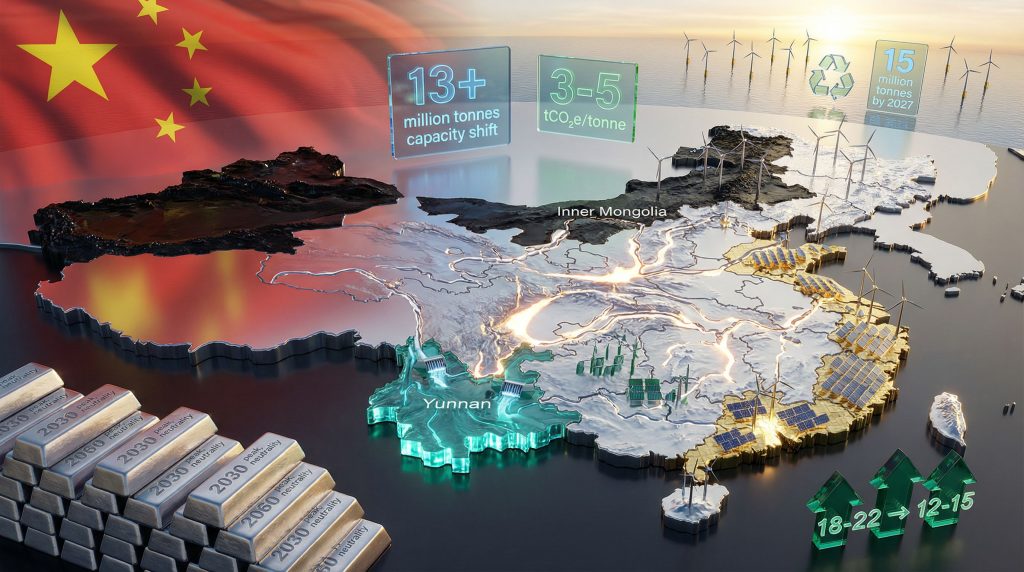
Since the early 2010s, China has orchestrated large-scale geographic reallocation of aluminium smelting capacity from coal-heavy northern and eastern provinces toward energy-rich western and southwestern regions. This strategic relocation involves moving 13 million tonnes of capacity from coal-dependent grids, potentially generating annual CO₂ savings of 100-140 million tonnes.
| Region | Primary Energy Source | Emissions Intensity (tCO₂e/tonne) | Strategic Focus |
|---|---|---|---|
| Yunnan | Hydropower (80%+) | 3-5 | Capacity expansion hub |
| Inner Mongolia | Coal/Wind transition | 18-22 → 12-15 | Grid modernisation |
| Shandong | Coal-dominant | 20-25 | Capacity reduction target |
| Guangdong | Offshore wind development | 12-16 | Coastal integration |
The relocation strategy addresses five interconnected objectives:
- Decarbonisation imperative: Accessing renewable energy sources reduces production emissions intensity
- Environmental policy enforcement: Compliance with mandates eliminating inefficient coal-fired power plants
- Energy cost optimisation: Rising coal prices make renewable alternatives economically attractive
- Capacity ceiling compliance: Working within the 45-million-tonne national production cap
- Environmental cost mitigation: Reducing exposure to carbon pricing through the national ETS
Renewable Energy Integration Scenarios
Coastal provinces including Guangdong, Jiangsu, and Shandong are accelerating offshore wind deployment as part of building the world's largest offshore wind capacity. State-backed utilities like China Three Gorges Corporation and manufacturers such as Mingyang Smart Energy lead project development in deeper waters.
This development aims to stabilise coastal power supply for energy-intensive industries. For aluminium production operating under strict domestic capacity constraints and rising decarbonisation pressure, clean coastal electricity provides strategically valuable alternatives to coal-heavy northern grids.
Offshore wind feeding eastern load centres offers pathways to rebalance the historical coal dependency. Hydropower-based smelting typically achieves electricity emissions of 0.3-1.5 tonnes of CO₂ per tonne of aluminium, depending on dry-season fossil backup requirements.
However, seasonal variability in hydropower generation creates reliability challenges that require backup power arrangements or energy storage solutions. The government targets increasing renewable energy usage to over 30 percent for primary aluminium capacity by 2027, compared to current levels of approximately 15-20 percent concentrated in regions like Yunnan.
Coal still accounts for 70-80 percent of power generation for the primary aluminium production sector. Furthermore, these developments align with broader energy transition strategies across the Chinese industrial landscape.
What Are the Key Technology Pathways for Emissions Reduction?
Power Decarbonisation: The Primary Lever
Power mix transformation represents the most significant opportunity for emissions reduction, with electricity accounting for the largest emissions component in aluminium production. Grid electricity transition toward renewables, captive renewable energy development, and cross-provincial green electricity trading mechanisms provide the foundation for meaningful decarbonisation.
Current renewable energy deployment focuses on three primary sources:
- Hydropower: Established in southwestern provinces, providing baseline clean electricity with seasonal variation
- Offshore wind: Rapid coastal deployment connecting marine renewables to manufacturing hubs
- Solar and wind: Distributed deployment supporting captive power requirements at smelting facilities
Real-time trading of renewable power across provincial boundaries requires sophisticated balancing mechanisms to manage hydropower seasonality and wind intermittency. Long-term renewable power agreements (PPAs) provide contract structures enabling predictable clean electricity access for industrial users.
Process Innovation and Efficiency Gains
Beyond power decarbonisation, process technology improvements offer incremental emissions reductions. Inert-anode electrolysis pilot projects could provide 0.5-1.0 tCO₂e per tonne reductions, though large-scale deployment remains uncertain due to technical and economic barriers.
Perfluorocarbon (PFC) emission control technologies address process-related greenhouse gas releases from electrolysis cells. Tighter PFC controls combined with improved cell efficiency can contribute marginal but meaningful emissions reductions.
Advanced refining technologies show promise for significant emissions reduction. While specific technical details require verification, process innovations in the refining stage could potentially achieve substantial CO₂ reduction compared to conventional methods.
Circular Economy Integration
Secondary aluminium presents the most dramatic emissions reduction opportunity, with recycled metal producing only 0.5-1.0 tCO₂e per tonne compared to 15-18 tCO₂e per tonne for primary production. This represents less than 5 percent of primary metal's carbon footprint.
China targets secondary aluminium expansion to 15 million tonnes by 2027, though current recycling volumes and infrastructure capacity require substantial development. Key barriers include:
- Scrap collection network optimisation
- Quality sorting and processing capabilities
- Transportation infrastructure for scrap materials
- Economic incentives for recycling versus primary production
Every incremental increase in scrap share reduces the national weighted average emissions intensity. Under an accelerated recycling scenario, national average intensity could reach approximately 16 tCO₂e per tonne by 2027.
Notably, several sustainable production projects demonstrate the viability of implementing circular economy principles at industrial scale.
How Do Policy Mechanisms Drive Decarbonisation Outcomes?
Regulatory Framework Evolution
China's national emissions trading system creates direct carbon cost pressures on aluminium producers, shifting environmental compliance from regulatory requirements to commercial cost considerations. The system covers major industrial emissions sources and translates carbon intensity into financial performance impacts.
The 45-million-tonne production capacity ceiling operates as a binding constraint preventing capacity expansion regardless of demand growth or cost competitiveness. This hard cap forces industry consolidation and efficiency improvements rather than production scaling.
Environmental compliance standards mandate elimination of subcritical coal-fired power plants, forcing retirement of inefficient captive power generation. Stricter anti-pollution campaigns and environmental inspections accelerate the transition toward cleaner production methods.
Financial Incentives and Market Mechanisms
Carbon pricing through the national ETS creates marginal cost disadvantages for coal-powered smelting compared to renewable-powered operations. While specific carbon prices fluctuate, the mechanism establishes ongoing financial incentives for cleaner production methods.
Green finance availability supports renewable energy investments through preferential lending rates and policy bank funding for clean energy projects. State-backed development banks provide capital for large-scale renewable energy infrastructure supporting industrial decarbonisation.
Export competitiveness considerations drive additional policy support as international carbon border adjustments create trade barriers for high-carbon products. Policy mechanisms increasingly align domestic environmental objectives with international trade competitiveness.
What Are the Contradictions in China's Global Aluminium Strategy?
Offshore Investment Patterns: The Indonesia Case Study
While pursuing domestic decarbonisation, Chinese companies represent the largest investors in Indonesian captive coal capacity, building or financing at least 70 percent of Indonesia's coal-powered industrial parks. This creates geographic arbitrage of carbon externalities, displacing rather than eliminating emissions.
The Morowali Industrial Park in Sulawesi exemplifies this pattern: a 3,000-hectare facility with integrated port, airport, and 10+ factories powered by captive coal plants. The operation, jointly managed by Indonesia's Bintang Delapan Minerals and China's Tsingshan Group, demonstrates parallel strategy development.
Industry observers note that continuing support for overseas coal projects locks in years of high-carbon operations while undermining global climate goals. Every tonne of coal burned abroad contradicts domestic decarbonisation achievements and international climate commitments.
Supply Chain Carbon Accounting Challenges
Integrated bauxite-alumina-aluminium projects in resource-rich regions create complex carbon accounting challenges. Chinese investments in Guinea bauxite mining, Southeast Asian alumina refining, and Central Asian smelting operations involve emissions across multiple jurisdictions and regulatory frameworks.
Scope 3 emissions from international operations may not appear in domestic carbon accounting, creating potential gaps between reported and actual carbon footprints. This raises questions about the comprehensiveness of China's aluminium decarbonisation strategy when viewed from a global supply chain perspective.
Resource diplomacy objectives sometimes conflict with climate commitments, as securing raw material access through integrated international projects may prioritise energy cost and supply security over carbon intensity optimisation.
The next major ASX story will hit our subscribers first
Which Scenarios Could Shape China's Aluminium Carbon Trajectory by 2030?
Accelerated Transition Scenario
Under rapid renewable energy deployment, China's aluminium sector could achieve 13-16 tCO₂e per tonne by 2030. This pathway requires:
- Renewable energy mix exceeding 30% through offshore wind scaling and hydropower optimisation
- Enhanced recycling rates approaching 15 million tonnes secondary capacity
- Faster coal plant retirement and grid integration improvements
- Technology deployment including process efficiency improvements
Key enablers include accelerated offshore wind deployment along coastal provinces, scrap supply chain optimisation through improved collection and processing infrastructure, and coordinated policy implementation across energy and industrial sectors.
Business-as-Usual Scenario
Gradual coal phase-out and moderate renewable adoption could yield 16-18 tCO₂e per tonne by 2030. This pathway assumes:
- Steady renewable energy growth following current deployment trajectories
- Incremental recycling expansion within existing infrastructure constraints
- Partial coal plant retirement balanced against energy security concerns
- Limited process technology deployment due to economic or technical barriers
Risk factors include hydropower seasonality creating backup fossil generation requirements, captive coal plant persistence due to sunk capital costs, and slower-than-expected offshore wind scaling.
Constrained Progress Scenario
Slow renewable deployment and limited scrap availability could result in 17-20 tCO₂e per tonne by 2030. Challenges include:
- Grid integration bottlenecks limiting renewable energy absorption capacity
- Financing constraints for large-scale clean energy infrastructure
- Scrap supply limitations restricting secondary aluminium expansion
- Technology deployment delays extending high-carbon production methods
This scenario reflects potential conflicts between energy security priorities and decarbonisation objectives, particularly during economic stress periods or supply chain disruptions.
What Are the Global Implications of China's Decarbonisation Strategy?
International Market Dynamics
Low-carbon aluminium premium development creates new market segments based on production emissions intensity rather than traditional quality specifications. Chinese producers pursuing renewable energy integration position themselves for access to premium markets while high-carbon competitors face potential market share erosion.
Competition with established low-carbon producers from Norway, Canada, and the UAE intensifies as carbon border adjustments create level playing fields based on emissions intensity rather than production costs alone. Geographic advantages in renewable energy access become competitive differentiators.
Supply chain reconfiguration accelerates as carbon-conscious buyers specify emissions intensity requirements in procurement contracts. This drives transparency improvements in carbon accounting and verification systems across international aluminium trade.
Technology Transfer and Innovation Spillovers
Chinese renewable energy technology deployment globally creates knowledge spillovers benefiting aluminium decarbonisation in other regions. Offshore wind, solar photovoltaics, and grid integration solutions developed for domestic industrial applications find international markets.
Best practice sharing in aluminium process optimisation, particularly in power management and recycling technologies, contributes to global industry transformation. Chinese innovations in secondary aluminium processing and scrap utilisation offer models for circular economy integration.
South-South cooperation in industrial decarbonisation enables technology transfer to emerging economies developing their own aluminium sectors. This cooperation could accelerate global emissions reduction compared to traditional North-South technology transfer patterns.
For instance, research by Transition Asia demonstrates how Chinese innovations in renewable energy integration are being adapted across Asia-Pacific markets.
How Can Stakeholders Navigate the Transition Risks and Opportunities?
Investment Decision Framework
Due diligence for aluminium sector investments requires comprehensive carbon risk assessment methodologies accounting for power mix evolution, regulatory policy changes, and international trade implications. Traditional financial metrics alone provide insufficient guidance for transition-exposed assets.
Portfolio rebalancing strategies should consider energy transition exposure across the aluminium value chain, from upstream bauxite mining through downstream fabrication. Geographic diversification may help manage regulatory and carbon pricing risks across different jurisdictions.
Investment opportunities concentrate in renewable energy infrastructure supporting industrial users, recycling capacity development, and process technology improvements. These areas offer both decarbonisation impact and commercial returns as carbon costs increase.
Supply Chain Adaptation Strategies
Supplier carbon footprint evaluation protocols require standardised emissions accounting across different production methods and geographic locations. Verification systems ensure transparency and prevent carbon accounting manipulation or misrepresentation.
Long-term contracting for low-carbon aluminium provides price certainty while supporting producer investments in clean energy infrastructure. Contract structures should specify emissions intensity targets with verification requirements and price adjustments.
Regional sourcing diversification approaches balance carbon intensity considerations against supply security, cost competitiveness, and quality requirements. Buyers increasingly evaluate total cost of ownership including carbon risk exposure rather than purchase price alone.
Recent industry analysis by the World Economic Forum highlights the importance of coordinated supply chain strategies in achieving meaningful decarbonisation outcomes.
China's aluminium decarbonisation strategy represents one of the most significant industrial transformation initiatives globally, with implications extending far beyond domestic emissions reduction. Success requires coordinated deployment of renewable energy infrastructure, process technology innovation, circular economy development, and international cooperation mechanisms. The outcomes will influence global aluminium markets, industrial decarbonisation practices, and climate policy effectiveness across multiple jurisdictions.
Disclaimer: This analysis involves forecasts and projections based on current trends and policies. Actual outcomes may vary significantly due to technological developments, policy changes, economic conditions, or unforeseen circumstances. Investment decisions should consider comprehensive risk assessment and professional guidance.
Ready to Capitalise on Industrial Transformation Opportunities?
China's aluminium sector decarbonisation presents significant investment opportunities across the metals and mining landscape, from renewable energy infrastructure to recycling technologies. Discovery Alert's proprietary Discovery IQ model delivers real-time alerts on significant ASX mineral discoveries, instantly empowering subscribers to identify actionable opportunities in this rapidly evolving sector. Begin your 14-day free trial today and secure your market-leading advantage in industrial transformation investments.