June 4, 2026
Industry 4.0 Integration Reshapes Traditional Metalworking Paradigms
Manufacturing excellence across global metal industries increasingly depends on technological convergence rather than isolated production improvements. Modern facilities integrate computational intelligence with physical processes, creating adaptive systems that respond to market demands whilst optimising resource utilisation. This transformation extends beyond equipment upgrades, fundamentally altering how technological advancements in metals flow from raw extraction through finished products.
Industrial ecosystems now prioritise circular material flows, where waste streams become input sources for subsequent production cycles. Advanced metallurgical processes incorporate real-time data analytics, enabling manufacturers to predict material behaviour and adjust parameters before quality deviations occur. These developments represent a departure from reactive manufacturing toward predictive operational models.
When big ASX news breaks, our subscribers know first
Revolutionary Additive Manufacturing Transforms Metal Component Production
Metal additive manufacturing has evolved from experimental prototyping to production-scale implementation across aerospace, medical, and automotive sectors. Direct Metal Laser Sintering (DMLS) enables creation of complex geometries impossible through traditional casting or machining methods, fundamentally changing design constraints that have limited engineers for decades.
Aerospace Applications Drive Weight Optimisation:
• Titanium components achieve 35-45% weight reduction compared to forged equivalents whilst maintaining structural integrity
• Complex internal cooling channels integrated directly into turbine blades improve thermal efficiency by 12-18%
• Assembly consolidation reduces part counts from 20+ components to single integrated structures
• Material waste decreases from 60-70% in traditional machining to 5-15% through near-net-shape production
Medical Device Customisation Capabilities:
Patient-specific implants manufactured through DMLS achieve anatomical fit accuracy within 0.1-0.5mm tolerances. Custom spinal cages and craniofacial reconstructions match individual CT scan data with >99% dimensional accuracy, reducing surgical time by 20-35% and improving patient outcomes through enhanced biocompatibility.
Automotive Prototyping Acceleration:
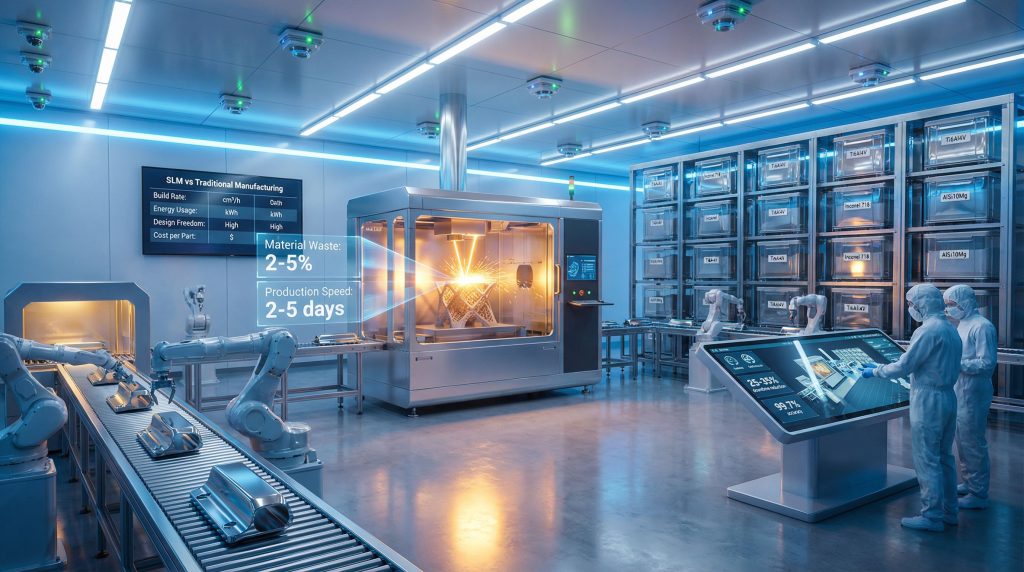
Development cycles for complex components have compressed from 4-8 weeks using traditional methods to 2-5 days through additive manufacturing. This timeline reduction enables rapid design iterations and market responsiveness that traditional tooling-dependent processes cannot achieve.
Selective Laser Melting Delivers Production Precision
| Performance Metric | Traditional Methods | SLM Technology |
|---|---|---|
| Material Utilisation | 70-85% | 95-98% |
| Design Flexibility | Tool-constrained | Geometry-unlimited |
| Setup Requirements | High tooling investment | Minimal preparation |
| Batch Size Economics | High-volume optimised | Single-unit viable |
SLM processes operate with laser systems generating 200-400W power, melting metal powders layer by layer with 20-50 micrometer precision. This approach enables production of internal lattice structures and conformal cooling channels that optimise thermal management in high-performance applications.
Technical specifications include fibre laser wavelengths at 1,070 nm, scan speeds ranging 300-2,000 mm/minute, and inert atmosphere requirements using argon or nitrogen gas systems. Achievable density reaches 99.5-99.9% of theoretical maximum through optimised processing parameters.
Artificial Intelligence Revolutionises Manufacturing Process Control
Smart manufacturing implementation has transformed metal production from reactive maintenance to predictive optimisation. Furthermore, AI transforming mining systems analyse thousands of variables simultaneously, identifying patterns invisible to human operators and adjusting parameters in real-time to prevent quality deviations before they occur.
Predictive Maintenance Achievements:
• Equipment downtime reduction of 20-30% through early failure detection
• Maintenance cost reduction of 25-40% by scheduling service based on actual condition rather than time intervals
• Asset utilisation improvement of 15-25% through optimised operational parameters
Machine learning algorithms trained on historical performance data predict equipment degradation 24-168 hours in advance, enabling scheduled maintenance during planned production breaks rather than emergency shutdowns.
Quality Control Precision:
Computer vision systems equipped with deep learning algorithms detect surface defects, dimensional variations, and material inconsistencies with 98.5-99.8% accuracy. These systems analyse thousands of components per hour, identifying defects as small as 0.5mm whilst maintaining production speeds impossible through manual inspection.
Industry Transformation: Modern steel facilities implementing AI-driven optimisation report 8-15% energy consumption reduction and 12-18% improvement in material yield through intelligent furnace control and thermal management.
Internet of Things Creates Intelligent Production Networks
IoT sensor networks transform manufacturing facilities into interconnected intelligent systems. Temperature monitoring achieves ±5°C accuracy with <100 millisecond response times, enabling real-time thermal management across blast furnaces and casting operations.
Comprehensive Monitoring Capabilities:
- Vibration analysis detects bearing degradation 3-6 weeks before failure through frequency spectrum analysis
- Pressure sensors monitor hydraulic systems and gas flows with 0.5% full-scale accuracy across 0-10,000 PSI ranges
- Environmental sensors track humidity, particulate levels, and atmospheric composition for quality control
- Supply chain sensors provide 95%+ visibility from ore extraction through finished product delivery
Edge computing devices filter and process sensor data locally, reducing cloud transmission requirements by 70-90% whilst enabling millisecond response times for critical safety systems.
Advanced Alloy Development Enables Next-Generation Applications
High-entropy alloys represent a fundamental departure from traditional metallurgy, combining five or more principal elements in near-equal atomic percentages. These materials exhibit superior strength-to-weight ratios and thermal stability exceeding 1000°C, enabling applications previously impossible with conventional alloys.
Performance Characteristics:
• Tensile strength increases of 200-300% compared to traditional steel alloys
• Corrosion resistance superior to stainless steel in marine and chemical environments
• Temperature stability maintaining mechanical properties at extreme operating conditions
• Fracture toughness exceeding aerospace-grade titanium alloys
Metal Matrix Composite Integration:
Carbon fibre reinforcement embedded within metal matrices creates hybrid materials combining metallic ductility with ceramic hardness. These composites achieve tensile strength improvements of 200% whilst maintaining electrical conductivity for electromagnetic applications.
| Alloy System | Primary Applications | Performance Advantage |
|---|---|---|
| Ti-Al-V-Cr-Mo | Aerospace turbines | 40% weight reduction |
| CoCrFeMnNi | Chemical processing | 300% corrosion resistance |
| AlCuMgSiZn | Automotive structures | 50% strength increase |
| NbMoTaW | Energy generation | 800°C operation capability |
Sustainable Production Methods Address Environmental Challenges
Hydrogen-based steel production eliminates 95% of carbon dioxide emissions compared to traditional coke-fired blast furnaces. These systems use renewable electricity to generate hydrogen, which reduces iron ore without carbon involvement, fundamentally changing metallurgy's environmental impact. Additionally, green iron production initiatives demonstrate how technological advancements in metals can support environmental objectives.
Green Energy Material Requirements:
Renewable technology deployment drives unprecedented demand for specific metals:
• Solar panel manufacturing requires silver consumption growth of 15-20% annually
• Wind turbine permanent magnets depend on rare earth element supplies increasing 12-18% yearly
• Electric vehicle batteries consume lithium, cobalt, and nickel with 25-40% annual demand growth
• Grid-scale energy storage systems drive vanadium and zinc demand increases of 20-30% annually
Circular Economy Implementation:
Closed-loop recycling systems achieve 90% material recovery rates through advanced separation technologies. Electromagnetic sorting, density separation, and chemical extraction processes recover metals from end-of-life products with purity levels suitable for primary production applications.
Electric arc furnaces powered by renewable electricity sources replace coal-dependent blast furnaces, reducing carbon footprint by 60-80% whilst maintaining steel quality standards required for structural and automotive applications.
Advanced Forming Technologies Enable Complex Geometries
Powder metallurgy innovations create near-net-shape components reducing secondary machining requirements by 80%. This approach enables uniform microstructure development impossible through traditional casting, achieving consistent material properties throughout complex geometries.
High-Energy Rate Forming Applications:
• Explosive forming shapes large aerospace components using controlled detonations to achieve precise geometries
• Electromagnetic pulse forming enables rapid prototyping of conductive materials through magnetic field interaction
• Electrohydraulic forming uses electrical discharge energy for deep drawing and complex shape development
These processes operate at strain rates 1000-10000 times faster than conventional forming, enabling material behaviour characteristics unavailable through traditional mechanical working methods.
Technical Innovation: Powder metallurgy components achieve density levels of 95-99% theoretical maximum whilst maintaining dimensional tolerances within ±0.05mm for precision applications.
Precision Sintering Controls Microstructure
Advanced sintering techniques control grain size and porosity at microscopic levels, tailoring material properties for specific applications. Hot isostatic pressing (HIP) eliminates internal porosity whilst maintaining complex geometries, achieving material properties equivalent to wrought products.
Temperature control within ±5°C and pressure regulation at 100-200 MPa enables predictable microstructure development. Atmosphere composition using hydrogen, nitrogen, or argon prevents oxidation whilst promoting desired grain boundary characteristics.
The next major ASX story will hit our subscribers first
Automation Transforms Mining and Extraction Operations
Robotic mining systems operate continuously without human intervention, increasing extraction efficiency by 15-25% whilst reducing worker exposure to hazardous conditions. Autonomous hauling vehicles navigate complex underground routes using LiDAR mapping and GPS coordination systems. Moreover, data-driven operations optimise these processes through intelligent analytics.
Machine Learning Applications:
- Geological pattern recognition identifies mineral deposits through satellite imagery analysis and seismic data interpretation
- Predictive modelling optimises extraction sequences to maximise ore recovery whilst minimising environmental disturbance
- Equipment optimisation algorithms adjust drilling parameters based on rock hardness and mineral composition
- Environmental monitoring systems track air quality, water contamination, and ecosystem impacts in real-time
AI-powered ore sorting increases extraction efficiency by analysing mineral composition through X-ray fluorescence and near-infrared spectroscopy, separating valuable minerals from waste rock with 95%+ accuracy.
Remote Operation Capabilities:
Operators control mining equipment from surface locations thousands of miles away, using high-definition cameras, force feedback systems, and real-time data transmission. This approach eliminates underground safety risks whilst enabling 24/7 operations regardless of local weather conditions.
Economic Impact Analysis Drives Technology Adoption
Smart factory conversion requires initial investments of $10-50 million depending on facility size and automation complexity. Return on investment typically occurs within 3-5 years through energy savings, labour optimisation, and quality improvements.
Cost-Benefit Calculations:
| Investment Category | Initial Cost (USD Million) | Annual Savings (USD Million) | ROI Timeline |
|---|---|---|---|
| AI Implementation | 0.5-5.0 | 2-8 | 2-4 years |
| IoT Infrastructure | 1-10 | 3-15 | 2-3 years |
| Additive Manufacturing | 0.3-3.5 | 1-12 | 3-5 years |
| Automation Systems | 5-25 | 8-40 | 2-4 years |
Operational cost reductions of 30-40% result from energy efficiency improvements, maintenance optimisation, and material waste reduction. Quality consistency improvements enable premium pricing and reduce warranty costs, contributing additional 5-15% margin improvement.
Market Competitiveness Factors:
Certification compliance for aerospace and medical applications requires consistent quality levels achievable only through advanced manufacturing systems. Environmental regulations increasingly favour low-carbon production methods, making sustainable technologies necessary for market access rather than optional improvements.
Digital Twin Technology Optimises Production Processes
Virtual process modelling creates digital replicas of entire manufacturing systems, enabling real-time simulation and optimisation without production interruption. These models predict equipment behaviour, identify bottlenecks, and test process changes before physical implementation.
Performance Optimisation Applications:
• Energy consumption modelling reduces utility costs by 10-15% through thermal efficiency optimisation
• Maintenance scheduling prevents unexpected equipment failures through predictive degradation analysis
• Quality prediction ensures specification compliance through parameter optimisation before production begins
• Remote monitoring enables expert oversight of multiple facilities from centralised control centres
Digital twins integrate data from IoT sensors, production databases, and external systems to create comprehensive operational models. Machine learning algorithms continuously update these models based on actual performance data, improving accuracy over time.
Real-Time Decision Support:
Virtual replicas enable operators to test parameter changes, evaluate scenarios, and optimise production schedules without risking actual equipment or materials. This capability reduces trial-and-error experimentation whilst accelerating process improvement initiatives.
Innovation Impact: Digital twin implementations report 20-35% improvement in first-pass yield rates and 15-25% reduction in product development cycles through enhanced design validation capabilities.
Future Technology Trends Shape Industry Evolution
Quantum computing applications will accelerate materials discovery by simulating atomic interactions impossible with conventional computers. These systems will enable design of alloys with precisely tailored properties for specific applications, reducing development timelines from years to months.
Emerging Technology Integration:
- Nanotechnology enables atomic-level precision in material structure control
- Biotechnology develops bio-based metal extraction methods using engineered microorganisms
- Blockchain systems provide immutable quality certification and supply chain tracking
- Augmented reality assists operators with real-time information overlay and remote expert guidance
Industry evolution trends progress toward fully autonomous production lines operating with minimal human intervention. AI systems will coordinate entire supply chains, optimising material flows from ore extraction through product delivery based on real-time demand signals.
Technology Convergence Timeline:
• 2025-2027: Widespread AI implementation across manufacturing processes
• 2027-2030: Quantum computing integration for materials design
• 2030-2035: Fully autonomous supply chain coordination
• 2035+: Bio-integrated production systems using engineered organisms
Strategic Implementation Framework for Technology Adoption
Successful technology integration requires systematic assessment of current capabilities, identification of improvement opportunities, and phased implementation minimising operational disruption. Companies must balance innovation investment with operational continuity to maintain market position during transformation.
Implementation Methodology:
- Technology Assessment: Evaluate existing systems and identify automation candidates
- Pilot Programme Development: Test technologies on limited production lines before full deployment
- Workforce Development: Train personnel on new systems and safety procedures
- Phased Rollout: Implement changes systematically with performance monitoring
- Continuous Optimisation: Refine processes based on operational data and performance metrics
Risk Management Protocols:
Cybersecurity frameworks protect connected systems from external threats whilst ensuring operational continuity. Backup systems maintain production capability during technology failures, and regulatory compliance procedures ensure adherence to safety and environmental standards across multiple jurisdictions.
Change management strategies address workforce concerns whilst developing skills necessary for technology-enhanced operations. Training programmes typically require 3-6 months for technical personnel and 6-12 months for comprehensive facility transformation.
Strategic Consideration: Companies implementing comprehensive technology upgrades report 18-month average timelines for full operational integration, with benefits beginning to appear within 6-9 months of initial deployment.
Collaborative Industry Leadership
Australia's position in green metals leadership demonstrates how national strategies align with technological capabilities. Furthermore, technological advances revolutionising metals continue to reshape global manufacturing landscapes through innovative approaches.
Modern metal manufacturing represents a convergence of computational intelligence, materials science, and sustainable production methods. Organisations successfully navigating this transformation integrate technological capabilities with operational expertise, creating competitive advantages through enhanced efficiency, quality, and environmental performance. The continuing evolution of technological advancements in metals will determine industry leadership as market demands increasingly favour intelligent, sustainable, and responsive manufacturing capabilities.
Want to Capitalise on the Next Major Metal Discovery?
Discovery Alert's proprietary Discovery IQ model delivers real-time alerts on significant ASX mineral discoveries, instantly empowering subscribers to identify actionable opportunities ahead of the broader market. Begin your 30-day free trial today and secure your market-leading advantage in the evolving metals landscape.