June 11, 2026
The Structural Problem That Has Always Slowed Mining Innovation
For decades, a persistent tension has shaped the way new technologies enter the mining sector. Research institutions and operational mining environments have functioned on fundamentally incompatible timescales. Academic research cycles prioritise rigour, peer review, and publication milestones, while mine sites demand solutions that work under shift pressure, variable geology, and unforgiving cost structures. The result has been a graveyard of technically sound industry-ready mining tech innovations that never graduated beyond the proof-of-concept stage.
That structural bottleneck is now being challenged in a meaningful way. The emergence of purpose-built collaborative research infrastructures, specifically designed to close the gap between laboratory validation and operational deployment, is changing the calculus of mining technology transfer. Rather than treating industry as a downstream recipient of academic outputs, these models embed industry requirements into the research design from the outset.
The practical consequences of this shift are becoming visible across four distinct technology domains now transitioning into commercial pilot territory, each representing a different facet of the challenge of operating efficiently in increasingly complex ore environments.
When big ASX news breaks, our subscribers know first
Why Research Architecture Matters as Much as Research Results
The Commercialisation Bottleneck Explained
Most mining technologies that fail to reach deployment do not fail because of scientific inadequacy. They fail because of institutional misalignment. Research programs are typically evaluated on publication volume and citation impact, metrics that bear little relationship to operational utility. Technologies advance through research readiness levels without ever being exposed to the conditions that determine whether they will function reliably in an actual mine.
The ARC Training Centre for Integrated Operations for Complex Resources (IOCR), established in 2021 and based at the University of Adelaide, was constructed around a different logic. Since its founding, the centre has delivered 16 PhD projects and three postdoctoral programs, each oriented toward industry problem-solving as its primary performance criterion. The result is a cohort of researchers who have spent their formative research years grappling with operational constraints, not just theoretical elegance.
Professor Peter Dowd, Director of the IOCR Training Centre and Professor of Mining Engineering at the University of Adelaide, has made clear that the technologies produced by this centre occupy a different maturity level than typical research outputs. His position is that the validation work is complete, and what is now required is the involvement of forward-looking industry partners willing to move these technologies into live operational trials.
Professor Bill Skinner has reinforced this perspective, noting that by structuring research directly around operational realities rather than disciplinary boundaries, the centre has materially shortened the timeline from initial innovation to practical application. This framing is important because it positions the IOCR not as a source of interesting research but as a pre-commercialisation engine.
Cross-Disciplinary Integration as a Force Multiplier
One of the less-discussed consequences of the IOCR model is the value created at the intersection of previously independent research streams. When PhD projects are structured around shared operational problems rather than disciplinary silos, researchers inevitably encounter data, methods, and insights generated by adjacent projects. Dr Sultan Abulkhair has noted that while the original research projects were developed independently, the team is now actively investigating how integration across projects can create compounding impact beyond what any single technology could deliver.
This cross-pollination effect is not incidental. It represents a structural feature of collaborative research centres that siloed university departments cannot easily replicate. The convergence of orebody sensing, fragmentation modelling, grade detection, and mine-to-mill optimisation into a unified operational intelligence architecture is an outcome that could only have emerged from a research environment designed around shared operational goals.
Four Industry-Ready Mining Tech Innovations Now Seeking Deployment Partners
AI-Driven Mine-to-Mill Optimisation: From Two Days to Ten Minutes
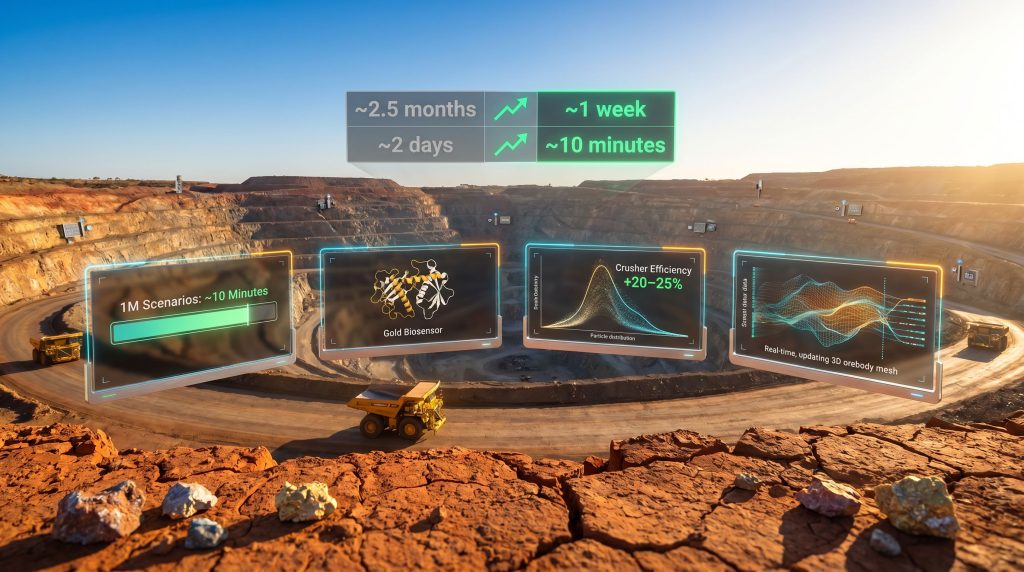
The first technology addresses one of the most persistent bottlenecks in operational mine planning: the time cost of scenario analysis. Existing computational platforms used for mine-to-mill optimisation require approximately two days to process one million operational scenarios. For a mine operating in a dynamic geological environment with variable ore grades, equipment constraints, and fluctuating market conditions, this lag effectively prevents responsive decision-making.
Researcher Pouya Nobahar has been central to developing an AI-powered mining efficiency system that compresses this computation time to ten minutes, a reduction exceeding 99% of the original processing time. To put the magnitude of this improvement into context:
| Metric | Legacy System | AI-Optimised System |
|---|---|---|
| Scenario computation (1M scenarios) | ~2 days (2,880 minutes) | ~10 minutes |
| Decision-making mode | Schedule-driven batch | Condition-responsive real-time |
| Value chain coverage | Partially decoupled | Full mine-to-mill integration |
| Replanning capability | Limited mid-shift | Continuous throughout operations |
The operational implications extend well beyond convenience. When scenario computation occurs in near real-time, mine planners can respond dynamically to unexpected ore variability encountered during a shift rather than waiting for the next planning cycle. For operations extracting ores with high mineralogical complexity, where grade distribution within a single blast block can vary significantly, this capability represents a fundamental change in how operational risk is managed.
The technology integrates upstream geological data with downstream processing parameters across the full value chain, meaning it treats extraction decisions and processing decisions as a coupled optimisation problem rather than two sequential problems with a handoff point between them. This is a meaningful technical distinction from conventional planning systems, which typically optimise mining and milling as partially independent functions.
Furthermore, data-driven mining operations of this kind are increasingly being recognised as essential infrastructure for future-ready mine sites, not merely an efficiency enhancement.
"The shift from batch-cycle to near-real-time scenario computation does not merely make existing planning processes faster. It enables entirely different planning behaviours that were previously impractical."
Validation work is confirmed as complete. The technology is now seeking industry partners for pilot trials across operational mine environments.
Protein-Based Gold Biosensor: Real-Time Detection at the Point of Extraction
The second technology tackles the economics of gold detection head-on. Current industry-standard detection methods, including X-ray fluorescence instruments and off-site laboratory assays, share a common limitation: they introduce latency and cost into the identification of ore bearing economically viable gold concentrations. Laboratory assay turnaround times typically range from 24 to 72 hours depending on sample batching arrangements.
During this window, ore material must be stockpiled, processed provisionally, or dispatched through the circuit without confirmed grade information. Dr Akhil Kumar has developed a protein-based biosensor system that addresses this gap by enabling real-time gold detection directly at the extraction point. The system uses biological protein mechanisms to identify gold presence and concentration without the chemical reagents associated with conventional assay methods.
The economic rationale is straightforward and quantifiable in principle, though specific production-scale figures would require site-specific modelling:
- Energy savings: Avoiding processing of non-gold-bearing material through standard circuits eliminates the energy cost of crushing, grinding, and leaching barren ore
- Water conservation: Cyanide leach circuits and associated water management infrastructure can be spared from processing material that contains no recoverable gold
- Reagent cost reduction: Chemical inputs to the processing circuit are consumed only against ore that has been confirmed to carry economic gold concentrations
- Circuit grade improvement: Diverting barren material before it enters the processing circuit improves the average feed grade to the mill, directly improving recovery economics
The environmental dimension of this technology is equally significant. By eliminating the need for certain chemical reagents in the detection process itself, the biosensor creates a lower-impact analytical pathway at the front end of gold processing operations. For mining companies facing increasingly detailed ESG reporting requirements from institutional investors and offtake partners, this characteristic has practical commercial value beyond pure operational efficiency.
A less commonly understood aspect of point-of-extraction sensor deployment is the engineering challenge of maintaining biological detection reliability in field conditions. Unlike laboratory environments, active mine faces expose sensors to variable temperatures, mechanical vibration, moisture, and dust loadings that can compromise sensor performance. The validation work completed by the IOCR team has addressed these operational durability requirements, positioning the technology beyond laboratory proof-of-concept into a form suited for field deployment trials.
Physics Engine-Driven Fragmentation Simulation: 89% Reduction in Modelling Time
The third technology addresses a problem that sits at the very beginning of the mine value chain: particle size management. Fragmentation, the size distribution of rock particles produced by blasting and initial crushing, is one of the highest-leverage variables across the entire mining operation. Particle size at the extraction stage directly determines energy consumption, throughput rates, equipment wear, and downstream recovery performance.
Despite this outsized influence, fragmentation simulation has historically been constrained by computational limitations. Linking particle size distribution to material flow behaviour through the processing circuit using traditional finite element or discrete element modelling methods could take approximately 2.5 months to complete a single simulation cycle. In addition, this delay significantly hampers responsive planning across the full value chain.
Researcher Ahmadreza Khodayari has developed a fragmentation simulation approach that borrows physics engine frameworks from simulation-heavy industries and applies them to the mining context. The result is a reduction in simulation cycle time from 2.5 months to approximately one week, an improvement of roughly 89%. Advances in AI in drilling and blasting are closely aligned with this kind of modelling capability.
| Simulation Parameter | Previous Benchmark | New Capability |
|---|---|---|
| Cycle time per simulation | ~2.5 months | ~1 week |
| Improvement factor | Baseline | ~10x faster |
| Crusher energy efficiency gain (projected) | Baseline | +20-25% |
| Modelling framework approach | Traditional FEM/DEM | Physics engine integration |
The energy efficiency dimension of this technology carries particular weight. Comminution, the combined process of crushing and grinding ore, accounts for an estimated 35 to 50% of total mine site energy consumption according to industry benchmarks. A projected improvement in crusher energy efficiency of 20 to 25% applied to this cost centre would represent substantial reductions in both operating costs and Scope 1 emissions intensity.
It is worth noting that the 20 to 25% efficiency improvement figure is described as a projection based on the simulation framework's capabilities rather than a measured outcome from full-scale operational deployment. This distinction is important for operators evaluating the technology, as actual performance will depend on site-specific geological conditions, existing equipment configurations, and operational practice.
Integrated Sensor-Driven Orebody Updating: Closing the Real-Time Intelligence Gap
The fourth technology addresses a structural limitation that affects every mine using conventional geological modelling practices. Resource models built during the exploration and pre-production phase are constructed from drilling data, geophysical surveys, and geological interpretation. However, these models are static documents that describe conditions as understood at a point in time before mining commenced.
As extraction proceeds, the actual conditions encountered in the mine inevitably diverge from the model. Geological contacts prove to be more irregular than interpreted. Grade distribution within modelled zones varies at scales below the drill spacing used to construct the model. These discrepancies accumulate over time, and without systematic correction, the gap between modelled reality and actual conditions grows progressively wider.
Dr Sultan Abulkhair's research addresses this gap through an integrated sensing system capable of updating orebody knowledge and resource models continuously as mining progresses. The system uses data streams from smart sensing tools deployed across the mine environment to create a self-correcting model that reflects actual conditions rather than pre-mining interpretations. Consequently, this approach complements advances in 3D geological modelling that are similarly reshaping how operators understand complex ore deposits.
The operational risk implications are significant. Grade control decisions based on an increasingly inaccurate model result in ore loss (high-grade material sent to waste) and dilution (waste material sent to the mill), both of which directly erode mining value. A continuously updated model reduces both forms of this grade control risk.
The integration potential of this technology with the mine-to-mill optimisation system is also notable. Real-time orebody intelligence fed into an AI-driven scenario computation engine could enable a genuinely closed-loop operational system where extraction decisions, processing parameters, and grade control strategies adjust continuously in response to actual geological conditions encountered during mining.
How These Technologies Sit Within the Broader Global Mining Technology Landscape
Autonomous Systems: The Foundation Layer Already in Place
Understanding where these four technologies sit requires contextualising them against the existing automation infrastructure that has been developing in large-scale mining for nearly two decades. Rio Tinto's Pilbara iron ore operations introduced 80 autonomous Komatsu haul trucks as early as 2008, establishing autonomous haulage as a proven operational model. Remote-operated drilling systems, autonomous train operations, and remotely supervised blast crews have followed in subsequent years.
Operations that have implemented integrated autonomous systems have recorded productivity improvements of 15 to 20%, with some recording injury rate reductions exceeding 25% according to industry reporting. This established autonomous infrastructure is not a competitor to the four IOCR technologies but rather their operational substrate. AI optimisation, biosensing, and physics-engine simulation layer intelligence on top of automated physical systems, creating progressively more capable operational environments.
"Globally, approximately 10% of mining businesses are classified as leaders in digital transformation, while the remaining 90% operate at earlier stages of adoption. The technologies emerging from Australian research are positioned to help close this gap."
Technology Readiness: Where These Innovations Sit on the Global Pipeline
Using the Technology Readiness Level (TRL) framework as a reference point, the four IOCR technologies have progressed beyond TRL 4-5 (laboratory and pilot validation) toward TRL 6-7 (demonstration in operational environments). This positions them materially ahead of the majority of the global mining technology pipeline, where many innovations remain at TRL 3-4 with significant development work required before operational deployment becomes feasible. According to recent reporting from the Canadian Mining Journal, a number of breakthrough technologies are now approaching this same deployment threshold internationally, underscoring the global momentum behind this shift.
IoT and Digital Twin Infrastructure: The Enabling Layer
The practical feasibility of real-time orebody updating and fragmentation sensing depends on the sensor network infrastructure that has been progressively deployed across modern mine sites. Mine IoT (MIoT) platforms now provide continuous data streams from equipment, geology sensing tools, and processing infrastructure that make real-time model updating technically achievable.
Digital twin architectures, virtual replicas of physical mine assets and processes, provide the computational environment within which AI-driven scenario engineering can operate. These enabling layers represent significant capital investment that has already been made by major mining operators. The IOCR technologies are designed to generate value from infrastructure that increasingly already exists, reducing the marginal deployment cost for operators with mature digital infrastructure.
The Key Operational Challenges These Technologies Are Engineered to Address
Decision Latency in Complex, Variable Ore Environments
As mining operations move deeper and engage with more geometrically complex orebodies, the range of conditions encountered during extraction widens. Ore grade, mineralogy, rock hardness, and structural geology can all vary at scales smaller than the data resolution available from pre-mining exploration. In these environments, the speed at which planners can evaluate and implement alternative extraction and processing strategies becomes a direct determinant of operational performance.
The Hidden Cost of Processing Non-Economic Material
One of the least visible cost centres in many gold mining operations is the energy, water, and chemical expenditure consumed by processing material that contains insufficient recoverable metal to justify that processing. In operations where grade characterisation relies on periodic assay results rather than continuous real-time detection, it is structurally impossible to prevent barren material from entering the processing circuit. The gold biosensor directly addresses this structural inefficiency.
Energy Intensity Across the Comminution Circuit
Comminution's contribution to total mine energy consumption, estimated at 35 to 50% across the industry, makes it the single largest target for energy efficiency improvement in most mining operations. Fragmentation optimisation through physics-engine simulation attacks this cost centre from the front end of the value chain, where particle size decisions made at the blasting stage cascade through every downstream energy input.
Static Resource Models in Dynamic Mining Environments
Pre-mining geological models carry inherent limitations in their ability to represent the full complexity of actual ore deposits. Drill spacing during exploration creates a spatial resolution ceiling below which grade variability remains invisible to the model. As mining exposes this sub-resolution variability, operations that continue to rely on the original static model accumulate grade control errors that are invisible within the model but visible in actual recovery performance.
Australia's Structural Position in Applied Mining Research and Technology Transfer
Why the Australian Research Ecosystem Is Well-Positioned
Australia's mining sector contributes approximately 14% of GDP and hosts an unusually diverse array of ore deposit types across its jurisdictions. This diversity creates a natural testing environment of global relevance. Technologies validated against Australian operational conditions are inherently validated against a broader spectrum of geological and mineralogical complexity than would be encountered in regions dominated by a narrower range of deposit types.
The concentration of major mining operators, METS organisations, and research institutions within a single regulatory and governance framework also creates coordination advantages that more fragmented international mining research ecosystems cannot easily replicate. Furthermore, mining's technology transformation across electrification and decarbonisation is accelerating the urgency of deploying technologies like these at scale.
The METS Sector as the Critical Commercialisation Bridge
Australia's Mining Equipment, Technology, and Services (METS) sector employs over 350,000 people and generates more than $90 billion in annual revenue, according to industry estimates. This sector occupies the critical interface between validated research outputs and scalable commercial products. METS organisations have the engineering, manufacturing, and integration capabilities required to translate a validated sensor system or optimisation algorithm into a product that can be deployed across diverse operational environments.
Their involvement in IOCR pilot programs is not incidental. It represents the essential bridge that transforms academic validation into commercial deployment at scale. For a broader overview of how Australian institutions are advancing commercialisable mining technologies, international mining media have begun documenting this pipeline in detail.
First-Mover Advantages for Early Industry Partners
Companies that participate in pilot trials of these four technologies gain access to several compounding advantages over those that wait for full commercial deployment:
- Operational learning advantage: Early adopters accumulate site-specific knowledge about how each technology performs under their particular geological and operational conditions
- IP co-development opportunities: Participation in trials typically creates pathways to joint intellectual property arrangements that influence how the technology is customised for specific applications
- Technology customisation influence: Early partners can shape how systems are designed to integrate with their existing infrastructure rather than adapting existing infrastructure to accommodate systems designed for others
- Competitive intelligence: Understanding a technology's performance envelope before competitors gain access provides meaningful strategic intelligence
Professor Peter Dowd's position is explicit on this point. In his assessment, the companies that engage during this current window will not only improve their own operations but will help determine the competitive architecture of the sector as these technologies move toward broader deployment.
The next major ASX story will hit our subscribers first
What Integration Across These Four Technologies Could Mean for Mining's Operating Model
From Individual Tools to Unified Intelligent Mining Systems
Each of the four technologies delivers measurable standalone value. However, the more significant near-term development is the convergence pathway Dr Abulkhair has identified. When real-time orebody updating feeds continuously into AI-driven mine-to-mill optimisation, and when fragmentation simulation informs the particle size targets used in that optimisation, and when biosensor-derived grade confirmation adjusts processing parameters in real time, the result is a closed-loop operational intelligence system with no direct precedent in current mining practice.
This architecture mirrors the autonomous mining system paradigm emerging at the frontier of global mining technology development, where extraction, grade control, fragmentation, and processing decisions are made with minimal external intervention across the full value chain.
ESG Dimensions of Intelligent Technology Adoption
The environmental and social governance implications of these technologies are substantial and increasingly material for institutional investors and offtake partners evaluating mining companies:
- Fragmentation optimisation delivering 20 to 25% crusher energy efficiency gains directly reduces Scope 1 emissions intensity
- Biosensor-based pre-processing detection reduces water consumption and tailings generation by eliminating barren ore from the processing circuit
- Elimination of certain chemical assay reagents from the detection process reduces hazardous material handling requirements
- Real-time orebody updating reduces the incidence of unplanned operational events driven by geological surprises, improving site safety planning
Workforce and Skills Implications
Intelligent mining platforms require different technical competencies from those developed for conventional mining operations. The intersection of geology, data science, sensor engineering, and process optimisation demands workers who can operate across disciplinary boundaries rather than within traditional functional roles. The PhD and postdoctoral pipelines that the IOCR model has developed since 2021 represent the early stages of a talent supply chain calibrated for this requirement.
Operators planning to deploy these technologies will need parallel workforce development strategies. Technical capability gaps at the operational level can undermine the performance of even well-validated technologies, making human capital investment as critical as technology investment.
Frequently Asked Questions: Industry-Ready Mining Tech Innovations
What does industry-ready mean in the context of mining technology?
A technology described as industry-ready has progressed beyond laboratory validation and controlled-environment testing. It has substantiated its core performance claims at a level of rigour sufficient to support deployment in live operational settings, and it is actively seeking industry partners for pilot trials rather than continued academic testing.
How does AI-driven mine-to-mill optimisation differ from conventional mine planning software?
Conventional mine planning software processes operational scenarios in batch cycles requiring hours to days. AI-driven optimisation systems evaluate millions of scenarios in near real-time, enabling condition-driven decision-making that responds to actual operational circumstances rather than planned scenarios constructed before the shift begins.
What is a protein-based gold biosensor and why is it commercially significant?
A protein-based gold biosensor uses biological protein mechanisms to detect gold presence and concentration in ore directly at the extraction point, delivering real-time results without chemical reagents or laboratory processing delays. Its commercial significance lies in enabling operators to divert non-gold-bearing material before it consumes energy, water, and reagents in the processing circuit.
Why does particle size optimisation have such a large impact on mining economics?
Particle size at the blasting and crushing stage determines how efficiently energy is applied across the entire comminution circuit. Since comminution accounts for an estimated 35 to 50% of total mine site energy consumption, a projected 20 to 25% improvement in crusher energy efficiency translates to substantial reductions in operating costs and emissions intensity.
What types of organisations can become partners for IOCR technology trials?
Mining operators, METS companies, equipment manufacturers, and technology integrators are all appropriate partners for pilot programs. Collaboration typically involves co-investment in trial infrastructure, access to operational data environments, and structured arrangements around intellectual property developed during the trial.
Are the performance improvements already proven at full operational scale?
The validation work is described as complete at the research and controlled-environment level. Specific performance metrics such as the 20 to 25% crusher energy efficiency gain represent projections based on validated modelling frameworks. Full operational-scale confirmation will occur through the industry pilot programs these technologies are now actively seeking.
Key Takeaways for Mining Operators and Technology Partners
The emergence of genuinely industry-ready mining tech innovations from the IOCR Training Centre marks a specific and time-limited opportunity window. Several high-confidence observations follow from the analysis above:
-
The innovation model matters as much as the innovation itself: The IOCR's structure has produced four technologies at pilot-ready maturity in five years, a pace that validates the collaborative research architecture as a replicable model.
-
Performance improvements are quantifiable and material: Scenario computation reduced from two days to ten minutes, simulation cycles from 2.5 months to one week, and projected energy efficiency gains of 20 to 25% represent measurable operational advantages.
-
Integration creates compounding value: The four technologies are individually valuable but architecturally designed to converge into a unified operational intelligence platform, where each data stream improves the accuracy and responsiveness of the others.
-
Early engagement carries strategic advantages: First-mover benefits in pilot programs, including operational learning, IP co-development, and technology customisation influence, diminish progressively as commercialisation advances.
-
ESG alignment is intrinsic, not supplementary: Reduced energy consumption, lower water use, eliminated chemical reagent requirements, and improved safety planning are built-in features of these technologies, not retrospective additions.
Readers interested in broader coverage of Australian mining technology developments can explore related reporting at Resources Review, which covers emerging innovations across the Australian resources sector.
This article contains forward-looking assessments, including projected performance improvements associated with technologies currently seeking operational pilot partners. Actual outcomes will depend on site-specific geological, operational, and infrastructure conditions. Nothing in this article constitutes financial or investment advice.
Want to Catch the Next Major ASX Mineral Discovery the Moment It's Announced?
Discovery Alert's proprietary Discovery IQ model scans ASX announcements in real time, instantly identifying significant mineral discoveries across more than 30 commodities and translating complex geological data into clear, actionable insights — the same kind of edge that has underpinned historic returns from discoveries like those made by De Grey Mining and WA1 Resources. Explore Discovery Alert's dedicated discoveries page to understand what major mineral discoveries can mean for returns, and begin your 14-day free trial today to position yourself ahead of the broader market.