August 21, 2026
Infrastructure Commodities Under Market Radar: North America's Critical Supply Gap
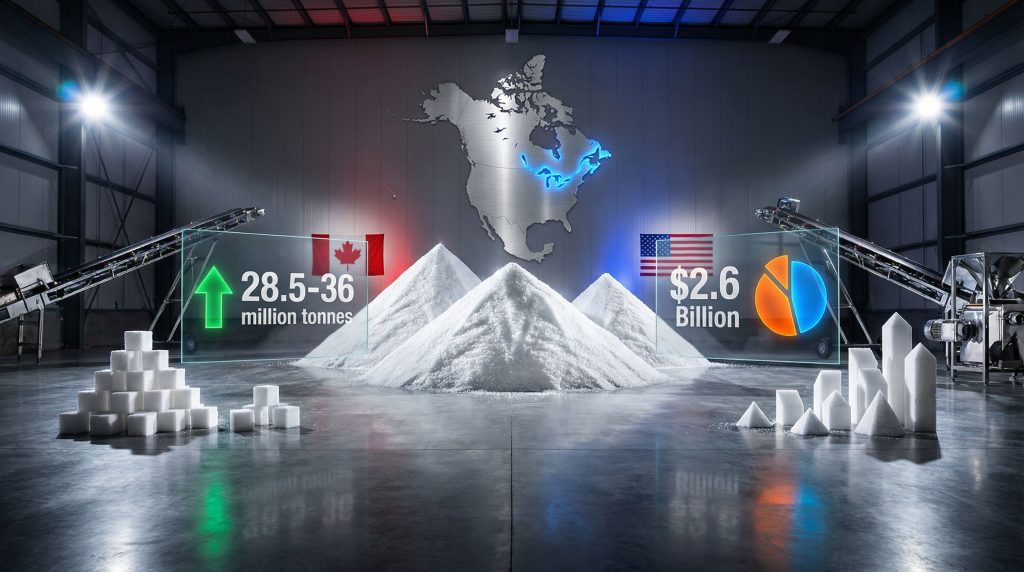
Industrial markets frequently overlook infrastructure commodities that operate outside traditional cyclical patterns. The North American road salt market represents precisely such an opportunity: a $2.6 billion annual sector consuming 28.5 to 36 million tonnes yearly, yet remaining largely invisible to institutional portfolios despite exhibiting defensive characteristics that align with late-cycle investment preferences.
Unlike copper, lithium, or other growth-dependent minerals, road salt demand operates independently of economic expansion cycles. Municipal liability frameworks mandate winter road treatment regardless of fiscal conditions, creating non-discretionary consumption patterns that persist through recessions. This fundamental demand structure, combined with persistent domestic supply shortfalls requiring 20-35% import dependency, establishes market dynamics worthy of strategic analysis.
When big ASX news breaks, our subscribers know first
Government Liability Creates Recession-Resistant Demand Fundamentals
Municipal Safety Obligations Drive Non-Discretionary Consumption
Winter road treatment represents a legal obligation rather than discretionary spending across northern jurisdictions. State transportation codes and provincial regulations establish liability frameworks where municipalities face litigation exposure if roads remain untreated during winter weather events. This creates a hard demand floor that persists regardless of broader economic conditions.
Salt application occurs preventively at the first indication of precipitation rather than reactively after accumulation. Municipal crews deploy salt based on weather forecasts, not actual conditions, ensuring consumption occurs even during false alarms. This behavioural pattern reinforces baseline demand predictability over multi-year horizons despite seasonal volatility.
The regulatory framework differs fundamentally from discretionary commodity consumption. Unlike construction materials subject to project delays or industrial inputs that fluctuate with production cycles, salt demand follows weather patterns and safety mandates. Furthermore, procurement departments cannot defer purchases or reduce application rates without accepting legal liability, highlighting permit constraints that shape municipal decision-making.
Market Scale and Regional Concentration Patterns
The North American road salt market exhibits pronounced geographic concentration, with the northeastern United States and Eastern Canada accounting for approximately 75% of continental consumption. This concentration reflects population density, road network complexity, and winter weather severity patterns across the region.
Regional Consumption Distribution:
• Northeast US: 18-22 million tonnes annually
• Eastern Canada: 8-12 million tonnes annually
• Midwest US: 6-8 million tonnes annually
• Western Regions: 2-4 million tonnes annually
Urban areas drive consumption intensity through higher road density, traffic volumes, and liability concerns. Cities like New York, Toronto, and Boston maintain extensive salt stockpiles year-round, with procurement occurring during summer months to ensure winter readiness. Municipal storage facilities typically maintain 3-6 months of average consumption as baseline inventory.
Weather volatility introduces annual demand fluctuations between 15-40% above or below baseline consumption. Severe winters such as 2013-14 or 2019-20 can exhaust stockpiles within weeks, forcing emergency procurement at premium pricing. Conversely, mild winters create inventory surpluses that reduce following-year purchases.
Structural Production Constraints Create Persistent Import Dependency
Domestic Mining Limitations and Infrastructure Aging
North American salt production faces structural constraints that have persisted for decades. Economically viable halite deposits concentrate in specific geological formations, primarily in Michigan, New York, Kansas, and select Canadian provinces. These deposits require underground mining techniques with substantial capital requirements and multi-year development timelines.
Existing mines face aging infrastructure challenges that limit expansion potential. Many facilities date to the 1960s-1980s era, requiring significant modernisation investments to maintain current output levels. Shaft deepening, equipment replacement, and safety system upgrades represent major capital expenditures that many operators defer due to commodity price volatility.
Environmental permitting adds complexity to capacity expansion projects. Groundwater protection requirements, subsidence monitoring, and waste disposal regulations extend approval timelines beyond typical mining projects. Consequently, these permit constraints significantly impact project development schedules and capital allocation decisions.
The Three-Decade Development Gap in North American Mining
No new salt mine has commenced production in North America since the 1990s, creating a generational gap in capacity development. This hiatus reflects multiple factors: low commodity pricing during the 2000s, regulatory complexity, and capital allocation toward higher-return mineral projects during commodity super-cycles.
Mine development timelines average 5-7 years from initial permitting through production, assuming no regulatory delays or community opposition. This extended timeline discourages speculative development, particularly given salt's relatively low per-tonne value compared to precious metals or battery materials.
Capital intensity creates additional barriers to entry. Underground salt mines require $100-300 million initial investments depending on scale and depth. Operating costs include specialised equipment, ventilation systems, and ongoing safety compliance that many junior developers cannot finance without established offtake agreements.
North American Salt Supply-Demand Analysis
| Region | Annual Demand (Mt) | Domestic Production (Mt) | Import Dependency (%) |
|---|---|---|---|
| Northeast US | 18-22 | 12-15 | 25-35% |
| Eastern Canada | 8-12 | 5-8 | 30-40% |
| Midwest US | 6-8 | 4-6 | 20-30% |
| Other Regions | 2-4 | 1-2 | 40-50% |
Import Lead Times Versus Emergency Response Requirements
Ocean Freight Logistics and Timing Asymmetries
International salt suppliers operate on predictable shipping schedules that conflict with emergency procurement needs. Bulk carriers from Chile, Egypt, and Morocco require 3-4 weeks minimum transit time to North American ports, assuming vessel availability and favourable weather conditions.
Port handling adds additional delays during peak winter months when multiple municipalities simultaneously seek emergency supplies. Atlantic Coast terminals experience congestion during January-March periods, extending total delivery timelines to 5-6 weeks during critical demand periods.
Inland distribution from coastal terminals creates further bottlenecks. Rail and truck capacity becomes constrained during severe weather events, precisely when emergency salt deliveries are most urgent. In addition, transport costs can exceed the commodity value during peak demand periods.
Emergency Procurement Challenges and Premium Pricing
Municipal stockpile management follows predictable seasonal patterns, with maximum inventory typically occurring in September-October following summer procurement cycles. Winter drawdown accelerates during severe weather events, with some jurisdictions depleting 30-40% of stockpiles during single storm systems.
Emergency procurement occurs when stockpiles drop below critical thresholds, typically 2-3 weeks of average consumption. At this point, municipalities prioritise delivery speed over cost optimisation, creating opportunities for premium pricing by suppliers offering rapid response capabilities.
Case Study: 2022 Winter Season Supply Disruptions
The 2021-22 winter season illustrated supply chain vulnerabilities when multiple severe weather events depleted municipal stockpiles across the Northeast. New York City's Department of Sanitation exhausted 60% of its salt reserves by February 2022, forcing emergency procurement at 40% premium pricing to standard contracts.
Similar patterns emerged across New England municipalities, with Boston paying $180 per tonne for emergency deliveries versus $120 per tonne under annual contracts. Import delays extended delivery timelines to 6-8 weeks during peak demand, forcing temporary rationing of salt applications on secondary roads.
Municipal procurement frameworks increasingly recognise that delivery certainty during emergency conditions provides greater value than marginal cost savings during normal procurement cycles.
Policy Evolution Toward Supply Chain Resilience
Legislative Changes Supporting Domestic Sourcing
State and municipal procurement policies increasingly incorporate supply chain resilience factors beyond traditional lowest-cost bidding frameworks. New York's Buy American Salt Act, enacted in 2023, allows state agencies to award contracts to domestic producers even when foreign suppliers submit lower bids, provided the premium remains within specified thresholds.
Denver's Environmentally Preferred Procurement programme integrates transportation emissions and supply chain reliability into vendor scoring matrices. Suppliers demonstrating local production, reduced transportation distances, and emergency response capabilities receive scoring advantages over distant low-cost alternatives.
Federal infrastructure legislation includes provisions encouraging domestic sourcing for critical materials. The Infrastructure Investment and Jobs Act allocates funding for supply chain resilience projects, with salt specifically referenced as a strategic material for winter road maintenance. Moreover, recent industry evolution trends highlight the shift toward strategic supply chain localisation.
Risk Premium Integration in Government Contracts
Municipal tender processes increasingly include delivery guarantee requirements that favour domestic suppliers. Standard contract terms now specify penalty provisions for delivery delays during declared winter emergencies, shifting risk from municipalities to suppliers.
Performance bonds and supply security requirements have become standard in major procurement cycles. Suppliers must demonstrate financial capacity to fulfil contracts during peak demand periods, advantaging established operators over spot market participants. These changes reflect broader domestic regulatory framework adaptations across North America.
Policy Impact on Procurement Patterns (2019-2025)
• Domestic sourcing preferences: Increased from 15% to 35% of total procurement value
• Supply guarantee requirements: Now standard in 80% of major municipal contracts
• Emergency response clauses: Included in 65% of state-level procurement frameworks
• Environmental scoring factors: Applied in 40% of municipal bidding processes
Market Control and Competitive Dynamics
Established Industry Players and Market Concentration
The North American road salt market exhibits significant concentration among established producers, with three companies controlling approximately 70% of domestic production capacity.
Compass Minerals International maintains market leadership through integrated production and distribution networks spanning multiple states and provinces. The company operates mines in Michigan, New York, and Kansas, with total estimated capacity of 8-10 million tonnes annually. Compass benefits from established customer relationships and logistics infrastructure developed over decades.
American Rock Salt, controlled by Ciner Resources, dominates Northeast regional markets through its New York operations. The company's strategic positioning near major population centres provides transportation cost advantages over distant competitors. Estimated production capacity ranges from 3-4 million tonnes annually.
Cargill's salt division focuses on distribution and logistics optimisation rather than primary production. The company leverages its broader agricultural and industrial networks to serve Midwest and Southern markets, with estimated capacity of 2-3 million tonnes annually.
Development-Stage Projects Targeting Import Displacement
Atlas Salt represents the most advanced development-stage project addressing North America's supply gap. The company's Great Atlantic project in Newfoundland and Labrador targets 1.5 million tonnes annual production beginning in 2030, specifically positioning to serve eastern seaboard markets currently dependent on imports.
The project has achieved significant development milestones including environmental assessment approval, early works permits, and a non-binding supply agreement with Scotwood Industries for 1.25-1.5 million tonnes annually. Engineering support from SLR Consulting and Sandvik positions the project for construction readiness pending final financing.
Furthermore, these developments align with broader government initiatives, including the production executive order emphasising domestic mineral security.
Major North American Salt Market Participants
| Company | Production Capacity | Geographic Focus | Market Position |
|---|---|---|---|
| Compass Minerals | 8-10 Mt/year | US/Canada Multi-Regional | Market leader |
| American Rock Salt | 3-4 Mt/year | Northeast US | Regional dominant |
| Cargill | 2-3 Mt/year | Midwest/South | Distribution focus |
| Atlas Salt (development) | 1.5 Mt/year (target) | Eastern seaboard | Import displacement |
The next major ASX story will hit our subscribers first
Transportation Economics and Delivered Cost Competitiveness
Freight Costs Versus Mine-Gate Pricing
Road salt competes on delivered cost rather than mine-gate pricing, creating advantages for strategically located deposits near major consumption centres. Transportation typically represents 30-50% of total delivered cost, making proximity to end markets a critical competitive factor.
Rail transportation dominates long-distance salt logistics, with unit train shipments providing cost efficiencies for high-volume routes. However, rail capacity constraints during winter months can disrupt delivery schedules, particularly when multiple commodities compete for limited car availability.
Truck distribution handles final delivery to municipal storage facilities and emergency shipments. Trucking costs escalate rapidly beyond 200-mile distances, limiting the economic radius for truck-based distribution networks.
Strategic Positioning and Logistics Network Advantages
Domestic producers benefit from established distribution infrastructure and customer relationships developed over decades. Storage facilities, rail sidings, and truck loading systems represent significant sunk costs that create barriers for new market entrants.
Port-based import operations require specialised handling equipment and storage facilities that many coastal terminals lack. Limited availability of bulk salt storage capacity constrains import volumes during peak demand periods. Additionally, concerns about supply security have led to increased focus on strategic supply reserves across multiple jurisdictions.
Direct-to-customer delivery capabilities provide competitive advantages during emergency procurement cycles. Domestic producers can mobilise truck fleets within hours of customer requests, while import suppliers require weeks for vessel charter and scheduling.
Investment Characteristics and Portfolio Positioning
Defensive Asset Attributes and Cash Flow Predictability
Road salt exhibits investment characteristics similar to regulated utilities and infrastructure assets. Demand predictability, government end-users, and essential service classification create defensive portfolio attributes particularly valuable during economic uncertainty periods.
Long-term municipal contracts provide revenue visibility extending 3-5 years with automatic renewal provisions. Pricing typically includes escalation clauses tied to inflation indices, providing protection against input cost inflation.
Counter-cyclical demand patterns offer portfolio diversification benefits. Severe winter weather that constrains other industrial activities simultaneously increases salt consumption, creating negative correlation with economic growth-dependent sectors.
Capital Requirements and Development Risk Assessment
Salt mine development requires substantial upfront capital with multi-year payback periods. Underground operations demand specialised equipment, ventilation systems, and safety infrastructure that create high barriers to entry.
Permitting timelines represent significant execution risk for development projects. Environmental assessments, community consultations, and regulatory approvals can extend beyond initial projections, particularly in jurisdictions with complex approval processes.
Investment Risk Framework Analysis:
• Demand risk: Low – government-mandated consumption
• Price risk: Moderate – municipal budget constraints
• Operational risk: Moderate – underground mining complexity
• Regulatory risk: Moderate – environmental permitting
• Competition risk: Low – limited new supply development
• Currency risk: Low – domestic end markets
Development-Stage Projects and Institutional Investment Interest
Import Substitution Economics and Market Entry Strategy
New domestic salt projects compete primarily against import suppliers rather than existing domestic producers. This dynamic creates market entry opportunities without direct displacement of established operators.
Import pricing includes ocean freight, port handling, currency conversion, and logistics costs that domestic projects can avoid. Analysis suggests domestic projects achieving production costs below $45-50 per tonne can compete effectively with delivered import pricing in major eastern markets.
Supply reliability premiums increasingly factor into municipal procurement decisions. Domestic projects offering guaranteed delivery within 72 hours command pricing advantages over foreign suppliers requiring 3-4 week lead times. According to research on North America's salt market, these reliability factors are becoming increasingly important in procurement frameworks.
ESG Considerations and Supply Chain Localisation Trends
Environmental, social, and governance factors increasingly influence municipal procurement frameworks. Local sourcing reduces transportation emissions, supports domestic employment, and enhances supply chain resilience against geopolitical disruptions.
Carbon footprint reduction aligns with municipal sustainability commitments. Domestic salt production eliminates trans-oceanic shipping emissions and reduces overall supply chain environmental impact.
Community economic impact considerations favour projects creating local employment and supporting regional economic development. Mining operations typically provide high-paying technical jobs in rural areas where economic opportunities may be limited. Furthermore, market analyses indicate growing institutional preference for domestically sourced materials.
Market Evolution and Future Growth Dynamics
Climate Change Impact on Winter Weather Variability
Climate research indicates increasing winter weather volatility with more frequent severe storm events despite overall warming trends. This pattern suggests higher peak salt consumption during extreme weather periods offset by reduced baseline consumption during mild periods.
Infrastructure adaptation requirements may increase salt demand through expanded road networks, higher traffic volumes, and increased safety standards. Urban population growth continues expanding road surfaces requiring winter treatment.
Regional demand shifts reflect population migration toward traditionally warmer regions that increasingly experience severe winter weather. Southern states historically consuming minimal salt may require increased winter preparedness as weather patterns become less predictable.
Technology Innovation and Application Efficiency Improvements
Brine pre-treatment adoption increases salt application efficiency but does not reduce total consumption proportionally. Pre-treating roads allows more effective salt distribution while maintaining public safety standards.
Smart city infrastructure enables precision salt application through weather monitoring and automated spreading systems. These technologies optimise consumption timing but maintain total seasonal volumes within historical ranges.
Alternative de-icing materials including calcium chloride and magnesium chloride serve specialised applications but cannot replace salt at the scale and cost effectiveness required for comprehensive road network treatment.
Market Growth Projections (2025-2035):
• Total demand growth: 2-3% annually driven by infrastructure expansion
• Import dependency: May increase without new domestic capacity
• Technology efficiency gains: 5-10% application optimisation potential
• Regional demand shifts: 15-20% increase in previously mild climate zones
How large is the North American road salt market?
The North American road salt market consumes approximately 28.5-36 million tonnes annually, valued at roughly $2.6 billion, concentrated primarily in the northeastern United States and Eastern Canada where winter road treatment is legally mandated.
Why does North America depend on salt imports?
Domestic production consistently falls short of demand due to aging mines, geographic concentration of viable deposits, environmental permitting constraints, and minimal capacity investment over three decades.
What creates supply chain vulnerabilities in salt procurement?
Import suppliers operate on 3-4 week shipping cycles while winter emergencies require immediate delivery, creating timing mismatches that expose municipalities to supply shortages during severe weather events.
How are procurement policies changing?
Jurisdictions including New York and Denver increasingly prioritise supply reliability and domestic sourcing over lowest-cost bidding, reflecting policy shifts toward supply chain resilience.
What makes road salt a defensive investment theme?
Demand is government-mandated, recession-proof, and driven by public safety requirements rather than economic cycles, combined with limited public market exposure creating scarcity value for investors.
What are the main investment risks in salt development projects?
Primary risks include permitting delays, capital cost overruns, market acceptance timelines, and financing execution, though demand risk remains minimal due to government-mandated consumption.
How do severe winters affect salt market dynamics?
Severe winters can deplete municipal stockpiles within weeks, forcing emergency procurement at premium pricing while exposing supply chain vulnerabilities for import-dependent regions.
Strategic Investment Implications for Infrastructure Portfolios
The North American road salt market presents institutional investors with exposure to defensive infrastructure characteristics rarely available in publicly traded formats. Government-mandated demand, limited substitution risk, and persistent supply deficits create investment dynamics that align with late-cycle portfolio positioning strategies.
Development-stage domestic projects offer asymmetric risk-reward profiles where successful execution captures market share from import suppliers rather than competing directly with established domestic producers. This import displacement thesis reduces competitive risk while addressing documented supply chain vulnerabilities.
Policy evolution toward supply chain resilience and domestic sourcing preferences supports long-term investment themes beyond cyclical commodity dynamics. Municipal procurement frameworks increasingly recognise the value proposition of reliable domestic supply during emergency conditions, creating sustainable competitive advantages for strategically positioned assets.
For investors seeking infrastructure-linked exposure with defensive characteristics and limited public market availability, the North American road salt market represents an under-recognised theme warranting analytical attention and strategic consideration.
Ready to Invest in the Next Major Mineral Discovery?
Discovery Alert instantly alerts investors to significant ASX mineral discoveries using its proprietary Discovery IQ model, turning complex mineral data into actionable insights. Begin your 30-day free trial today to position yourself ahead of the market and capitalise on defensive infrastructure commodities like those transforming North American supply chains.