June 9, 2026
Strategic calculations across global energy markets increasingly centre on infrastructure vulnerabilities that could reshape supply chains within hours. Persian Gulf terminals handle approximately 17 million barrels per day of crude oil exports, representing nearly 20% of global petroleum flows. Among these facilities, certain installations carry disproportionate systemic risk due to their concentrated processing capabilities and limited redundancy options.
This analysis examines how single-point-of-failure scenarios at critical energy infrastructure could trigger cascading market disruptions, insurance premium spikes, and geopolitical realignments. Understanding these vulnerabilities becomes essential as energy transition timelines extend and fossil fuel infrastructure aging accelerates across major producing regions, particularly in light of recent oil price rally dynamics.
Geographic Positioning and Strategic Infrastructure Analysis
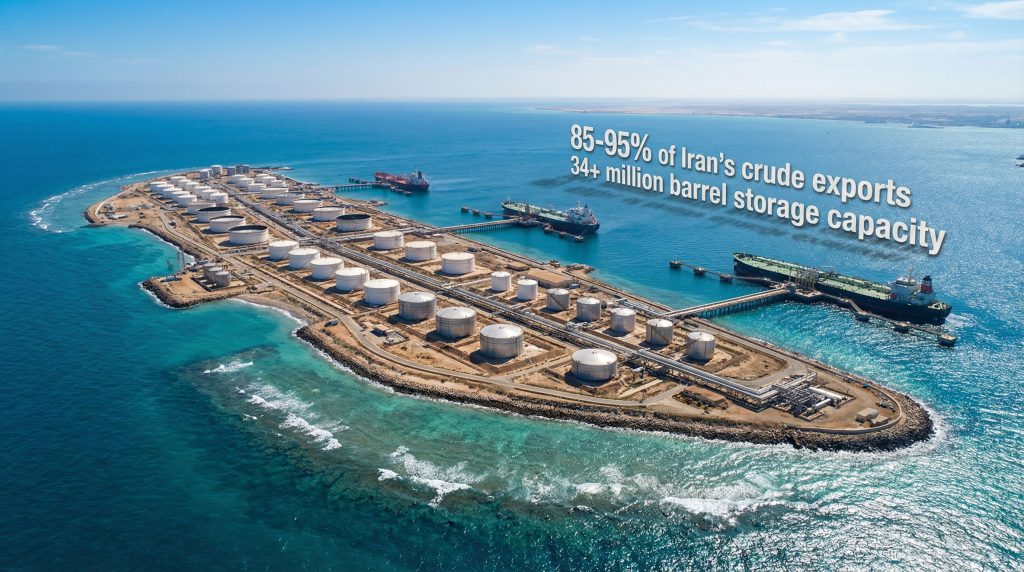
The Kharg Island oil export terminal operates as Iran's primary petroleum export gateway, positioned 25 kilometres offshore in the Persian Gulf. This coral formation measures approximately 8 kilometres long and 4-5 kilometres wide, creating a natural deepwater harbour suitable for supertanker operations without extensive dredging requirements.
Key Infrastructure Specifications:
• Storage capacity: Over 34 million barrels across 50+ crude oil tanks
• Export share: Handles 85-95% of Iran's total crude oil exports
• Daily throughput: Capacity for 1.1-1.7 million barrels per day
• Pipeline connectivity: Direct links to Agha Jari, Maroon, and Gachsaran oil fields
The facility's offshore positioning provides several operational advantages compared to mainland terminals. Natural water depth accommodates Very Large Crude Carriers (VLCCs) and Ultra Large Crude Carriers (ULCCs) without channel restrictions. Coral reef formations create natural breakwaters, reducing infrastructure maintenance costs from wave action and storm surge.
Supply Chain Integration and Export Operations
Pipeline transportation systems connect the island to Iran's major onshore production centres through submarine pipeline networks. These connections enable continuous crude oil flows from multiple field sources, allowing for quality blending operations and inventory management across different crude specifications.
Operational Capacity Metrics:
| Infrastructure Component | Specification |
|---|---|
| Storage Tank Capacity | 34+ million barrels |
| Loading Berths | Multiple simultaneous operations |
| Pipeline Diameter | Large-bore transmission capacity |
| Export Processing | 1.5-2.0 million bpd peak capacity |
Quality specifications vary based on source field characteristics, with API gravity ratings typically ranging from 27-35 degrees depending on the crude blend composition. Furthermore, sulphur content and viscosity parameters influence pricing differentials and destination market preferences.
When big ASX news breaks, our subscribers know first
Economic Dependency and Revenue Generation Patterns
Iran's fiscal dependency on petroleum export revenues creates significant exposure to infrastructure disruption scenarios. Government budget allocations rely on consistent export volumes through the Kharg Island terminal, with foreign currency earnings supporting import financing and economic stability measures.
Revenue Impact Analysis:
• Export earnings: $40-60 billion annually at current production levels
• Government dependency: 60-70% of total fiscal revenues from oil exports
• Economic multiplier effects: Downstream impacts across multiple sectors
• Currency stability: Petroleum exports support foreign exchange reserves
Sanctions circumvention strategies have increased reliance on alternative marketing channels and ship-to-ship transfers, creating additional operational complexity. Floating storage and inventory management become critical components for maintaining export continuity during market access restrictions.
Market Positioning and Competitive Dynamics
OPEC production capacity comparisons highlight Iran's potential contribution to global supply balances, particularly when considering OPEC production impact on pricing mechanisms. Spare capacity utilisation scenarios suggest that rapid production increases could significantly impact international pricing mechanisms if infrastructure bottlenecks were resolved.
Customer base diversification includes Asian refineries seeking medium-sour crude specifications and European processors requiring specific quality parameters. Destination market analysis shows concentration risks in key consuming regions.
Military Infrastructure and Dual-Use Capabilities
Security installations at the Kharg Island facility extend beyond typical industrial protection measures. According to official Iranian sources, radar surveillance networks provide maritime domain awareness across Persian Gulf shipping lanes, while coastal missile launcher positions create area denial capabilities.
Defensive Infrastructure Components:
• Surveillance systems: Comprehensive radar coverage and monitoring networks
• Access control: Islamic Revolutionary Guards Corps security protocols
• Communication facilities: Strategic coordination and intelligence operations
• Drone capabilities: Reconnaissance and potential offensive applications
Intelligence gathering operations leverage the facility's strategic positioning to monitor international shipping movements and naval activities throughout the Strait of Hormuz approach routes. Electronic surveillance capabilities provide early warning systems for potential threats.
Regional Power Projection Mechanisms
Geographic proximity to major shipping chokepoints enables significant leverage over global energy flows. The Strait of Hormuz handles approximately 21% of global petroleum liquids and 25% of liquefied natural gas exports, creating systemic vulnerability to regional conflict scenarios.
Escalation scenario modelling suggests that infrastructure targeting could trigger supply chain disruptions extending beyond Iranian export capacity. However, regional terminal vulnerabilities include shared waterway dependencies and insurance market reactions.
Global Market Vulnerability and Price Impact Modelling
Supply shock calculations indicate that complete Kharg Island disruption would remove 1.5-2.0 million barrels per day from global markets. Price elasticity models suggest immediate price increases of $10-15 per barrel, with sustained impacts dependent on alternative supply activation and strategic reserve deployments.
Market Response Scenarios:
| Disruption Duration | Price Impact | Alternative Supply | Strategic Reserve Response |
|---|---|---|---|
| 1-7 days | +$5-10/barrel | Limited activation | Coordination discussions |
| 2-4 weeks | +$10-20/barrel | OPEC spare capacity | Reserve releases begin |
| 1-3 months | +$15-30/barrel | Maximum alternative supply | Sustained reserve drawdowns |
Cascade effects across energy infrastructure networks could amplify initial disruptions. Consequently, shipping route diversions, insurance premium spikes, and refinery supply chain adjustments create secondary market impacts extending beyond crude oil pricing.
Strategic Reserve Deployment Considerations
International Energy Agency coordination mechanisms enable synchronised strategic petroleum reserve releases during supply emergencies. Reserve capacity calculations suggest 60-90 days of buffer capability at normal demand levels, though economic growth impacts could accelerate depletion rates.
Alternative supply source limitations include pipeline capacity constraints, production ramp-up timelines, and quality specification mismatches. Furthermore, spare capacity utilisation across OPEC+ producers faces technical limitations and political coordination challenges, affecting WTI and Brent trends in global markets.
Historical Precedents and Operational Resilience Lessons
Iran-Iraq War experience during the 1980s provides critical insights into infrastructure resilience and operational continuity under sustained attack scenarios. The Tanker War period demonstrated both vulnerability patterns and recovery capabilities for offshore petroleum facilities.
Historical Impact Analysis:
• Production disruptions: 40-60% capacity reductions during peak conflict periods
• Recovery timelines: 6-18 months for major infrastructure reconstruction
• Alternative routing: Development of temporary export alternatives
• International response: Convoy protection and insurance market adaptations
Engineering resilience improvements since the 1980s include hardened infrastructure designs, redundant systems implementation, and rapid repair capabilities. Modular construction techniques enable faster replacement of damaged components.
Modern Warfare Technology Implications
Precision strike capabilities using guided munitions and cruise missile systems create targeted destruction potential for specific infrastructure components. Underwater pipeline vulnerabilities and storage tank exposure represent high-value targeting opportunities.
Cyber warfare integration with physical attack scenarios could compromise control systems, safety mechanisms, and operational coordination. Industrial control system vulnerabilities extend attack surface area beyond kinetic weapon impacts.
Current Geopolitical Risk Assessment
US-Iran strategic competition encompasses economic sanctions enforcement, military positioning, and regional alliance coordination. Escalation threshold analysis suggests infrastructure targeting could trigger broader regional conflict involving multiple state actors.
Regional Security Dynamics:
• Military targeting policies: Rules of engagement and escalation management
• Economic warfare tools: Sanctions effectiveness and enforcement mechanisms
• Alliance coordination: Gulf Cooperation Council security integration
• Diplomatic channels: De-escalation pathways and crisis management protocols
Energy market participants increasingly factor geopolitical risk premiums into investment decisions and supply contract negotiations. Moreover, insurance market reactions to regional tensions create additional operational costs for petroleum transportation, influenced by ongoing trade war market effects.
Long-term Strategic Competition Implications
Energy transition context influences long-term strategic calculations regarding fossil fuel infrastructure investments. Peak demand scenarios and renewable energy competition affect economic justification for major infrastructure projects.
Stranded asset risks increase as carbon pricing mechanisms and environmental regulations reduce long-term demand projections for petroleum products. Infrastructure depreciation timelines may not align with economic transition schedules.
The next major ASX story will hit our subscribers first
Risk Management and Investment Implications
Supply chain diversification strategies require alternative sourcing arrangements and flexible contract structures. Financial hedging instruments including commodity futures and political risk insurance provide partial protection against supply disruption scenarios.
Portfolio Risk Management Approaches:
• Geographic diversification: Multiple supply source regions and routing options
• Inventory management: Strategic buffer stocks and flexible storage arrangements
• Contract flexibility: Force majeure provisions and alternative delivery terms
• Insurance coverage: Political risk, terrorism, and business interruption policies
Investment decision frameworks increasingly incorporate geopolitical stability assessments and infrastructure vulnerability analysis. Regional security architecture and conflict prevention mechanisms influence long-term project viability.
Business Continuity Planning Requirements
Emergency response protocols must address rapid supply chain reconfiguration and alternative sourcing activation. Communication systems, logistics coordination, and financial contingency arrangements require regular testing and scenario-based exercises.
Technology solutions for supply chain transparency include satellite monitoring, vessel tracking systems, and real-time market intelligence. Automated decision-making systems can accelerate response times during crisis situations.
Energy Transition Impact on Strategic Infrastructure
Peak oil demand scenarios create uncertainty regarding long-term infrastructure utilisation and economic viability. Carbon neutrality commitments across major consuming nations influence investment priorities and strategic planning horizons.
Transition Timeline Implications:
| Time Horizon | Demand Projections | Infrastructure Requirements | Investment Priorities |
|---|---|---|---|
| 2025-2030 | Stable/growing demand | Maintenance and upgrades | Operational efficiency |
| 2030-2040 | Peak demand period | Selective capacity additions | Flexibility and adaptability |
| 2040-2050 | Declining demand | Infrastructure rationalisation | Decommissioning planning |
Renewable energy cost competitiveness affects petroleum product demand across transportation, heating, and industrial applications. In addition, technology disruption timelines influence infrastructure depreciation schedules and capital allocation decisions, particularly considering trade war oil movements.
Regional Energy Security Architecture Evolution
Multilateral cooperation frameworks for energy security include emergency response coordination, information sharing agreements, and strategic reserve management. Gulf Cooperation Council initiatives focus on infrastructure protection and supply chain resilience.
International maritime security cooperation addresses shipping lane protection, naval escort services, and crisis response coordination. Recent analysis by security experts highlights the importance of preventive diplomacy mechanisms that aim to reduce conflict risks and maintain operational stability.
Disclaimer: This analysis contains forward-looking statements and scenario-based projections that involve significant uncertainties. Geopolitical developments, market conditions, and policy changes may differ materially from the assumptions presented. Readers should conduct independent research and consult qualified advisors before making investment or business decisions based on this information.
Ready to Capitalise on Energy Market Disruptions?
Discovery Alert's proprietary Discovery IQ model delivers real-time alerts on significant mineral discoveries that could benefit from energy market volatility, including battery metals and strategic commodities essential for energy transition infrastructure. Begin your 14-day free trial today and position yourself ahead of market movements that could reshape global supply chains.