June 9, 2026
The Structural Forces Reshaping Long-Term Commodity Investing
Few investment themes generate as much complexity and opportunity simultaneously as commodity supercycles. Unlike equity growth cycles driven by earnings expansion, commodity supercycles are powered by physical scarcity, infrastructure investment gaps, and decades-long demand transformations. The current cycle, which gathered momentum through 2024 and accelerated sharply into 2025 and 2026, is distinguished from previous cycles by three intersecting structural forces that show no signs of reversing: the buildout of artificial intelligence infrastructure, the global electrification push, and the accelerating transition away from fossil fuel energy systems.
For long-term investors evaluating the top ASX mining shares to buy, understanding these forces is not merely background context. It is the analytical foundation on which investment conviction is built.
When big ASX news breaks, our subscribers know first
Why the 2025–2026 ASX Materials Rally Is Different From Previous Cycles
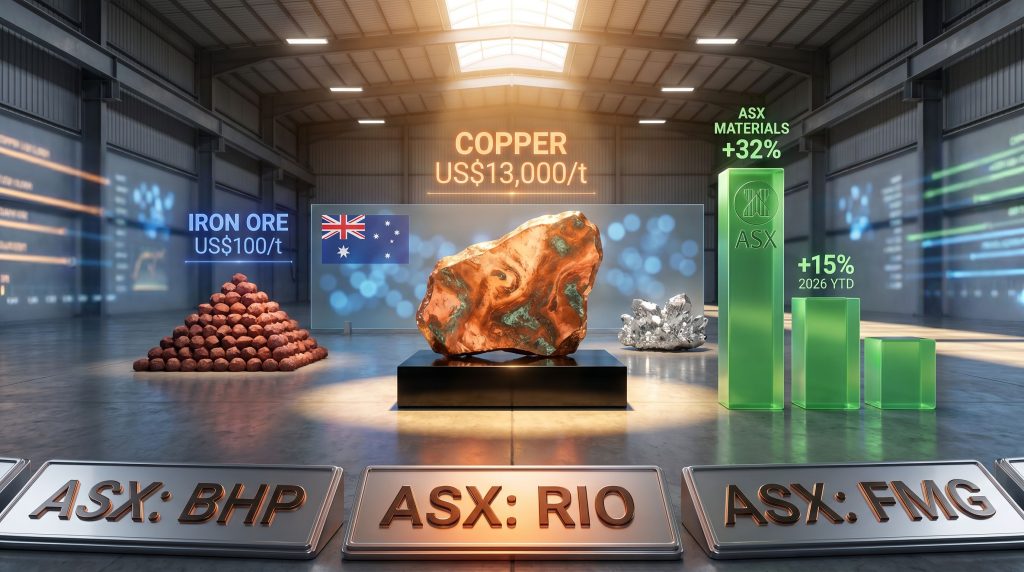
The ASX materials sector delivered a 32% return across 2025, followed by a further 15% gain in the first half of 2026. Those are extraordinary figures by any measure, but the more important question is whether the performance reflects speculative froth or durable structural demand.
The evidence points firmly toward the latter. Three distinct demand pillars are simultaneously driving commodity consumption at a scale the industry has rarely encountered:
- AI infrastructure construction: Each hyperscale data centre requires enormous quantities of copper wiring, aluminium cooling systems, and steel structural components. Global data centre capacity investment is projected to exceed US$1 trillion cumulatively by 2030, according to industry estimates.
- Electric vehicle adoption acceleration: EV penetration rates in China, Europe, and the United States are rising in tandem, creating compounding demand for copper, lithium, nickel, and aluminium across battery and drivetrain applications.
- Grid infrastructure modernisation: Ageing transmission networks across developed economies require wholesale upgrades to accommodate distributed renewable generation, creating decades of sustained copper and aluminium demand.
Copper has emerged as the single most important metal at the intersection of all three drivers. Prices surpassed US$13,000 per tonne during 2026, a level that reflects genuine supply-demand tension rather than speculative positioning. The copper supply crunch is underpinned by a geological reality: deposits are becoming harder to find at meaningful grades, with average ore grades at producing mines declining gradually as high-quality shallow deposits are exhausted.
Iron ore, meanwhile, has stabilised above US$100 per tonne, a signal that Chinese industrial demand has not collapsed despite ongoing headwinds from the property sector. The distinction matters for investors: stabilisation is different from recovery, and the nuance shapes which ASX mining shares offer the most compelling risk-adjusted returns at this point in the cycle. Furthermore, understanding the China steel and iron ore market dynamics is essential for correctly positioning around iron ore producers.
Sector Performance Snapshot
| Metric | 2025 | 2026 YTD |
|---|---|---|
| ASX Materials Sector Return | +32% | +15% |
| Copper Price Level | Rising sharply | Above US$13,000/t |
| Iron Ore Price | Recovering | Above US$100/t |
| Lithium Sector Sentiment | Severely depressed | Stabilising |
How to Evaluate the Top ASX Mining Shares to Buy: A 2026 Framework
Not all mining shares benefit equally from a commodity supercycle. The key analytical variables that distinguish durable long-term holdings from cycle-sensitive trades include:
- Commodity mix and diversification: Single-commodity exposure amplifies both gains and losses. Multi-commodity portfolios provide natural hedging when one market weakens.
- Production growth trajectory: Look for miners with visible, funded production expansion plans across a five to ten year horizon rather than reliance on existing capacity.
- Dividend sustainability: Payout ratios, franking credit availability, and whether dividends are genuinely supported by operating cash flow rather than balance sheet engineering.
- Valuation relative to peers: Price-to-sales ratios, EV/EBITDA multiples, and earnings comparisons against sector benchmarks reveal whether the market is pricing in too much optimism.
- Macro sensitivity mapping: Quantify how sensitive earnings are to a 10% to 20% move in each commodity price, Chinese steel demand shifts, Australian dollar movements, and energy cost inflation.
- Management capital allocation quality: How management allocates capital during high-price periods reveals far more about long-term shareholder returns than any short-term earnings figure.
Understanding how commodity prices affect mining equities is, consequently, a critical skill for anyone building a long-term portfolio in this sector.
"Commodity mix is consistently more predictive of long-term mining share returns than short-term price momentum. Diversified miners tend to sustain dividends through price cycles that would otherwise force single-commodity producers into payout cuts."
BHP Group (ASX: BHP): When Copper Becomes the Core Business
A Historic Earnings Inflection Point
BHP Group recently reached an all-time high above $65 per share before a subsequent pullback that, viewed analytically, reflects broader market risk-off sentiment rather than any deterioration in BHP's underlying business. The distinction between macro-driven selling pressure and company-specific earnings risk is critical for long-term investors, and BHP's current situation falls clearly into the former category.
The more significant story at BHP is a genuine structural shift in the company's earnings composition. For the first time in BHP's 136-year corporate history, copper earnings exceeded iron ore contributions during the first half of FY2026. This is not a temporary anomaly. It reflects the convergence of copper price strength above US$13,000 per tonne with BHP's deliberate multi-year strategic pivot toward copper-weighted growth.
BHP's plan to grow copper-equivalent production at 3% to 4% annually through 2035 creates a compounding production growth story that relatively few miners of BHP's scale can match. At the same time, the company retains substantial iron ore cash flows as a complementary earnings and dividend-funding stream.
Why Ore Grade Quality Matters More Than Most Investors Realise
One dimension of BHP's copper portfolio that receives insufficient investor attention is ore grade quality. Higher-grade copper deposits require less energy and processing input per tonne of metal produced, translating directly into lower unit costs and higher margins.
As global copper grades continue their long-term declining trend, miners with access to higher-grade reserves hold a structural cost advantage that compounds over time. This geological factor sits underneath the headline earnings numbers and rarely receives adequate weighting in standard valuation analyses.
BHP Investment Profile at a Glance
- Primary growth commodity: Copper (now the largest earnings contributor for the first time in corporate history)
- Secondary earnings streams: Iron ore, potash (longer-term), nickel (under review)
- Dividend structure: Fully franked, supported by diversified dual cash flows
- Production growth target: 3% to 4% copper-equivalent annual growth through 2035
- Key near-term risk: Iron ore price sensitivity to Chinese property sector weakness
- Key long-term risk: Potash project capital intensity and execution timeline at Jansen
Rio Tinto (ASX: RIO): Commodity Breadth as Structural Advantage
The Arcadium Acquisition: Repositioning for the Electrification Era
Rio Tinto completed the acquisition of Arcadium Lithium in March 2025 for US$6.7 billion, a transaction that fundamentally altered the company's long-term commodity profile. The deal elevated Rio to one of the world's largest lithium producers at a moment when lithium market sentiment was depressed following the sharp 2023–2024 price correction.
Acquiring scale at trough valuations rather than cycle peaks reflects exactly the kind of countercyclical capital allocation discipline that creates long-term shareholder value. The broader lithium market downturn that preceded this acquisition, however, underscores how volatile battery metals can be in the short term.
Lithium's role in the electrification megatrend extends well beyond passenger EVs. Grid-scale battery storage, industrial electrification, and commercial vehicle electrification all require lithium-ion chemistry at scale. The Arcadium acquisition gives Rio exposure to these demand pathways in a way that BHP and Fortescue currently cannot match.
How Rio's Portfolio Compares to Its Peers
| Commodity | BHP | Rio Tinto | Fortescue |
|---|---|---|---|
| Iron Ore | High | High | Very High |
| Copper | High (growing) | Moderate | None |
| Aluminium | Low | High | None |
| Lithium | None | High (post-Arcadium) | None |
| Titanium | None | Moderate | None |
| Green Energy | Limited | Limited | Active (Fortescue Energy) |
The 60% Payout Ratio: Reliable Income Architecture
Rio's formal dividend policy commits to distributing 60% of earnings to shareholders across the cycle. The mechanical relationship between commodity price tailwinds and shareholder distributions is straightforward: when earnings rise on higher copper, aluminium, or lithium prices, dividend distributions rise proportionally.
This policy makes Rio one of the most analytically predictable income-generating mining companies accessible to Australian investors. The aluminium exposure, which BHP largely lacks, deserves particular attention. Aluminium is increasingly critical to lightweight EV construction, renewable energy infrastructure, and data centre cooling systems.
"Rio Tinto's multi-commodity architecture spanning iron ore, copper, aluminium, lithium, and titanium creates a natural earnings diversification that is genuinely difficult to replicate through any other single ASX holding."
Fortescue (ASX: FMG): High Iron Ore Leverage and an Emerging Energy Narrative
Understanding the Ore Grade Discount
Fortescue occupies a distinct position among the major ASX iron ore producers, and investors who do not account for ore grade dynamics are missing a critical variable. Fortescue's iron ore product carries a lower iron content percentage compared to the higher-grade material produced by BHP and Rio Tinto.
Chinese steel mills, which are the primary customers for Pilbara iron ore, apply a pricing discount to lower-grade product that widens during periods of tight mill profitability. When mill margins are compressed by environmental compliance costs, weaker property sector construction activity, or oversupply in steel markets, mill operators preferentially purchase higher-grade ore to maximise yield per tonne of input.
This creates a structural margin headwind for Fortescue during stress periods that does not affect BHP and Rio Tinto to the same degree. It is a geological and metallurgical reality that shapes Fortescue's earnings volatility profile in ways that go beyond simple iron ore price exposure.
The CMRG Index: A Leading Indicator Most Investors Overlook
One of the more technically useful real-time indicators for iron ore investors is the CMRG index, which tracks Chinese steel mill restocking demand on a weekly basis. Unlike lagging indicators such as published port inventory data, the CMRG functions as a forward-looking signal of purchasing intent.
As of mid-2026, the CMRG had been rising for three consecutive weeks, a pattern that suggests near-term order improvement may provide price support for Fortescue's primary product. Investors monitoring Fortescue's near-term earnings trajectory should treat the CMRG as a higher-frequency data point than quarterly production reports.
Fortescue Energy: The Long-Term Diversification Thesis
Beyond iron ore, Fortescue has been constructing what it positions as a second growth engine through its Fortescue Energy division. The division's green hydrogen and green ammonia pipeline spans multiple continents including Australia, the United States, and various emerging market locations.
The critical question for investors is whether this division can generate commercial-scale revenues within a timeframe meaningful to current shareholders. Green hydrogen project economics remain challenging at current production costs, and the pathway from pilot-scale demonstration to utility-scale revenue generation is both capital-intensive and technically complex.
Investors should monitor announced project milestones, offtake agreement signings, and production cost benchmarks as the key metrics for assessing whether Fortescue Energy is becoming a genuine value contributor or consuming capital without near-term commercial return.
Fortescue vs. Rio Tinto: A Side-by-Side Comparison
| Factor | Fortescue (FMG) | Rio Tinto (RIO) |
|---|---|---|
| Primary Commodity | Iron Ore | Iron Ore + Copper + Aluminium + Lithium |
| Commodity Diversification | Low | High |
| Dividend Payout Policy | 50–80% of NPAT | 60% of earnings |
| Dividend Franking | Fully Franked | Partially Franked |
| Valuation vs. Peers | Below sector average P/S | Sector average |
| Green Energy Exposure | Active (Fortescue Energy) | Limited |
| Ore Grade Profile | Lower grade, wider price discount | Higher grade, narrower discount |
| Risk Profile | Higher | Moderate |
The next major ASX story will hit our subscribers first
South32, Mineral Resources, and the Next Tier of ASX Mining Opportunities
South32 (ASX: S32): A Different Diversification Profile
South32 offers a commodity portfolio that is deliberately distinct from BHP and Rio Tinto, with meaningful exposure to manganese, aluminium, zinc, copper, and silver. This composition provides leverage to battery supply chains through manganese and zinc exposure while also capturing copper's energy transition demand story.
South32's smaller market capitalisation relative to BHP and Rio means it appears frequently in analyst top-pick lists as a way to access ASX mining sector returns with different commodity weighting. For a broader overview of names in this space, resources such as top ASX mining stocks from investing news outlets can supplement individual company research.
Mineral Resources (ASX: MIN): Operational Complexity and Dual Commodity Exposure
Mineral Resources occupies an unusual structural position in the ASX mining universe. Unlike pure-play commodity producers, MIN operates simultaneously as a mining services contractor and a commodity producer, creating an earnings complexity that requires more analytical effort than straightforward miners.
The company's dual exposure to lithium and iron ore means it carries leverage to two commodity cycles simultaneously, which amplifies returns in favourable conditions but also compounds risk when both cycles turn negative at the same time.
The key metrics for Mineral Resources investors to monitor closely include:
- Debt management and balance sheet leverage
- Lithium project production timelines and capital expenditure requirements
- Iron ore shipment volumes as a cash flow stability indicator
MIN consistently appears in sector analysis not because it is the simplest mining investment, but because its risk-reward profile appeals to investors who accept operational complexity in exchange for potentially asymmetric returns.
Battery Metals and Royalty Models: Completing the ASX Mining Watchlist
Pilbara Minerals (ASX: PLS): Benchmarking ASX Lithium Exposure
Pilbara Minerals remains the most tracked pure-play lithium exposure on the ASX, centred on its Pilgangoora operation in Western Australia, which is one of the largest hard-rock lithium deposits globally by reserve size. The Pilgangoora deposit's scale matters because lithium production economics improve substantially with scale.
Larger operations spread fixed processing costs across more tonnes of output, lowering the breakeven price per unit of lithium carbonate equivalent produced. The lithium price cycle that collapsed from 2022 peak levels through 2024 reflected an oversupply shock as Chinese lepidolite production ramped ahead of EV demand growth.
The 2026 stabilisation thesis rests on the premise that lower prices have curtailed marginal supply additions while EV adoption continues compounding toward 2030 targets. Investors taking lithium exposure through PLS are essentially expressing a view on whether demand growth resumes faster than new supply enters the market.
Deterra Royalties: Mining Returns Without Mining Risk
Deterra Royalties offers a structurally different way to access ASX mining sector returns. Royalty business models generate revenue as a percentage of production value without bearing capital expenditure, operating cost, or production risk. When commodity prices rise, royalty revenue rises proportionally.
Deterra's primary royalty stream over BHP's Mining Area C iron ore operation in the Pilbara represents one of the highest-volume iron ore royalties in Australia. For income-focused investors who want iron ore price exposure without the balance sheet risk, operational complexity, or earnings volatility of direct iron ore producers, Deterra provides a genuinely differentiated exposure mechanism.
Key Risks Every ASX Mining Investor Must Understand
Commodity Price Volatility: The Variables That Can Reverse the Cycle
- Iron ore remains structurally sensitive to Chinese steel demand, which faces ongoing headwinds from environmental production caps and property sector deleveraging
- Copper prices, despite structural tailwinds, are not immune to short-term demand shocks from manufacturing slowdowns or global interest rate cycles
- Lithium has a documented history of sharp oversupply-driven price corrections when production capacity additions outpace near-term EV adoption rates
- Aluminium prices are particularly sensitive to energy costs, as smelting is highly electricity-intensive
Geopolitical and Macro Risk Factors
- Oil price escalation from geopolitical conflict directly increases diesel consumption costs across all mining operations, compressing margins at the operating level
- A strengthening US dollar creates a headwind for USD-denominated commodity prices when translated back into Australian dollar earnings
- China's economic policy effectiveness, particularly the resolution of its property sector deleveraging cycle, remains the single largest swing factor for iron ore demand
Company-Specific Risk Monitoring
| Company | Primary Specific Risk |
|---|---|
| BHP | Potash project capital intensity and construction timeline at Jansen |
| Rio Tinto | Arcadium Lithium integration risk and lithium market timing |
| Fortescue | Green hydrogen commercialisation timeline and ore grade discount widening |
| Mineral Resources | Balance sheet leverage and lithium project capital requirements |
| Pilbara Minerals | Lithium price recovery timeline vs. cash burn during low-price periods |
"Commodity businesses are inherently cyclical. Strong sector performance across 2025 and 2026 does not guarantee continuation. Investors should carefully assess position sizing, portfolio diversification, and investment time horizon before increasing mining sector exposure. Past performance is not indicative of future returns."
Building a Balanced ASX Mining Portfolio: A Practical Framework
Matching Mining Shares to Investment Objectives
| Investment Objective | Suggested Exposure | Example ASX Names |
|---|---|---|
| Core blue-chip stability | Large-cap diversified miners | BHP, Rio Tinto |
| Broad commodity diversification | Multi-metal exposure | Rio Tinto, South32 |
| Income and fully franked dividends | High payout ratio miners | BHP, Fortescue, Deterra |
| Copper and energy transition leverage | Copper-weighted positions | BHP |
| Lithium and battery metals growth | Hard-rock lithium producers | Pilbara Minerals |
| Higher risk, higher reward positioning | Iron ore pure-plays | Fortescue |
| Operational risk reduction | Royalty income models | Deterra Royalties |
Step-by-Step Evaluation Process Before Buying Any ASX Mining Share
Our ASX mining stocks guide provides a comprehensive starting point, however the following framework applies regardless of the specific shares under consideration:
- Map the commodity mix by revenue contribution percentage and research current price trends for each commodity in the portfolio
- Stress-test the dividend by checking whether payout ratios are genuinely supported by operating cash flow, and model what happens to distributions if the primary commodity price falls 20%
- Review the production growth pipeline including funded expansion projects, announced capital expenditure guidance, and any acquisition activity that alters the commodity profile
- Run a peer valuation comparison using price-to-earnings, price-to-sales, and EV/EBITDA multiples against direct sector comparisons, not just the broader market
- Model commodity price sensitivity scenarios for each significant input, particularly iron ore, copper, and lithium, to understand the earnings range across plausible outcomes
- Assess portfolio concentration risk before adding any position, ensuring no single commodity or single miner represents a disproportionate share of total portfolio exposure
In addition, independent sector-level analysis from platforms covering ASX materials companies can provide useful peer context when comparing valuations across the sector.
Frequently Asked Questions: Top ASX Mining Shares to Buy
What are the top ASX mining shares to buy in 2026?
The most consistently referenced large-cap names for 2026 include BHP and Rio Tinto for diversified exposure and income reliability, Fortescue for concentrated iron ore leverage with a lower entry valuation, Pilbara Minerals for battery metals exposure, and Deterra Royalties for income-focused investors seeking reduced operational risk. South32 is frequently highlighted for investors wanting a different commodity mix from the two major diversified names.
Is BHP or Rio Tinto the better buy right now?
BHP provides stronger copper growth momentum and a fully franked dividend backed by dual cash flows. Rio Tinto offers broader commodity diversification including significant new lithium exposure following the US$6.7 billion Arcadium acquisition and an aluminium business that BHP cannot match. The better choice depends on whether an investor prioritises copper-weighted earnings growth or multi-commodity diversification and partially franked income.
What is the CMRG index and why should iron ore investors track it?
The CMRG index monitors Chinese steel mill restocking demand on a weekly basis, functioning as a leading indicator for iron ore order volumes. When the index rises across multiple consecutive weeks, it typically precedes increased purchasing activity from Chinese mills, providing near-term price support for Pilbara iron ore producers. It is a more timely signal than quarterly production data and is particularly relevant for tracking Fortescue's near-term earnings environment.
Why has Fortescue lagged BHP and Rio Tinto in 2026?
Fortescue's lower-grade iron ore product attracts a wider price discount relative to higher-grade material during periods of margin pressure at Chinese steel mills. When mills are operating under tighter profitability conditions, they preferentially purchase higher-grade ore to maximise output per input tonne, which structurally disadvantages lower-grade producers during periods of steel sector stress.
Are ASX mining shares suitable for dividend income?
Large-cap ASX miners can be strong dividend generators, particularly given Australia's franking credit system. BHP and Fortescue pay fully franked dividends, with Fortescue's policy targeting 50% to 80% of net profit after tax. Rio Tinto's formal 60% earnings payout ratio creates a mechanical linkage between commodity earnings and shareholder distributions. Deterra Royalties offers a royalty-based income stream with lower earnings volatility than direct producers. However, all dividend levels are commodity-dependent and can vary significantly between reporting periods.
Key Takeaways for Long-Term ASX Mining Investors
The 2025 to 2026 ASX materials sector rally is supported by structural commodity demand forces rather than speculative momentum, with copper's energy transition role, iron ore stabilisation above US$100 per tonne, and the emerging lithium recovery thesis all contributing to a multi-year investment thesis.
Recent pullbacks across BHP, Rio Tinto, and Fortescue have been driven by macro risk-off sentiment and iron ore supply concerns rather than fundamental earnings deterioration, creating improved entry points for long-term investors without altering the underlying commodity demand story.
The most durable positions in ASX mining are built on:
- Commodity diversification that provides natural hedging across price cycles
- Visible production growth pipelines funded by existing cash flows
- Dividend frameworks that are mechanically linked to earnings rather than subject to discretionary management decisions
- Entry valuations that reflect an honest assessment of commodity price risk scenarios, not just upside projections
Investors evaluating the top ASX mining shares to buy should align their selections to their specific combination of income requirements, risk tolerance, commodity preferences, and investment time horizon rather than treating any single mining share as a universal solution for resources sector exposure.
This article contains general information only and does not constitute personal financial advice. Commodity markets are volatile and past performance is not indicative of future results. Investors should consider seeking independent financial advice before making investment decisions. For further analysis of ASX resources sector trends, readers can explore related editorial coverage at Motley Fool Australia.
Want to Know When the Next Major ASX Mineral Discovery Hits the Market?
Discovery Alert's proprietary Discovery IQ model delivers real-time alerts the moment significant mineral discoveries are announced on the ASX, transforming complex geological data into clear, actionable investment insights across copper, lithium, iron ore, and more than 30 other commodities. To understand just how transformative early discovery positioning can be, explore Discovery Alert's dedicated discoveries page — then begin your 14-day free trial and ensure you're positioned ahead of the broader market when the next major find is announced.