August 14, 2026
The Technology That Keeps Energy Flowing When the Sun Stops Shining
Long before lithium-ion batteries became the dominant narrative in the global energy transition, engineers working on grid-scale storage understood a fundamental problem that portable battery chemistry was never designed to solve: the electricity grid does not run on four-hour cycles. Industrial facilities, population centres, and renewable energy farms require storage systems capable of dispatching power across entire nights, overcast days, and multi-day weather events.
The physics of flow battery chemistry, particularly the vanadium redox variant, addresses this challenge in ways that fixed-electrode systems simply cannot replicate. Furthermore, as the critical minerals demand surge accelerates globally, the strategic importance of domestic supply chains becomes increasingly clear.
This is the technological backdrop against which the Richmond Vanadium Technology vanadium battery project is taking shape, and it explains why the commercial milestone reached in June 2026 carries implications that extend well beyond a single ASX-listed company.
When big ASX news breaks, our subscribers know first
Understanding Vanadium Redox Flow Batteries: The Technology Behind the Strategy
To appreciate what Richmond Vanadium Technology (ASX: RVT) is attempting to build, it helps to understand why vanadium redox flow batteries (VRFBs) occupy a structurally different position in the energy storage landscape compared to lithium-ion systems that dominate consumer electronics and short-duration grid applications.
How Does a VRFB Actually Work?
A VRFB stores energy in liquid vanadium electrolyte held in external tanks rather than within a fixed electrode structure. When the battery charges or discharges, electrolyte is pumped through a membrane cell where electrochemical reactions occur. The critical implication of this architecture is that power capacity (kW) and energy capacity (kWh) are completely independent variables. To store more energy, you simply add more electrolyte. To deliver more power, you add more cell stacks.
This decoupling is architecturally impossible with lithium-ion systems, where energy and power are fixed at manufacture. However, the other property that makes vanadium electrolyte commercially unique is that vanadium ions do not cross-contaminate between the two electrolyte tanks over time.
Because both the positive and negative electrolyte solutions use vanadium in different oxidation states (V²⁺/V³⁺ on one side, V⁴⁺/V⁵⁺ on the other), any ionic crossover through the membrane is recoverable through simple rebalancing. The electrolyte does not degrade and does not need to be replaced, unlike lithium-ion systems where capacity fade is an inherent characteristic of electrode chemistry.
The practical consequence for grid operators is substantial:
| Feature | Vanadium Redox Flow Battery (VRFB) | Lithium-Ion Battery |
|---|---|---|
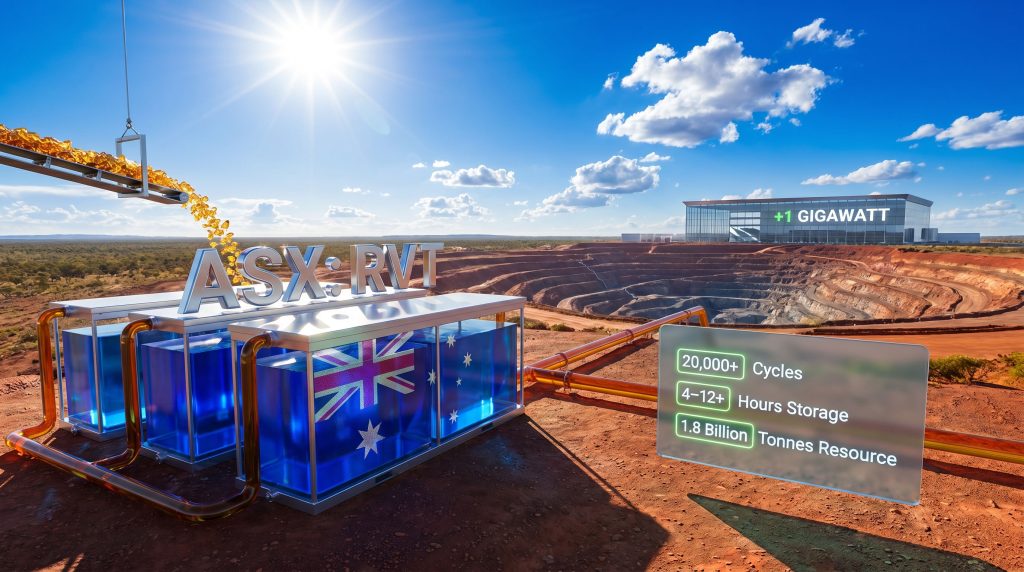
| Cycle Life | 20,000+ cycles | 3,000–5,000 cycles |
| Storage Duration | 4–12+ hours, scalable | Typically 2–4 hours |
| Capacity Degradation | Near-zero over operational life | Gradual fade over time |
| Safety Profile | Non-flammable aqueous electrolyte | Fire and thermal runaway risk |
| Electrolyte Recyclability | Fully reusable and reconditioning | Complex recycling requirements |
| Power/Energy Scalability | Independently scalable | Fixed at manufacture |
Beyond the technical attributes, VRFBs carry a less-discussed advantage in project finance contexts: the electrolyte itself retains residual vanadium value throughout the asset's life. At end-of-life, the vanadium can be recovered and resold, providing a residual asset value that no lithium chemistry can match. This characteristic is beginning to attract attention from infrastructure investors who assess projects over 20 to 30-year horizons.
The Richmond–Julia Creek Vanadium Resource: Scale as a Strategic Asset
The foundation of RVT's mine-to-battery ambition is the Richmond–Julia Creek vanadium deposit in north Queensland, described as one of the largest vanadium resources in Australia. The deposit carries a resource base of approximately 1.8 billion tonnes, with project modelling targeting production of 12,701 tonnes per annum of battery-grade vanadium pentoxide (V₂O₅) flake.
Battery-grade V₂O₅ flake is the specific product form required as the feedstock for vanadium electrolyte manufacturing. This is a critical and often overlooked distinction in vanadium project assessments. Not all vanadium products are interchangeable, and the specifications required for electrolyte-grade material are considerably more demanding than those for steel alloying applications, which historically accounted for the majority of global vanadium consumption.
What Purity Standards Are Required?
Technical note for investors: Vanadium used in steel production typically requires purity levels of 98% V₂O₅ or above, but electrolyte-grade material demands purities exceeding 99.5%, with tight controls on specific impurities including chromium, iron, and silicon. Projects that cannot demonstrate a credible metallurgical pathway to electrolyte-grade specifications face a meaningful commercial barrier regardless of resource size.
RVT's metallurgical testwork and flowsheet development are specifically oriented toward validating this conversion pathway, which represents one of the more technically demanding aspects of the company's development programme. You can explore RVT's project details to better understand the full scope of the deposit and processing ambitions.
North Queensland's infrastructure profile, furthermore, supports the project's logistics case. Existing port, rail, and energy corridor access in the region reduces the capital intensity of getting product to processing facilities, a factor that materially affects project economics at the prefeasibility stage.
The Binding Agreement With RKP Global: Two Years in the Making
The binding development agreement executed between RVT and RKP Global in June 2026 is the culmination of more than two years of structured engagement rather than a rapid commercial arrangement. This distinction matters for investors assessing the credibility of the framework. Partnerships assembled quickly in response to market enthusiasm tend to lack the technical depth that sustained engagement produces.
In May 2026, RVT representatives travelled to Dalian, China, for direct meetings with RKP executives and technical personnel. The discussions focused on Australian project development pathways, electrolyte localisation opportunities, and the specific technical requirements associated with the Richmond–Julia Creek resource.
Why Does Dalian Matter?
Why Dalian matters: Dalian is not an arbitrary meeting location. The city hosts some of the world's most significant VRFB manufacturing infrastructure, including facilities operated by Dalian Rongke Power Group, which has commissioned grid-scale VRFB installations with aggregate capacity measured in hundreds of megawatts. Conducting technical due diligence meetings in Dalian signals engagement with commercially operational, industrially scaled manufacturing capability rather than laboratory-stage technology.
The agreement establishes a collaborative framework with the following structural characteristics:
- Project-specific Special Purpose Vehicles (SPVs) for individual battery deployment opportunities
- Tailored financing structures aligned to each project's capital profile and risk characteristics
- Electrolyte localisation initiatives to develop Australian-based vanadium electrolyte production capability
- Broader mine-to-battery supply chain development progressing over a defined horizon
- Multi-jurisdictional scope, with explicit provision to evaluate opportunities across Australian states and industry sectors
Critically, RVT retains 100% ownership of the Richmond–Julia Creek vanadium project throughout this framework. The RVT Energy (RVTe) subsidiary functions as the coordination platform without transferring any upstream resource equity to external parties. This structure is architecturally significant: it allows RVT to participate in battery project economics while preserving its resource position as an unencumbered asset.
Electrolyte Localisation: The Least Understood and Most Valuable Part of the Plan
Among the components of the RVT development framework, electrolyte localisation deserves specific attention because it represents both the highest-value opportunity and the least widely understood aspect of the supply chain.
Currently, the overwhelming majority of global vanadium electrolyte production is concentrated in China. This creates a structural dependency that affects every VRFB project developed outside China: the primary energy storage medium must be imported, adding cost, lead time, and sovereign risk to projects intended to improve energy security. In this context, the relationship between critical minerals and energy security has never been more strategically consequential.
Electrolyte localisation involves developing domestic capability to convert battery-grade V₂O₅ into the sulphate-based vanadium electrolyte solution used inside VRFBs. The process requires controlled dissolution of vanadium pentoxide in sulphuric acid under specific temperature and concentration conditions, followed by electrochemical reduction to achieve the correct vanadium oxidation state balance. It is an electrochemical manufacturing process, not a mining or metallurgical one, and requires different infrastructure, skills, and quality management systems.
For Australia, establishing this capability would accomplish three things simultaneously:
- Break the import dependency for the core energy-storage medium in the fastest-growing segment of the long-duration storage market
- Add significant value to domestically produced vanadium before export or domestic sale
- Create a new manufacturing sector that positions Australia as a supplier of battery-ready materials rather than raw mineral precursors
RVT's metallurgical flowsheet work is specifically designed to enable a direct conversion pathway from concentrate to electrolyte-grade product, bypassing intermediate processing steps that would otherwise add cost and complexity.
The +1 Gigawatt Queensland Manufacturing Vision: Ambition Grounded in Existing Partnerships
The broader manufacturing ambition associated with the Richmond Vanadium Technology vanadium battery project involves a proposed localised VRFB manufacturing and assembly facility in Queensland targeting capacity in excess of 1 gigawatt per annum. This initiative involves collaboration with Dalian Rongke Power Group and TS Hold Co, both of whom are materially significant participants in the global VRFB manufacturing ecosystem.
A 1 GW+ annual manufacturing output would position Queensland as a meaningful contributor to Australia's grid-scale battery supply requirements at a time when renewable energy integration is placing growing demands on storage infrastructure. In addition, the broader battery metals investment landscape is increasingly favouring projects that offer vertically integrated supply chains over single-commodity exposure.
Queensland's industrial logic for this facility is supported by several converging factors:
- Proximity to the Richmond–Julia Creek vanadium resource reduces raw material logistics costs
- Existing port and rail infrastructure in north and central Queensland supports both inbound material and outbound product movement
- The state's critical minerals framework prioritises downstream processing and value-added manufacturing as economic development priorities
- A substantial pipeline of large-scale solar and wind projects in Queensland creates proximate end-market demand for long-duration storage assets
It is worth noting that at this stage, the +1 GW manufacturing facility remains a stated ambition within a broader development framework rather than a fully committed capital project. Investors should, consequently, interpret it as a strategic direction indicator rather than a near-term construction commitment.
The next major ASX story will hit our subscribers first
VRFB vs. Competing Long-Duration Storage Technologies: Where Vanadium Wins
The competitive positioning of VRFBs within the broader long-duration energy storage (LDES) landscape is not static, and understanding where vanadium holds durable advantages versus where competing technologies may challenge its position is important context for assessing RVT's commercial opportunity.
| Technology | Energy Density | Maturity Level | Key Advantage | Primary Limitation |
|---|---|---|---|---|
| Vanadium Redox Flow | Moderate | Commercial scale | Electrolyte longevity and reuse | Vanadium price exposure |
| Zinc-Bromine Flow | Moderate | Early commercial | Lower material cost potential | Bromine handling complexity |
| Iron-Air | Low-moderate | Pre-commercial | Abundant low-cost materials | Technology readiness level |
| Long-Duration Hydrogen | High | Emerging | Highest energy density | Round-trip efficiency losses |
For storage durations beyond four hours, VRFBs currently offer the most commercially validated combination of performance, safety, and operational track record. The technology has been deployed at scale in China, with installations ranging from utility firming projects to industrial campuses, providing a real-world operational dataset that competing technologies cannot yet match.
How Does RVT's Integrated Model Address Vanadium Price Risk?
One underappreciated risk in the VRFB investment thesis is vanadium price volatility. Vanadium trades globally as a commodity, and its price has historically exhibited significant cyclicality driven by steel industry demand, which still represents the majority of consumption. An integrated mine-to-battery developer like RVT is naturally hedged against this risk to a degree that a pure battery manufacturer is not.
Higher vanadium prices improve the economics of the mining business while potentially compressing electrolyte manufacturing margins, and vice versa. This internal hedge is a structural advantage of the vertically integrated model that is not widely discussed in mainstream coverage of the sector. For broader context, Australia's critical minerals reserve strategy further underscores why domestic supply chain development carries policy-level support.
Market Position and Commercial Context
At the time of the agreement announcement, RVT was trading at 13 cents per share with a market capitalisation of approximately $28.64 million. This valuation reflects the realities of early-stage critical minerals development in Australia: significant resource scale and strategic relevance coexisting with substantial execution risk and capital requirements ahead.
The execution of a binding agreement with an internationally credible VRFB partner represents a genuine de-risking milestone in the commercial development pathway. However, investors should maintain realistic expectations about the timeline between framework agreements and revenue-generating battery projects. Mine-to-battery supply chains of this complexity are typically developed over multi-year horizons, with each stage requiring its own technical validation, permitting, financing, and construction programme.
The SPV-based project architecture is designed to manage this complexity by enabling individual projects to be financed and structured independently, reducing the capital burden on RVT's corporate balance sheet while allowing third-party capital to participate at the project level. This is a financially sophisticated approach that mirrors structures used in infrastructure project finance more broadly. Innovations in direct lithium extraction and other battery material processing technologies offer useful parallel examples of how these supply chain frameworks are evolving across the critical minerals sector.
This article is intended for informational purposes only and does not constitute financial advice. Investors should conduct their own due diligence and consult a licensed financial adviser before making investment decisions. Forecasts, project timelines, and production targets referenced in this article are based on company statements and development assumptions, and actual outcomes may differ materially.
Frequently Asked Questions: Richmond Vanadium Technology Vanadium Battery Project
What is the Richmond Vanadium Technology vanadium battery project?
The Richmond Vanadium Technology vanadium battery project (ASX: RVT) is pursuing an integrated vanadium supply chain in Queensland that connects its Richmond–Julia Creek vanadium deposit to domestic VRFB manufacturing and grid-scale battery deployment, with the goal of establishing a complete mine-to-battery supply chain including vanadium processing, electrolyte production, and battery assembly. Further detail on the company's partnership structure provides useful context for understanding the commercial framework.
What is the significance of the RKP Global binding agreement?
The agreement, executed in June 2026 following more than two years of engagement, establishes a framework for developing Australian vanadium battery projects through project-specific SPVs, tailored financing structures, and electrolyte localisation initiatives, with RVTe acting as the Australian development platform.
Does RVT retain ownership of its vanadium resource under the partnership?
Yes. RVT retains 100% ownership of the Richmond–Julia Creek vanadium project. The development framework operates through the wholly owned RVTe subsidiary without transferring any project equity to external parties.
Why is electrolyte localisation considered a strategic priority?
Because global vanadium electrolyte production is currently concentrated in China, developing Australian-based electrolyte manufacturing capability would reduce import dependency, add downstream value to domestically produced vanadium, and create a new manufacturing sector directly linked to Australia's vanadium resource endowment.
What is the scale of the Richmond–Julia Creek vanadium resource?
The deposit carries a resource base of approximately 1.8 billion tonnes, with project modelling indicating planned production of 12,701 tonnes per annum of battery-grade vanadium pentoxide (V₂O₅) flake.
What makes VRFBs preferable to lithium-ion for grid-scale applications?
VRFBs offer independently scalable power and energy capacity, cycle lives exceeding 20,000 cycles, near-zero capacity degradation, non-flammable aqueous electrolyte chemistry, and fully reusable electrolyte, making them structurally better suited to multi-hour and multi-day grid storage applications than lithium-ion systems.
Want To Stay Ahead of the Next Major ASX Mineral Discovery?
Discovery Alert's proprietary Discovery IQ model delivers real-time alerts on significant ASX mineral discoveries — including critical minerals like vanadium that are powering the global energy transition — turning complex data across 30+ commodities into clear, actionable insights for both traders and long-term investors. Start your 14-day free trial today and explore historic discovery returns to understand just how transformative the right alert at the right time can be.