May 21, 2026
Understanding Institutional Vulnerabilities in Multilateral Sanctions Architecture
Hungary threatens EU sanctions over oil shipment blockage as the European Union's approach to sanctions enforcement reveals fundamental tensions between supranational coordination and national sovereignty. When unanimous consent becomes a prerequisite for collective action, individual member states can leverage veto power to extract concessions on unrelated issues, potentially undermining the entire sanctions framework.
Hungary's current position regarding EU sanctions illustrates how procedural safeguards designed to protect smaller nations can paradoxically weaken collective security responses. The country's threat to block the 20th sanctions package over interrupted oil deliveries demonstrates the institutional fragility inherent in unanimity requirements for foreign policy decisions.
When big ASX news breaks, our subscribers know first
The Legal Framework Governing EU Sanctions Authority
Article 31 of the Treaty on European Union mandates unanimous approval from all 27 member states for Common Foreign and Security Policy decisions, including sanctions packages. This requirement contrasts sharply with qualified majority voting procedures used in most other EU policy areas, where 55% of member states representing 65% of the population suffice for decision-making.
Historical precedents reveal the challenges posed by this unanimity requirement. Hungary has previously blocked or delayed EU decisions, most notably Ukraine aid complications in December 2022. Each instance of vetoing creates institutional precedents that may encourage future obstructionist tactics by any member state seeking leverage in unrelated negotiations.
The Council procedures under Article 31 TEU require formal notification of objections during ministerial meetings or through written communication. This creates opportunities for diplomatic resolution but also enables prolonged stalemate when member states maintain firm positions on seemingly irreconcilable issues.
Constitutional Tensions Between National Interests and Collective Action
The unanimity requirement reflects foundational EU principles regarding national sovereignty in foreign policy matters. Member states retain ultimate control over their international relations, making CFSP decisions fundamentally different from internal market regulations or environmental standards where qualified majority voting applies.
Legal scholars debate whether this protection mechanism serves its intended purpose or creates vulnerabilities that hostile actors can exploit. Hungary threatens EU sanctions over oil shipment blockage exemplifies this tension: protecting Hungary's energy security interests potentially undermines collective pressure on Russia's war financing through energy revenues.
Furthermore, constitutional implications extend beyond immediate sanctions effectiveness. Each successful use of veto power for leverage establishes precedents that other member states may invoke in future disputes, potentially eroding the EU's capacity for unified foreign policy responses. These dynamics become particularly complex when considering broader issues such as European supply vulnerabilities affecting strategic materials.
Critical Infrastructure Dependencies and Strategic Vulnerabilities
The Druzhba pipeline disruption that triggered Hungary's threat represents more than a simple supply interruption. Russian oil shipments through this strategic infrastructure were halted on January 27, 2026, following what Ukrainian officials attributed to Russian drone attacks on pipeline facilities.
This pipeline historically transported approximately 850,000 barrels per day to Eastern Europe, though current capacity utilisation requires verification given ongoing conflict conditions. The disruption affects not only immediate supply but also highlights the vulnerability of cross-border energy infrastructure in wartime conditions.
Technical Specifications and Alternative Supply Constraints
The Druzhba pipeline extends approximately 1,084 kilometres through Ukrainian territory to reach Central European markets. Its strategic importance stems not only from capacity but from the specific characteristics of Russian Urals crude it carries.
Russian crude has distinct sulphur content and processing requirements that Central European refineries are configured to handle. Hungary's MOL refineries and Slovakia's SLOVNAFT facilities were designed for these specifications, creating technical barriers to rapid diversification.
However, alternative crude sources, such as Azerbaijan's output via the Baku-Tbilisi-Ceyhan pipeline, have different properties requiring costly refinery reconfiguration. This technical constraint underlies legitimate concerns about immediate supply substitution, though it also raises questions about long-term strategic planning.
Current Dependency Levels and Diversification Progress:
- Hungary: 60% Russian oil dependency (down from 65% in 2022)
- Slovakia: 65% Russian oil dependency (down from 70% in 2022)
- Czech Republic: <10% Russian oil dependency (down from 50% in 2022)
- Poland: 5% Russian oil dependency (down from 95% in 2022)
Successful Diversification Models and Implementation Barriers
The Czech Republic's transition demonstrates the feasibility of moving away from Russian energy dependence. Since 2022, Czechia increased imports from Azerbaijan and developed access to North Sea crude through expanded refinery partnerships, reducing Russian oil dependency from approximately 50% to under 10%.
However, this success required specific conditions not present in Hungary and Slovakia. Geographic advantages include better access to alternative pipeline networks and shipping routes. Additionally, refinery flexibility provides technical capacity to process different crude specifications without major capital investment.
In addition, political commitment ensures consistent government support for diversification despite short-term costs. Timeline considerations allow multi-year implementation periods with gradual transition phases.
Czech refineries benefit from connections to the Transalpine Pipeline system, which provides access to Mediterranean ports and alternative crude sources. Hungarian and Slovak facilities lack comparable infrastructure diversity, creating genuine technical constraints beyond political preferences.
Emergency Legal Mechanisms and Alternative Frameworks
European Union treaties provide several mechanisms for addressing energy supply disruptions, though their application to the current crisis remains complex. Article 122 TFEU allows the Council to adopt emergency measures in cases of sudden difficulties in supply of certain products, requiring only qualified majority voting rather than unanimity.
As of February 23, 2026, no public record exists of formal Article 122 TFEU activation for the Druzhba pipeline disruption, despite the January 27 interruption affecting two member states. This absence raises questions about threshold requirements and political willingness to invoke emergency procedures.
Legal Requirements for Emergency Energy Coordination
Article 122 TFEU specifies that supply difficulties must be both sudden and significant to trigger emergency measures. Legal experts debate whether the Druzhba disruption meets this threshold, particularly given the availability of alternative sources, albeit at higher costs and with technical challenges.
The Energy Union framework, established through 2015 legislation and updated in 2023, prioritises energy security through diversification and solidarity mechanisms. However, enforcement mechanisms for mandatory sharing during crises remain underdeveloped compared to gas security regulations.
Key Distinctions in Emergency Response Authority:
- Article 122 decisions: Qualified majority voting (55% of member states, 65% of population)
- CFSP sanctions: Unanimous consent from all 27 member states
- Energy solidarity measures: Supramajority requirements with national security exceptions
- Infrastructure protection: Shared competence between EU and member state levels
Theoretical Alternatives to Unanimous Sanctions Implementation
Enhanced cooperation procedures under Article 20 TEU allow at least nine member states to proceed with integration in specific policy areas without requiring consent from all members. However, the treaty explicitly excludes CFSP from enhanced cooperation, creating fundamental barriers to sanctions implementation bypass.
Consequently, constructive abstention represents another theoretical mechanism, allowing member states to abstain from CFSP decisions without preventing adoption by others. Critical limitations apply: this prevents blocking through abstention but does not enable sanction implementation when active opposition exists, as indicated by explicit statements of non-consent.
Individual member states retain authority to implement unilateral sanctions outside EU frameworks. For instance, the Russian uranium ban demonstrates how countries can develop independent measures. However, bilateral sanctions create enforcement gaps and coordination challenges while lacking the unified pressure that coordinated EU measures provide.
Exemption Analysis and Strategic Dependencies
Hungary and Slovakia received temporary exemptions from EU bans on Russian oil imports through Council Decision 2022/2504 following Russia's invasion. These exemptions were explicitly justified based on energy infrastructure dependency and economic feasibility constraints affecting landlocked nations.
The exemption justifications centred on several technical factors: geographic constraints limiting alternative pipeline access, refinery infrastructure specifications designed for Russian crude, absence of viable LNG regasification capacity, and timeline requirements for infrastructure investment spanning 5-10 years minimum.
Economic Impact Assessment of Rapid Diversification
Slovakia's SLOVNAFT refinery operates at approximately 110,000 barrels per day capacity, specifically designed for heavier Russian crude processing. Converting to lighter crude alternatives requires substantial capital investment in hydrotreating equipment, potentially disrupting operations for extended periods.
Hungarian refineries operated by MOL maintain combined capacity of approximately 170,000 barrels per day, similarly optimised for Russian crude specifications. The economic impact of forced diversification extends beyond immediate supply costs to include several key factors.
Capital expenditure requirements include refinery modification and upgrade needs. Operational disruption occurs during reduced capacity transition periods. Supply premium costs affect alternative crude sources and transportation expenses.
These legitimate economic concerns must be balanced against broader strategic objectives and collective security requirements. The tension between national economic interests and supranational policy goals remains unresolved within current EU institutional frameworks, particularly when considering broader trade dynamics like US tariffs and inflation.
The next major ASX story will hit our subscribers first
Financial Leverage Mechanisms and Enforcement Tools
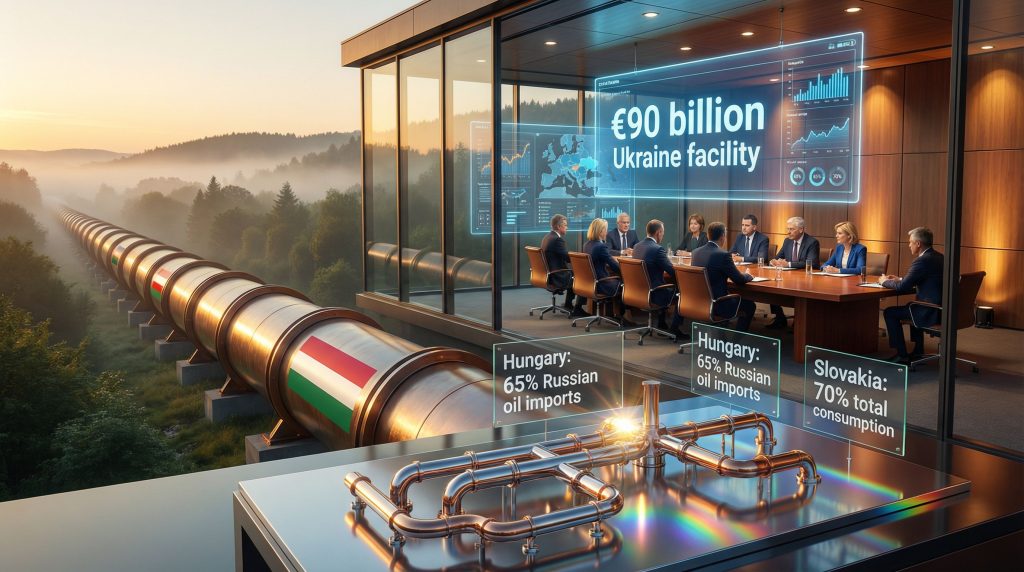
The European Union possesses several financial instruments that could potentially influence member state compliance with sanctions policies. The €90 billion Ukraine facility represents the most immediate leverage mechanism, providing essential military and economic support that Hungary threatens EU sanctions over oil shipment blockage now puts at risk.
This facility's legal structure includes disbursement conditions that may create opportunities for conditional funding approaches. However, using financial assistance as policy enforcement tools raises constitutional questions about the relationship between EU budget mechanisms and foreign policy decisions.
Recovery and Resilience Fund as Conditional Policy Tool
Hungary's access to Recovery and Resilience Fund resources could theoretically be conditioned on sanctions compliance, though this approach faces legal and political obstacles. Article 7 procedures provide mechanisms for addressing rule of law concerns but have not been successfully applied to foreign policy disagreements.
The challenge lies in establishing legal precedents for linking EU financial assistance to CFSP compliance without undermining the treaty framework that protects national sovereignty in foreign policy matters. This tension reflects broader questions about differentiated integration and multi-speed Europe concepts.
Available Financial Leverage Instruments:
- Ukraine Facility: €90 billion emergency assistance programme with conditional disbursement
- Recovery Funds: Post-pandemic reconstruction financing with rule-of-law conditions
- Cohesion Policy: Regional development funding subject to performance criteria
- Energy Transition Support: Green Deal implementation financing with compliance requirements
Long-Term Institutional Reform Considerations
The current crisis highlights structural weaknesses in EU decision-making architecture that extend beyond immediate sanctions effectiveness. Reforming these institutions requires careful balance between collective action capacity and member state sovereignty protection.
Extending qualified majority voting to foreign policy areas would fundamentally alter EU institutional architecture. While this could prevent individual state vetoes, it might also undermine the consensus-building processes that provide legitimacy to EU foreign policy decisions.
What Would Differentiated Integration and Multi-Speed Solutions Look Like?
Multi-speed Europe concepts offer potential solutions for sanctions policy coordination amongst willing member states while maintaining institutional frameworks for broader cooperation. This approach acknowledges that uniform integration may not be feasible across all policy areas.
Emergency brake procedures could provide safeguards for vital national interests while enabling collective action in most circumstances. However, defining "vital interests" and preventing abuse of emergency procedures presents implementation challenges that require careful institutional design.
Potential Reform Directions:
- Qualified majority expansion: Extending QMV to specific CFSP areas with national security exceptions
- Enhanced cooperation: Developing CFSP-compatible mechanisms for willing member state coordination
- Emergency procedures: Fast-track decision-making for time-sensitive security responses
- Institutional differentiation: Separate frameworks for different levels of integration commitment
Regional Security Implications and Strategic Calculations
Ukraine's position in this dispute extends beyond immediate pipeline repairs to broader strategic calculations about Western integration and energy weapon dynamics. Infrastructure targeting represents a deliberate strategy to create divisions within European alliance structures, particularly when considering the global tariff impact on international cooperation frameworks.
The timing of pipeline disruptions coinciding with sanctions package discussions suggests coordinated efforts to exploit institutional vulnerabilities. Russia's hybrid warfare tactics include infrastructure targeting designed to create economic pressure that translates into political leverage within democratic decision-making processes.
Energy Infrastructure as Geopolitical Instrument
Pipeline control provides Ukraine with significant leverage over Central European energy security, though exercising this leverage creates diplomatic costs with potential EU partners. The balance between immediate tactical advantages and long-term strategic relationships requires careful calibration.
Furthermore, Russian drone attacks on energy infrastructure serve multiple strategic purposes: direct economic impact, psychological pressure on civilian populations, and creation of divisions within Western alliance structures. The success of these tactics depends partly on institutional vulnerabilities within democratic decision-making processes.
According to Hungary's Ministry of Foreign Affairs, "We cannot support further sanctions whilst our energy security remains compromised by actions beyond our control." This statement reflects the complex intersection of national interests and collective security obligations.
Strategic Implications for Regional Actors:
- Ukraine: Balancing infrastructure leverage against EU integration objectives
- Russia: Exploiting institutional divisions to weaken sanctions effectiveness
- Central Europe: Managing energy security alongside alliance commitments
- EU institutions: Addressing procedural vulnerabilities whilst maintaining legitimacy
Market Psychology and Investment Implications
Energy markets respond to geopolitical uncertainty through risk premium adjustments that affect broader economic calculations. Hungary threatens EU sanctions over oil shipment blockage creates multiple layers of uncertainty that influence investment decisions across Central European energy infrastructure.
Regional oil prices reflect both immediate supply constraints and longer-term diversification risk assessments. Alternative supply arrangements typically command premium pricing that affects refinery margins and consumer costs, creating economic incentives that may influence political positions.
Long-Term Infrastructure Investment Requirements
Successful energy diversification requires substantial capital investment in pipeline infrastructure, refinery modifications, and alternative supply chain development. These investments face uncertainty regarding regulatory frameworks, geopolitical stability, and technological transition toward renewable energy systems.
Investment Risk Factors:
- Regulatory uncertainty: Changing sanctions regimes and energy policies
- Infrastructure vulnerability: Physical security risks in conflict-adjacent regions
- Technology transition: Competing demands between diversification and decarbonisation
- Geopolitical volatility: Shifting alliance structures and trade relationships
Private investment in energy infrastructure increasingly requires risk assessment frameworks that account for hybrid warfare tactics, institutional instability, and accelerated energy transition policies. Traditional infrastructure investment models may not adequately address these evolving risk profiles.
As The Guardian reports, "The dispute threatens to derail crucial financial support for Ukraine whilst exposing deep fractures in European unity over energy security versus collective defence priorities."
The current dispute demonstrates how energy dependencies create vulnerabilities that extend beyond immediate supply security to affect broader institutional stability and collective action capacity. Resolution requires balancing legitimate technical and economic constraints against strategic objectives and institutional integrity requirements.
Investment Disclaimer: This analysis contains speculative elements regarding geopolitical developments and market dynamics. Investment decisions should be based on comprehensive due diligence and professional financial advice rather than geopolitical analysis alone.
Looking for Investment Opportunities in Critical Resources?
Discovery Alert's proprietary Discovery IQ model delivers real-time alerts on significant ASX mineral discoveries, instantly empowering subscribers to identify actionable opportunities ahead of the broader market. Understand why major mineral discoveries can lead to substantial market returns by exploring Discovery Alert's dedicated discoveries page, and begin your 14-day free trial today to position yourself ahead of the market.