July 6, 2026
What Are Integrated Equipment and Fluid Solutions in Industrial Operations?
Modern industrial operations increasingly rely on sophisticated hydraulic systems that combine specialised equipment with engineered fluids to optimise performance across demanding applications. These integrated equipment and fluid solutions represent a fundamental shift from traditional procurement approaches, where machinery and lubricants were sourced independently without consideration for systematic compatibility.
Defining System Integration in Fluid Management
Integrated systems combine hardware components including pumps, valves, filtration systems, and monitoring equipment with specifically formulated fluid chemistry to create unified operational platforms. Unlike standalone equipment approaches, these solutions undergo coordinated testing and validation to ensure optimal performance under specific operational conditions.
The technical foundation follows ISO 4414 standards for fluid power systems safety and performance, establishing baseline requirements for pressure dynamics, flow control mechanisms, and component compatibility. System integration extends beyond mechanical connections to encompass communication protocols, predictive maintenance capabilities, and unified technical support structures.
Engineering Principles Behind Fluid-Equipment Integration
Pascal's Law applications in hydraulic system design demonstrate how integrated solutions leverage fundamental physics principles to optimise performance. Typical longwall hydraulic systems operate at pressures ranging from 210-280 bar (3,000-4,000 psi) in modern underground mining applications, requiring precise coordination between fluid properties and equipment specifications.
Fluid compatibility matrices become critical when considering material science interactions between synthetic formulations and equipment components. Furthermore, this mining industry evolution demonstrates how advanced materials science is transforming traditional approaches. Nitrile rubber seals demonstrate standard compatibility with mineral and synthetic oils, while PTFE seals offer broader chemical compatibility but exhibit different swelling characteristics under varying pressure conditions.
When big ASX news breaks, our subscribers know first
How Do Integrated Solutions Transform Mining Operations?
Australian longwall coal mining operations produce approximately 87 million tonnes annually, with longwall systems accounting for roughly 52% of Australian underground coal production. This mechanised segment represents the most capital-intensive mining applications, where equipment reliability directly correlates with production efficiency and operational costs.
Longwall Mining Hydraulic Systems
High-water-content hydraulic fluids address specific challenges in underground mining environments, particularly corrosion protection and fire resistance requirements. HBT Corsave 330 represents one example of specialised formulation designed specifically for longwall systems, utilising water-in-oil emulsion technology to maintain protective properties regardless of water hardness variations.
The formulation undergoes testing with water samples from Australian coalfields to verify stability and performance characteristics under localised conditions. This regional validation addresses a critical integration challenge where universal product specifications must adapt to specific hydrogeological conditions found in different mining regions.
Equipment Compatibility and Performance Metrics
Synthetic polyalphaolefin (PAO) formulations enable extended drain intervals compared to conventional mineral oils, directly reducing maintenance scheduling complexity and associated costs. Consequently, data-driven mining operations can leverage these extended intervals to optimise maintenance scheduling. Dynatrans WS 75W-90 synthetic gear oil demonstrates this approach through specialised additive packages providing anti-wear protection, corrosion resistance, and prevention of foaming and stick-slip phenomena.
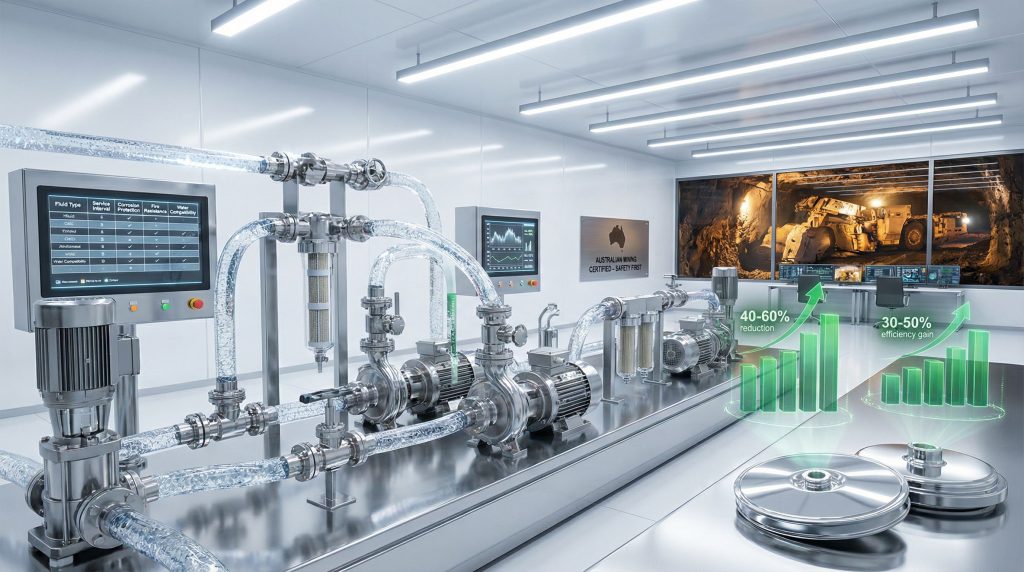
| Fluid Type | Service Interval | Corrosion Protection | Fire Resistance | Water Compatibility |
|---|---|---|---|---|
| Conventional Mineral | Standard | Basic | Limited | Variable |
| High-Water Content | Extended | Enhanced | Superior | Optimised |
| Synthetic PAO | Maximum | Advanced | Good | Engineered |
Extended service intervals translate directly to reduced equipment downtime and lower consumable consumption. Filtration characteristics remain stable even in hard-water conditions, reducing filter change frequency and maintaining hydraulic system reliability during continuous longwall operations.
Which Industries Benefit Most from Integrated Fluid Solutions?
The global fluid management market for mining operations was valued at approximately USD $3.8 billion in 2023, with expectations for 5.2% CAGR growth through 2030. This expansion reflects increasing adoption of integrated approaches across multiple industrial sectors requiring specialised fluid management capabilities.
Oil and Gas Drilling Operations
Solids control equipment packages for drilling fluids represent a significant application area where integration delivers measurable performance improvements. Centrifuge and vertical cuttings dryer integration enables more effective environmental impact reduction through optimised fluid recovery and waste minimisation protocols.
The global drilling fluid market was valued at approximately USD $9.2 billion in 2023, with expectations for 5.8% annual growth reflecting increased drilling activity and technological advancement in fluid management systems.
Semiconductor Manufacturing Requirements
Ultra-high purity flow control systems require exceptional chemical compatibility and contamination prevention capabilities. Industry 4.0 monitoring and Industrial Internet of Things (IIoT) integration enable real-time quality control and predictive maintenance optimisation across semiconductor fabrication facilities.
Heavy Industrial and Construction Applications
Mobile hydraulic solutions for equipment rental operations benefit from standardised fluid specifications and unified technical support structures. Emergency response and disaster recovery systems require exceptional reliability under extreme operating conditions, where integrated equipment and fluid solutions provide coordinated performance validation.
What Are the Key Technical Challenges in System Integration?
Component compatibility issues represent the most significant technical challenge in implementing integrated solutions. Elastomer compatibility testing per ISO 1817 standards reveals different swelling characteristics between nitrile rubber and PTFE seals when exposed to synthetic versus mineral oil formulations.
Component Compatibility Issues
Material science considerations extend beyond seal compatibility to include ferrous material corrosion prevention and passivation layer formation. Steel and cast iron components require anti-corrosion additives specifically formulated for synthetic fluid chemistry, with performance validation through ASTM D665 copper corrosion testing protocols.
Standardised communication protocols between systems present another integration challenge. CANbus implementation follows ISO 11898 standards for industrial applications, while Ethernet adoption in mining equipment represents an emerging trend requiring specialised protocol development for harsh operating environments.
Fluid Selection and Engineering Optimisation
Reservoir condition analysis requires matching fluid chemistry to equipment design specifications across varying temperature and pressure ranges. In addition, direct lithium extraction technologies demonstrate how fluid chemistry optimisation can enhance extraction efficiency. Regional water chemistry variations necessitate localised testing protocols to ensure stability under specific operating conditions.
System integration success depends on three fundamental parameters: fluid chemistry compatibility with equipment materials, standardised communication protocols for monitoring systems, and comprehensive testing under operational conditions.
Temperature stability validation across operational ranges becomes critical when considering synthetic formulations versus mineral oil alternatives. Pressure stability under peak load conditions requires extensive testing to prevent system failures during critical operational periods.
How Do Modern Monitoring Systems Enhance Fluid Management?
The global predictive maintenance market was valued at approximately USD $5.1 billion in 2023, with projected 12.8% CAGR through 2030, reflecting increasing adoption of automated monitoring technologies across industrial applications.
Automated Parameter Control Technologies
Real-time fluid property measurement systems enable continuous monitoring of viscosity, temperature, and contamination levels throughout operational cycles. Furthermore, AI-powered mining efficiency demonstrates how predictive maintenance analytics integration provides early warning capabilities for component wear and fluid degradation, preventing unexpected system failures.
Remote monitoring capabilities become particularly valuable for distributed operations where on-site technical support may be limited. Edge computing technologies enable real-time data processing and decision-making without reliance on centralised communication systems.
Data-Driven Optimisation Strategies
Fluid analysis for performance trending identifies gradual changes in system performance before critical thresholds are reached. Equipment wear pattern recognition algorithms analyse operational data to optimise maintenance scheduling and extend component service life.
Cost optimisation through integrated maintenance scheduling reduces total operational expenses by coordinating fluid changes with equipment servicing requirements. This approach minimises downtime while ensuring optimal system performance throughout operational cycles.
What Economic Benefits Drive Integrated Solution Adoption?
Single-source procurement advantages eliminate complexity associated with managing multiple vendor relationships and technical specifications. This streamlined approach reduces administrative overhead while ensuring coordinated technical support across all system components.
Operational Cost Reduction Analysis
Reduced inventory management complexity results from standardised fluid specifications and coordinated delivery schedules. Technical support structures benefit from unified expertise combining equipment manufacturer knowledge with comprehensive maintenance solutions and fluid performance optimisation capabilities.
| Cost Factor | Traditional Approach | Integrated Solution | Improvement |
|---|---|---|---|
| Procurement Complexity | Multiple vendors | Single source | 40-60% reduction |
| Technical Support | Fragmented | Unified | 30-50% efficiency gain |
| Maintenance Scheduling | Independent systems | Coordinated | 25-35% time savings |
Performance Optimisation ROI
Extended equipment service life through optimised fluids reduces capital replacement costs while improving operational reliability. Enhanced system reliability metrics demonstrate measurable improvements in equipment availability and production consistency.
Reduced maintenance scheduling complexity enables more efficient resource allocation and improved operational planning. Coordinated maintenance approaches minimise production interruptions while ensuring optimal system performance.
The next major ASX story will hit our subscribers first
Which Global Markets Show Strongest Growth Potential?
Asia-Pacific industrial expansion drives significant growth in integrated equipment and fluid solutions, particularly in mining sector modernisation and infrastructure development applications. Semiconductor manufacturing growth in the region creates additional demand for ultra-high purity fluid management systems.
Asia-Pacific Industrial Expansion
Mining sector modernisation requirements reflect increasing automation and equipment sophistication across Australian and regional operations. However, mining leadership trends indicate that executive teams are prioritising integrated approaches to maximise operational efficiency. Infrastructure development projects require reliable fluid management systems for construction equipment and mobile hydraulic applications.
North American Energy Sector Applications
Unconventional drilling fluid optimisation represents a growing market segment where integrated solutions provide significant performance advantages. Renewable energy hydraulic systems require specialised fluid formulations optimised for varying operational conditions and extended service intervals.
Industrial automation integration trends drive demand for coordinated monitoring and control systems across energy sector applications. This technological evolution requires sophisticated fluid management capabilities integrated with advanced equipment control systems.
What Future Technologies Will Shape Integrated Solutions?
Advanced materials and fluid chemistry developments will enable next-generation integrated systems with enhanced performance characteristics. Nanotechnology applications in fluid formulations promise improved wear protection and extended service capabilities under extreme operating conditions.
Advanced Materials and Fluid Chemistry
Smart materials for adaptive system responses represent an emerging technology area where fluid properties can adjust automatically to changing operational conditions. Biotechnology-derived fluid additives offer environmentally sustainable alternatives while maintaining performance requirements.
Digital Integration and AI Applications
Machine learning algorithms for predictive maintenance enable more sophisticated analysis of operational data and component wear patterns. Blockchain technology for supply chain transparency provides enhanced quality control and traceability throughout integrated system lifecycles.
Edge computing for real-time optimisation enables autonomous system adjustment without reliance on external communication networks. These technological advances will enable more sophisticated integration between equipment operation and fluid management systems.
How Should Organisations Evaluate Integrated Solution Providers?
Technical capability assessment requires evaluation of both equipment manufacturing expertise and fluid chemistry research capabilities. ISO certifications and mining-specific validations provide baseline qualifications for integrated solution providers.
Technical Capability Assessment Framework
Equipment manufacturing expertise should include documented experience with specialised applications and harsh operating environments. Fluid chemistry research and development capabilities require demonstrated innovation in synthetic formulations and performance optimisation.
Integration testing and validation methodologies must demonstrate coordinated performance under actual operating conditions rather than isolated component testing. This comprehensive approach ensures system-level optimisation rather than individual component excellence.
Service and Support Infrastructure
Global technical support network coverage becomes critical for organisations operating across multiple geographic regions. Training and knowledge transfer programmes ensure local technical competency while maintaining system-level expertise.
Emergency response and troubleshooting capabilities require 24/7 availability and rapid deployment of technical resources. These support structures become particularly important for critical applications where equipment downtime directly impacts production or safety.
Integrated equipment and fluid solutions represent the evolution of industrial fluid management from component-based approaches to system-level optimisation. Organisations implementing these solutions benefit from improved reliability, reduced operational complexity, and enhanced performance across demanding industrial applications.
Looking to Invest in Australia's Mining Technology Revolution?
Discovery Alert's proprietary Discovery IQ model instantly alerts subscribers to significant ASX mineral discoveries, transforming complex mining announcements into actionable investment opportunities. Explore how historic mineral discoveries have delivered exceptional returns and begin your 30-day free trial today to position yourself ahead of the market in Australia's rapidly evolving industrial technology sector.