August 5, 2026
Why the Race to Find Natural Hydrogen Underground Is Accelerating Faster Than Most Investors Realise
For most of the twentieth century, hydrogen detected in subsurface rock formations was treated as little more than a geological curiosity. Petroleum geologists encountered it occasionally during drilling operations and moved on. No commercial framework existed to capture it, no pipeline was built to transport it, and no industrial buyer was waiting to purchase it. That picture has changed with remarkable speed, and the Thor Energy natural hydrogen HY Range project sits at the centre of this emerging conversation.
The convergence of decarbonisation pressure, green hydrogen's persistent economic challenges, and a handful of encouraging geological discoveries has repositioned naturally occurring subsurface hydrogen as one of the most watched emerging commodities in the resources sector. Understanding why this matters requires looking at the geology first, then the economics, and finally the exploration methodology being deployed by companies working to convert surface anomalies into subsurface discoveries.
When big ASX news breaks, our subscribers know first
The Geological Case for Natural Hydrogen: Why South Australia Is Emerging as a Global Hotspot
What Makes a Region Prospective for Natural Hydrogen?
Not every geological province is capable of generating commercially relevant quantities of hydrogen. The process depends on a specific combination of rock chemistry, structural architecture, and fluid movement through the crust.
Two primary geochemical mechanisms drive natural hydrogen generation at depth. The first is serpentinisation, a reaction that occurs when water interacts with iron- and magnesium-rich ultramafic rocks under elevated temperature and pressure conditions, releasing hydrogen as a byproduct. The second is radiolysis, a slower process in which radioactive decay within ancient basement rocks breaks water molecules apart, liberating hydrogen over geological timescales.
Both processes require old, compositionally appropriate basement rock, which is exactly what South Australia's Precambrian basement provides. Equally important is the structural plumbing. Hydrogen generated at depth needs fault systems and permeable pathways to migrate upward toward potential accumulation zones. Without connected fault architecture linking the generation zone to a structural trap, hydrogen disperses into the crust rather than concentrating in exploitable volumes.
South Australia's geological framework combines Precambrian basement with a sedimentary sequence sitting above it that shares characteristics more familiar to petroleum geologists than mining geologists. This dual character — hard rock hydrogen generation beneath a more conventional sedimentary package above — is what makes the region structurally compelling as a natural hydrogen exploration province.
How Does South Australia Compare to Other Global Natural Hydrogen Provinces?
The table below contextualises South Australia's position within the emerging global landscape of natural hydrogen exploration:
| Region | Geological Setting | Key Operators | Exploration Stage |
|---|---|---|---|
| South Australia, Australia | Precambrian basement, sedimentary cover | Thor Energy, Gold Hydrogen | Active survey and drilling preparation |
| Mali, West Africa | Cratonic basement | Hydroma | Production pilot underway |
| Kansas, USA | Mid-continental basement | Various juniors | Early-stage |
| Oman | Ophiolite sequences | Academic and government | Research phase |
| Pyrenees, France and Spain | Orogenic basement | Academic | Research phase |
Mali's Hydroma project represents the most advanced proof of concept globally, having moved into a small-scale production pilot that demonstrated commercial hydrogen can be extracted from geological sources. Furthermore, a recent white hydrogen discovery in France has added further validation to the global thesis that naturally occurring subsurface hydrogen is a commercially viable target.
South Australia has a regional validation signal of its own in the form of Gold Hydrogen Limited's Ramsay-1 and Ramsay-2 well results on the Yorke Peninsula, which confirmed the presence of significant natural hydrogen concentrations in the state's subsurface geology. Geography also plays a commercial role. Unlike remote discoveries in West Africa or the American mid-continent, South Australia's prospective hydrogen acreage sits within practical distance of Adelaide's industrial and energy infrastructure.
What Is the Thor Energy HY-Range Project? A Technical and Operational Overview
Project Fundamentals: License, Ownership, and Geographic Scope
The HY-Range project operates under the formal license designation RSEL 802, though the more accessible name HY-Range is used operationally. Thor Energy holds an 80.2% interest in the project, which sits immediately north of Adelaide and extends approximately 200 to 300 kilometres, covering several thousand square kilometres of tenure.
That scale is frequently misunderstood by investors more familiar with conventional mineral tenements. In petroleum-style exploration, large license areas are operationally standard because the exploration question being answered is regional in nature. Identifying the right structural and stratigraphic setting for fluid accumulation requires the freedom to test multiple geological hypotheses across a meaningful geographic canvas before narrowing toward specific drill locations.
What Are the Three Priority Exploration Focus Areas Within HY-Range?
Geochemical survey work has progressively delineated three validated priority zones within the broader license area:
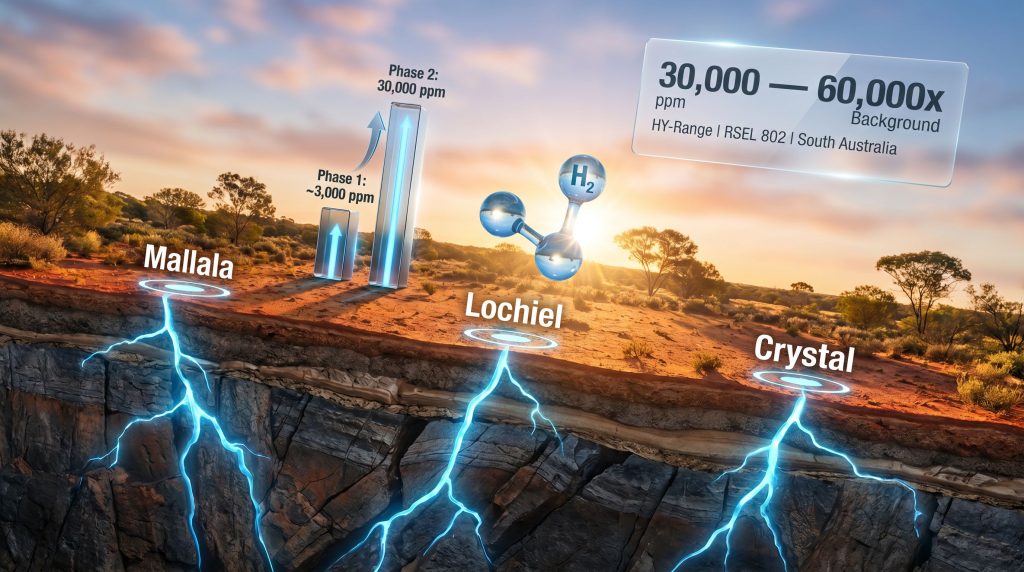
- Mallala: Identified through Phase 1 and confirmed with elevated readings in Phase 2, correlating with modelled basement architecture and interpreted fault structures.
- Lochiel: A second high-priority zone showing percentage-level hydrogen enrichment, supporting the interpretation of active subsurface hydrogen migration.
- Crystal: A third focus area demonstrating hydrogen and helium co-occurrence, adding confidence to the subsurface fluid migration model.
Each of these zones was delineated by cross-referencing surface geochemical anomalies with existing gravity, magnetics, and open-file subsurface datasets. The correlation between surface readings and modelled basement fault pathways is central to the geological argument supporting further investment in seismic acquisition and eventual drilling.
How Was the HY-Range Project De-Risked? A Two-Phase Geochemical Survey Methodology
What Is Soil Air Geochemistry and Why Is It Used in Natural Hydrogen Exploration?
Soil air geochemistry involves collecting gas samples from shallow depths, typically a few metres below surface, and analysing them for dissolved and free gas concentrations. In the context of natural hydrogen exploration, the scientific logic is straightforward: hydrogen migrating from depth through fault systems and permeable pathways will produce measurable surface seepage anomalies that act as indicators of deeper accumulation potential.
This approach borrows more from petroleum exploration methodology than from conventional mineral geochemistry. It is a regional screening tool rather than a definitive resource estimate, and its value lies in efficiently prioritising which parts of a large license deserve more expensive investigation such as seismic acquisition and drilling.
Phase 1 vs. Phase 2: What Did Each Survey Reveal?
The difference between the two survey phases was significant, both in terms of peak readings and methodological refinement:
| Parameter | Phase 1 (Mid-2024) | Phase 2 (Completed Q2 2025) |
|---|---|---|
| Peak Hydrogen Concentration | Up to 3,000 ppm | Up to 30,000 ppm (3%) |
| Sampling Approach | Standard density | Enhanced density, improved methodology |
| Focus Areas Validated | Initial target identification | Mallala, Lochiel, Crystal confirmed |
| Helium Detection | Limited | Confirmed across multiple locations |
| Primary Outcome | Priority zone identification | Strong confirmatory anomalies recorded |
The tenfold improvement between Phase 1 and Phase 2 peak readings is attributed to a combination of enhanced sampling technique, higher spatial density of sample collection, and potentially seasonal variations in gas flux that affect surface detectability. According to Thor Energy's project announcements, the Phase 2 results represent a meaningful de-risking milestone across all three priority zones.
What Does a 3% Soil Hydrogen Reading Actually Mean for Subsurface Potential?
The significance of the 3% surface reading becomes clearer when expressed against a reference point. Background atmospheric hydrogen concentration is approximately 0.5 parts per million. The recorded peak of 30,000 ppm at HY-Range represents a concentration roughly 60,000 times higher than ambient atmospheric levels. That is not a trivial anomaly.
Critical context: Surface geochemical anomalies at percentage-level concentrations are considered strong qualitative indicators of active subsurface hydrogen generation and migration. They do not constitute proof of commercial accumulation, but they represent a meaningful de-risking milestone that justifies investment in seismic imaging and eventual drilling.
The inferential logic used in petroleum exploration is applicable here. Surface seepage at these concentrations points toward deeper, higher-concentration accumulations at reservoir depth, potentially one kilometre or more below surface. The co-occurrence of helium enrichment in multiple zones adds a second independent line of evidence supporting the subsurface fluid migration hypothesis.
Surface geochemistry alone cannot confirm the geometry or volume of a subsurface accumulation. Seismic imaging is required to resolve structural traps, fault connectivity, and the depth profile of the basement. That is precisely the next step in the HY-Range exploration sequence.
What Comes Next? The 2D Seismic Acquisition Program Explained
Why Is 2D Seismic the Critical Next Step in the HY-Range Exploration Sequence?
Seismic acquisition works by generating an acoustic signal at surface and recording the reflected energy as it bounces back from geological boundaries and fault surfaces at depth. The resulting dataset, when processed and interpreted, produces a cross-sectional image of the subsurface that can resolve features down to several kilometres below surface.
For the HY-Range project, the seismic program is designed to answer a specific set of subsurface questions that geochemistry and desktop analysis cannot resolve on their own:
- What is the depth to the Precambrian basement beneath the project area?
- What is the nature and structural character of the basement lithology?
- Where are the principal fault systems located, and how are they connected?
- Are there structural traps or focusing mechanisms that could concentrate migrating hydrogen and helium?
- What is the thickness and stratigraphic character of the overlying sedimentary sequence?
These answers directly determine where wells can be placed with the highest probability of intersecting a subsurface hydrogen and helium accumulation.
Who Is Conducting the Seismic Program and When Will It Be Executed?
Thor Energy has awarded the seismic acquisition contract to Velsis, identified as a principal Australian seismic acquisition company. Field operations are planned for the end of Q3 or start of Q4 2025, with acquisition expected to span approximately three to four weeks in the field.
Thor Energy is fully funded for the seismic acquisition program. Following field acquisition, data processing, workstation integration, and geological interpretation will feed directly into the process of selecting specific well locations for drilling. For further detail, Thor Energy's corporate announcements provide ongoing updates as the program progresses.
How Does Seismic Data Integration Accelerate the Path to Drilling?
The exploration methodology being applied at HY-Range reflects what is known in petroleum exploration as play-based exploration (PBE), a framework originally developed by major oil companies including Shell and ExxonMobil over the past two to three decades. PBE uses a risk-weighted, multi-element approach to systematically de-risk exploration opportunities before committing capital to drilling.
The full de-risking sequence at HY-Range follows a logical progression:
- Regional desktop analysis incorporating gravity, magnetics, and open-file subsurface data.
- Phase 1 soil air geochemistry survey to identify priority anomaly zones.
- Phase 2 soil air geochemistry survey with enhanced methodology to confirm and rank anomaly zones.
- 2D seismic acquisition program (Q3/Q4 2025) to image subsurface structure and basement architecture.
- Multi-dataset integration across geochemistry, gravity, magnetics, and seismic on workstations.
- Refined geological modelling and drill target finalisation.
- Well drilling program, currently planned to begin in 2026 subject to seismic interpretation outcomes.
What Is Natural Hydrogen and Why Is It Attracting Global Exploration Interest?
How Does Natural Hydrogen Differ From Green and Blue Hydrogen?
The hydrogen landscape encompasses several distinct production pathways, each with a different carbon profile, cost structure, and maturity level:
| Hydrogen Type | Production Method | Carbon Intensity | Cost Profile | Maturity |
|---|---|---|---|---|
| Grey Hydrogen | Steam methane reforming of fossil gas | High | Low | Commercial scale globally |
| Blue Hydrogen | Steam methane reforming plus carbon capture | Medium | Medium | Early commercial |
| Green Hydrogen | Electrolysis powered by renewable energy | Near-zero | Currently high | Scaling phase |
| Natural (Gold) Hydrogen | Geological extraction from subsurface | Near-zero | Potentially very low | Pre-commercial exploration |
The geological hydrogen category, sometimes called gold hydrogen, has a critical distinguishing feature. It requires no energy-intensive manufacturing process. The generation work has been done over millions of years by geochemical reactions in basement rocks. If extracted and delivered to market, the carbon footprint of geological hydrogen can be near-zero, comparable to green hydrogen but without the electrolysis energy cost that currently makes green hydrogen economically challenging at scale.
The economic problems facing green hydrogen electrolysis, which remain unresolved at meaningful scale, have created an opening for naturally occurring hydrogen that did not exist even a decade ago. In addition, the growing focus on renewable energy for mining operations has intensified the search for cost-competitive clean energy carriers such as geological hydrogen.
What Are the Industrial and Energy Applications That Drive Natural Hydrogen Demand?
The demand case for clean hydrogen is substantial and, critically, it already exists today in the form of fossil-derived hydrogen consumption.
Industrial feedstock applications currently dominated by fossil-derived hydrogen:
- Oil refining processes that use hydrogen to remove sulphur and crack heavy hydrocarbons.
- Ammonia and urea production underpinning global fertiliser supply chains.
- Methanol synthesis for industrial chemical processes.
- Importantly, more than 99% of current global hydrogen supply is derived from fossil fuels, representing a massive decarbonisation opportunity if clean alternatives can compete on cost.
Energy applications with growing relevance:
- Direct blending into existing natural gas pipeline networks.
- Hydrogen fuel cells for stationary electricity generation.
- Transportation fuel for heavy vehicles and mining equipment, where battery electrification faces weight and range constraints.
The decarbonisation of existing industrial hydrogen consumption represents one of the largest and most immediate potential markets for any source of clean hydrogen, including natural geological hydrogen.
The next major ASX story will hit our subscribers first
How Does Natural Hydrogen Fit Into the Mining Industry's Decarbonisation Challenge?
What Is the Structural Paradox Facing the Mining Industry on Emissions?
The mining industry faces a structurally worsening emissions challenge. As high-grade ore deposits are progressively depleted, the grade of remaining deposits declines. Lower-grade ore requires processing larger volumes of material to produce the same quantity of metal, which directly increases energy consumption and associated emissions per unit of output. This is not a cyclical problem that will resolve itself with commodity prices.
Consequently, mining electrification and decarbonisation has become one of the defining operational and strategic challenges across the global resources sector. This tension between mounting decarbonisation pressure and rising energy intensity per unit of production defines the challenge facing operators globally.
Can On-Site Natural Hydrogen Supply Reshape Mining Energy Economics?
Consider the scenario where a natural hydrogen discovery sits in proximity to a major mining operation. The potential applications are material:
- Hydrogen used as fuel for heavy mining equipment, directly displacing diesel and eliminating combustion emissions from the largest single emissions source in most open-cut operations.
- Hydrogen fed through fuel cells to generate on-site electricity, replacing diesel generation or high-emission grid power.
- Supply chain sovereignty achieved by removing dependence on imported diesel and exposure to global fuel price volatility.
When hydrogen is used as an energy source, the only combustion byproduct is water. This characteristic makes it uniquely aligned with the emissions reduction requirements facing modern mining operations.
What Role Does In-Situ Recovery Play in Thor's Dual Decarbonisation Strategy?
Thor Energy's approach to decarbonisation encompasses two complementary arms. The first is the Thor Energy natural hydrogen HY Range project. The second is its focus on in-situ recovery (ISR) of critical minerals through its significant shareholding in Envirro Copper Limited, targeting copper and associated metals in South Australia.
ISR fundamentally changes the environmental profile of mining operations. The in-situ leaching benefits are considerable: rather than excavating and crushing rock at surface, ISR uses wells to inject fluid into the orebody, dissolving target metals in place and recovering them at surface. This dramatically reduces surface disturbance, eliminates waste rock generation, and lowers energy intensity compared with conventional mining.
The integrated scenario — natural hydrogen as a co-located energy source supporting ISR copper operations — represents a genuinely novel approach to low-emission critical minerals production. Whether this integration can be realised in practice depends on the outcomes of ongoing exploration at HY-Range and the ISR programme.
How AI and Cross-Disciplinary Methodology Are Transforming Junior Exploration
What Does AI-Augmented Exploration Look Like for a Small-Cap Operator?
Large resource companies have dedicated data science teams and proprietary machine learning platforms. Junior exploration companies face a different reality. They must achieve comparable analytical outcomes with a fraction of the staff and budget. The growing role of AI in mineral exploration is, however, rapidly narrowing that gap for smaller operators.
At Thor Energy, AI tools are being applied to manage and interrogate large proprietary and open-file datasets, identifying patterns across gravity, magnetics, geochemistry, and subsurface data that would previously have required significantly larger technical teams. The efficiency argument is compelling: AI allows a small technical group to interrogate data volumes that once required multiple specialist departments.
The addition of seismic data to the existing dataset stack will expand the AI-assisted analysis further, with pattern recognition tools applied to look for rock property signatures and structural features relevant to hydrogen and helium accumulation.
How Does Cross-Disciplinary Methodology Create Exploration Advantages?
One of the less commonly understood advantages that petroleum-trained geoscientists bring to natural hydrogen exploration is the "bottom-up" regional basin analysis approach. Conventional mining geologists typically work from the surface inward, using outcrops, geophysics, and near-surface sampling to locate mineralisation. Petroleum geologists work the opposite direction, starting with regional source rock deposition, basin evolution, and fluid migration modelling before narrowing to specific structural targets.
Combining both methodologies simultaneously creates what might be described as an hourglass model. Analysis converges on high-confidence subsurface targets from two independent analytical directions, each acting as a cross-check on the other. This is particularly valuable when working with gravity and magnetics datasets, since petroleum and mining geologists extract different information from the same dataset based on their respective interpretive frameworks.
The play-based exploration framework adapted from major oil company practice provides the overarching risk-management structure within which this cross-disciplinary integration operates, systematically de-risking each geological element before committing capital to drilling.
Key Metrics and Project Snapshot
| Metric | Detail |
|---|---|
| License designation | RSEL 802 (HY-Range) |
| Thor Energy ownership | 80.2% |
| Location | Immediately north of Adelaide, South Australia |
| License area | Several thousand km² |
| Peak H₂ concentration recorded | 3% / 30,000 ppm (Phase 2) |
| Background atmospheric H₂ | Approximately 0.5 ppm |
| Concentration multiple vs. background | Approximately 60,000 times |
| Phase 1 peak reading | Approximately 3,000 ppm |
| Priority focus areas | Mallala, Lochiel, Crystal |
| Seismic contractor | Velsis |
| Seismic timing | Q3/Q4 2025 |
| Funding status | Fully funded for seismic acquisition |
| Drilling target | 2026 (subject to seismic interpretation) |
| Co-located commodity | Helium (confirmed across multiple zones) |
Frequently Asked Questions: Thor Energy HY-Range Project and Natural Hydrogen
What Is the HY-Range Project?
The HY-Range project, formally designated RSEL 802, is a natural hydrogen and helium exploration license covering several thousand square kilometres immediately north of Adelaide in South Australia. Thor Energy holds an 80.2% interest in the project. The project is currently in the advanced pre-drilling phase, with two phases of soil air geochemistry completed and a 2D seismic acquisition programme scheduled for Q3/Q4 2025.
What Hydrogen Concentrations Has Thor Energy Recorded at HY-Range?
Phase 2 soil air geochemistry recorded peak natural hydrogen concentrations of 3%, equivalent to 30,000 parts per million, at the highest-anomaly location within the license area. Background atmospheric hydrogen concentration is approximately 0.5 ppm, meaning the recorded peak is roughly 60,000 times the ambient atmospheric level. Phase 1, completed approximately one year earlier, recorded peak readings of approximately 3,000 ppm.
When Will Thor Energy Drill at HY-Range?
Subject to the outcomes of the Q3/Q4 2025 seismic acquisition programme and subsequent geological modelling, the company is currently planning its first well programme for 2026. Seismic data interpretation will directly inform well location selection.
What Is Natural Hydrogen and Is It Different From Green Hydrogen?
Natural hydrogen, sometimes called gold hydrogen, refers to hydrogen generated through geological processes in the subsurface over millions of years — specifically through reactions such as serpentinisation and radiolysis in ancient basement rocks. Unlike green hydrogen, which is manufactured through electrolysis of water using renewable electricity, natural hydrogen requires extraction rather than production. Both have near-zero combustion emissions, but the Thor Energy natural hydrogen HY Range project and similar ventures have the potential for substantially lower production costs if geological accumulations prove sufficient for commercial extraction.
What Are the Risks Associated With Natural Hydrogen Exploration?
Investors and stakeholders should be aware of several material risks specific to this sector:
- Subsurface geological uncertainty: Surface geochemistry and seismic data are inferential tools. Subsurface volumes and concentrations can only be confirmed through drilling.
- Pre-commercial industry status: No large-scale commercial natural hydrogen operation exists anywhere globally. The sector is at an early validation stage.
- Capital requirements: Seismic acquisition and drilling programmes represent significant expenditure that may require additional funding depending on programme scope.
- Regulatory framework development: Natural hydrogen sits between petroleum and mining regulatory regimes in most jurisdictions, and frameworks are still maturing.
- Market infrastructure: Industrial and energy infrastructure to receive, transport, and utilise geological hydrogen at scale does not yet exist in most regions.
What the Natural Hydrogen Sector Needs to Achieve Commercial Maturity
Critical Milestones That Will Define the Sector's Trajectory
The natural hydrogen sector is at an inflection point. Several developments have the potential to shift industry and investor attention substantially:
- The first commercial-scale natural hydrogen well announcement globally is widely anticipated within the exploration community to act as the defining catalyst for sector-wide attention and capital allocation.
- Development of regulatory frameworks specifically designed for natural hydrogen, distinct from both petroleum and conventional mining legislation, is proceeding in several jurisdictions including South Australia, but is not yet fully resolved.
- Establishment of pricing benchmarks and offtake structures for naturally sourced hydrogen will be required to underpin project financing for any discovery that moves toward development.
- Infrastructure investment connecting geological hydrogen sources to existing industrial demand centres is the final commercial bridge that must be built before production-scale operations can operate economically.
How Should Investors and Industry Stakeholders Evaluate Natural Hydrogen Exploration Companies?
A practical due diligence framework for assessing junior natural hydrogen explorers includes the following considerations:
- Quality and coherence of geological evidence across geochemistry, geophysics, and regional analogues.
- Infrastructure proximity and realistic market access for any potential discovery.
- Technical depth of the management team and its cross-disciplinary capability spanning both petroleum and mining methodologies.
- Funding adequacy relative to planned work programmes, including seismic and drilling budgets.
- Regulatory jurisdiction maturity and the clarity of the permitting pathway for natural hydrogen extraction.
- Portfolio diversification, particularly whether the company holds complementary critical minerals assets that can absorb overhead and create strategic synergies during the pre-production exploration phase.
This article is intended for informational and educational purposes only. It does not constitute financial or investment advice. Natural hydrogen exploration involves significant geological, commercial, and regulatory uncertainties. Readers should conduct their own due diligence and consult qualified financial advisers before making any investment decisions.
Want to Stay Ahead of the Next Major Resource Discovery?
Discovery Alert's proprietary Discovery IQ model delivers real-time alerts the moment significant mineral discoveries are announced on the ASX, turning complex data across more than 30 commodities into clear, actionable insights for investors at every level — start your 14-day free trial today and position yourself ahead of the broader market, or explore Discovery Alert's dedicated discoveries page to understand how historic finds have generated extraordinary returns for early movers.