June 4, 2026
Understanding the Strategic Value of Integrated Mineral Sands Operations
Critical mineral supply chains face unprecedented disruption as traditional extraction approaches struggle with capital intensity and single-commodity exposure. The emergence of large-scale mineral sands operations capable of producing multiple commodities simultaneously represents a fundamental shift in resource development economics, offering diversified revenue streams that reduce operational risk while maximising capital efficiency. Furthermore, the critical minerals strategy has become increasingly important for national security considerations.
Modern heavy mineral sands projects demonstrate superior economic resilience through their multi-commodity production model. Unlike dedicated rare earth operations that concentrate financial performance on volatile single-commodity markets, integrated mineral sands facilities generate primary revenue from stable industrial commodities while capturing valuable rare earth concentrates as byproducts. This approach distributes operational risks across titanium, zircon, and rare earth markets, creating sustainable cash flow profiles that support long-term investment horizons.
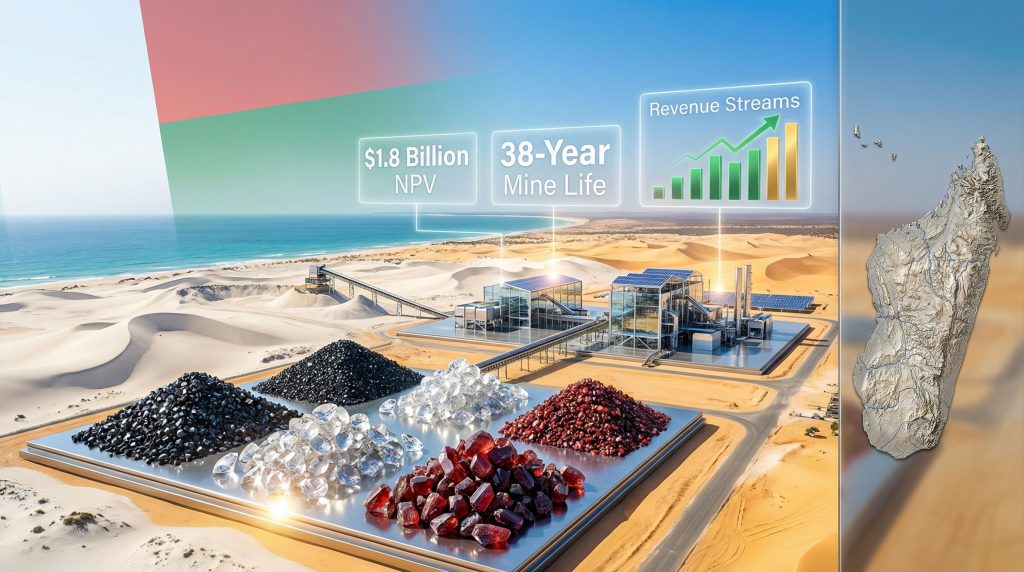
The feasibility study confirms economics of energy fuels madagascar rare earth project with a $1.8 billion net present value achieved by Energy Fuels' Vara Mada project, exemplifying the economic potential of this integrated approach. With projected annual operating profits exceeding $500 million from mining operations alone, the project demonstrates how mineral sands operations can achieve superior returns compared to traditional rare earth ventures. The 38-year operational timeframe provides unprecedented supply security, addressing critical concerns about resource availability and production continuity that have plagued shorter-duration projects.
Strategic Production Capabilities:
- 959,000 tonnes per year of ilmenite production for titanium pigment markets
- 66,000 tonnes per year of zircon for ceramics and refractory applications
- 24,000 tonnes per year of monazite concentrate containing both light and heavy rare earth elements
- 8,000 tonnes per year of rutile for high-purity titanium applications
The integration of downstream rare earth processing capabilities further enhances project economics. Energy Fuels' planned expansion at its White Mesa Mill facility in Utah demonstrates how vertical integration captures additional margins. Phase 1 expansion targets production of 1,000 tonnes of neodymium-praseodymium oxide, 48 tonnes of dysprosium, and 14 tonnes of terbium oxides by fourth quarter 2026, while Phase 2 expansion would scale processing to handle 60,000 tonnes of monazite concentrate annually by fourth quarter 2028.
When big ASX news breaks, our subscribers know first
What Makes Madagascar's Heavy Mineral Sands Sector Economically Transformative?
Madagascar's geological endowment positions the island nation as a strategic cornerstone in global critical minerals supply diversification efforts. The country's heavy mineral sands deposits contain unique mineral assemblages that serve multiple industrial applications simultaneously, creating economic value propositions that extend far beyond traditional mining paradigms. Moreover, understanding the mineral exploration importance becomes crucial in evaluating such large-scale projects.
The Ranobe deposit underpinning the Vara Mada project contains 904 million tonnes of proven and probable mineral reserves at an average heavy mineral grade of 6.1%, supporting the initially modeled 38-year mine life with significant potential for extension. Additional measured and indicated mineral resources total 485 million tonnes at 3.3% heavy mineral grade, complemented by 1.2 billion tonnes of inferred mineral resources at similar grades.
Resource Base Characteristics:
| Resource Category | Tonnage (Million Tonnes) | Heavy Mineral Grade (%) |
|---|---|---|
| Proven & Probable Reserves | 904 | 6.1% |
| Measured & Indicated Resources | 485 | 3.3% |
| Inferred Resources | 1,200 | 3.3% |
This substantial resource endowment creates unique economic advantages through scale and longevity. The multi-decade operational timeline provides customers with supply security that shorter-duration projects cannot match, enabling long-term supply agreements that reduce commodity price volatility exposure while supporting premium pricing for reliable supply commitments. Additionally, recent developments in rare earth extraction highlight the increasing viability of such projects.
Madagascar's strategic geographic positioning offers additional economic benefits through diversified shipping routes and proximity to major consuming markets. The island's location provides alternative supply pathways to Asian markets while maintaining reasonable logistics costs to European and North American destinations, supporting supply chain resilience objectives increasingly prioritised by major consuming nations.
The economic transformation potential extends beyond direct mining impacts to encompass regional infrastructure development and skills transfer. The project's substantial capital requirements—totalling approximately $1.032 billion across all development phases—represent transformational investment levels for Madagascar's economy, creating employment opportunities and technical capacity building that generate long-term economic benefits.
How Do Large-Scale Capital Investments Reshape Regional Development Economics?
Multi-billion dollar mineral projects create cascading economic effects that fundamentally alter regional development trajectories through infrastructure investment, employment creation, and supply chain integration. The scale of capital deployment required for modern heavy mineral sands operations generates economic multiplier effects that extend far beyond direct mining activities. In addition, mining consolidation strategies are becoming increasingly relevant for such large-scale developments.
The Vara Mada project's phased development approach demonstrates sophisticated capital allocation strategies that maximise economic impact while managing execution risk. Pre-final investment decision capital expenditure of $121 million enables detailed engineering and permitting activities, while Stage 1 post-FID capex of $769 million establishes initial 13-million tonnes per year processing capacity. Stage 2 expansion requiring $142 million doubles processing capacity to 25-million tonnes per year, demonstrating scalable production models that adapt to market demand evolution.
Capital Deployment Structure:
The project's infrastructure requirements—including processing facilities, port facilities, and transportation systems—create primary, secondary, and tertiary economic impacts that multiply initial investment effects throughout the regional economy.
Revenue structure analysis reveals the strategic importance of diversified commodity exposure. 73% of expected revenue derives from external sales of ilmenite, zircon, and rutile—established commodities with stable demand characteristics. 27% of revenue originates from internal sales of monazite concentrate for rare earth oxide processing, providing exposure to higher-growth rare earth markets while maintaining operational sustainability through primary commodity sales.
The integration of downstream processing capabilities creates additional economic value capture opportunities. Processing monazite concentrates at Energy Fuels' White Mesa Mill facility generates value-added employment in the United States while capturing processing margins that would otherwise accrue to third-party operators. This vertical integration model demonstrates how modern mineral projects can create economic benefits across multiple jurisdictions while maintaining strategic control over supply chain operations.
Why Do Mineral Sands Projects Offer Superior Economics to Traditional Rare Earth Operations?
The economic advantages of mineral sands-based rare earth production stem from fundamental structural differences in cost profiles, capital requirements, and operational risk characteristics compared to dedicated rare earth mining operations. These advantages create sustainable competitive positions that traditional rare earth projects struggle to match. Furthermore, green transition insights show how such projects align with global decarbonisation efforts.
Cost Structure Advantages:
- Lower capital intensity per tonne of rare earth output through shared infrastructure across multiple commodities
- Diversified revenue streams reducing single-commodity price volatility exposure
- Established processing technologies minimising technical risk premiums and development timelines
- Scalable production models enabling phased capacity expansion aligned with market demand growth
Traditional rare earth projects often face significant economic challenges including high capital requirements for complex metallurgical facilities, single-commodity revenue exposure creating vulnerability to price volatility, and technical risks associated with unproven processing methodologies. Mineral sands operations distribute these risks across multiple proven commodities while leveraging established beneficiation technologies.
The byproduct nature of rare earth production in mineral sands operations creates unique economic dynamics that enhance project resilience. Primary revenue from ilmenite and zircon sales—commodities with stable industrial demand—can sustain operations during rare earth price downturns, while rare earth concentrates provide upside potential during supply constraint periods or demand growth cycles.
Industry precedent supports the economic viability of this approach. Chinese rare earth industry structure demonstrates successful monetisation of monazite concentrates produced as byproducts of heavy mineral sands operations. This established market model validates the economic framework that Western operators are now pursuing to compete with dominant Chinese supply sources.
Operational Risk Distribution:
| Risk Factor | Traditional Rare Earth Projects | Mineral Sands Projects |
|---|---|---|
| Revenue Concentration | Single commodity exposure | Multi-commodity diversification |
| Technical Risk | Complex metallurgy | Proven beneficiation methods |
| Capital Intensity | High per tonne of output | Distributed across commodities |
| Market Volatility | Full exposure to rare earth prices | Cushioned by stable commodity revenues |
What Role Does Vertical Integration Play in Project Economics?
Vertical integration from mining through oxide production represents strategic positioning that captures value across the entire supply chain while maintaining control over product specifications, quality standards, and customer relationships. This integration model transforms commodity producers into value-added manufacturers, significantly enhancing economic returns and market positioning.
Energy Fuels' integration strategy demonstrates the economic potential of controlling multiple supply chain stages. Processing monazite concentrates at the White Mesa Mill facility enables direct customer relationships with commercial and government buyers rather than selling concentrates to third-party processors. This approach captures processing margins while providing customers with supply chain transparency and security increasingly valued in critical minerals markets. However, mining permits regulation continues to impact development timelines significantly.
Phase 1 Integration Economics:
- 1,000 tonnes of neodymium-praseodymium oxide production capacity by Q4 2026
- 48 tonnes of dysprosium annual production for high-performance magnet applications
- 14 tonnes of terbium targeting specialised electronics and defence applications
Phase 2 Expansion Potential:
- 60,000 tonnes of monazite concentrate processing capacity by Q4 2028
- 6,000 tonnes of neodymium-praseodymium scaled production for electric vehicle markets
- 275 tonnes of dysprosium meeting substantial portion of Western demand
- 80 tonnes of terbium establishing significant market position in critical applications
The economic advantages of vertical integration extend beyond simple margin capture to encompass market responsiveness and customer relationship development. Integrated operators can adjust product mix and specifications rapidly in response to market demand changes, while maintaining direct communication channels with end-users that inform strategic planning and investment decisions.
Government procurement programmes for critical minerals often prioritise domestic or allied supply sources, creating premium pricing opportunities for appropriately positioned suppliers. Vertical integration enables suppliers to meet stringent government requirements for supply chain transparency, domestic content, and security of supply that concentrate producers cannot satisfy.
How Do Extended Mine Lives Impact Investment Economics and Resource Security?
The 38-year operational timeframe modeled for the Vara Mada project, with expectations for significant extension through additional drilling and mine plan refinements, fundamentally alters investment proposition characteristics compared to shorter-duration operations. Extended mine lives provide unprecedented visibility into long-term supply security while enabling capital cost amortisation across extended production periods. The feasibility study confirms economics of energy fuels madagascar rare earth project over this extended timeframe, demonstrating remarkable project stability.
Long-Term Economic Advantages:
- Amortisation benefits spreading initial capital costs across nearly four decades of production
- Supply contract potential enabling 10-20 year customer agreements with pricing stability
- Infrastructure utilisation maximising returns on port and processing facility investments
- Exploration upside with potential for resource expansion extending operational timeline further
Extended operational timeframes create strategic value for consuming nations seeking to reduce supply chain vulnerabilities associated with geopolitical tensions and market concentration. Long-term supply agreements with mines demonstrating multi-decade capabilities provide greater security than shorter-duration operations subject to resource depletion, operational disruption, or political instability.
The investment implications of extended mine lives include enhanced debt financing capabilities, reduced equity dilution requirements, and improved return profiles that attract institutional investors focused on long-term value creation. Projects with 38-year operational visibility can support larger debt facilities at lower interest rates compared to shorter-duration operations with higher refinancing risks.
Resource expansion potential adds significant optionality value to long-life projects. The combination of 1.2 billion tonnes of inferred mineral resources beyond current mine plan parameters, plus potential for additional discoveries within the project area, suggests possible mine life extensions that could double or triple current operational projections.
What Are the Macro-Economic Implications for Global Rare Earth Supply Chains?
The emergence of large-scale, integrated mineral sands operations capable of producing significant rare earth volumes represents potential structural transformation in global supply chain architecture. When individual projects can potentially supply substantial portions of Western rare earth demand, they represent strategic game-changers rather than marginal supply additions. Consequently, analysis from Energy Fuels' corporate updates shows growing investor confidence in such transformative projects.
Supply Chain Transformation Potential:
- Geographic diversification reducing concentration risks associated with current supply patterns
- Production method diversification beyond traditional hard rock mining approaches
- Scale economics enabling competitive pricing against established suppliers
- Allied nation sourcing supporting strategic autonomy objectives of major consuming economies
Current rare earth supply chains suffer from extreme geographic concentration, with Chinese sources dominating global production and processing capabilities. Large-scale Western projects offering multi-decade supply commitments could fundamentally alter this dynamic by providing consuming nations with alternative sources aligned with their strategic objectives.
The economic significance extends beyond simple supply addition to encompass supply chain resilience and strategic resource security. Government policy initiatives in the United States, European Union, and allied nations increasingly prioritise domestic and friendly-nation supply development through financial incentives, procurement preferences, and strategic stockpile programmes.
Market Disruption Implications:
The scale of potential production from integrated mineral sands operations—when multiple projects achieve commercial production—could supply significant portions of non-Chinese rare earth demand, fundamentally altering competitive dynamics and pricing structures in global markets.
Investment capital allocation patterns reflect growing recognition of supply chain transformation potential. Government funding programmes, development finance institutions, and strategic investors are directing substantial resources toward critical minerals projects that demonstrate capability to alter global supply dynamics rather than simply participating in existing market structures.
How Do Government Negotiations Impact Project Economics and Development Timelines?
The economic viability of large-scale mineral projects increasingly depends on favourable fiscal and regulatory frameworks negotiated with host governments. These agreements determine not only tax structures but also operational parameters, export permits, and infrastructure development commitments that directly impact project economics and investment attractiveness.
Critical Negotiation Elements:
- Fiscal stability agreements protecting against adverse tax changes during operational periods
- Export permit frameworks enabling unrestricted product sales to international markets
- Infrastructure development commitments sharing capital requirements between operators and governments
- Local content requirements balancing development objectives with operational cost control
The negotiation process creates economic uncertainty that must be factored into investment decisions and project valuations. Projects with clear regulatory pathways and stable fiscal terms command higher valuations and lower financing costs than those facing regulatory uncertainty or adverse government policies.
Madagascar's regulatory environment for large-scale mining projects involves complex negotiations over fiscal terms, environmental permitting, and community development obligations. The success of these negotiations directly impacts project economics through their influence on effective tax rates, operational flexibility, and development timeline certainty.
Risk Mitigation Approaches:
- Political risk insurance protecting against government action affecting project operations
- International arbitration clauses providing legal recourse for investment disputes
- Multilateral development bank participation enhancing political risk management
- Strategic partnership structures involving multiple stakeholders to distribute political risks
What Investment Considerations Apply to Large-Scale Critical Minerals Projects?
Investment in multi-billion dollar mineral projects requires sophisticated analysis of technical, economic, and geopolitical factors that extend well beyond traditional mining investment criteria. The convergence of supply chain security concerns, energy transition demand growth, and geopolitical tensions creates complex risk-return profiles that demand specialised evaluation frameworks.
Key Investment Metrics:
- Capital efficiency ratios comparing total investment to annual production capacity across multiple commodities
- Payback periods under various commodity price scenarios including rare earth volatility cycles
- Political risk assessments evaluating regulatory stability and operational continuity in host jurisdictions
- Market positioning analysis examining competitive advantages against established and emerging suppliers
The investment proposition becomes particularly complex when projects span multiple commodities with different market dynamics, customer bases, and price volatility characteristics. Investors must evaluate not only individual commodity outlooks but also correlation effects and portfolio optimisation opportunities created by diversified production profiles.
Risk Assessment Framework:
| Risk Category | Traditional Mining | Critical Minerals Projects |
|---|---|---|
| Commodity Price Risk | Single commodity exposure | Multi-commodity diversification |
| Geopolitical Risk | Market access concerns | Strategic resource importance |
| Regulatory Risk | Standard permitting | National security considerations |
| Technical Risk | Established methodologies | Integration complexity |
Strategic positioning relative to government policies and procurement programmes increasingly influences investment attractiveness. Projects aligned with national security objectives, domestic supply chain development, or allied nation strategic partnerships often receive preferential treatment through tax incentives, loan guarantees, or procurement commitments that enhance investment returns.
Investment Mitigation Strategies:
- Phased development approaches reducing initial capital exposure while maintaining expansion optionality
- Off-take agreement structures securing revenue visibility through long-term customer commitments
- Technical partnerships sharing operational expertise and processing knowledge with established operators
- Financial partnerships involving strategic investors, government agencies, or development finance institutions
The next major ASX story will hit our subscribers first
Future Economic Outlook for Integrated Mineral Sands Operations
The economic outlook for large-scale, integrated mineral sands operations reflects broader trends toward supply chain diversification, critical minerals security, and strategic resource control. As consuming nations prioritise domestic and allied supply sources, projects offering long-term production capabilities and strategic positioning command premium valuations and preferential treatment. The feasibility study confirms economics of energy fuels madagascar rare earth project represents a pivotal example of this trend toward strategic resource development.
Multiple favourable factors converge to create supportive environments for well-positioned projects: resource scarcity driven by energy transition demand growth, geopolitical tensions motivating supply chain diversification, government policy support for domestic critical minerals development, and supply chain vulnerabilities exposed by recent global disruptions.
The success of integrated mineral sands operations depends not only on technical and economic competence but also on strategic positioning relative to evolving geopolitical dynamics and market structures. Projects demonstrating long-term supply security, operational excellence, and alignment with strategic objectives of major consuming economies are positioned to capture disproportionate value in increasingly constrained supply environments.
Success Factors for Economic Optimisation:
- Technical excellence in mining and processing operations to ensure consistent product quality and delivery
- Strategic partnerships with government agencies, major customers, and financial institutions
- Regulatory compliance meeting increasingly stringent environmental and social governance requirements
- Market intelligence enabling rapid adaptation to evolving demand patterns and competitive dynamics
The integration of environmental, social, and governance considerations into project development creates both challenges and opportunities for economic optimisation. Projects demonstrating superior ESG performance often access lower-cost financing, premium pricing from environmentally conscious customers, and preferential treatment from government agencies prioritising sustainable resource development.
Long-term economic sustainability requires continuous adaptation to evolving market conditions, technological developments, and regulatory requirements. The most successful integrated mineral sands operations will likely be those that maintain operational flexibility while building strategic relationships that enhance their position in global supply chains serving critical industries and national security objectives. The feasibility study confirms economics of energy fuels madagascar rare earth project provides a compelling blueprint for this strategic positioning.
Want to Position Yourself Ahead of the Next Major Mineral Discovery?
Discovery Alert's proprietary Discovery IQ model delivers real-time alerts on significant ASX mineral discoveries, instantly transforming complex mineral data into actionable investment insights for both short-term traders and long-term investors. Understand why historic discoveries can generate substantial returns by exploring Discovery Alert's dedicated discoveries page, showcasing exceptional market outcomes, and begin your 30-day free trial today to secure your market-leading advantage.