June 20, 2026
International Legal Framework and Constitutional Constraints
The complex web of international law governing sovereign state relations has evolved significantly since the establishment of the United Nations system in 1945. At the heart of this framework lies Article 2(4) of the UN Charter, which explicitly prohibits "the threat or use of force against the territorial integrity or political independence of any state." This foundational principle creates a presumption against unilateral military intervention, regardless of domestic circumstances within target nations. Recent discussions surrounding US intervention in Venezuela highlight how these legal frameworks face challenges when geopolitical interests intersect with humanitarian concerns.
Historical Precedents and Legal Justifications
The 1989 Panama invasion presents a particularly relevant case study for understanding how major powers construct legal frameworks around military intervention. Operation Just Cause involved approximately 27,000 US troops and resulted in 23 US military deaths alongside between 200-3,000 Panamanian casualties, depending on source estimates. The operation was justified through a combination of treaty obligations, protection of US nationals, and counter-narcotics enforcement.
However, the Nicaragua v. United States case (1986) at the International Court of Justice demonstrates the limitations of such justifications. The ICJ ruled against the US for supporting Contra rebels, finding clear violations of sovereignty and non-intervention principles. Crucially, the US refused to participate after the jurisdictional phase, highlighting enforcement challenges against major powers in the international legal system.
Congressional Authorization and Executive Power Limits
The War Powers Resolution of 1973 establishes specific constraints on executive authority regarding military engagement. Under this framework, presidents must provide 48-hour notification to Congress and face a 60-day limit on military engagement without congressional authorization. However, counter-narcotics operations often operate under different legal authorities, creating potential gaps in legislative oversight.
The Constitution's Article I, Section 8 grants Congress exclusive power to declare war, yet modern military operations frequently blur the line between law enforcement cooperation and armed intervention. This tension becomes particularly acute in Latin American contexts, where the OAS Charter Article 19 explicitly states that "No State or group of States has the right to intervene, directly or indirectly, for any reason whatever, in the internal or external affairs of any other State."
When big ASX news breaks, our subscribers know first
Economic Pressure and Military Escalation Patterns
The trajectory from economic sanctions to military intervention follows recognisable patterns across multiple international conflicts. Executive Order 13692, issued March 8, 2015, declared a "national emergency with respect to the unusual and extraordinary threat to the national security and foreign policy of the United States posed by the situation in Venezuela." This foundational declaration provided legal authority for escalating measures over subsequent years.
Asset Freezing and Financial Warfare
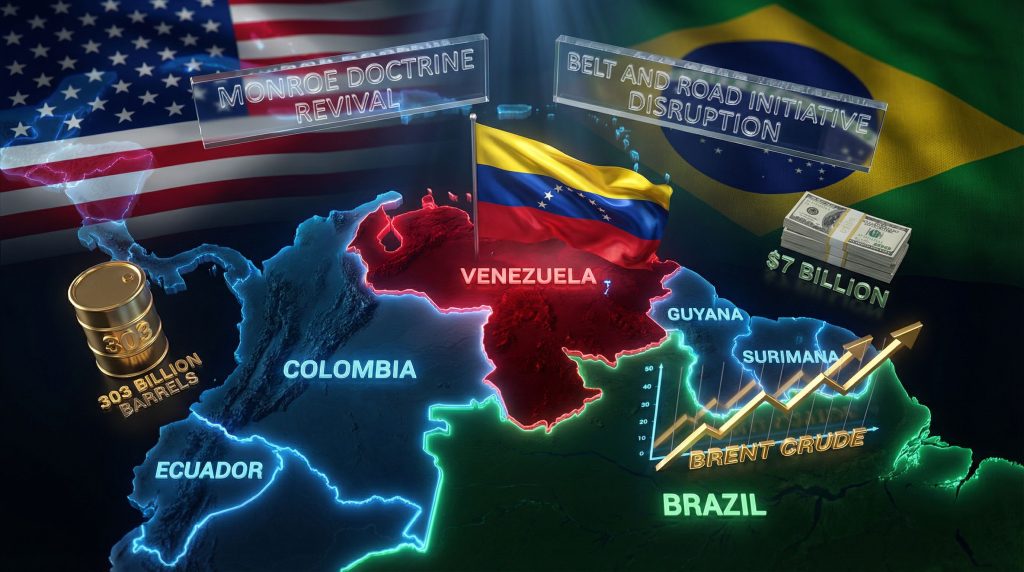
The $7 billion in blocked Venezuelan resources represents just one component of a comprehensive financial pressure campaign. PDVSA asset freezing has effectively severed Venezuela's primary revenue stream from international markets, creating conditions that proponents argue necessitate intervention for humanitarian purposes.
OFAC General Licence 44 initially permitted limited transactions with PDVSA before its revocation on January 28, 2019. This licencing approach demonstrates how sanctions regimes can be calibrated to increase pressure systematically whilst maintaining legal frameworks for potential future engagement.
Counter-Narcotics Legal Expansion
The designation of Cartel de los Soles and Tren de Aragua as terrorist organisations provides additional legal justification for expanded military operations. The $50 million bounty authorisation creates financial incentives for intelligence gathering whilst establishing precedent for treating state-level actors as criminal enterprises.
Maritime interdiction authority in international waters represents a particularly significant expansion of enforcement capability. These operations can effectively blockade national economies without crossing traditional territorial boundaries, creating hybrid warfare scenarios that challenge conventional sovereignty concepts. Furthermore, how tariffs impact markets during periods of heightened geopolitical tension adds another layer of economic complexity to intervention scenarios.
Regional Sovereignty and Strategic Competition
The resurrection of Monroe Doctrine principles in 21st-century geopolitics reflects broader shifts in global power dynamics rather than mere historical nostalgia. The 1895 Venezuela boundary dispute provides instructive parallels, where US intervention forced British arbitration over territorial claims between Venezuela and British Guiana.
Modern Spheres of Influence
According to André Pereira César of Hold Consultoria, US intervention in Venezuela "signals that the United States wants to reaffirm the region as part of its sphere of influence and contain China's growing presence in recent decades." This assessment highlights how regional sovereignty questions intersect with global strategic competition between major powers.
Brazilian sovereignty concerns over US regional expansion reflect deeper anxieties about maintaining foreign policy independence. Brazil's traditional non-intervention doctrine, maintained by the Ministry of Foreign Affairs (Itamaraty), faces pressure when neighbouring countries experience major political transitions through external force.
Regional Institution Effectiveness
The Organisation of American States (OAS) faces credibility challenges in managing intervention scenarios. Venezuela's membership suspension in 2019 removed the target nation from institutional decision-making processes, potentially undermining collective security mechanisms. The 35-member organisation struggles to balance sovereignty principles with democratic governance requirements.
UNASUR (Union of South American Nations) has been effectively dormant since 2018-2019 when multiple countries suspended participation. CELAC (Community of Latin American and Caribbean States), founded in 2011 as an alternative excluding the US and Canada, lacks enforcement mechanisms for preventing intervention.
The Rio Treaty (Inter-American Treaty of Reciprocal Assistance) was invoked by Colombia in 2019 regarding Venezuela, but produced no military consensus among signatory nations. This demonstrates how regional security frameworks can be activated without generating coordinated responses.
Global Energy Market Dynamics and Resource Control
Venezuela possesses 303 billion barrels of proven oil reserves, surpassing Saudi Arabia's 267 billion barrels to claim the world's largest known petroleum deposits. However, this resource advantage faces significant technical constraints that affect global market implications. Additionally, OPEC production impact on global markets becomes particularly relevant when considering Venezuelan energy sector developments.
Heavy Crude Technical Limitations
Venezuelan oil consists primarily of extra-heavy crude with 8-10° API gravity, requiring specialised refining infrastructure unavailable in most global facilities. US Gulf Coast refineries are specifically configured for heavy crude processing, creating natural market dependencies regardless of political circumstances.
Coking units and specialised refining infrastructure represent billions of dollars in capital investment, making alternative processing locations economically challenging. This technical reality provides strategic leverage independent of military considerations. Moreover, global energy security challenges continue to influence how nations approach resource control and energy independence.
Market Impact Assessment
According to Roberto Troster, former chief economist of the Brazilian Banking Federation (Febraban), "In practical terms, the United States' intervention in Venezuela has zero effect on Brazil's macroeconomy, because for years Venezuela had already been showing very poor indicators and the trade relationship with Brazil was practically nonexistent."
However, Troster warned this scenario could change long-term as US plans advance in Venezuelan oil sector development. Brazilian oil exports became the country's largest export product in 2025, surpassing soybeans and iron ore, making global price dynamics increasingly critical for trade balance considerations.
Production Recovery Requirements
Venezuelan oil production declined from approximately 3.5 million barrels per day in 2000 to under 500,000 bpd by 2020, representing infrastructure degradation requiring estimated $100-150 billion investment for production restoration. This massive capital requirement affects timelines for any potential market impact from increased Venezuelan output.
Historical comparisons provide context for potential price effects. The Libyan civil war (2011) removed approximately 1.6 million bpd from global markets, causing $20-30 per barrel price increases. Venezuelan production restoration could theoretically reverse such price pressures, though technical constraints limit rapid implementation.
Chinese Investment Patterns and Strategic Competition
China's Belt and Road Initiative has channelled over $150 billion into Latin America and the Caribbean between 2005-2023, according to the Inter-American Dialogue's China-Latin America Finance Database. This massive investment footprint creates complex relationships that US intervention in Venezuela strategies must consider.
Mining Sector Penetration
Chinese companies have executed systematic acquisitions across Latin American mining assets, including CMOC's acquisition of Equinox Gold's Brazilian assets for $1 billion. China represents Brazil's largest trading partner, accounting for approximately 27-30% of Brazilian exports, creating deep economic interdependencies. This pattern of China mining expansion affects regional resource control dynamics significantly.
André Pereira César notes that the US has shown "growing interest in Latin America's mining sector, especially in rare earth elements" as part of containment strategies. This focus reflects China's dominance of approximately 70% of global rare earth element mining and 90% of processing capacity.
Critical Mineral Competition
Venezuelan mineral potential remains largely untapped, with the Arco Minero del Orinoco region containing estimated deposits of gold, coltan, diamonds, and rare earths. However, systematic geological surveys remain incomplete, creating uncertainty about actual reserve quantities and extraction feasibility. Consequently, developing a comprehensive critical minerals strategy becomes essential for regional stability.
China Development Bank and China Export-Import Bank extended approximately $60 billion in oil-backed loans to Venezuela between 2007-2019, creating complex debt relationships that intervention scenarios must address. These loans typically include commodity export commitments that could complicate resource control transitions.
Supply Chain Security Implications
The US imported 74% of rare earth compounds and metals from China in 2023, highlighting strategic vulnerability in critical mineral supply chains. The US Department of Interior designated 50 critical minerals in 2022, emphasising diversification imperatives that could drive Latin American resource acquisition strategies.
César warned that "we can't rule out that, at some point, the United States may want to impose some kind of sanction on countries that do business with China, which would affect Brazil." Such secondary sanctions could force binary choices between major economic partners throughout the region.
Electoral Implications and Democratic Legitimacy
Brazil's October 2026 elections for president, governors, representatives, and senators occur within this heightened regional tension environment. Christopher Garman of Eurasia Group assessed "around 60% for the re-election of President Lula, who remains the favourite," though intervention dynamics could affect these calculations.
Opposition Messaging Opportunities
According to Garman, "The Venezuelan issue may have some resonance in the discourse of the opposition in Brazil, and polls show significant support for American intervention in Latin America. This may tactically help the opposition in the short term, but it should not structurally change the electoral scenario."
Tarcísio de Freitas, Governor of São Paulo and potential right-wing candidate, "celebrated the capture" of Maduro, demonstrating how intervention supporters can frame events as pro-democracy actions. However, Jair Bolsonaro's arrest for attempted coup d'état has complicated right-wing candidate selection processes.
Regional Electoral Patterns
The broader "pink tide" of left-wing governments across Mexico (AMLO), Colombia (Petro), and Chile (Boric) creates regional political dynamics that intervention policies must navigate. Historical US electoral intervention in Chile (1970s) and Nicaragua (1980s) provides cautionary precedents about backlash effects.
Brazilian Supreme Court (STF) rulings on Bolsonaro's prosecution and electoral eligibility affect candidate availability, whilst Trump's mid-2025 imposition of 50% tariffs on Brazilian exports demonstrated how bilateral tensions can escalate rapidly before finding "more balanced" arrangements.
Lula's response strategy of criticising US operations whilst avoiding "direct criticisms of Trump" represents tactical calculation to prevent direct electoral interference. This approach acknowledges historical patterns of US involvement in regional electoral processes.
The next major ASX story will hit our subscribers first
Infrastructure Investment Resilience and Long-Term Planning
Brazil's infrastructure sector demonstrates remarkable resilience to geopolitical disruptions, with 11 concession and PPP auctions scheduled for Q1 2026, expected to generate approximately 34 billion reais ($6.3 billion) in projected investments.
Investment Horizon Analysis
According to Roberto Guimarães, Planning and Economics director at the Brazilian Association of Infrastructure and Basic Industries (Abdib), "Investments in infrastructure are decisions that look at horizons of twenty to thirty years, which is why there is greater resilience among these investors."
This long-term perspective insulates infrastructure markets from short-term political volatility, though systematic changes in regional security environments could eventually affect project bankability and financing costs.
Financing Framework Stability
Brazilian PPP Law 11.079/2004 established federal frameworks with minimum 5-year and maximum 35-year concession periods, providing legal certainty that reduces political risk premiums. Brazilian Development Bank (BNDES) financing availability and sovereign credit ratings affect project feasibility more directly than regional geopolitical tensions.
Latin America requires approximately $200-250 billion annually to meet infrastructure needs according to Inter-American Development Bank estimates, highlighting massive capital requirements that transcend individual political events.
International Court Jurisdiction and Legal Remedies
The International Court of Justice requires mutual consent under Article 36 of the ICJ Statute, or jurisdiction through compromissory treaty clauses. ICJ case processing time averages 3-5 years from application to judgment, limiting effectiveness for urgent intervention scenarios.
Enforcement Limitations
The Nicaragua precedent demonstrates ICJ authority limitations when major powers refuse participation. UN Charter Chapter VII allows Security Council authorisation of force for international peace threats, but requires Security Council resolution approval that permanent members can veto.
Provisional measures and interim relief possibilities exist under ICJ procedures, though enforcement depends on voluntary compliance or Security Council action. Against major powers, these mechanisms face structural limitations that reduce their practical deterrent effect. In addition, understanding the complex history of US-Venezuela relations provides crucial context for current legal challenges.
Regional Human Rights Mechanisms
The Inter-American Commission on Human Rights possesses investigation authority and can document humanitarian law violations, though lacks enforcement powers beyond reputational pressure and recommendations. Reparations frameworks for civilian impact require voluntary compliance or domestic court enforcement.
Asset Recovery and Sovereign Debt Implications
Venezuelan state assets face complex legal challenges across multiple jurisdictions. PDVSA subsidiary control in international jurisdictions creates precedents for asset seizure and redistribution that could affect future sovereign debt markets throughout the region.
Citgo Petroleum Resolution
Citgo Petroleum Corporation ownership questions involve US courts, Venezuelan opposition representatives, and various creditor claims. US District Court for the District of Delaware proceedings since 2019-2020 demonstrate how domestic courts can determine foreign asset control during political transitions.
Gold reserves and central bank asset freezing create additional complications for monetary sovereignty and international reserve management. These precedents could affect how other nations structure foreign asset holdings to reduce seizure vulnerabilities.
Debt Restructuring Challenges
Sovereign bond holder protection mechanisms and Chinese loan portfolio renegotiation requirements create competing claims on Venezuelan resources. International arbitration tribunal jurisdiction provides forums for resolving creditor disputes, though political control changes complicate debt service continuity.
The approximately $60 billion in Chinese oil-backed loans creates structural complications for any resource control transition, as these agreements typically include long-term commodity export commitments that new authorities would inherit.
Long-Term Regional Security Architecture
US Southern Command operational capacity enhancement represents institutional preparation for sustained regional engagement beyond individual crisis scenarios. Regional military cooperation agreement renegotiation affects defence relationships across Latin America. The precedent established by US intervention in Venezuela could reshape security frameworks throughout the hemisphere.
Migration and Protection Systems
Venezuelan displacement acceleration projections suggest continued refugee flows regardless of political resolution methods. Regional burden-sharing mechanism activation and international protection system capacity constraints require multilateral coordination that intervention scenarios could complicate.
Defence spending allocation shifts across Latin America reflect broader strategic environment changes, with countries reassessing security priorities in response to increased US regional engagement and evolving threat perceptions.
Disclaimer: This analysis involves geopolitical forecasting and speculation about future policy developments. Actual outcomes may vary significantly from projections presented. Readers should conduct independent research before making investment or policy decisions based on this information.
Ready to Capitalise on Market-Moving Geological Developments?
Discovery Alert's proprietary Discovery IQ model delivers instant notifications on significant ASX mineral discoveries, empowering subscribers to identify actionable opportunities in critical minerals and energy transition resources ahead of broader market awareness. Begin your 30-day free trial today and explore Discovery Alert's historic discovery examples to understand how major geological developments can generate substantial returns for prepared investors.