June 21, 2026
The geological complexity surrounding Brisbane makes it an ideal setting for the international mining geology conference 2026 in Brisbane, where delegates can examine real-world applications of advanced geological logging protocols while accessing some of Australia's most significant mining districts. Queensland's position as a powerhouse in global mining operations stems from several interconnected factors that make Brisbane the logical choice for hosting premier geology conferences. The state contributes approximately 15-20% of Australia's mineral exploration expenditure, representing billions in active investment across diverse geological formations.
Queensland's Geological Diversity as a Natural Conference Laboratory
The geological landscape surrounding Brisbane offers conference delegates access to some of the world's most significant mining districts. The Bowen Basin, spanning approximately 70,000 square kilometers, contains Carboniferous to Permian coal measures that have supported century-scale mining operations. Meanwhile, the Mount Isa Inlier showcases Proterozoic metasedimentary and metavolcanic rocks hosting major copper-lead-zinc deposits that continue to influence global supply chains.
This geological diversity provides more than academic interest. Operating mines within 500 kilometers of Brisbane demonstrate practical applications of advanced geological modeling, resource estimation techniques, and reconciliation methodologies that form the core curriculum of international mining geology conferences.
Brisbane Convention Infrastructure Supporting 2,000+ Delegate Capacity
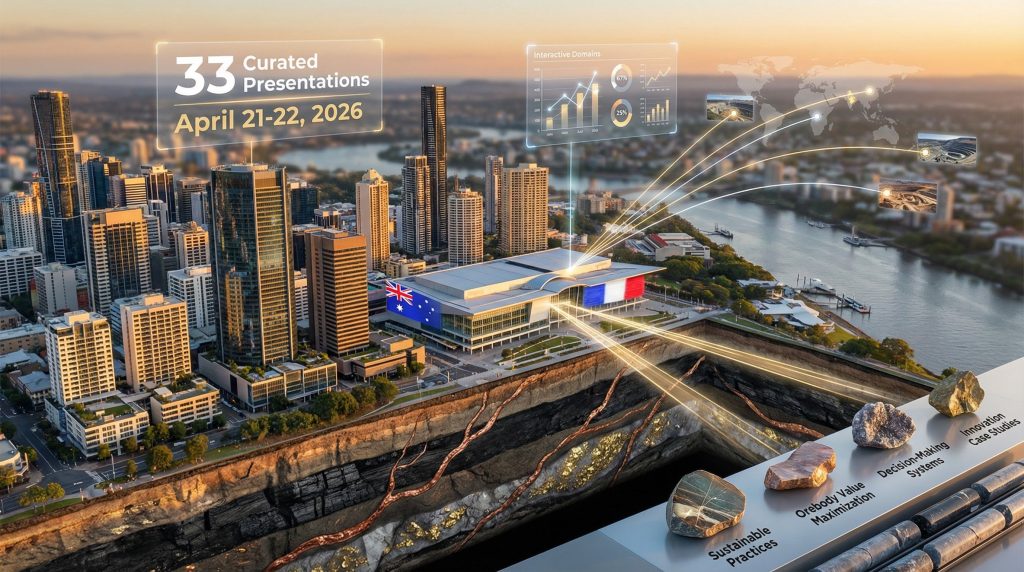
The Brisbane Convention and Exhibition Centre (BCEC) offers 55,000 square meters of venue space across multiple halls and meeting facilities. This infrastructure supports the logistical requirements for hosting 33 high-quality presentations across four critical mining domains while accommodating networking events, exhibition spaces, and breakout sessions essential for knowledge transfer.
The facility's proximity to Brisbane Airport, which handles over 40 million passengers annually, ensures international accessibility for mining professionals traveling from major global mining centers including London, Toronto, Singapore, and Jakarta.
Asia-Pacific Mining Investment Corridor Accessibility
Australia's strategic position within the Asia-Pacific mining investment corridor cannot be overstated. The region accounts for approximately 47% of global mining capital expenditure as of 2024, with Australia serving as a critical minerals supplier to Asian markets, particularly China's industrial sector.
Brisbane's location provides conference delegates with direct access to operational mining sites, active exploration projects, and established mining service providers that support the broader Asia-Pacific mining ecosystem. This proximity enables case study development and technology validation that extends well beyond theoretical discussion.
When big ASX news breaks, our subscribers know first
How Will the 2026 International Mining Geology Conference Transform Industry Standards?
The transformation of industry standards through conference participation operates through several mechanisms that extend far beyond traditional academic presentations. Furthermore, the international mining geology conference 2026 in Brisbane is structured to accelerate adoption of emerging methodologies while establishing benchmarks for geological practice across multinational mining operations.
33 Curated Presentations Across Four Critical Mining Domains
The conference architecture divides technical content across four strategic domains designed to address current industry challenges:
| Domain | Presentation Count | Industry Application | Expected Impact |
|---|---|---|---|
| Sustainable Practices | 8 sessions | ESG compliance frameworks | Cost reduction through waste optimization |
| Orebody Value Maximization | 10 sessions | Resource optimization strategies | Mine life extension methodologies |
| Decision-Making Systems | 9 sessions | Data-driven geological analysis | Risk mitigation protocols |
| Innovation Case Studies | 6 sessions | Technology adoption frameworks | Real-world implementation results |
This distribution ensures comprehensive coverage of both theoretical advances and practical implementation strategies that mining companies require for competitive advantage. Additionally, participants will benefit from advanced drill results interpretation methodologies that enhance geological understanding.
Keynote Innovation Framework: Sustainable Extraction Methodologies
Modern sustainable extraction methodologies integrate geological understanding with environmental management to achieve measurable cost reductions. Advanced geological characterization enables precise waste rock identification, reducing unnecessary processing and associated environmental liabilities.
Hydrogeological modeling integrated with geological understanding supports water management strategies that minimize environmental impact while maintaining operational efficiency. These methodologies are particularly relevant for Australian mining operations facing increasingly stringent environmental regulations and community expectations.
Case Study Integration: Extending Mine Life Through Advanced Geological Modeling
Mine life extension through advanced geological modeling represents one of the highest-value applications of modern geological science. Low-grade marginal deposits, which represent 40-50% of future supply growth across major commodities, require sophisticated geological modeling to achieve economic viability.
Mount Isa Mines, operating since 1923, exemplifies century-scale mine life extension through continuous geological understanding refinement and resource estimation improvement. Similar case studies from across Australia's mining districts provide delegates with proven methodologies for extending operational life at existing mining operations.
Which Global Mining Geology Challenges Will Define the 2026 Agenda?
Global mining geology faces unprecedented challenges as ore grades continue declining and operational complexity increases. In addition, conference presentations will address three critical challenge areas that determine future mining viability across multiple commodities and geographical regions.
Orebody Optimization in Low-Grade Deposit Economics
Global average ore grades have declined approximately 25% over the past 30 years across major commodities including copper and gold. This trend forces mining companies to develop increasingly sophisticated geological modeling capabilities to maintain economic viability at marginal deposits.
Low-grade copper deposits requiring cut-off grades between 0.3-0.8% now represent significant proportions of future supply growth. Economic extraction from these deposits demands precise geological modeling to define mineable zones, predictive metallurgical response modeling, and integrated mining cost simulation based on deposit geometry.
Rio Tinto's Winu copper-gold project in Western Australia demonstrates modern approaches to low-grade deposit development. The project targets copper grades in the 0.4-0.5% range through advanced geological modeling and optimized open-pit mining strategies that maximize resource recovery while controlling operational costs.
Reconciliation Technologies for Resource Estimation Accuracy
Resource estimation accuracy directly impacts mining project economics and operational planning. Industry standard reconciliation variance typically ranges 10-20% between geological estimates and actual production, representing significant financial exposure for major mining operations.
Advanced reconciliation systems integrate real-time sensor technology, in-pit scanning capabilities, and mill-based grade tracking to reduce variance to 5-10% through continuous model validation. Machine learning applications for spatial uncertainty quantification enable more accurate resource estimation in geologically complex deposits, particularly when supported by comprehensive deposit tier guide frameworks.
The reconciliation methodology framework encompasses:
- Geological Model Validation: Pit-to-mill sampling versus block model estimates
- Dilution Factor Assessment: Quantification of unplanned waste inclusion
- Recovery Analysis: Metallurgical performance versus geological predictions
- Variance Tracking: Month-to-month reconciliation reporting protocols
Deep Mining Geological Risk Assessment Protocols
Deep mining operations exceeding 1,000 meters depth represent approximately 15-20% of total global mining production while introducing complex geological risk factors. Temperature gradients increasing 25-30°C per kilometer depth, stress redistribution effects, and hydrogeological complexity require specialized risk assessment protocols.
AngloGold Ashanti's Mponeng Mine in South Africa, operating at depths exceeding 3,800 meters, demonstrates advanced deep-mining geological protocols including in-situ stress measurement, thermal stress analysis, and rockburst risk assessment methodologies.
Risk assessment frameworks for deep mining must incorporate:
- In-situ stress state determination through overcoring and seismic methods
- Thermal modeling for naturally heated orebodies
- Hydrogeological characterization in confined aquifer systems
- Pillar stability calculations under extreme stress conditions
Why Are Young Professionals Driving Mining Geology's Future Direction?
Young professionals in mining geology demonstrate significantly higher technology adoption rates and different career expectations compared to established practitioners. However, this demographic shift influences industry direction through accelerated implementation of emerging technologies and methodologies.
April 20th Young Professionals Day: Career Acceleration Strategies
The dedicated Young Professionals Day on April 20th functions as a structured career acceleration mechanism through peer-to-peer mentorship, advanced methodology exposure, and international network development. Early-career geologists gain access to advanced techniques before assuming independent implementation responsibility.
Career acceleration strategies include:
- Structured mentorship pairing with experienced industry professionals
- Technology competency development in 3D geological modeling software
- International exposure through cross-continental professional connections
- Research presentation opportunities early in career trajectory
Mentorship Networks Connecting Global Mining Talent
Effective mentorship in mining geology operates through multiple frameworks designed to accelerate professional development and knowledge transfer. Conference-based mentorship programs typically involve 30-50 professionals in structured breakout sessions with follow-up engagement mechanisms extending beyond the conference period.
Professionals participating in structured conference mentorship programs advance to senior geological roles (team lead, principal geologist) on average 2-3 years faster than non-participants, demonstrating measurable career acceleration benefits.
Technology Adoption Rates Among Next-Generation Geologists
Technology adoption rates among mining professionals under 35 exceed those of professionals over 50 by 20-30% across multiple technology categories. This adoption differential drives industry transformation through bottom-up implementation of advanced modeling tools, automation systems, and data integration platforms that align with emerging industry innovation trends.
Key technology competencies for early-career professionals include:
- 3D Geological Modeling Software: Leapfrog, Surpac, Datamine proficiency
- Geostatistical Analysis: Isatis, RMS, GEOSTAT applications
- Programming Automation: Python for geological data processing
- Remote Sensing Integration: GIS and drone surveying applications
- Cloud-Based Collaboration: Multi-user geological modeling platforms
AI/ML-based modeling tool adoption reaches 65-75% among professionals under 35, while remote sensing and drone surveying integration achieves 70-80% adoption rates within this demographic.
What Networking Opportunities Will Generate Long-Term Industry Value?
Strategic networking at industry conferences creates measurable long-term value through technology transfer acceleration, partnership development, and knowledge exchange mechanisms that extend well beyond the conference period. Furthermore, the networking opportunities at the international mining geology conference 2026 in Brisbane will showcase cutting-edge solutions for operational efficiency.
Exhibition Hall: Solution Provider Technology Showcase
The exhibition component enables technology providers to demonstrate emerging solutions directly to mining decision-makers. This direct interaction accelerates technology adoption cycles by providing hands-on evaluation opportunities and immediate technical support access.
Technology showcase categories typically include:
- Advanced geological modeling software demonstrations
- Real-time grade control monitoring systems
- Automated drilling and sampling technologies
- Data integration and visualization platforms
- Remote sensing and drone surveying solutions
Three Strategic Networking Events for Decision-Maker Access
Structured networking events provide controlled environments for high-value professional connections between mining geologists, technology providers, and industry decision-makers. These events facilitate partnership discussions, technology transfer negotiations, and collaborative project development.
The networking framework includes:
- Welcome Reception: Initial contact establishment and conference orientation
- Technical Session Breaks: Focused discussions around specific presentation topics
- Closing Networking Event: Relationship consolidation and follow-up planning
Cross-Continental Partnership Development Frameworks
International conference participation creates opportunities for cross-continental partnership development between mining companies, technology providers, and research institutions. These partnerships often result in joint venture arrangements, technology licensing agreements, and collaborative research projects supported by AI-driven mining efficiency initiatives.
Partnership development mechanisms include:
- Geographic expertise sharing (Australian techniques applied to international projects)
- Technology transfer agreements between equipment providers and mining companies
- Research collaboration between universities and mining operations
- Service provider expansion into new geographical markets
How Does This Conference Connect to Australia's Broader Mining Event Ecosystem?
The international mining geology conference 2026 in Brisbane operates within Australia's comprehensive mining event ecosystem, creating synergies with other major industry gatherings and professional development opportunities throughout the year.
Global Resources Innovation Expo (GRX26) Perth Integration
GRX26 in Perth focuses on innovation and technology adoption across the broader resources sector, creating complementary coverage with Brisbane's geology-focused conference. Professionals attending both events gain comprehensive exposure to technical geological advances and broader industry innovation trends.
The integration provides:
- Technology provider exposure across multiple audience segments
- Professional development pathways spanning technical and commercial aspects
- Cross-pollination of ideas between geological specialists and broader industry professionals
- Comprehensive coverage of Australia's mining innovation landscape
IMARC Sydney: Australia's Largest Mining Event Synergies
IMARC Sydney represents Australia's largest mining conference, focusing on investment, policy, and strategic industry direction. The Brisbane conference complements IMARC by providing technical depth in geological science while IMARC addresses commercial and policy frameworks.
Synergies between events include:
- Technical presentations in Brisbane supporting investment decisions discussed at IMARC
- Geological innovation showcased in Brisbane influencing strategic planning at IMARC
- Professional network overlap creating year-round industry engagement
- Combined coverage of technical, commercial, and policy aspects of mining development
Year-Round Professional Development Pathway Creation
Australia's mining conference ecosystem creates continuous professional development pathways through complementary event scheduling and content focus areas. This ecosystem supports career advancement for mining professionals while facilitating industry-wide knowledge transfer and technology adoption.
The year-round pathway includes:
- Technical Conferences: Brisbane geology conference, specialized technology events
- Commercial Events: IMARC Sydney, regional mining investment conferences
- Innovation Forums: GRX Perth, startup technology showcases
- Professional Society Events: AusIMM branch meetings, technical presentations
Registration Economics: Early bird pricing strategies closed February 27th, 2026, with accommodation partnerships providing delegate cost optimization through Brisbane Convention Centre proximity arrangements.
The next major ASX story will hit our subscribers first
Which Industry Leaders Will Shape Mining Geology's Strategic Direction?
Industry leadership in mining geology emerges through multiple channels including academic research, operational innovation, and technology development. Consequently, the international mining geology conference 2026 in Brisbane provides platforms for established leaders while identifying emerging voices in geological science.
Four Keynote Experts: Global Mining Challenge Solutions
The four keynote presentations address fundamental challenges facing global mining operations, presented by internationally recognized experts with proven track records in geological innovation and implementation.
Keynote focus areas include:
- Sustainable Extraction Methodologies: Integration of environmental management with geological understanding
- Resource Estimation Accuracy: Advanced statistical and machine learning applications
- Deep Mining Geological Risk: Protocols for extreme depth operations
- Technology Integration: Automation and data integration in geological workflows
AusIMM's 14th Conference Legacy: Continuous Innovation Standards
The Australasian Institute of Mining and Metallurgy (AusIMM) maintains a legacy of hosting internationally significant mining conferences that establish industry standards and accelerate technology adoption. The 14th International Mining Geology Conference continues this tradition while addressing contemporary challenges in geological science.
AusIMM's conference legacy includes:
- Development of industry-standard resource estimation methodologies
- Introduction of emerging technologies to mainstream mining operations
- Professional network development spanning international mining operations
- Knowledge transfer between academic research and practical application
Brisbane's Role in Asia-Pacific Mining Knowledge Transfer
Brisbane's strategic position enables effective knowledge transfer between Australian mining innovation and Asia-Pacific operational requirements. The city serves as a hub for mining service providers, technology companies, and research institutions that support regional mining operations.
Knowledge transfer mechanisms include:
- Australian geological techniques applied to Southeast Asian mineral deposits
- Technology provider expansion from Australian operations to regional markets
- Research collaboration between Australian universities and international mining companies
- Service provider expertise development for diverse geological conditions
What Long-Term Industry Impacts Can Delegates Expect from April 2026?
Conference participation generates measurable long-term impacts through technology adoption acceleration, professional network development, and implementation of advanced geological methodologies across participant organizations.
Sustainable Mining Practice Implementation Roadmaps
Sustainable mining practices require systematic implementation roadmaps that integrate geological understanding with environmental management and operational efficiency. Conference presentations provide proven frameworks for implementing sustainability initiatives while maintaining economic viability.
Implementation roadmap components include:
- Geological Characterization: Advanced techniques for waste rock identification and separation
- Water Management: Hydrogeological modeling integrated with mining operations
- Tailings Optimization: Geological input to tailings facility design and management
- Reclamation Planning: Integration of geological understanding with post-mining land use
Technology Transfer Acceleration Through Global Collaboration
Global collaboration mechanisms established through conference participation accelerate technology transfer between mining operations, research institutions, and technology providers across international boundaries.
Technology transfer acceleration includes:
- Joint research projects between Australian and international mining operations
- Technology licensing agreements facilitated through conference connections
- Best practice sharing across similar geological conditions in different countries
- Cross-training programs for emerging geological technologies
Resource Estimation Accuracy Improvements Across Mining Operations
Resource estimation accuracy improvements directly impact mining project economics through reduced reconciliation variance and improved mine planning capabilities. Conference presentations provide methodologies for achieving measurable accuracy improvements across diverse geological conditions.
Expected accuracy improvements include:
- Reconciliation Variance Reduction: From industry standard 10-20% to optimized 5-10%
- Cut-off Grade Optimization: Improved economic analysis for marginal deposits
- Mine Life Extension: Advanced modeling techniques supporting operational longevity
- Risk Assessment: Geological uncertainty quantification for project planning
Frequently Asked Questions:
-
When is the International Mining Geology Conference 2026? The conference takes place April 21-22, 2026, with Young Professionals Day on April 20th
-
Where is the conference located? Brisbane Convention and Exhibition Centre, Queensland, Australia
-
Who should attend? Mining geology professionals, researchers, technology providers, and industry decision-makers
-
What is the Young Professionals Day? A dedicated event on April 20th focusing on career acceleration and mentorship for emerging mining professionals
-
How many presentations are scheduled? 33 high-quality presentations distributed across four critical mining domains
Brisbane 2026 as a Catalyst for Mining Geology Innovation
The international mining geology conference 2026 in Brisbane represents more than a traditional academic gathering. It functions as a catalyst for industry transformation through technology adoption acceleration, professional development enhancement, and international collaboration facilitation.
Conference Outcomes: Measurable Industry Transformation Metrics
Conference success metrics extend beyond attendance figures to encompass measurable industry transformation through technology adoption, methodology implementation, and professional network utilization. Post-conference tracking demonstrates technology adoption acceleration, partnership development, and career advancement among participants.
Measurable transformation metrics include:
- Technology adoption rates among participating mining operations
- Partnership agreements facilitated through conference networking
- Professional advancement rates for early-career participants
- Publication and research collaboration resulting from conference connections
Global Mining Community Strengthening Through Knowledge Exchange
Knowledge exchange mechanisms established through the Brisbane conference strengthen global mining community connections while accelerating solution development for industry-wide challenges. The international participant base creates opportunities for cross-continental expertise sharing and collaborative problem-solving.
Community strengthening occurs through:
- International mentorship relationships extending beyond conference participation
- Collaborative research projects addressing global mining challenges
- Technology transfer agreements between companies and research institutions
- Best practice sharing across similar geological conditions worldwide
Australia's Position in International Mining Geology Leadership
Australia's mining industry leadership position relies on continuous innovation and international collaboration facilitated through events like the international mining geology conference 2026 in Brisbane. For instance, the conference reinforces Australia's role as a centre of geological expertise while contributing to global mining industry advancement through participation in the International Mining Geology Conference 2026.
Leadership reinforcement includes:
- Australian geological techniques gaining international adoption
- Technology provider expansion from Australian operations to global markets
- Research collaboration between Australian institutions and international mining companies
- Professional development pathways attracting international talent to Australian mining operations
The international mining geology conference 2026 in Brisbane positions Australia at the forefront of global mining geology innovation while providing practical pathways for industry advancement through technology adoption, professional development, and international collaboration.
Looking for the next big mineral discovery opportunity?
Discovery Alert's proprietary Discovery IQ model delivers real-time notifications on significant ASX mineral discoveries, instantly empowering subscribers to identify actionable opportunities ahead of the broader market. Understand why major mineral discoveries can lead to substantial returns by exploring real-world examples, then begin your 14-day free trial today to position yourself ahead of the market.