May 21, 2026
International Sanctions Framework Reshaping Energy Trade Dynamics
Regional energy partnerships across Central Asia face unprecedented complexity as evolving sanctions regimes fundamentally alter established trade patterns. Modern energy security strategies now require sophisticated navigation of multilateral regulatory frameworks, forcing traditional supplier relationships to adapt or risk compliance violations. The intersection of geopolitical tensions and energy infrastructure creates new challenges for countries seeking to maintain diversified supply portfolios while satisfying international legal obligations.
Turkey's position as a critical energy transit hub exemplifies these modern challenges, where maintaining energy security intersects with complex sanctions compliance requirements. The country's strategic location between major production regions and consumer markets creates both opportunities and regulatory burdens that extend beyond simple commercial transactions.
When big ASX news breaks, our subscribers know first
Understanding Turkey's Energy Security Framework
Critical Energy Dependency Metrics
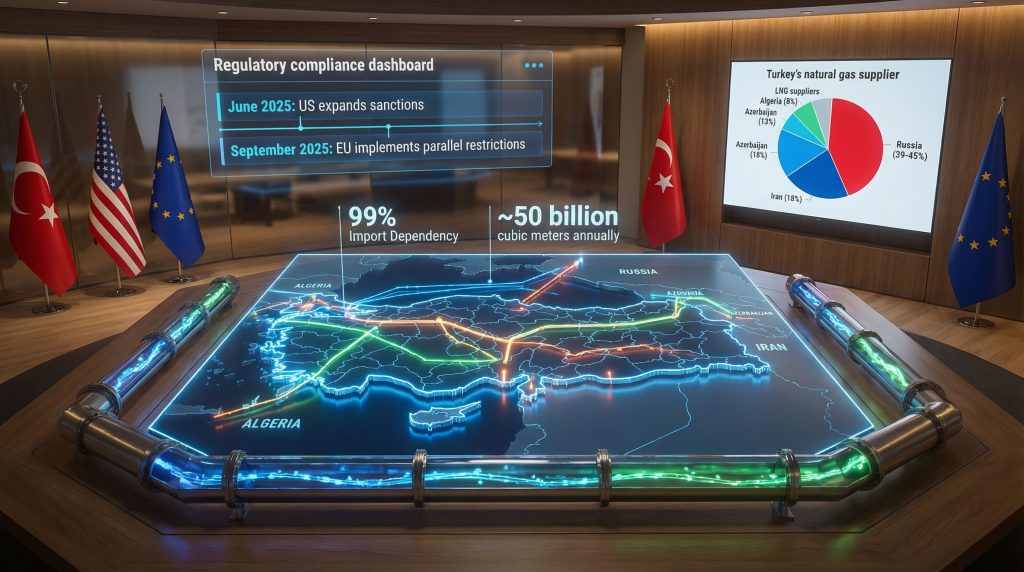
Turkey's energy landscape reveals fundamental structural vulnerabilities that drive policy decisions across the region. The country consumes approximately 50 billion cubic meters (bcm) of natural gas annually, with a staggering 99% import dependency rate that creates significant supply security concerns during peak winter demand periods.
Primary Supply Source Distribution:
• Russia: 39-45% of total imports
• Iran: 18% through established pipeline infrastructure
• Azerbaijan: Growing share via Southern Gas Corridor
• Algeria: Supplementary LNG supplies
• United States: Expanding LNG import capacity
This dependency structure creates inherent vulnerabilities when sanctions regimes target specific supplier relationships. Historical precedents demonstrate real-world consequences, particularly during the winter 2022 power crisis when Iranian supply disruptions contributed to significant power outages across Turkey's major urban centres. Furthermore, these energy export challenges illustrate how geopolitical tensions can impact regional energy security.
Infrastructure Complexity and Transit Capabilities
Turkey operates approximately 15,000 kilometres of natural gas pipeline infrastructure, establishing the country as a critical regional transit hub. This extensive network includes multiple entry points designed to diversify supply sources and reduce single-point-of-failure risks.
Key Infrastructure Elements:
• Iran-Turkey Pipeline: Operational since 1997, spanning 2,577 kilometres with 30 bcm annual capacity
• Trans-Anatolian Pipeline (TANAP): Connects Azerbaijani supplies to European markets
• Blue Stream Pipeline: Russian gas corridor through Black Sea region
• LNG Regasification Terminals: Multiple facilities supporting import diversification
The technical sophistication of this infrastructure enables complex swap arrangements and transit operations, though sanctions compliance increasingly constrains operational flexibility. Each custody transfer point requires transparent volume tracking and regulatory verification, creating multiple compliance checkpoints throughout the supply chain.
Current Sanctions Affecting Turkey Gas Deals with Iran and Turkmenistan
Escalation of US Treasury Restrictions
The June 2025 expansion of US sanctions against Iran represents a qualitative shift in enforcement methodology, moving beyond traditional financial transaction restrictions to encompass physical commodity exchanges and barter arrangements. This escalation specifically targets innovative mechanisms that energy partners previously used to navigate earlier sanctions frameworks.
Timeline of Sanctions Evolution:
• June 2025: Trump administration expands sanctions to include barter trades and energy swaps
• September 2025: European Union implements parallel restrictions
• Current Status: Dual-jurisdiction compliance requirements for regional partners
The Iranian gas purchase agreement, valued at 9.6 billion cubic metres annually and operational since January 2001, maintains an active US sanctions waiver expected to continue through the contract's July 2026 expiration. However, the June 2025 expansion creates uncertainty around innovative financing and exchange mechanisms that countries use to manage sanctions compliance. Additionally, the broader Trump tariffs implications may affect global trade patterns and energy relationships.
European Union Regulatory Coordination
The EU's September 2025 sanctions package demonstrates unprecedented Western coordination in restricting Iranian energy revenues. This alignment eliminates potential regulatory arbitrage opportunities and creates standardised compliance requirements across Atlantic alliance partners.
Dual Compliance Architecture:
| Regulatory Authority | Scope | Enforcement Focus |
|---|---|---|
| US Treasury (OFAC) | Barter arrangements, swap transactions | Financial institution compliance |
| EU Sanctions Office | Physical commodity transfers | Infrastructure operator liability |
| Turkish Energy Ministry | Import certification | National energy security balance |
This coordination creates complex legal environments where energy transactions must satisfy multiple jurisdictional requirements simultaneously. Companies managing pipeline infrastructure face particular scrutiny regarding transit compliance and beneficial ownership verification. Consequently, this mirrors broader US–China trade war impacts where multiple regulatory frameworks create compliance challenges for global businesses.
Technical Implementation Challenges
The June 2025 sanctions explicitly prohibit several transaction types that energy partners previously considered compliant:
• Physical transfer of Iranian gas or petroleum products without explicit authorisation
• Barter transactions involving energy commodities as payment mechanisms
• Value-equivalent swap arrangements lacking US Treasury pre-approval
• Financing mechanisms supporting Iranian energy export revenues
These restrictions create operational complexity for existing infrastructure, as each transaction stage requires separate compliance verification. The Iran-Turkey pipeline, despite operating under established bilateral agreements, now faces enhanced regulatory scrutiny for each custody transfer and payment settlement.
Swap Arrangement Mechanics and Compliance Challenges
The Turkmenistan-Iran-Turkey Triangle Structure
The swap arrangement that commenced in March 2025 represents a sophisticated attempt to maintain energy diversification while navigating sanctions restrictions. This mechanism involves multiple custody transfers and financial settlements designed to avoid direct Iranian gas sales to Turkey.
Operational Flow Structure:
- Turkmenistan delivers gas to northern Iran via Central Asian pipeline infrastructure
- Iran releases equivalent volumes to Turkey through existing Iran-Turkey pipeline
- Iran retains transit fees through volume differential mechanisms
- Target capacity: 1.3-2.0 bcm annually with transparent metering verification
Initial performance demonstrated technical feasibility, with Turkey receiving 112 million cubic metres (mcm) in March 2025. Cumulative deliveries through June totalled 465 mcm, establishing operational precedent before the sudden halt coinciding with expanded sanctions implementation.
Sanctions Compliance Breakdown Analysis
The complete cessation of deliveries after June 2025 suggests regulatory intervention rather than technical failure. Turkish state gas importer BOTAS continued making regular monthly capacity reservations, indicating readiness to receive deliveries despite supply interruption.
Compliance Risk Assessment by Stage:
Stage 1 – Turkmen Export to Iran
• Risk Level: Medium
• Regulatory Concern: Indirect support for Iranian export revenues
• Mitigation Options: Explicit volume tracking and payment transparency
Stage 2 – Iranian Transit Services
• Risk Level: High
• Regulatory Concern: Direct Iranian involvement in commodity movement
• Compliance Challenge: New sanctions explicitly target transit arrangements
Stage 3 – Turkish Import Receipt
• Risk Level: Low
• Regulatory Position: Turkey maintains active sanctions waiver
• Operational Status: Import capacity remains technically available
Financial Mechanism Vulnerabilities
Cross-border payments involving Iranian entities require sanctions-compliant financial routing, creating additional complexity beyond physical commodity transfers. The volume differential mechanism that compensates Iran for transit services potentially violates restrictions on barter trade arrangements.
Turkmengaz CEO Maksat Babayev's attribution of the supply halt to technical reasons appears to mask underlying sanctions compliance determinations. Turkish Energy Minister Alparslan Bayraktar's October references to payment issues further suggest financial mechanism complications rather than infrastructure problems. These developments coincide with broader oil price movements affecting regional energy markets.
Long-term Policy Implications for Regional Energy Security
Trans-Caspian Pipeline Revival Strategy
The revival of trans-Caspian pipeline discussions coinciding with sanctions escalation demonstrates coordinated Western strategy to incentivise infrastructure alignment. This project, conceptualised in the 1990s and dormant for decades, gains renewed strategic importance as existing routes face compliance restrictions.
Project Parameters:
• Proposed capacity: 10-20 bcm annually (estimates vary by development phase)
• Route structure: Caspian seabed pipeline connecting Turkmenistan to Azerbaijan
• Connection point: Integration with Southern Gas Corridor infrastructure
• Strategic objective: Circumvent Iranian transit dependency entirely
Turkish Energy Minister Bayraktar's December 2025 statement characterises trans-Caspian development as a "30-year dream" entering a "concrete steps" phase, representing explicit government commitment despite extended project delays. This advocacy occurs through the Organisation of Turkic States (OTS), providing multilateral diplomatic framework for project advancement.
Geopolitical Pressure and Infrastructure Alignment
US policy appears designed to create incentive structures favouring Western-aligned infrastructure over existing arrangements involving sanctioned entities. For Turkmenistan, trans-Caspian participation could provide alternative export routes while potentially earning sanctions relief or economic incentives from Western partners.
Strategic Policy Objectives:
• Reduce Iranian transit dependence across Central Asian energy exports
• Create direct Caspian-European corridors controlled by Western-aligned states
• Strengthen energy security partnerships within Atlantic alliance framework
• Counterbalance Russian energy dominance through diversified supply sources
Notably, Turkmenistan did not send high-level delegation to the December 2025 OTS energy officials gathering focused on trans-Caspian advancement. This absence potentially signals diplomatic balancing between Western pressure and existing relationships with Russia and Iran.
Regional Infrastructure Development Implications
The trans-Caspian project requires substantial environmental approvals for seabed pipeline construction, including Caspian Sea environmental impact assessments that involve multiple littoral states. Previous discussions highlighted environmental concerns and jurisdictional complexities that extended project timelines significantly. According to OilPrice, these complex regional energy dynamics often require decades of diplomatic coordination.
Technical Implementation Requirements:
• Seabed section: Approximately 320 kilometres through Caspian Sea
• Environmental clearance: Multiple littoral state coordination required
• Integration infrastructure: Connection to Azerbaijani Baku-Tbilisi-Kars network
• European distribution: Routes through TANAP to Turkish and European markets
Alternative Compliance Strategies and Market Adaptation
Western-Aligned Supply Diversification
Turkey's increasing focus on US LNG imports and expanded Azerbaijani gas represents compliance-friendly diversification strategy that aligns with Western energy security objectives while reducing sanctions exposure risk.
Sanctions-Resistant Supply Options:
• US LNG terminal expansions with increased regasification capacity
• Southern Gas Corridor capacity increases through TANAP infrastructure upgrades
• Eastern Mediterranean pipeline projects connecting offshore gas discoveries
• Renewable energy transition investments reducing overall import dependency
These alternatives require significant infrastructure investment and long-term supply contracts, but provide regulatory certainty that swap arrangements and barter trades currently lack under evolving sanctions frameworks. In addition, the tariff market impact may influence investment decisions regarding energy infrastructure development.
Financial Innovation Within Compliance Frameworks
Energy trading increasingly relies on sanctions-compliant financial structures designed to avoid prohibited transaction types while maintaining commercial viability:
• Non-dollar denominated transactions reducing US regulatory oversight
• Bilateral clearing arrangements between central banks
• Commodity-backed financing mechanisms structured to avoid barter trade classification
• Regional development bank participation providing multilateral financial intermediation
However, the June 2025 sanctions expansion demonstrates that innovative financial structures may face retroactive restrictions as enforcement authorities identify compliance gaps in existing arrangements.
Market Psychology and Investment Implications
Sanctions uncertainty drives investment toward politically stable energy corridors, even when development costs exceed existing infrastructure utilisation. The trans-Caspian pipeline revival reflects this strategic pivot toward sanctions-resistant infrastructure despite significant capital requirements.
Investment Risk Assessment Factors:
• Regulatory stability over project development timelines
• Geopolitical alignment with major financial centres
• Infrastructure redundancy reducing single-point-of-failure exposure
• Long-term supply security versus short-term cost optimisation
Private sector energy companies increasingly factor sanctions compliance costs into infrastructure development decisions, potentially accelerating investment in Western-aligned projects while reducing capital allocation to arrangements involving sanctioned entities.
The next major ASX story will hit our subscribers first
Future Scenarios and Strategic Implications
Waiver Decision Framework Analysis
Washington's approach to sanctions waivers depends on broader geopolitical considerations beyond energy sector concerns. Turkey's NATO membership status creates incentive alignment with Western policy objectives while maintaining regional energy security requirements.
Waiver Consideration Factors:
• Alliance relationship maintenance within NATO framework
• Regional stability requirements preventing humanitarian energy crises
• Alternative supply availability through Western-aligned sources
• Economic impact assessments on allied country energy security
The existing waiver for Turkish-Iranian gas purchases likely continues through July 2026 contract expiration, though renewal depends on evolving geopolitical dynamics and alternative infrastructure development progress.
Technology and Infrastructure Evolution
Sanctions compliance drives technological innovation in energy trading, metering, and financial settlement systems. Smart contract technology and blockchain verification systems offer potential solutions for transparent compliance verification while maintaining commercial confidentiality.
Emerging Compliance Technologies:
• Automated custody transfer verification reducing manual compliance oversight
• Blockchain-based payment systems providing transparent transaction audit trails
• Real-time sanctions screening integrated with pipeline control systems
• Multi-jurisdictional compliance dashboards for regulatory authority coordination
These technological developments may eventually enable compliant swap arrangements through enhanced transparency and automated regulatory reporting, though current sanctions frameworks require explicit pre-approval regardless of technological sophistication. Furthermore, comprehensive monitoring systems help countries analyse sanctions' economic impacts on energy trade relationships.
Conclusion: Navigating Sanctions Complexity in Energy Security
The evolution of Turkey gas deals with Iran and Turkmenistan demonstrates broader challenges facing regional powers seeking energy security within increasingly complex sanctions environments. Success requires sophisticated regulatory navigation, infrastructure diversification, and strategic policy alignment with major economic centres.
The sudden halt of the Turkmen swap arrangement following June 2025 sanctions escalation illustrates how quickly compliance landscapes can shift, rendering previously acceptable arrangements legally problematic. Energy planners must now factor regulatory volatility into long-term supply security strategies.
Key Strategic Considerations:
• Diversification beyond sanctions-exposed suppliers reduces regulatory risk
• Infrastructure investment in Western-aligned corridors provides long-term security
• Financial mechanism innovation must anticipate evolving enforcement scope
• Diplomatic engagement maintains option value for waiver negotiations
The ultimate resolution of Turkey gas deals with Iran and Turkmenistan may depend less on technical compliance mechanisms than on broader geopolitical realignments affecting US-Turkey relations, regional stability requirements, and alternative infrastructure development timelines. Energy security increasingly intersects with foreign policy alignment in ways that traditional commercial considerations cannot address independently.
Disclaimer: This analysis involves geopolitical speculation and regulatory interpretation that may change based on evolving sanctions frameworks and diplomatic developments. Energy investment decisions should consider professional legal and compliance consultation.
Want to Capitalise on Energy Market Shifts?
Discovery Alert's proprietary Discovery IQ model delivers instant notifications on significant ASX mineral discoveries, including critical battery metals and energy transition commodities that benefit from shifting global trade patterns. Transform complex geopolitical energy developments into actionable investment opportunities and begin your 30-day free trial today to secure your market-leading advantage.