June 18, 2026
The Structural Fault Lines Beneath U.S. Offshore Wind's Federal Lease System
Long before any turbine enters the water, an offshore wind project must survive one of the most complex regulatory gauntlets in American energy development. Federal lease awards from the Bureau of Ocean Energy Management represent the starting line, not the finish line. What happens between that starting line and commercial operation involves years of environmental review, permitting, supply chain procurement, and financing negotiations that can stretch well beyond a decade. The gap between a lease award and a functioning offshore wind farm is precisely where projects are most exposed to shifts in political priority, cost inflation, and capital reallocation.
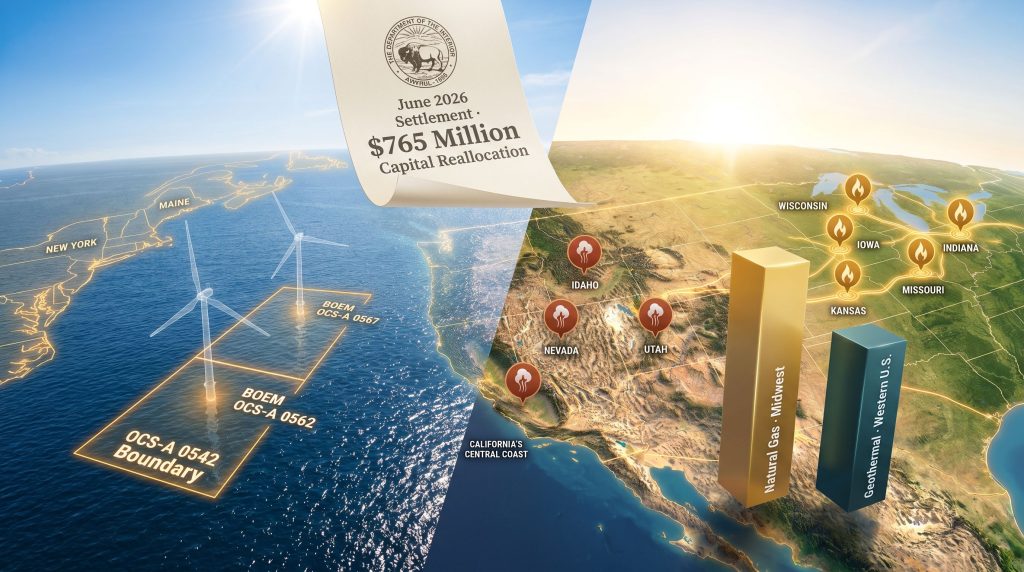
The June 2026 agreement between the U.S. Department of the Interior and Invenergy illuminates exactly that vulnerability. The Invenergy offshore wind lease termination involving four federal BOEM leases and the redirection of approximately $765 million in capital toward natural gas and geothermal infrastructure represents more than a single company's strategic pivot. It functions as a case study in how early-stage federal lease positions can be restructured when policy preferences shift and commercial risk calculus changes simultaneously.
When big ASX news breaks, our subscribers know first
How BOEM Leases Actually Work: The Preliminary Period Explained
Understanding why this particular termination was structurally achievable requires a working knowledge of how BOEM offshore wind lease lifecycles operate. The federal leasing process follows a defined sequence:
- Competitive lease auction – BOEM auctions designated offshore wind areas, with winning bidders paying upfront lease payments.
- Preliminary period – The leaseholder conducts site assessment activities, including met mast installations and subsurface surveys, but has not yet submitted a formal development plan.
- Construction and Operations Plan (COP) submission – The developer files a COP outlining the full project scope, triggering an extensive federal environmental review process.
- BOEM COP approval – Following environmental impact assessments and interagency consultation, BOEM may approve or conditionally approve the COP.
- Construction and commercial operation – Physical installation proceeds, culminating in grid-connected power generation.
Projects in the preliminary period occupy the most politically and commercially flexible position in this sequence. No COP has been filed, no environmental review has been formally initiated for the construction phase, and no physical infrastructure has been installed. This makes the preliminary period the most tractable stage for a negotiated lease exit.
All four of Invenergy's terminated leases were in this preliminary period at the time of the June 2026 agreement. None had progressed to COP submission.
The Four Leases: What Was Actually Terminated
The geographic spread of the affected leases reflects the ambition of Invenergy's original offshore wind portfolio strategy, spanning three distinct federal maritime zones across both the Atlantic and Pacific coasts.
| Lease Designation | Location | BOEM Status at Termination | COP Filed |
|---|---|---|---|
| OCS-A 0542 | New York Bight | Preliminary period | No |
| OCS-A 0562 | Gulf of Maine | Preliminary period | No |
| OCS-A 0567 | Gulf of Maine | Preliminary period | No |
| Undisclosed | California Central Coast | Preliminary period | No |
The California Central Coast lease was secured by Invenergy in 2022, as part of a broader federal auction that drew significant industry interest in Pacific floating wind technology. No advanced development milestones were publicly confirmed before the settlement was reached.
Important Distinction: The Invenergy offshore wind lease termination covered by this DOI settlement is structurally different from the earlier cancellation of Invenergy's Leading Light Wind project off New Jersey. That 2.4-GW project was abandoned due to unfavourable state renewable energy certificate pricing, a project-economics decision. The June 2026 action involves the termination of federal BOEM lease agreements themselves, which carries different legal, financial, and policy implications.
Where $765 Million Is Being Redeployed
The capital being redirected is not disappearing from the energy sector. Invenergy has confirmed two primary destinations for the $765 million in reallocated investment.
Natural Gas Power Generation
The largest share of redirected capital will fund natural gas-fired power plant developments across five Midwestern states: Indiana, Wisconsin, Iowa, Kansas, and Missouri. These states share several characteristics relevant to the investment rationale:
- Growing industrial electricity demand linked to manufacturing re-shoring activity
- Existing gas transmission infrastructure that supports new generation capacity
- Grid reliability pressures intensified by the retirement of coal-fired baseload units
- Regional power markets that value dispatchable generation, particularly during peak demand periods
Natural gas combined-cycle plants typically achieve commercial operation within 3 to 5 years of project initiation, a dramatically compressed timeline relative to offshore wind.
Geothermal Energy Projects
A portion of the redirected capital will support geothermal power development in the western United States. This allocation is notable for several reasons that extend beyond simple policy compliance. Furthermore, renewable energy solutions such as geothermal occupy an increasingly important role in diversified energy portfolios.
Geothermal energy occupies a unique position in the renewable power landscape. Unlike wind and solar, geothermal generation operates as true baseload power, producing electricity continuously regardless of weather conditions. The western U.S. geography of these investments aligns with the most resource-rich geothermal zones in North America, spanning Nevada's Basin and Range province, Utah's geothermal belt, parts of Idaho, and California's inland regions.
Geothermal's intermittency-free generation profile makes it one of the few renewable technologies capable of directly substituting for the dispatchability characteristics associated with fossil fuel baseload plants.
Capital Reallocation Summary
| Destination Sector | Geography | Key Rationale |
|---|---|---|
| Natural Gas Power Plants | Indiana, Wisconsin, Iowa, Kansas, Missouri | Grid reliability, 3-5 year build timeline |
| Geothermal Energy Projects | Western United States | Baseload-capable renewable, resource-aligned geography |
| Offshore Wind (exited) | NY Bight, CA Central Coast, Gulf of Maine | Preliminary period leases, no COP filed |
The DOI Settlement Mechanism: Voluntary Exit vs. Forced Cancellation
The legal architecture of the DOI-Invenergy agreement matters considerably. The settlement is framed as a negotiated, voluntary termination rather than an administrative revocation of lease rights. This distinction has meaningful implications for both parties.
For Invenergy, a voluntary settlement framework may preserve avenues to recover portions of original lease payments and avoid the reputational and financial costs of contested regulatory proceedings. For the federal government, the negotiated approach reduces the risk of legal challenge that an outright administrative cancellation might invite, particularly given the significant capital investments leaseholders typically make during the preliminary period.
Interior Secretary Doug Burgum described the outcome as consistent with an administrative priority to redirect private investment toward what he characterised as dependable, secure energy infrastructure capable of supporting economic activity and moderating utility costs. This aligns closely with the broader U.S. energy security push that has shaped federal resource policy in recent years.
A comparable framework was applied in a separately negotiated lease exit agreement with TotalEnergies, suggesting the DOI has developed a repeatable mechanism for facilitating voluntary offshore wind lease terminations under the current administration.
Development Timeline Realities: Why Speed Now Matters More Than Capacity
A critical but underappreciated dimension of this story is the relationship between energy development timelines and the structural urgency of U.S. electricity demand growth. Three converging forces are driving sustained, structural increases in U.S. power consumption:
- Industrial re-shoring driven by domestic manufacturing incentives and supply chain restructuring following post-pandemic disruptions
- Electrification of transport and building systems, expanding residential and commercial electricity loads
- Data centre and AI infrastructure growth, with hyperscale computing facilities requiring reliable, always-on power at unprecedented scale
These demand drivers create a commercial environment that rewards generation assets with compressed development timelines. The comparison below illustrates the competitive disadvantage facing early-stage offshore wind projects in this context.
| Energy Source | Typical U.S. Development Timeline | Dispatchability |
|---|---|---|
| Offshore Wind (U.S.) | 8-12+ years | Intermittent |
| Onshore Natural Gas | 3-5 years | Fully dispatchable |
| Geothermal (Conventional) | 5-8 years | Baseload / dispatchable |
| Onshore Wind and Solar | 2-4 years | Intermittent |
Leases in the BOEM preliminary period were not positioned to contribute meaningfully to near-term grid capacity under any scenario. Projects at this stage were still years away from COP submission, which itself triggers an environmental review process that has historically taken two to four additional years to complete. Commercial operation for any of these four projects would have been unlikely before the mid-2030s under optimistic assumptions.
The next major ASX story will hit our subscribers first
What This Signals for U.S. Offshore Wind's Commercial Future
The Invenergy offshore wind lease termination does not exist in isolation. It is one data point in a broader pattern of stress affecting the U.S. offshore wind pipeline. In addition, questions surrounding energy transition and security continue to shape how developers and governments alike reassess long-term project commitments.
Since 2022, the sector has experienced a wave of project cancellations, renegotiated power purchase agreements, and cost-escalation disclosures from developers operating in both Atlantic and Pacific lease areas. The contributing factors are well-documented:
- Supply chain inflation affecting turbine components, installation vessels, and subsea cabling
- Rising interest rates increasing the cost of capital for long-duration infrastructure projects
- Permitting timelines that have extended beyond original projections in multiple federal jurisdictions
- State-level REC pricing mechanisms that in some cases have failed to keep pace with project cost increases
Against this backdrop, early-stage lease positions carrying no construction commitment represent optionality, but also ongoing carrying costs and development risk without near-term revenue visibility. For a privately held developer like Invenergy managing a diversified portfolio across generation, transmission, and storage, the return-on-capital logic of exiting these positions in exchange for a negotiated settlement becomes more understandable.
Invenergy's senior vice president for development, Daniel Runyan, framed the company's strategic direction as centred on meeting growing electricity demand through disciplined, scalable investment practices. The natural gas and geothermal redeployment reflects a capital allocation preference for sectors offering more predictable regulatory pathways and established offtake markets in the current investment environment. Consequently, the Trump administration's resource policy has accelerated the pace at which developers are reassessing their federal lease positions. Furthermore, rapid permitting reforms introduced under the current administration have added further commercial uncertainty to offshore wind's already complex development calculus.
FAQs: Invenergy Offshore Wind Lease Termination
What leases did Invenergy terminate?
Four BOEM offshore wind leases covering areas in the New York Bight, California's Central Coast, and the Gulf of Maine, all terminated as part of a June 2026 DOI settlement agreement.
How much capital is being redirected?
Approximately $765 million will be redirected from offshore wind development toward natural gas power generation and geothermal energy projects.
Had any of the terminated projects reached construction?
No. All four leases were in the BOEM preliminary period at the time of the agreement, and none had submitted a Construction and Operations Plan.
Is this the same as the Leading Light Wind cancellation?
No. The Leading Light Wind cancellation in New Jersey was a project-economics decision driven by state REC pricing. The June 2026 DOI settlement involves federal BOEM lease terminations, a structurally and legally distinct action.
What is the difference between a voluntary settlement and an administrative cancellation?
A voluntary settlement is negotiated between the leaseholder and the federal government, potentially allowing the developer to recover portions of lease payments and avoid litigation. An administrative cancellation is a unilateral regulatory action by the government, which carries greater legal challenge risk.
Does this agreement mean Invenergy is exiting offshore wind entirely?
The company has stated it will continue evaluating future opportunities as market conditions evolve, suggesting the exit from these four specific leases reflects current conditions rather than a permanent strategic withdrawal from the offshore wind sector.
Key Takeaways
- The DOI-Invenergy settlement represents one of the most significant individual capital redirections away from U.S. offshore wind development recorded in 2026, involving $765 million across four federal BOEM lease areas.
- The preliminary-period status of all four leases, with no COP filings and no construction commitments, was the structural feature that made this negotiated exit achievable without triggering complex environmental review or legal complications.
- Capital redeployment into Midwestern natural gas generation and western U.S. geothermal projects reflects both the federal administration's current energy priorities and Invenergy's own assessment of where near-term, risk-adjusted returns are most accessible.
- The agreement follows a recognisable pattern established by comparable settlements with other offshore wind developers, indicating the DOI has constructed a systematic approach to facilitating voluntary lease exits.
- For investors and developers with exposure to early-stage federal offshore wind lease positions, the settlement reinforces the importance of understanding where a project sits in the BOEM lifecycle. Preliminary-period leases with no COP represent a fundamentally different risk profile than projects in active permitting or construction.
- The structural mismatch between offshore wind's 8-to-12-plus-year development timeline and the urgency of current U.S. electricity demand growth is likely to remain a persistent commercial headwind for early-stage lease positions regardless of which administration occupies the White House.
This article contains analysis of publicly available information and regulatory frameworks. It does not constitute investment advice. Readers should conduct independent research before making any investment or business decisions related to the U.S. offshore wind sector or energy infrastructure markets.
Want to Capitalise on the Next Major Energy and Minerals Discovery Before the Market Moves?
While U.S. offshore wind capital is being redirected toward natural gas and geothermal projects, the real-time identification of significant resource discoveries remains one of the most powerful edges available to investors — and Discovery Alert's proprietary Discovery IQ model delivers exactly that, instantly alerting subscribers to actionable ASX mineral discoveries as they happen. Explore Discovery Alert's discoveries page to understand how historic finds have generated substantial returns, and begin your 14-day free trial today to position yourself ahead of the broader market.