August 14, 2026
The Brazilian rare earth elements market operates under geopolitical dependency logic that has shaped decades of industrial strategies. While developed nations built their supply chains relying on concentrated sources, few anticipated this centralisation would become a critical strategic vulnerability. The global energy transition security now exposes this fragility, creating a race for supply alternatives that transcends purely economic considerations.
Why do investimentos em terras raras projeto Carina Transform the Brazilian Scenario?
Geopolitical Disruption in Global Supply
Chinese concentration in the rare earth market has reached strategically concerning levels for Western economies. With control over approximately 90% of global production, China has established a dominant position that extends far beyond simple commercial leadership. This concentration creates systemic risks for industries dependent on these critical elements.
The investimentos em terras raras projeto Carina emerges in this context as a viable Western alternative, promising to partially break this dependency. With capacity to produce equivalent to approximately 11.8% of Chinese dysprosium and terbium production in 2024, the Brazilian project represents a significant diversification source.
Technological Advantage of Goiás Deposits
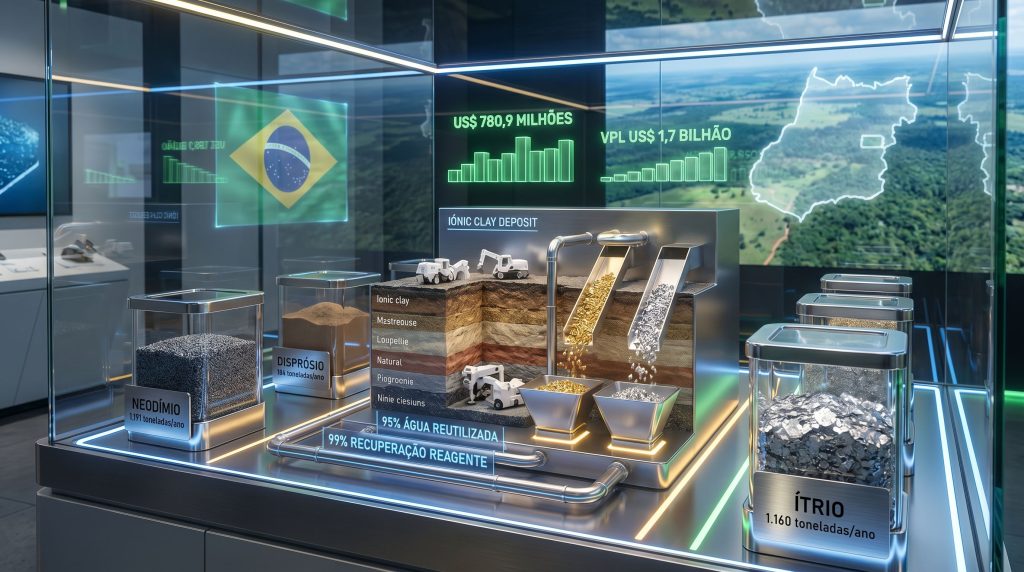
The ionic clays found in Goiás present unique characteristics conferring substantial competitive advantages. Unlike traditional methods requiring intensive acid and energy processes, these deposits permit mechanical extraction with 97% purity concentrates.
The geological uniqueness of these deposits positions Aclara as the only company globally reporting heavy rare earth reserves from ionic clays according to NI 43-101 standards. This technical exclusivity fundamentally supports the transformational potential of investimentos em terras raras projeto Carina.
Impact on Green Supply Chains
Carina's projected capacity to supply approximately 5 million electric vehicles annually demonstrates its relevance for global energy transition. This volume positions the project as a fundamental piece in green technology supply chains, reducing dependency on single suppliers.
Furthermore, the project's significance extends beyond mere production volumes. The mining industry innovation represented by Carina's Circular Mineral Harvesting method exemplifies how modern mining operations can align environmental responsibility with commercial viability.
When big ASX news breaks, our subscribers know first
Financial Anatomy of the Project: US$ 780.9 Million in Detail
Capital Structure and Investment Distribution
| Investment Category | Value (US$ millions) | Participation |
|---|---|---|
| Construction Base CAPEX | 678.2 | 86.8% |
| Operating Contingency | 102.7 | 13.2% |
| Total Investment | 780.9 | 100% |
The US$ 100.4 million increase compared to the Pre-Feasibility Study primarily reflects exchange rate variations, inflation, and enhanced engineering precision. This upward revision, whilst significant, maintains the attractiveness of projected returns.
Financial Performance Metrics
Financial projections based on Argus Media forecasts reveal robust metrics:
- Net Present Value: US$ 1.7 billion (8% discount rate)
- Internal Rate of Return: 26.9% after taxes
- Payback Period: 2.9 years
- Average annual EBITDA: US$ 460 million
- Average annual net revenue: US$ 599 million
The 2.9-year payback period situates within the upper range for commodity projects, reflecting both deposit quality and premium prices for heavy rare earth elements. The 26.9% IRR significantly exceeds typical cost of capital for large-scale mining projects.
Comparison with Sectoral Benchmarks
Although rare earth projects vary substantially in scale and product composition, Carina's capital intensity (approximately US$ 178,000 per tonne of REO capacity) positions competitively when considering high-value element concentration.
Implementation Timeline: From Conception to Production
Modular Implementation Strategy
The development timeline follows a modular approach designed to reduce costs and accelerate construction:
Q3 2026 – Preliminary Works:
- Construction of operational camps
- Access infrastructure improvements
- Site preparation for accelerated construction
2027 – Modular Construction Phase:
- Parallel equipment manufacturing
- Simultaneous site preparation
- Processing plant construction
H1 2028 – Commissioning:
- System testing initiation
- Equipment calibration
- Operational training
H2 2028 – Initial Production:
- Gradual production ramp-up
- Process optimisation
- Nominal capacity achievement during 2029
Critical Timeline Factors
Modularisation allows equipment manufacturing to occur parallel to site preparation, a strategy historically reducing construction timelines by 15-20%. However, dependence on specialised imported equipment and availability of technical skilled labour in Goiás represent potential bottlenecks.
Production Portfolio and Strategic Element Mix
Detailed Annual Production Composition
| Element | Production (t/year) | Concentration | Primary Application |
|---|---|---|---|
| Neodymium (Nd) | 1,191 | 27.2% (NdPr) | EV permanent magnets |
| Praseodymium (Pr) | 382 | 27.2% (NdPr) | High-performance magnets |
| Dysprosium (Dy) | 184 | 4.2% (DyTb) | High-temperature magnets |
| Terbium (Tb) | – | 4.2% (DyTb) | Advanced electronics |
| Samarium (Sm) | 173 | – | Specialised magnets |
| Gadolinium (Gd) | 176 | – | Medical applications |
| Yttrium (Y) | 1,160 | – | Phosphors and superconductors |
| Lutetium (Lu) | 10 | – | Specialised medical applications |
Strategic Significance of Projected Production
The total production of 4,378 tonnes annual rare earth oxides concentrates on higher value-added elements. The high concentration of heavy elements (DyTb at 4.2%) differentiates the project from traditional deposits, frequently presenting concentrations below 1%.
This composition allows investimentos em terras raras projeto Carina to capture significant price premiums, especially for dysprosium and terbium, critical elements for high-temperature applications in electric vehicles and wind energy.
Global Market Positioning
The project's capacity to supply 5 million electric vehicles annually equals approximately 20% of global EV production in 2024. This scale confers systemic relevance to the project in electric mobility supply chains.
Circular Mineral Harvesting Method Revolution
Sustainable Technological Innovations
The Circular Mineral Harvesting (CMH) method represents a rupture with conventional mining practices. Primary characteristics include:
- Mechanical extraction without explosives or crushing
- 95% water reuse in the productive process
- 99% reagent recovery ammonium sulphate
- Zero liquid effluents or tailings dams
- Return of processed clays to original pit
Competitive Environmental Advantages
The CMH method creates a truly circular cycle where processed clays return to the original pit, minimising permanent environmental impact and eliminating long-term risks associated with tailings dams.
This approach contrasts dramatically with traditional methods consuming 80% more water and generating substantial volumes of acidic tailings. The elimination of tailings dams completely removes catastrophic risks associated with structural failures.
The implementation of such innovative waste management solutions positions Carina at the forefront of sustainable mining practices globally.
Comparison with Conventional Methods
| Parameter | CMH Carina | Traditional Methods |
|---|---|---|
| Water Consumption | 80% reduction | Baseline |
| Solid Tailings | Return to pit | Permanent dams |
| Acid Usage | Minimal | Intensive |
| Carbon Footprint | Reduced | Elevated |
| Environmental Risk | Low | Moderate to High |
Regional and National Economic Impact
Employment Generation and Social Development
| Phase | Direct Jobs | Indirect Jobs | Duration |
|---|---|---|---|
| Construction | 1,500-2,000 | 4,500-6,000 | 2027-2028 |
| Operation | 800-1,000 | 2,400-3,000 | 18 years |
| Total | 2,500+ | 7,500+ | Permanent |
Generating 2,500 quality direct jobs in Goiás represents substantial socioeconomic impact for the region. Considering typical mining multipliers, the project can generate over 10,000 total jobs (direct, indirect, and induced).
Tax Collection and Royalties
Estimates indicate investimentos em terras raras projeto Carina will generate approximately 6 times superior tax collection in Brazil compared to equivalent operations in the USA. This difference reflects:
- Federal taxes on mining operations
- State ICMS on product movement
- Municipal ISS on services
- CFEM (Financial Compensation for Mineral Exploration)
- Social contributions on payroll
Supply Chain Development
The project will create opportunities for local and regional supplier development, including:
- Companies providing specialised mining services
- Equipment and spare parts suppliers
- Logistics and transport service providers
- Industrial maintenance companies
The next major ASX story will hit our subscribers first
Integrated "Mine to Magnet" Strategy: Long-Term Vision
Geographic Value Distribution
Aclara's strategy distributes the value chain between Brazil and the United States in an apparently unbalanced but strategically founded manner:
| Location | Investment | Jobs | Activity |
|---|---|---|---|
| Brazil (Goiás) | US$ 780 million | 2,500 | Mining, concentration, purification |
| USA (Louisiana) | US$ 270 million | 130 | Element separation |
Strategic Justification for External Separation
The decision to perform separation in the USA reflects complex technological and strategic realities. Separation technology remains dominated by China, whilst the American academic ecosystem offers infrastructure for developing Western alternatives.
The partnership with Virginia Tech and Argonne National Laboratory aims to develop capabilities that can subsequently be transferred to Brazil. This approach represents a "technological school" for future development of national capabilities.
Technology Transfer Vision
The medium-term strategy foresees application of separation technology in Brazil and other countries where the company operates, once processes are mastered through American experience.
This approach recognises Brazil needs to gradually develop its academic and industrial ecosystem in rare earths, instead of attempting premature technological leaps.
Risk Analysis and Mitigation Factors
Technical and Operational Risks
Geological Variability:
- Heterogeneity of ionic clay deposits
- Variations in mineral composition
- Need for continuous processing adjustments
Technological Complexity:
- Dependence on CMH technology still at pilot scale
- Operational learning curve
- Integration of automated systems
Regulatory and Political Risks
Brazilian Regulatory Environment:
- Potential changes in mineral policy
- Pressures for integral local processing
- Environmental licensing complexity
Geopolitical Pressures:
- Possible Chinese dumping to maintain market share
- Volatility in international trade relations
- Changes in critical mineral policies
Market Risks and Mitigation
Price Volatility:
Rare earth prices historically present high volatility, with fluctuations significantly impacting project returns. Mitigation strategies include:
- Long-term contracts with strategic clients
- Product portfolio diversification
- Operational flexibility for production adjustments
The importance of establishing secure supply chains becomes evident when examining global critical minerals order initiatives and European CRM supply strategies.
Expansion Potential and Future Developments
Project Pipeline in Brazil
Investimentos em terras raras projeto Carina represents only the beginning of a potential Brazilian rare earth hub. The country possesses over 40 identified projects, creating opportunities for:
- CMH technology replication in other deposits
- Regional operation consolidation
- Shared infrastructure development
- Technological excellence centre creation
Demand Growth Scenarios
| Sector | Annual Growth | Critical Elements | Project Impact |
|---|---|---|---|
| Electric Vehicles | 25-30% | Nd, Pr, Dy | High |
| Wind Energy | 15-20% | Nd, Pr | Medium |
| Electronics | 5-10% | Tb, Y | Stable |
| Medical Applications | 10-15% | Gd, Lu | Growing |
Model Replicability
The CMH technology developed for Carina can be applied to other ionic clay deposits globally. This technological scalability represents opportunities for Brazilian knowledge export and positioning as leader in sustainable rare earth mining.
Investment Opportunities and Monitoring
Available Investment Instruments
Direct Exposure:
- Aclara Resources shares (TSX: ARA)
- Tracking through Canadian market
- Quarterly progress reports
Indirect Exposure:
- Global rare earth ETFs
- Specialised commodity funds
- Critical metals ETFs
Key Monitoring Indicators
Operational Milestones:
- Environmental licensing progress
- Effective preliminary works initiation
- Construction and commissioning milestones
- Commercial production achievement
Market Indicators:
- DyTb and NdPr spot prices
- Global electric vehicle demand
- Separation technology developments
- Government policies on critical minerals
Transformational Impact on Brazilian Mining Sector
The success of investimentos em terras raras projeto Carina can catalyse broader transformation of the Brazilian mining sector, positioning the country as reliable supplier of critical minerals for global energy transition.
Expected Systemic Benefits:
- Attraction of new REE investments
- Development of national expertise
- Creation of specialised supplier chains
- Strengthening of Brazilian geopolitical position
Long-Term Perspectives and Strategic Conclusions
National Scenario Transformation
Investimentos em terras raras projeto Carina transcend the dimension of an isolated mineral project. They represent a strategic bet on Brazilian capacity to position itself as relevant player in critical minerals, combining exceptional natural resources with sustainable technology and long-term geopolitical vision.
Next Critical Milestones
2026-2027:
- Definitive environmental licensing finalisation
- Infrastructure works initiation
- Specialised workforce development
2028-2030:
- Commissioning and productive ramp-up
- Long-term contract establishment
- Expansion project evaluation
Impact on Geopolitical Diversification
The Carina project contributes to necessary rebalancing in global rare earth supply, reducing Western dependence on single sources. This diversification strengthens resilience of supply chains critical for energy transition.
The combination of unique geological resources, sustainable technology, and strategic geographic positioning positions Brazil to capture significant value in the emerging critical minerals economy. The success of investimentos em terras raras projeto Carina can establish a precedent for sustainable and technologically advanced mineral development in the country.
Disclaimer: This article presents analysis based on available public information and market projections. Investimentos em terras raras projeto Carina involve significant risks, including technical, regulatory, market, and geopolitical risks. Potential investors should conduct their own due diligence and consider consultation with specialised advisors before making investment decisions.
External References
For comprehensive coverage of Carina project developments, see the detailed reports by Brasil Mineral on the project's investment requirements and G1's analysis of rare earth testing operations in Goiás.
Ready to Position Yourself in the Critical Minerals Revolution?
Discovery Alert's proprietary Discovery IQ model delivers real-time alerts on significant mineral discoveries across the ASX, instantly empowering subscribers to identify actionable opportunities ahead of the broader market. Understand why historic discoveries can generate substantial returns by exploring how major mineral finds have transformed investor portfolios, then begin your 14-day free trial today to secure your market-leading advantage.