May 23, 2026
When Physical Markets Tighten Faster Than Mines Can React
Precious metals markets move in cycles, but not all cycles behave the same way. In most commodity markets, sustained price increases eventually call forth more supply, easing the shortage and stabilising prices. Platinum's structural reality challenges this assumption in ways that matter enormously for investors tracking investment demand for platinum and trying to understand whether the current bullish environment has genuine staying power or simply reflects short-term enthusiasm.
The answer lies in a combination of geological constraints, demand durability, shrinking inventory buffers, and a macro environment that is actively redirecting capital toward hard assets. Understanding how each of these forces interacts is key to evaluating where platinum is headed in 2026. For broader context, the precious metals market analysis available for 2025 offers a useful comparative baseline.
When big ASX news breaks, our subscribers know first
The 2026 Platinum Balance: What the Numbers Actually Say
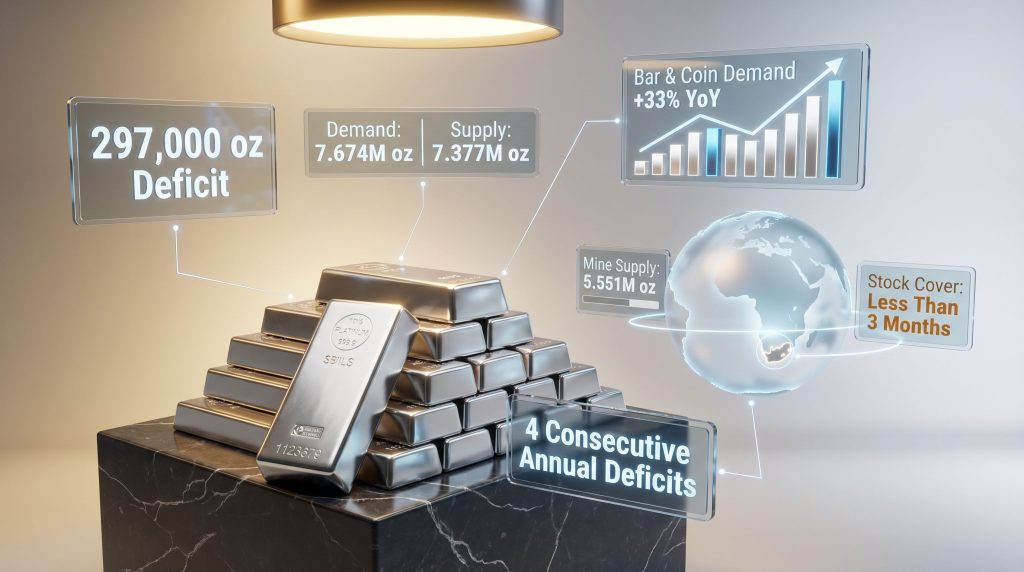
The World Platinum Investment Council's Platinum Quarterly for Q1 2026 presents a market in structural tension. Total platinum demand for the full year is projected at 7.674 million ounces, while total supply is expected to reach only 7.377 million ounces, implying a deficit of 297,000 ounces. Critically, this is not an isolated event. It marks the fourth consecutive annual deficit, meaning cumulative inventory depletion has been building since 2023.
By year-end 2026, above-ground stocks are expected to provide less than three months of global demand cover, a level that, by any historical standard, represents extremely thin protection against disruption.
| Metric | 2026 Forecast |
|---|---|
| Total demand | 7.674 million oz |
| Total supply | 7.377 million oz |
| Market deficit | 297,000 oz |
| Above-ground stock cover | Less than 3 months |
| Consecutive annual deficits | 4 years |
| Bar and coin demand growth | +33% year-on-year |
| Full-year mine supply | 5.551 million oz (broadly flat) |
| Full-year recycling supply | 1.826 million oz (+9%) |
Four Consecutive Deficits: Why Cumulative Depletion Matters More Than Any Single Year
A single-year deficit can be absorbed if above-ground stocks are deep enough. However, four consecutive years of deficit spending against finite inventory reserves is a categorically different situation. Each successive shortfall draws the buffer down further, narrowing the margin available to absorb unexpected supply disruptions or demand spikes.
Edward Sterck, director of research at the World Platinum Investment Council, has noted that while the precise level of above-ground stocks is inherently an estimate and should be treated with appropriate caution, the direction of change is what carries the most analytical weight. Falling stocks signal tightening physical availability; rising stocks would indicate easing conditions. On the current trajectory, the direction is unambiguously downward.
Key insight: It was the recognition of above-ground stocks falling to critically low levels that acted as one of the catalysts behind the platinum price rally that began approximately a year ago. Prices at one stage reached nearly 200% above year-earlier levels before settling to a position that is still over 100% higher than twelve months prior.
| Year | Market Balance | Inventory Trend | Investor Implication |
|---|---|---|---|
| 2023 | Deficit | Declining | Early tightness signal |
| 2024 | Deficit | Declining | Lease rates elevating |
| 2025 | Deficit | Declining | Price rally triggered |
| 2026 (f) | Deficit (-297k oz) | Declining further | Sub-3-month cover |
Why Investment Demand for Platinum Does Not Require ETF Surges to Stay Strong
One of the most common analytical mistakes when assessing investment demand for platinum is conflating total investor interest with exchange-traded fund inflows specifically. The two are related but distinct, and understanding this distinction is essential in 2026.
Last year saw exceptional inflows into both ETFs and exchange stocks, driven by a combination of factors: a widespread view that platinum was undervalued relative to gold, and a fourth-quarter pivot toward non-dollar, monetary-like assets benefiting the broader precious metals complex. Those exceptional inflows are not expected to repeat at the same scale in 2026.
However, Sterck has made clear that bar and coin demand is expected to rise by 33% year-on-year, which represents genuine and robust retail investment interest. ETF and exchange-stock positions are expected to remain broadly stable, with only modest outflows, rather than showing any meaningful collapse in investor conviction. Furthermore, safe-haven investment trends in gold during 2025 demonstrated the broader macro conditions that have supported this pivot toward hard assets.
The distinction matters:
- ETF inflows are institutional and sentiment-driven, highly sensitive to macro rotations
- Bar and coin demand reflects retail conviction and physical accumulation
- Exchange stock behaviour in the US has been influenced by trade-barrier concerns, which have not fully dissipated despite geopolitical shifts
Bottom line for investors: Platinum investment demand is not weakening. It is consolidating after an exceptional prior year, while physical retail buying continues to strengthen.
Supply Rigidity: Why Higher Prices Are Not Unlocking New Mine Output
Perhaps the most counterintuitive aspect of the platinum market is that prices rising more than 100% in twelve months have not produced a meaningful supply response. To understand why, it is necessary to appreciate the geological and operational realities of deep-level underground PGM mining.
The majority of global platinum originates from large tabular orebodies in southern Africa. These are not open-pit operations that can be scaled by adding more trucks and fuel. Expanding the production footprint of a deep underground mine requires:
- Extensive off-reef development to access new reef panels
- Multi-year lead times before new ore sources reach productive output
- Significant head-count increases that cannot be achieved quickly
- Capital commitment against a price environment that must demonstrate durability over many years, not months
- Shareholder pressure favouring returns over expansion risk, particularly after a decade of depressed prices
Sterck has been explicit on this point: after roughly ten years of weak platinum prices, mining companies are understandably cautious about committing to multi-year capital programmes on the strength of twelve months of higher prices. The geological nature of these orebodies, governed by geotechnics as much as economics, means that even willing operators face hard physical limits on how quickly they can scale output.
Full-year mine supply for 2026 is forecast at 5.551 million oz, essentially flat year-on-year, despite the dramatic price improvement.
| Factor | Mine Supply | Recycling Supply |
|---|---|---|
| Price sensitivity | Low in short term | Moderate |
| Lead time to respond | Multi-year | 6-18 months |
| Main bottleneck | Geology, geotechnics, capex | Financing, credit, energy costs |
| 2026 outlook | Flat at 5.551m oz | +9% to 1.826m oz |
Can Recycling Close the Gap? The Honest Answer
Recycling represents the most price-responsive component of platinum supply, and growth of 9% year-on-year to 1.826 million oz is meaningful. Q1 2026 already showed +7% growth to 416,000 oz, demonstrating that higher prices are incentivising greater collection activity.
However, several structural constraints limit just how far recycling can stretch to fill the deficit:
- Working capital pressure: With platinum prices more than doubling in some periods, the capital required to purchase spent catalysts before processing and selling the recovered metal has increased substantially. This requires expanded credit lines, which take time to negotiate with lenders.
- Energy cost escalation: Processing costs have risen sharply alongside broader energy price inflation, compressing recycler margins even as metal prices appear favourable.
- Lower PGM loadings per catalyst: A critical technical nuance that is often overlooked is that the platinum-group metal loading embedded in each autocatalyst has declined over successive vehicle generations. Collecting more spent catalysts therefore does not translate proportionally into more recovered metal.
- End-of-life vehicle timing: Higher interest rates and economic uncertainty may slow new vehicle purchases, which in turn delays the availability of end-of-life vehicles entering the recycling stream.
The next major ASX story will hit our subscribers first
Demand Segmentation: Where Strength and Weakness Are Concentrated
A full-picture view of platinum demand in 2026 reveals a market where different sectors are moving in sharply different directions.
Industrial Demand: The Standout Performer
Industrial demand is the sector posting the most dramatic growth. Q1 2026 industrial demand reached 513,000 oz, up 41% year-on-year, with glass demand alone reaching 94,000 oz in that quarter. For the full year, industrial demand is projected to rise 9% to 2.238 million oz, led by glass at +83% to 377,000 oz.
The glass sector's demand surge reflects investment in glass manufacturing capacity, particularly for specialty and display applications, where platinum-rhodium spinnerettes and bushings are irreplaceable process components.
Petroleum demand tells the opposite story, forecast at 132,000 oz, down 28% from 182,000 oz in 2025, with the full-year estimate revised down by a further 22,000 oz to reflect disruption risk from Middle East conflict. The chemical segment also contracted slightly in Q1, down 4% year-on-year to 116,000 oz.
Automotive Demand: Modest Decline With Structural Support
Automotive platinum demand is expected to fall approximately 2% year-on-year, a modest decline supported partly by tighter emissions standards continuing to require platinum-bearing catalytic converters in internal combustion and hybrid vehicles. The vehicle production forecast has been cut by 1 million units, reflecting the economic drag from higher energy prices and related supply chain constraints affecting both ICE and battery electric vehicles.
It is worth noting that semiconductor shortages and materials constraints, including reduced availability of automotive-grade aluminium alloys and helium used in chip production, are secondary risks that could push automotive demand lower if geopolitical pressures persist.
Jewellery Demand: Concentrated Weakness
Jewellery demand is forecast to fall 12% year-on-year, with the weakness concentrated in China rather than reflecting a broad global contraction. In most other geographies, platinum jewellery demand is expected to remain stable or modestly positive.
Market Tightness Indicators: Reading the Signals Professionals Use
Beyond the headline supply-demand balance, experienced market participants watch a specific set of indicators to gauge whether a paper deficit is translating into real physical scarcity.
| Indicator | What It Measures | Bullish Reading | Current Status |
|---|---|---|---|
| Above-ground stocks | Surface inventory buffer | Falling toward critical lows | Less than 3 months cover |
| Lease rates | Cost to borrow physical platinum | Persistently elevated | Still historically high |
| Backwardation | Near-term price premium over forward | Indicates immediate scarcity | Present in London OTC market |
| Mine supply response | Producer reaction to higher prices | Flat despite 100%+ price gain | Essentially flat |
Backwardation in the London over-the-counter market is particularly informative. When near-term metal commands a premium over future delivery, it typically reflects a genuine preference for immediate availability over promised future supply — a strong signal of physical tightness rather than speculative positioning.
Lease rates have eased somewhat from their peaks but remain historically elevated according to Sterck, consistent with a market where borrowing physical platinum carries a meaningful cost premium.
Geopolitical Scenarios and the Offset Dynamic
The current geopolitical environment introduces both downside risks and potential demand redirects that make platinum's outlook more nuanced than a simple supply-demand spreadsheet can capture.
Scenario 1: Contained Disruption
Energy prices remain elevated but stable. Vehicle production falls by the currently modelled 1 million units, petroleum catalyst demand softens as forecasted, and investment demand remains firm. The market records a deficit of approximately 297,000 oz and above-ground stocks continue to fall.
Scenario 2: Prolonged Energy Shock
A more extended conflict scenario accelerates supply chain disruptions for aluminium alloys and semiconductors, pushing automotive demand lower than current forecasts. However, sustained inflationary pressure from energy costs intensifies scrutiny of the US debt burden and dollar-asset concentration, repeating the conditions that drove the fourth-quarter 2025 pivot toward monetary-like assets including platinum.
In this scenario, losses in automotive and petrochemical catalyst demand could be more than offset by strengthened investment demand — a dynamic that Sterck has explicitly described as a plausible outcome.
Scenario 3: Risk-Off Safe-Haven Rotation
If macro instability intensifies, investors seeking alternatives to dollar-denominated exposure may rotate toward the broader precious metals complex. Platinum, sitting at the intersection of industrial utility and precious-metal characteristics, is positioned to benefit from exactly this type of capital reallocation.
Platinum Beyond Autocatalysts: A Widening Investment Narrative
For much of its modern history, platinum's investment case has been tethered closely to automotive demand. That framing is becoming increasingly incomplete.
Trevor Raymond, CEO of the World Platinum Investment Council, has pointed to a far wider cohort of investors now actively engaging with platinum's precious-metal attributes. Importantly, platinum is already embedded in several technology categories directly connected to the expansion of AI infrastructure, including optical communications hardware and data storage systems where platinum's properties are functionally irreplaceable.
Additional demand growth vectors include:
- Emissions regulation tightening, extending the lifespan of autocatalyst demand beyond what electric vehicle penetration alone would suggest
- Hydrogen economy development, particularly in Europe and East Asia, where regional energy security concerns are accelerating interest in hydrogen technologies — the hydrogen and energy transition momentum is a key structural tailwind for platinum-based catalysts
- Advanced manufacturing in glass, chemicals, and specialty industrial processes
In addition, the surge in critical minerals demand across the energy transition broadly reinforces platinum's expanding industrial relevance. This broadening of platinum's demand base means that investment demand for platinum is increasingly supported by multiple concurrent industrial drivers rather than a single legacy application.
Comparing Platinum With Other Hard-Asset Investment Options
| Attribute | Platinum | Gold | Silver | Palladium |
|---|---|---|---|---|
| Stock cover / scarcity | Sub-3-month cover | Abundant above-ground stocks | Moderate | Tighter than gold |
| Industrial linkage | High (auto, glass, hydrogen) | Low | Moderate | High (auto) |
| Macro stress sensitivity | Dual benefit (hard asset + industrial) | Strong safe-haven | Mixed | Auto-cycle linked |
| Supply deficit present | Yes, 4 consecutive years | Typically surplus | Variable | Variable |
| Volatility risk | Moderate-high | Lower | Higher | Higher |
Platinum occupies a genuinely distinctive position: part precious metal responding to macro stress, part industrial metal driven by real manufacturing demand. For instance, the platinum and palladium dynamics shaping 2025 help illustrate how these two metals can diverge significantly in their supply-demand trajectories even while sharing the same mining geography. This hybrid nature can generate sharper cyclical swings, but it also means platinum can benefit from multiple simultaneously supportive conditions.
Risk Framework: What Could Weaken the Investment Case
A rigorous assessment must include a clear-eyed view of what could undermine the thesis.
| Risk | Transmission Mechanism | Most Exposed Demand Segment | Indicator to Watch |
|---|---|---|---|
| Accelerated ETF outflows | Institutional sentiment shift | Investment | Weekly ETF holdings data |
| Deeper auto production cuts | Vehicle output lower than modelled | Automotive | Monthly production statistics |
| Industrial demand disappointment | Capex slowdown in glass/chemicals | Industrial | Quarterly WPIC updates |
| China jewellery collapse | Consumer spending weakness | Jewellery | China retail data |
| Larger-than-assumed inventories | Physical scarcity less acute | All segments | OTC lease rates, backwardation |
| Geopolitical resolution | Reduces safe-haven premium | Investment | Oil price, conflict duration |
Quarterly Monitoring Framework for Platinum Investors
Tracking investment demand for platinum effectively requires consistent attention to a structured set of indicators rather than reacting to individual price moves.
- Compare total quarterly supply against total demand to confirm deficit trajectory
- Observe whether above-ground stock estimates are rising or falling, prioritising direction over precision
- Separate physical retail buying (bars and coins) from ETF and exchange-stock flows
- Monitor glass and chemical segments as leading industrial demand indicators
- Watch OTC lease rates and backwardation as real-time tightness signals
- Track vehicle production revisions as the key swing variable for autocatalyst demand
- Assess energy price movements for their dual effect on recycling costs and investment demand redirection
FAQ: Investment Demand for Platinum in 2026
Is investment demand for platinum rising in 2026?
Physical investment demand is rising, with bar and coin buying projected 33% higher year-on-year. ETF inflows are not expected to match last year's exceptional volumes, but this reflects consolidation after an unusual surge rather than a fundamental loss of investor interest.
Why do analysts focus so heavily on above-ground stocks?
Because the level and direction of above-ground stocks determines how much buffer exists to absorb supply disruptions or unexpected demand increases. At less than three months of global demand cover, the current buffer is historically thin and leaves the market highly sensitive to any additional supply shortfall.
Can higher platinum prices quickly increase mine supply?
Not materially. Deep-level underground PGM mines operate under geological and geotechnical constraints that prevent rapid output increases. Expanding production requires years of development work, significant capital investment, and sustained price confidence that twelve months of higher prices cannot yet fully provide.
Which demand segment is providing the strongest support in 2026?
Investment and industrial demand are the two most dynamic positive contributors. Glass demand within the industrial segment is growing particularly sharply, up 83% year-on-year on a full-year basis. Physical investment buying is also expanding strongly.
What would most effectively weaken the platinum investment thesis?
The sharpest risks include a significant acceleration of ETF outflows beyond current modest levels, a deeper-than-expected contraction in automotive or industrial demand, evidence that above-ground stocks are less depleted than current estimates suggest, or a rapid resolution of geopolitical tensions that reduces safe-haven demand.
Structural Tightness Plus Macro Optionality: The Enduring Case
The investment demand for platinum in 2026 is not built on a single pillar that could collapse if one market segment disappoints. It rests on the simultaneous presence of four reinforcing conditions: a physical market running its fourth consecutive deficit, above-ground inventories at critically low cover levels, mine supply that cannot meaningfully accelerate regardless of price, and a macro backdrop that repeatedly redirects capital toward monetary-like hard assets during periods of stress.
Even if ETF enthusiasm does not return to last year's exceptional levels, and even if automotive demand softens further than currently modelled, the combination of sub-three-month stock cover, structural mine inflexibility, recycling limitations, and strong physical retail buying creates a foundation that is qualitatively different from speculative enthusiasm. Consequently, as Mining Weekly notes, extremely robust platinum investment demand is expected to persist — a view echoed by the CME Group's forward outlook for the metal.
This article is intended for informational purposes only and does not constitute financial advice. Forecasts and projections involve uncertainty and may not eventuate as described. Readers should conduct their own due diligence before making investment decisions.
Want to Stay Ahead of the Next Major ASX Mineral Discovery?
Discovery Alert's proprietary Discovery IQ model delivers real-time alerts on significant ASX mineral discoveries, cutting through complex data to surface actionable opportunities the moment they are announced — explore historic discoveries and their returns to understand the scale of what's possible, then begin your 14-day free trial at Discovery Alert to position yourself ahead of the broader market.