August 6, 2026

Investment behavior during geopolitical upheaval reveals fascinating patterns that go beyond simple supply-demand equations. When regional conflicts disrupt critical energy infrastructure, markets exhibit complex psychological responses that blend rational risk assessment with emotional decision-making. These dynamics create opportunities for investors who understand how fear, uncertainty, and strategic positioning interact during crisis periods, as demonstrated by the recent oil prices & geopolitics developments affecting global markets.
What Drives Investor Confidence During Geopolitical Oil Crises?
The psychological landscape of energy investing transforms dramatically when geopolitical tensions threaten global supply chains. Saudi Aramco stock rally patterns during the March 2026 Middle East crisis demonstrate how investor sentiment operates independently from fundamental earnings metrics, creating distinct valuation frameworks that traditional analysis often misses.
Fear-Premium Valuations vs. Fundamental Analysis
Market psychology during supply disruptions operates through dual pricing mechanisms that reflect both tangible risks and psychological uncertainty. The Saudi Aramco stock rally of 12.72 percent year-to-date occurred despite the company reporting a 12.1 percent decline in net profits, highlighting how investors price future scarcity rather than current profitability.
Oil markets demonstrated this psychological complexity when prices reached $119 per barrel on March 9, 2026, before stabilizing around $98.26 for Brent crude and $93.09 for WTI following strategic reserve announcements. Furthermore, this price action revealed investor behavior patterns that extend beyond pure supply-demand calculations, particularly as global trade war impact continues to influence market dynamics:
- Anchoring effects: Markets referenced the mid-2022 price peaks as psychological ceiling levels
- Risk premium layering: Investors simultaneously priced operational disruptions and duration uncertainty
- Scenario-based positioning: Portfolio allocation reflected probability-weighted outcomes across multiple conflict resolution timelines
The fear-premium framework becomes particularly evident when analyzing how markets responded to the 20 percent of global oil transit normally flowing through the Strait of Hormuz being effectively blocked. Rather than simply calculating supply shortage arithmetic, investors incorporated complex variables including infrastructure vulnerability, geopolitical escalation potential, and strategic response effectiveness.
Strategic Reserve Release Psychology
The International Energy Agency's announcement of a 400 million barrel strategic reserve release represented the largest such intervention in history, yet market reactions revealed sophisticated psychological pricing mechanisms. Despite the massive scale, oil prices remained elevated, suggesting investors had already incorporated reserve deployment expectations into their risk models.
Analysis from energy market specialists indicated that 400 million barrels would satisfy IEA oil demand for approximately 9-10 days, creating a mathematical framework that investors used to assess intervention sustainability. This calculation demonstrates how behavioral finance principles influence commodity markets:
The limited duration of reserve releases creates psychological pressure points where investors must evaluate whether fundamental supply-demand balance restoration occurs before strategic stockpiles become depleted.
Market participants exhibited skepticism regarding implementation timelines, recognizing that coordinated release mechanisms require unanimous member country agreement and detailed logistical planning. This institutional knowledge gap between announcement and execution created additional uncertainty layers that sophisticated investors priced into their positioning strategies.
Risk-Adjusted Return Calculations During Supply Disruptions
Energy sector volatility during geopolitical crises creates distinct risk-return profiles that differ substantially from normal market conditions. The Saudi Aramco stock rally exemplifies how investors adjust expected returns based on:
Scenario Probability Weighting:
- Base case: Gradual normalization by month-end (higher probability)
- Bear case: Extended disruption lasting multiple quarters (lower probability but catastrophic impact)
- Current pricing positioned between scenarios, reflecting rational risk distribution
Infrastructure Damage Assessment:
Energy analysts noted that meaningful infrastructure damage remained absent during the initial crisis phase, suggesting that current supply disruptions reflected tactical rather than strategic targeting. This technical distinction influenced how institutional investors modelled recovery timelines and positioned for various resolution scenarios.
Logistics Cost Premium Integration:
Beyond supply scarcity, markets incorporated elevated transportation costs from alternative routing, insurance premium increases, and heightened security requirements. These factors created persistent cost structures that would likely remain elevated even after initial supply restoration.
When big ASX news breaks, our subscribers know first
Why Energy Giants Outperform During Supply Chain Disruptions
Portfolio rebalancing dynamics during geopolitical uncertainty reveal systematic patterns in how institutional capital flows between sectors. The Saudi Aramco stock rally occurred within broader market movements that saw 88 stocks advancing while 176 declined on the Tadawul exchange, indicating selective rather than broad-based strength.
Portfolio Rebalancing Dynamics
Capital flight patterns during regional conflicts typically follow predictable institutional behaviour models. The SR5.05 billion trading turnover on March 12, 2026, reflected significant portfolio repositioning as investors sought defensive characteristics and inflation hedging properties that energy stocks provide during supply disruption periods.
Institutional Positioning Patterns:
- Defensive allocation increase: Energy stocks offer protection against broader market volatility
- Inflation hedge positioning: Rising oil prices provide natural inflation protection
- Geographic diversification: Saudi-based energy assets offer exposure outside traditional Western markets
The Tadawul All Share Index performance of +4.01 percent year-to-date compared to Aramco's +12.72 percent demonstrated concentrated outperformance that reflects strategic sector rotation rather than broad-based Saudi market strength. This divergence pattern suggests sophisticated institutional investor recognition of energy sector-specific advantages during supply crisis periods.
Dividend Yield Attraction in Volatile Markets
Income-focused investment strategies become particularly attractive during periods of elevated market volatility and inflation concerns. Energy majors with established dividend payment histories offer portfolio stability through sustainable cash flow generation capabilities.
Sustainable Cash Flow Generation:
Despite earnings volatility, established energy producers maintain robust cash flow generation capabilities that support dividend sustainability even during commodity price fluctuations. The combination of operational scale and geographic diversification provides income stability that growth-oriented sectors cannot match.
Inflation Protection Characteristics:
Energy dividends offer natural inflation hedging since underlying commodity prices typically rise with broader price level increases. This relationship becomes particularly valuable during geopolitical supply disruptions when tariffs and inflation trends accelerate inflationary expectations.
Yield Comparison Framework:
| Energy Major Category | Estimated Dividend Yield Range | Geographic Focus | Risk Profile |
|---|---|---|---|
| Middle Eastern NOCs | 5.0% – 6.5% | Regional concentration | Geopolitical risk |
| European Integrated | 4.5% – 6.0% | Global diversification | Transition risk |
| US Shale Focused | 3.5% – 5.5% | North American base | Commodity volatility |
| Asian Energy Giants | 4.0% – 5.5% | Asia-Pacific markets | Regulatory complexity |
Sustainability of Dividend Payments Under Stress Scenarios
Dividend sustainability analysis requires examining cash flow generation capabilities under various oil price scenarios and geopolitical stress conditions. Energy companies with strong balance sheet positions and diversified revenue streams demonstrate greater dividend reliability during extended crisis periods.
Critical factors for dividend sustainability assessment include:
- Free cash flow generation at current oil price levels
- Capital expenditure flexibility and timing adjustability
- Debt service obligations and refinancing requirements
- Revenue diversification across products and geographic markets
Companies with integrated business models spanning upstream production, refining operations, and petrochemical manufacturing typically demonstrate greater earnings stability than pure-play upstream producers, supporting more reliable dividend payment capabilities during volatile periods.
How Market Structure Amplifies Energy Stock Volatility
Exchange-specific dynamics significantly influence how geopolitical events translate into stock price movements. The Saudi Aramco stock rally occurred within the unique structural characteristics of the Tadawul exchange, where concentrated ownership patterns and foreign investment flows create distinct volatility amplification mechanisms.
Tadawul Exchange Dynamics and Foreign Investment Flows
The SR5.05 billion trading turnover on March 12, 2026, represented significant volume concentration in a market where Aramco carries the heaviest weighting. This structural characteristic creates several important dynamics:
Index Weight Concentration Effects:
Aramco's dominant position means its price movements disproportionately influence overall index performance, creating feedback loops where sector-specific news generates broader market reactions. The 1.07 percent weekly gain for the Tadawul All Share Index reflected this concentration effect as Aramco's outperformance lifted the broader index.
Foreign Investment Flow Sensitivity:
International institutional investors face specific considerations when investing in Saudi energy stocks, including:
- Currency exposure management for non-SAR denominated portfolios
- Liquidity considerations for large-scale position adjustments
- Regulatory compliance requirements for various international investment mandates
- Benchmark tracking obligations that may require specific Saudi energy exposure levels
The parallel performance of the MSCI Tadawul Index, which declined 0.40 percent while the broader index gained, suggests different investor categories exhibited varying behaviour patterns during the crisis period.
Strait of Hormuz Risk Premium Calculations
Quantifying geopolitical risk premiums requires sophisticated modelling that considers both probability assessments and potential impact magnitudes. The 20 percent of global oil transit dependency through the Strait of Hormuz creates a binary risk scenario where partial disruption quickly escalates to systemic supply shortage, closely linked to OPEC production impact decisions.
Historical Precedent Analysis:
Previous conflicts affecting Middle Eastern oil infrastructure provide frameworks for estimating duration and intensity of supply disruptions. Key variables include:
- Infrastructure targeting patterns: Whether attacks focus on production facilities or transportation routes
- International intervention timing: Speed and effectiveness of diplomatic and military responses
- Alternative routing capacity: Availability and cost of pipeline and alternative shipping routes
- Strategic reserve deployment: Coordination effectiveness among consuming nations
Insurance Market Integration:
Maritime insurance premiums for tanker operations through the Strait of Hormuz reflect professional risk assessment that influences overall supply chain costs. These insurance cost increases become embedded in oil price structures and affect energy company operational margins, creating persistent rather than temporary cost pressures.
Correlation Analysis with Global Energy Markets
Cross-asset correlation patterns during geopolitical crises reveal important portfolio construction implications. Energy stock performance typically exhibits decreased correlation with broader equity markets while showing increased correlation with:
- Commodity futures pricing across oil, natural gas, and refined products
- Currency markets, particularly for oil-exporting nations
- Bond yield movements in consuming countries facing inflation pressures
- Alternative energy investments as substitution effects accelerate
The Saudi Aramco stock rally demonstrated these correlation shifts as the stock moved independently of broader market sentiment while tracking closely with oil price movements and regional geopolitical developments.
What Technical Indicators Reveal About Momentum Sustainability
Technical analysis during geopolitical crises requires modified interpretation frameworks that account for fundamental event-driven catalysts alongside traditional price pattern recognition. The Saudi Aramco stock rally exhibited technical characteristics that provide insights into momentum sustainability and potential reversal points.
Support and Resistance Levels Analysis
The stock's movement within its trading range provides important technical context for evaluating rally sustainability. With shares closing at SR26.86 and maintaining 12.72 percent year-to-date gains, several technical factors emerge:
Volume-Weighted Analysis:
The SR5.05 billion turnover on March 12 represents significant volume that validates price movements rather than suggesting low-liquidity distortions. High-volume advances typically demonstrate broader market participation and suggest more sustainable price trends.
Momentum Characteristics:
- Consistent weekly gains over multiple periods indicate trend strength
- Intraday volatility patterns reflect ongoing uncertainty but sustained directional bias
- Relative strength versus broader market indices demonstrates sector-specific catalysts
Sector Rotation Signals
Energy sector outperformance relative to broader market indices provides signals about institutional allocation priorities and potential duration of rotation trends. The performance divergence between individual energy stocks and market averages suggests:
Rotation Sustainability Factors:
- Fundamental catalyst duration: Geopolitical tensions provide extended support for energy outperformance
- Valuation gap opportunities: Energy stocks historically trade at discounts during bull markets in other sectors
- Income generation appeal: Dividend yields become increasingly attractive as interest rate environments shift
Cross-Sector Analysis:
The 88 advancing versus 176 declining stocks on Tadawul indicates selective rather than broad-based strength, suggesting investors are making discriminating choices rather than experiencing general risk-on sentiment.
What drives sustained momentum patterns?
Trend-following indicators during crisis periods require careful interpretation since geopolitical events can create sudden direction changes that traditional technical analysis may not anticipate. However, several patterns remain relevant:
Short-term Momentum Indicators:
Recent price action above previous resistance levels suggests potential for continued advance, particularly if fundamental catalysts (ongoing supply disruption) persist. The 3.09 percent premium to the previous week's close indicates momentum maintenance despite daily volatility.
Volume Confirmation Patterns:
Strong volume accompanying price advances typically suggests institutional participation rather than speculative positioning, providing greater confidence in trend sustainability.
How Earnings Quality Affects Long-Term Investment Thesis
The apparent contradiction between Saudi Aramco's 12.1 percent earnings decline and 12.72 percent stock price rally highlights the importance of distinguishing between backward-looking financial performance and forward-looking market expectations during crisis periods.
Revenue Diversification Beyond Crude Oil
Aramco's reported earnings reflected the impact of lower crude prices on 2025 performance, despite higher sales volumes across oil, gas, and refined products. This revenue diversification provides several investment thesis elements:
Integrated Business Model Advantages:
- Refining margins often improve when crude prices decline, providing natural hedging characteristics
- Natural gas operations offer exposure to different supply-demand dynamics than crude oil
- Petrochemical integration provides higher-value product exposure and geographic diversification
Volume Growth Despite Price Weakness:
The ability to increase sales volumes while crude prices declined demonstrates operational flexibility and market share maintenance capabilities that support long-term competitive positioning.
Capital Allocation Efficiency Metrics
Energy companies face complex capital allocation decisions during volatile commodity price environments, balancing growth investment requirements with shareholder return priorities. Key evaluation metrics include:
Free Cash Flow Generation:
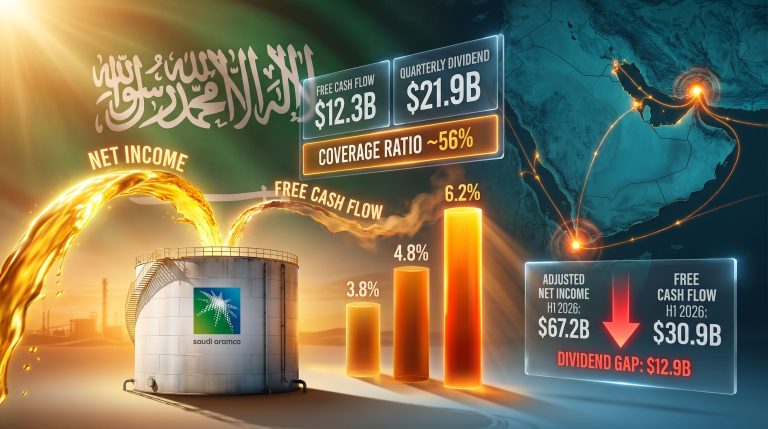
The $104.7 billion in adjusted net income provides substantial cash flow generation capability that supports both dividend payments and capital investment programmes. This cash flow level enables flexible capital allocation responses to changing market conditions.
Investment Priority Framework:
- Maintenance capital expenditure requirements for existing operations
- Growth project evaluation under various oil price scenarios
- Dividend sustainability assessment across commodity price cycles
- Balance sheet optimisation for financial flexibility maintenance
Return on Invested Capital Trends
ROIC analysis for energy companies requires adjustment for commodity price cyclicality and long-term asset investment characteristics. During crisis periods, ROIC metrics may temporarily reflect:
- Inventory valuation effects from rapid commodity price changes
- Capacity utilisation impacts from supply chain disruptions
- Geographic profit distribution variations due to regional market conditions
Long-term ROIC sustainability depends on operational efficiency improvements, technology deployment effectiveness, and strategic market positioning rather than short-term commodity price movements.
What Global Energy Transition Means for Traditional Oil Majors
The intersection of geopolitical supply disruptions and long-term energy transition strategies creates complex investment dynamics for traditional oil companies. The Saudi Aramco stock rally occurred within a broader context where energy security concerns compete with decarbonisation objectives.
ESG Investment Criteria and Energy Stocks
Environmental, social, and governance considerations significantly influence institutional investment flows into energy companies, creating tension between short-term supply security and long-term sustainability objectives.
Institutional Mandate Evolution:
Many large institutional investors face conflicting pressures during energy crises, where ESG commitments may limit energy sector allocation even as supply disruption creates attractive return opportunities. This dynamic affects:
- Pension fund allocation constraints based on ESG mandate requirements
- Sovereign wealth fund positioning balancing financial returns with policy objectives
- Asset manager responses to client ESG preferences versus performance expectations
Green Financing Availability:
Traditional energy companies increasingly seek financing for transition-related investments, but availability and cost of green financing options may be limited during periods of elevated geopolitical risk when traditional projects appear more profitable.
Renewable Energy Investment Integration
Energy majors face strategic decisions about renewable energy investment timing and scale, particularly during periods when traditional operations generate superior short-term returns. Key considerations include:
Technology Partnership Evaluation:
- Scale requirements for meaningful renewable energy market participation
- Geographic focus decisions balancing existing infrastructure with growth markets
- Timeline optimisation for transition investment deployment
Competitive Positioning Analysis:
Traditional oil majors compete with pure-play renewable energy companies that may have different cost of capital characteristics and growth expectations, requiring careful strategic positioning to maintain competitiveness across energy transition timelines.
The next major ASX story will hit our subscribers first
How Geopolitical Risk Assessment Shapes Valuation Models
Sophisticated investors employ complex risk assessment frameworks that incorporate multiple scenario probabilities when valuing energy assets during geopolitical uncertainty periods. The Saudi Aramco stock rally reflects these multifaceted valuation approaches.
Country Risk Premium Calculations
Regional risk assessment requires evaluation of multiple overlapping factors that influence long-term investment attractiveness:
Sovereign Risk Components:
- Political stability indicators and institutional strength measures
- Economic diversification levels and fiscal policy sustainability
- International relationship quality and diplomatic positioning
- Infrastructure security and protective capability assessment
Regional Stability Framework:
Middle Eastern energy investments require specialised risk assessment that considers:
- Conflict duration probability distributions based on historical precedent analysis
- Infrastructure vulnerability mapping for critical facilities and transportation routes
- International intervention likelihood and effectiveness expectations
- Alternative supply activation potential and timeline requirements
Currency Hedging Strategies for International Investors
International investors in Saudi energy assets face currency exposure that requires sophisticated hedging strategies, particularly during periods of elevated oil prices and regional uncertainty.
SAR Stability Factors:
The Saudi riyal's peg to the US dollar provides currency stability for dollar-based investors but creates different dynamics for euro, yen, and other currency-denominated portfolios. Hedging considerations include:
- Correlation patterns between oil prices and currency movements
- Central bank intervention potential during crisis periods
- Alternative currency exposure through revenue geographic diversification
How do investors model different conflict scenarios?
Professional investment management requires explicit scenario modelling that assigns probability weights to different conflict resolution timelines and outcomes.
Base Case Scenario (Higher Probability):
Gradual normalisation beginning by month-end with supply disruption compensation through strategic reserve releases. Oil prices declining to fundamental-driven levels around $70-71 per barrel for Brent crude by Q4 2026.
Bear Case Scenario (Lower Probability, Higher Impact):
Extended disruption lasting multiple quarters with meaningful infrastructure damage. Oil prices sustained above $100 per barrel with potential spikes to $150 or higher during peak disruption periods.
Bull Case Scenario (Moderate Probability):
Rapid conflict resolution with minimal lasting impact on supply infrastructure. Oil prices declining below $65 per barrel as markets overshoot fundamental equilibrium during normalisation.
Why Institutional Ownership Patterns Matter for Price Discovery
The structure of institutional ownership significantly influences how energy stocks respond to geopolitical events and how efficiently markets process information during crisis periods.
Sovereign Wealth Fund Investment Behaviour
Government ownership concentration in national oil companies creates unique market dynamics that differ from traditional publicly-traded energy companies:
Float Availability Considerations:
Limited publicly available shares can amplify price movements during periods of increased institutional interest, as limited supply meets elevated demand from investors seeking energy exposure during supply crises.
Strategic vs. Financial Investment Objectives:
Sovereign ownership may prioritise strategic national interests over short-term financial returns, creating information asymmetries where public investors must interpret government policy signals alongside traditional financial analysis.
International Fund Manager Positioning
Geographic allocation mandates and benchmark requirements create institutional demand patterns that may not reflect pure financial optimisation:
Benchmark Weighting Implications:
- MSCI inclusion effects on passive investment flows
- Sector allocation requirements for diversified institutional portfolios
- Geographic exposure mandates balancing regional diversification objectives
Currency Exposure Management:
International institutional investors must balance energy sector exposure with currency hedging costs and effectiveness, creating additional layers of complexity in position sizing decisions.
What Market Efficiency Theory Suggests About Current Valuations
The Saudi Aramco stock rally provides insights into market efficiency during information-rich crisis periods when multiple variables change simultaneously.
Information Asymmetry in Energy Markets
Energy markets exhibit unique information distribution characteristics where certain market participants may have privileged access to production data, government policy intentions, or infrastructure assessment information.
Production Data Access:
- Real-time supply information availability varies among market participants
- Reserve assessment quality differences between internal and external analysis
- Government policy insight advantages for certain institutional investors
Analyst Coverage Quality:
Energy sector analysis requires specialised technical expertise and geographic knowledge that may create coverage quality variations among research providers, potentially contributing to price discovery inefficiencies.
Behavioural Biases in Commodity-Linked Equity Pricing
The relationship between commodity prices and energy stock valuations reveals several behavioural bias patterns:
Anchoring Effects:
Investors may anchor expectations to recent peak oil prices ($119 per barrel on March 9) when evaluating energy stock fair value, potentially creating persistent overvaluation even as oil prices moderate.
Herding Behaviour Patterns:
Institutional investor movement into energy stocks during supply disruption periods may exhibit herding characteristics where investment decisions reflect peer positioning rather than independent fundamental analysis.
Overreaction vs. Underreaction Analysis:
The 12.72 percent rally despite 12.1 percent earnings decline suggests potential market overreaction to geopolitical catalysts, though this interpretation requires careful analysis of forward-looking earnings expectations rather than backward-looking performance metrics.
How Options Market Activity Reveals Investor Sentiment
Options market positioning provides additional insight into investor sentiment and expected volatility patterns during geopolitical uncertainty periods.
Implied Volatility Patterns
Energy sector options typically exhibit elevated implied volatility during geopolitical crises as investors seek portfolio protection and speculative positioning opportunities.
Volatility Surface Interpretation:
- Short-term volatility spikes reflect immediate event-driven uncertainty
- Longer-term volatility elevation suggests persistent uncertainty about conflict resolution timing
- Volatility smile patterns indicate investor assessment of tail risk probabilities
Hedging Strategy Implementation
Institutional investors employ various options strategies to manage energy sector exposure during volatile periods:
Portfolio Insurance Mechanisms:
- Protective put strategies for existing energy holdings
- Collar strategies balancing upside limitation with downside protection
- Volatility trading approaches capitalising on implied volatility elevation
Correlation Hedging Approaches:
Energy stock options may be used to hedge broader portfolio exposures to oil price movements, creating complex cross-market hedging relationships that influence options pricing dynamics.
During geopolitical crises, energy stocks often experience dual momentum from both supply-side fundamentals and risk-premium psychology. The Saudi Aramco stock rally exemplifies how investors simultaneously price operational excellence and regional uncertainty, creating opportunities for both value and momentum strategies.
Investment Psychology Comparison During Regional Conflicts:
| Conflict Period | Energy Sector Performance | Flight-to-Quality Assets | Recovery Timeline |
|---|---|---|---|
| Gulf War 1991 | +45% peak rally | Gold +8%, Bonds +12% | 6-8 months |
| Iraq War 2003 | +35% initial surge | USD strengthening | 4-6 months |
| Arab Spring 2011 | +28% volatility spike | Swiss Franc +15% | 8-12 months |
| Current Crisis 2026 | +13% YTD (ongoing) | Treasury yields declining | TBD |
The psychological complexity of energy investing during geopolitical uncertainty creates multiple opportunity sets for investors who understand the interaction between fundamental analysis, technical momentum, and behavioural finance principles. Furthermore, the Saudi Aramco stock rally demonstrates how sophisticated market participants navigate these dynamics whilst maintaining awareness of both short-term trading opportunities and long-term strategic positioning requirements.
Understanding these psychological frameworks provides crucial context for investment decision-making during volatile periods when traditional valuation models may provide incomplete guidance for portfolio construction and risk management strategies. Additionally, market participants must consider how supply chain vulnerabilities continue to influence pricing mechanisms throughout the energy sector.
Disclaimer: This analysis is for informational purposes only and should not be considered investment advice. Energy sector investments involve significant risks including commodity price volatility, geopolitical uncertainty, and regulatory changes. Past performance does not guarantee future results. Investors should conduct their own research and consult with qualified financial advisors before making investment decisions.
Looking for Energy Investment Opportunities During Market Volatility?
Discovery Alert's proprietary Discovery IQ model delivers real-time notifications on significant ASX mineral discoveries, including energy and commodity companies positioned to benefit from geopolitical supply disruptions. With markets experiencing heightened volatility and sector rotation into energy stocks, subscribers gain immediate access to actionable discoveries that could capitalise on current market dynamics. Begin your 14-day free trial today to stay ahead of market-moving announcements during these uncertain times.