May 19, 2026
The Quiet Crisis Underneath Mexico's Oil Ambitions
Global energy markets have entered a period defined by competing pressures: the accelerating energy transition on one side, and the stubborn reality of hydrocarbon dependency on the other. For emerging producers, this tension creates a narrow strategic window. Capital is mobile, patient money is scarce, and upstream investment decisions made today will determine production capacity for the next two to three decades. In this environment, countries that fail to create competitive, predictable investment frameworks do not simply miss an opportunity; they cede it permanently to jurisdictions that have done the work.
Mexico sits at the centre of this dynamic with enormous geological endowment, proximity to the world's largest energy market, and an investment story that should, on paper, be compelling. Yet the reality of investment in Mexico's oil sector tells a more complicated story, one where structural barriers, contractual misalignment, and institutional uncertainty have collectively suppressed capital deployment far below what the resource base warrants.
When big ASX news breaks, our subscribers know first
The FDI Illusion: Why Record Numbers Can Mask a Structural Problem
At first glance, Mexico's foreign direct investment figures appear robust. However, understanding what those numbers actually represent is critical for any serious assessment of the sector's capital dynamics. According to analysis of current FDI composition, approximately 67% of inflows consist of reinvested profits rather than genuinely new capital entering the country. This distinction matters enormously.
Reinvested profits indicate that established operators are maintaining their existing positions rather than committing fresh capital to new exploration and development programmes. It is a signal of capital retention, not capital attraction, and the difference between these two phenomena is the difference between a sector sustaining itself and a sector growing. In a period where Mexico needs transformative upstream investment to reverse production decline trends, the nuance embedded within headline FDI figures is not a minor technical footnote; it is the central story.
Compounding this picture is the ongoing uncertainty surrounding the renegotiation of the United States-Mexico-Canada Agreement (USMCA). For multinational corporations evaluating long-duration capital commitments, trade policy instability creates a fundamental problem: the risk-adjusted returns on new-money investments cannot be reliably modelled when the regulatory and commercial framework governing cross-border commerce remains in flux. Furthermore, the broader US-China trade war impacts on global capital flows are compressing available risk appetite across emerging markets simultaneously. This dynamic is suppressing new capital commitments across multiple industries, and the hydrocarbons sector is no exception.
The broader macroeconomic backdrop amplifies these concerns. A 0.8% contraction in GDP during Q1, driven substantially by weak investment in physical and public infrastructure, reduces the government's fiscal capacity to fund complementary state-led development programmes. When public spending capacity contracts, the dependency on private capital deepens, yet the conditions for attracting that capital have not yet been adequately reformed.
The Investment Gap: US$60 Billion in Deployed Capital Still Missing
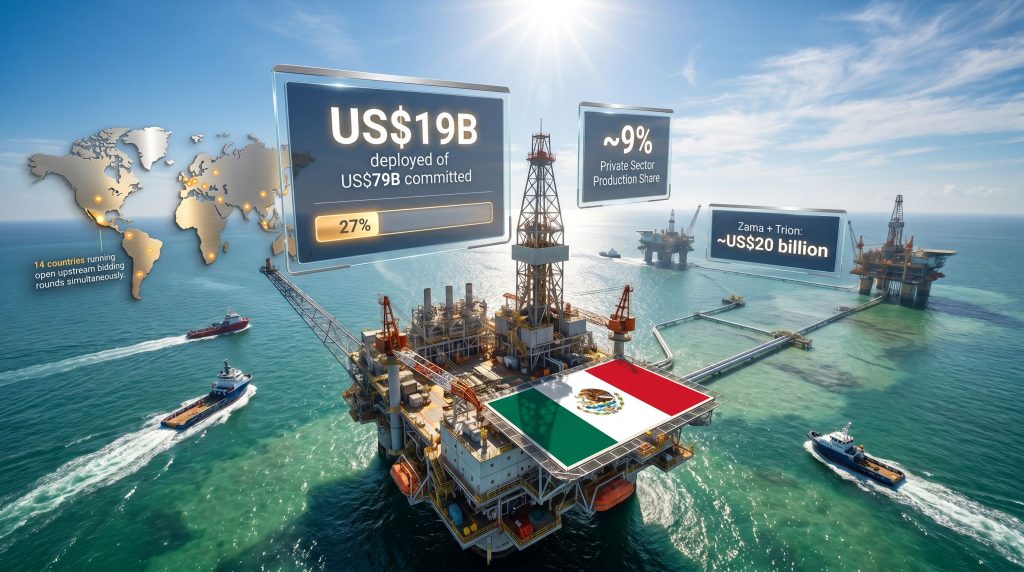
The most telling single statistic in Mexico's upstream story is the gap between commitment and execution. According to data from Mexico's National Hydrocarbons Commission (CNH), which has since been dissolved, only US$19 billion of a total committed upstream investment of US$79 billion had actually been deployed as of the most recent reporting period. That represents approximately 27 cents of every committed dollar reaching the ground.
This is not primarily a story about capital unavailability. The commitments were made; the capital existed. What prevented deployment was a combination of structural barriers, commercially unviable exploration block conditions, and contractual frameworks that operators ultimately found incompatible with investment logic. Consequently, exploration blocks were cancelled not because operators lacked capital but because the economics, risk structures, and regulatory conditions did not support deployment.
Key Projects in the Pipeline: Zama, Trion, and the Offshore Horizon
Mexico's most prominent active upstream projects provide some context for the scale of the challenge. The Zama and Trion deepwater developments together represent an estimated combined investment of approximately US$20 billion, making them genuinely significant capital commitments by any standard. Yet even accounting for both projects in full, they represent only a partial response to the sector's total capital deficit.
The offshore development pipeline extends well beyond these flagship assets. The Nobilis-Maximino discovery represents a deepwater opportunity potentially larger in investment terms than Trion, yet critical development decisions on this asset have been deferred. Every year of delayed decision-making on high-value offshore resources represents both foregone production and foregone exploration knowledge that would otherwise inform adjacent development decisions.
Equally concerning is the state of offshore exploration activity more broadly. No meaningful investment in seismic survey work has been made across Mexico's offshore territory in years. Seismic data acquisition is the foundational prerequisite for any serious offshore exploration programme; without it, operators cannot identify drillable prospects, and without prospects, there is nothing to bid on. This exploration backlog is not self-correcting and will require deliberate, sustained investment to address. For a broader crude oil price analysis that contextualises how these delays affect global supply expectations, the macro-level implications are increasingly difficult to ignore.
The Shale Arithmetic: A Capital Requirement Unlike Any Other
Mexico's unconventional resource base, particularly its shale formations in the northeast of the country, represents a theoretically transformative development opportunity. However, the capital mathematics of shale development at commercial scale are sobering:
| Metric | Estimate |
|---|---|
| Minimum wells required annually for commercial viability | 3,000 |
| Conservative cost per well | US$15 million |
| Implied annual capital requirement | US$45 billion |
| Current private sector share of oil production | ~9% |
Shale development is not a project-level funding challenge. It is a systemic financing requirement that demands a fundamentally different contractual architecture, regulatory clarity, and sustained investor confidence over decades, not years.
At US$45 billion annually, the capital intensity of meaningful unconventional development dwarfs current deployment levels by an order of magnitude. For context, total committed upstream investment across all of Mexico currently stands at US$79 billion, a figure accumulated over multiple years and only 27% deployed. Unlocking shale at commercial scale requires not just incremental policy adjustment but a wholesale reimagining of how Mexico structures its upstream investment environment.
Government Positioning: An Ideological Recalibration Under Way
One of the more significant shifts in Mexico's energy policy landscape is the current administration's acknowledgment that private capital is not merely tolerable but necessary. This marks a departure from the previous administration's posture, which leaned more heavily on state-led development as both an economic and ideological priority.
The current approach attempts to balance two competing imperatives: the principle of energy sovereignty, which remains a deeply held institutional value, and the operational pragmatism of recognising that PEMEX alone cannot finance the sector's development requirements. This balancing act shapes every policy decision, from contract model design to the pace of regulatory reform.
Fracking Regulation: From Moratorium to Scientific Review
The establishment of a scientific committee to evaluate hydraulic fracturing methodologies represents a meaningful shift in Mexico's approach to unconventional resource development. Previously prohibited outright, fracking is now subject to a structured technical review process, with findings expected in the coming months.
The anticipated outcome is a conditional approval pathway, with environmental protection and community consultation requirements embedded as preconditions. While this direction is constructive, the critical variable is the speed and specificity of the regulatory framework that follows. A positive scientific committee finding means little if the subsequent rule-making process takes years to complete or produces regulations so ambiguous that compliance costs become prohibitive.
Investors in unconventional development need clarity on well spacing regulations, water management requirements, community consultation processes, and fiscal treatment before they can construct reliable project economics. The gap between policy intent and regulatory specificity is precisely where investment decisions stall.
Mixed Contracts: Structurally Limited Appetite from International Operators
PEMEX's mixed contract model has produced 10 contract awards to date, predominantly with domestic operators. International oil companies, which bring the technical expertise, execution capability, and capital scale that Mexico's upstream development requires, have shown limited interest in the current contract structures.
The reasons are structural rather than situational. Mixed contracts as currently designed require operators to assume full execution risk while sharing a minimum 40% of project upside with PEMEX. For experienced international operators accustomed to balanced risk-reward frameworks, this structure fundamentally misaligns incentives. The operator absorbs all downside exposure while surrendering a substantial portion of the upside that would otherwise justify bearing that risk. According to investment opportunities in Mexico's oil industry, this asymmetry is consistently cited as the primary deterrent by major international operators evaluating entry into the Mexican market.
Structural Barriers: The Five Reasons Capital Stays Away
Understanding why investment in Mexico's oil sector consistently underperforms its potential requires a clear-eyed examination of the structural barriers that international capital encounters. Furthermore, the compounding effect of shifting tariffs and supply chains at the global level makes the domestic reform agenda even more urgent:
-
Legal and institutional certainty – Changes resulting from judicial reform have measurably altered the risk calculus for long-duration investments. Communications from government officials cannot substitute for concrete structural improvements to the institutional framework. Projects with 20 to 30-year productive horizons require regulatory stability across political cycles, not reassurances tied to specific administrations.
-
Uncompetitive contract risk allocation – The 60/40 economic split in PEMEX mixed contracts, combined with 100% execution risk borne by the operator, creates a framework that most international operators find commercially unattractive when compared to what other jurisdictions offer.
-
Global competition for upstream capital – At any given time, there are currently open upstream bidding rounds in at least 14 countries simultaneously. Mexico is not competing against a static baseline; it is competing against jurisdictions that are actively optimising their frameworks to attract the same pool of global exploration and production capital.
-
Fiscal architecture misaligned with project economics – The current tax burden framework (DPB) prioritises government take over operator cost recovery. This structure increases project-level cost of capital and compresses the returns available to investors during the critical early phases of field development.
-
Regulatory ambiguity as a risk premium driver – Unclear compliance requirements, undefined obligations, and the influence of political considerations on technical regulatory decisions all add a layer of unpredictability that investors price into their required returns, effectively raising the bar for project approval.
How Mexico Compares to Peer Markets
The most instructive way to assess Mexico's investment climate is through comparison with frameworks that have successfully attracted upstream capital at scale:
| Dimension | Mexico (Current) | US Model | Argentina (Vaca Muerta) | Brazil (Petrobras) |
|---|---|---|---|---|
| Contract Duration | Fixed term | Until commercially viable | Flexible / incentive-linked | Long-term concession |
| Risk Allocation | Operator-heavy | Balanced | Balanced | Shared |
| Cost Recovery Priority | Low (DPB-first) | High | High | High |
| Bidding Round Activity | Limited | Active | Active | Active |
| Private Sector Production Share | ~9% | Dominant | Growing rapidly | Mixed (NOC + private) |
The US upstream model's most instructive feature is contract duration. Fields remain under contract until they are no longer commercially viable, aligning the operator's contractual rights with the productive life of the asset. This eliminates the risk of losing contractual position mid-field life and allows operators to make economically rational investment decisions across the full production cycle.
Argentina's Vaca Muerta development offers perhaps the most directly applicable lesson for Mexico's shale ambitions. Through a combination of targeted fiscal incentives, stable regulatory frameworks, and competitive risk-sharing arrangements, Argentina transformed investor sentiment toward an unconventional play that initially attracted significant scepticism. The policy instruments that achieved this transformation are well-documented and transfer directly to comparable Latin American contexts.
Brazil's Petrobras provides an operational efficiency benchmark, particularly relevant given PEMEX's structural similarities as a national oil company. However, industry analysts note that meaningful knowledge transfer from Petrobras to PEMEX is contingent on PEMEX demonstrating genuine willingness to implement structural operational reforms, not merely symbolic gestures toward modernisation.
The next major ASX story will hit our subscribers first
Frequently Asked Questions: Investment in Mexico's Oil Sector
How much capital does Mexico's upstream sector actually need?
The figures are substantial. The undeployed committed capital alone stands at more than US$60 billion, representing the gap between the US$79 billion committed and the US$19 billion deployed. Add the estimated US$45 billion annually required for shale development at commercial scale and the total investment requirement becomes a multi-decade financing challenge that dwarfs anything PEMEX can deliver independently.
Why have international oil companies been reluctant to invest?
The combination of asymmetric risk allocation, legal uncertainty stemming from institutional reforms, uncompetitive fiscal terms, and active competition from more than 14 jurisdictions running simultaneous bidding rounds creates a formidable set of disincentives. International operators have viable alternatives and will continue to deploy capital where the risk-reward framework is most attractive. In addition, an oil price rally in global markets does not automatically translate into increased upstream commitment where structural deterrents remain unaddressed.
What is the current status of fracking regulation in Mexico?
A scientific committee has been established to evaluate current hydraulic fracturing methodologies, with results expected within months. A conditional approval pathway is the anticipated outcome, with environmental and community protection requirements embedded as preconditions. The key risk is the pace and specificity of the regulatory framework that follows any positive recommendation.
What does PEMEX's own investment plan look like?
PEMEX's 2025 to 2030 strategic plan includes 18 new oil and gas fields, 15 offshore platforms, and 14 pipelines totalling 175 kilometres, alongside refinery modernisation initiatives. This represents a meaningful commitment but cannot alone close the structural investment gap that decades of underinvestment and contractual deterrents have created. For further context on sector needs, Mexico's oil and gas sector continues to require long-term certainty to drive the scale of investment required.
What are the primary risks for investors today?
Key risks include permitting delays, delayed payment obligations from PEMEX, local content requirements, regulatory uncertainty across both fiscal and operational dimensions, and in certain operational environments, security considerations. The overarching risk remains institutional unpredictability for investments with productive lives extending across multiple political cycles.
Three Scenarios for Mexico's Upstream Future
The trajectory of investment in Mexico's oil sector over the next decade will be shaped by the pace and depth of structural reform. Three distinct scenarios emerge from the current evidence base:
Scenario A: Reform Accelerates
Bidding rounds resume within 12 to 18 months, contract models are restructured to distribute risk more equitably, and fracking regulations are finalised with sufficient specificity to enable project-level investment decisions. International operators re-engage; the private sector's production share grows from 9% toward 20 to 25%. Mexico begins capturing a meaningful proportion of the global upstream capital currently allocated across 14-plus competing jurisdictions.
Scenario B: Incremental Adjustment
Mixed contracts are modestly improved but retain their structural asymmetry. Fracking regulations are delayed or emerge with excessive ambiguity. Investment continues at its current pace, the deployment gap widens further, and Mexico's upstream potential remains substantially unrealised through the current decade.
Scenario C: Policy Stagnation
Institutional uncertainty persists, international operators continue to deprioritise Mexico in their capital allocation decisions, and PEMEX-centred spending sustains baseline production without meaningfully developing unconventional or deepwater resources. Energy sovereignty is achieved in institutional terms without the production capacity required to make it economically meaningful. Consequently, an oil price crash scenario would further erode the fiscal foundation needed to sustain even state-led development programmes.
Mexico's challenge is not geological. The resource base is world-class. The gap between what the geology promises and what current production delivers is structural, regulatory, and institutional in nature. Closing it requires deliberate sequenced reform, not incremental adjustment at the margins.
The reform agenda is clear, even if the political will to execute it remains uncertain. Five levers would move the needle materially: restoring legal and institutional certainty through concrete structural actions rather than communications; redesigning contract models to distribute risk equitably; resuming competitive bidding rounds; rebalancing the fiscal framework to prioritise cost recovery; and accelerating specific rule-making for unconventional development and offshore exploration. Mexico possesses everything needed to become a leading destination for upstream capital. The distance between potential and performance is a policy choice, and policy choices can be changed.
Want to Track the Next Major Resource Discovery Before the Market Does?
Discovery Alert's proprietary Discovery IQ model delivers real-time ASX alerts the moment significant mineral discoveries are announced, translating complex resource data into clear, actionable insights for both short-term traders and long-term investors — begin your 14-day free trial today, and explore historic discovery returns to understand just how transformative early positioning in major resource finds can be.