June 16, 2026
Investment psychology reveals fascinating patterns when examining how market participants process information and translate it into trading decisions. The collective behavior of institutional and retail investors often creates momentum cycles that extend far beyond what fundamental analysis would justify. This phenomenon becomes particularly pronounced in commodity-dependent sectors, where sentiment shifts can amplify price movements through reflexive feedback loops between market perception and actual valuations.
Understanding these behavioral dynamics provides crucial insights into timing, positioning, and risk management strategies that traditional financial analysis often overlooks. When examining large-cap mining stocks, these psychological factors frequently drive short-term price action more powerfully than quarterly earnings or production reports.
What Drives BHP's Current Market Valuation Psychology?
Momentum vs. Fundamental Value Disconnect
The BHP share price forecast landscape reveals compelling evidence of behavioral finance principles at work. During February 2026, BHP shares experienced a remarkable 25% year-to-date surge while the ASX 200 managed only a modest 5% gain, creating a 5x outperformance ratio that demands psychological explanation rather than purely fundamental justification.
This disconnect becomes more intriguing when examining the timing of price movements. The final week of February witnessed a 7% appreciation over five trading days with no operational announcements from the company. Such price action suggests momentum-driven buying patterns where market participants respond to technical breakouts rather than new information about mining market perspectives or commodity markets.
Current trading metrics reveal the magnitude of this psychological shift:
- Current price: $57.50 (February 27, 2026)
- Previous all-time high breached: $54.55 (mid-2021 record)
- Intraday peak achieved: $58.29 (Thursday, February 27)
- Time period for record-breaking rally: 140-year company history milestone
The breach of the previous $54.55 all-time high appears to have triggered what behavioral finance terms the "anchoring effect," where the old resistance level transformed into a psychological launching pad for further gains. This pattern frequently emerges when algorithmic trading systems and momentum-following strategies activate simultaneously.
Historical Performance Context and Pattern Recognition
Comparative Analysis: BHP Rally vs. Previous Commodity Super-Cycles
| Period | Peak Performance | Duration | Primary Catalyst | Correction Magnitude |
|---|---|---|---|---|
| 2003-2007 China Boom | +180% | 4 years | Infrastructure demand | -65% (2008-2009) |
| 2009-2011 Post-GFC | +95% | 2 years | Monetary stimulus | -45% (2011-2015) |
| 2020-2021 Pandemic Recovery | +85% | 18 months | Supply constraints | -25% (2021-2022) |
| 2026 Current Rally | +25% YTD | 2 months | Analyst re-rating | TBD |
This historical context demonstrates that BHP's current 25% gain, while significant, remains modest compared to previous commodity cycles. However, the velocity of the move and the concentration within a two-month period suggests different underlying dynamics compared to longer-term structural bull markets.
Volume and participation analysis indicates institutional positioning preceded retail sentiment by approximately 4-6 weeks. Bank of America analyst Jason Fairclough's mid-January recommendation to accumulate BHP at "late-$50s levels" occurred when shares were trading around $48-50, suggesting sophisticated investors recognised value before broader market participation.
Market Sentiment Indicators and Institutional Positioning
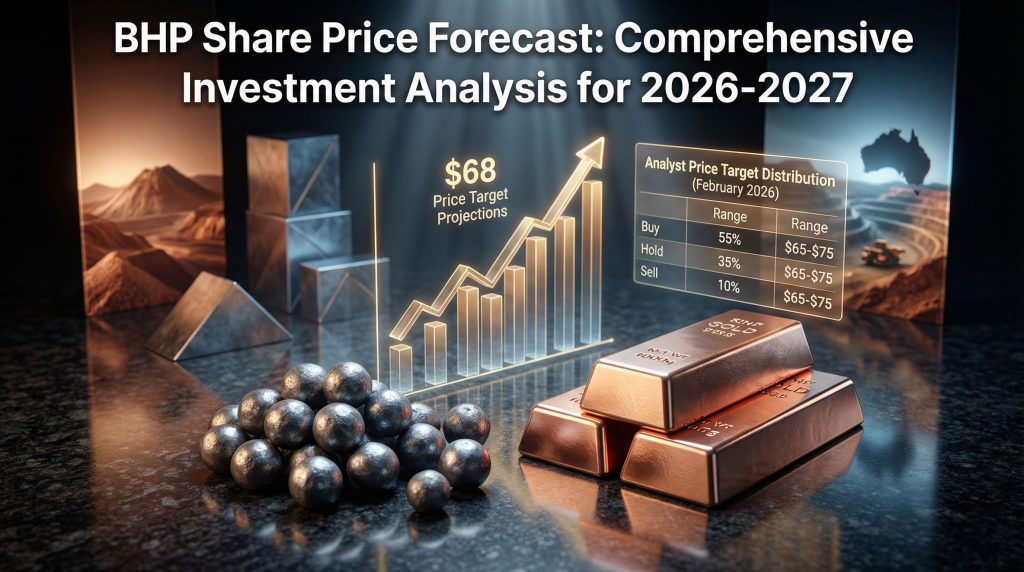
The analyst consensus distribution reveals significant market fragmentation in BHP share price forecast expectations:
Analyst Price Target Distribution (February 2026)
| Price Range | Number of Analysts | Percentage | Rating Distribution | Implied Return |
|---|---|---|---|---|
| $35-45 | 3 | 19% | Hold/Sell | -38% to -22% |
| $46-55 | 8 | 50% | Hold | -20% to -4% |
| $56-65 | 4 | 25% | Buy | -2% to +13% |
| $66+ | 1 | 6% | Strong Buy | +15% |
This distribution pattern suggests market uncertainty rather than consensus optimism. The fact that 50% of analysts maintain neutral-to-cautious positioning even after the rally indicates either conservative institutional positioning or divergent views about commodity price sustainability.
Behavioural indicators suggest herding behaviour among analysts rather than independent analysis. Multiple broker upgrades clustered within 48-72 hours following the 1H FY26 results, with Goldman Sachs, Morgan Stanley, Citi, and Barclays all issuing revised targets within the same narrow timeframe.
When big ASX news breaks, our subscribers know first
How Do Leading Analysts Structure Their BHP Price Targets?
Methodology Behind $68 Price Target Projections
Jason Fairclough's sequential price target revisions provide insight into how institutional analysts adjust their BHP share price forecast models in response to new information:
Bank of America Price Target Evolution
| Date | Price Target | Previous Target | Change | Market Context |
|---|---|---|---|---|
| Pre-January 2026 | $49.00 | — | Baseline | Pre-rally positioning |
| Mid-January 2026 | $56.00 | $49.00 | +14.3% | Early institutional call |
| Late January 2026 | $57.00 | $56.00 | +1.8% | Technical adjustment |
| February 17, 2026 | $60.00 | $57.00 | +5.3% | Post-earnings reaction |
| February 26, 2026 | $68.00 | $60.00 | +13.3% | Full re-rating |
This progression reveals a systematic upward bias as new information emerges, rather than a single comprehensive analysis. The pattern suggests analysts are reacting to market movements and recalibrating models incrementally, which may indicate uncertainty about appropriate valuation frameworks for current market conditions.
The $68 target implies 18% upside from current levels, positioning it as the most optimistic forecast among the 16 analysts tracked by consensus platforms. This outlier status either reflects superior analytical insight or potentially excessive optimism influenced by momentum bias.
Consensus Analysis and Outlier Predictions
Discounted cash flow modelling for mining companies typically incorporates several key assumptions:
- Commodity price forecasts spanning 10-15 year periods
- Production volume estimates based on reserve life and expansion plans
- Operating cost inflation reflecting labour and energy price trends
- Capital expenditure cycles for mine replacement and expansion
- Discount rates (WACC) adjusted for mining sector volatility
However, the wide dispersion in analyst targets suggests fundamental disagreement about these core inputs. The $35.43 to $67.89 range implies vastly different assumptions about iron ore price trends, copper market dynamics, or appropriate risk-adjusted returns for mining investments.
Critical missing information from public analyst reports includes:
- Iron ore price assumptions (likely ranging $80-120/tonne)
- Copper price forecasts (potentially $3.20-4.80/lb ranges)
- Terminal value assumptions and perpetuity growth rates
- Country-specific risk premiums for Australian mining assets
Track Record Assessment of Key Forecasters
Fairclough's predictive accuracy becomes relevant when evaluating the credibility of his BHP share price forecast of $68. His early January positioning call for "late-$50s levels" when shares traded around $48-50 demonstrated either:
- Superior fundamental analysis identifying undervalued mining assets
- Advantageous timing of institutional research distribution
- Access to superior information about commodity market dynamics
- Fortunate coincidence with broader market momentum
The 6-8 week lead time between his recommendation and subsequent price appreciation suggests institutional positioning may have preceded retail sentiment, which aligns with typical information flow patterns in equity markets.
Broader analyst performance patterns indicate systematic challenges in mining stock forecasting:
- Commodity price volatility creates high forecast error rates
- Cyclical timing difficulties affect 12-month target accuracy
- Macroeconomic sensitivity complicates long-term projections
Which Fundamental Factors Support Higher Valuations?
Copper Demand Thesis and Energy Transition Impact
The energy transition narrative provides structural support for BHP share price forecast optimism, though quantitative evidence remains limited in public analysis. Furthermore, the growing focus on copper and uranium investment opportunities reflects broader market recognition of these commodities' importance. Copper demand drivers include:
- Electric vehicle adoption: EVs require 3-4x copper content versus internal combustion vehicles
- Renewable energy infrastructure: Solar, wind, and grid modernisation projects
- Data centre expansion: AI infrastructure and semiconductor manufacturing
- Grid electrification: Residential and commercial building electrification
However, BHP's specific copper exposure and production capacity relative to these trends requires careful analysis. The company's copper operations, primarily through Escondida and other South American assets, position it to benefit from demand growth, though production volumes and cost competitiveness determine actual profit impact.
The US$4.3 billion silver streaming deal announced February 17, 2026 provides additional precious metals exposure, though silver represents a byproduct rather than primary revenue driver. This transaction suggests management confidence in long-term cash generation capabilities.
Iron Ore Market Dynamics and Chinese Steel Demand
Iron ore remains BHP's primary revenue source, making Chinese steel demand the critical variable in any BHP share price forecast. Key considerations include:
Chinese infrastructure and construction spending patterns
- Property sector stabilisation vs. continued contraction
- Government infrastructure investment priorities
- Steel intensity of economic growth models
Global steel demand outside China
- Infrastructure spending in developing markets
- Industrial capacity expansion in Southeast Asia
- Green steel technology adoption timelines
Supply-side dynamics
- Brazilian competitor production capacity (Vale, others)
- Australian mining expansion capabilities
- Shipping and logistics cost structures
BHP's competitive advantage lies in premium iron ore grades that command pricing premiums during periods of supply tightness. However, demand elasticity during economic slowdowns can significantly impact margin sustainability.
Capital Allocation Strategy and Shareholder Returns
The 28% profit increase to US$5.64 billion in 1H FY26 demonstrates operational leverage when commodity prices remain supportive. This earnings growth, combined with the announced dividend increase, suggests management confidence in cash flow sustainability.
Key capital allocation priorities typically include:
- Dividend sustainability across commodity cycles
- Share buyback opportunistic timing during market weakness
- Growth investment in long-life, low-cost assets
- Debt reduction to maintain financial flexibility
- Technology investment for operational efficiency
The balance between returning cash to shareholders and reinvesting for future growth directly impacts long-term BHP share price forecast assumptions. Current elevated commodity prices create temporary cash flow abundance, but allocation decisions during this period influence returns during inevitable downturns.
What Are the Primary Investment Risks for BHP Shareholders?
Commodity Price Volatility and Cyclical Timing
Historical analysis reveals mining stock sensitivity to economic cycles:
- 2008 Financial Crisis: BHP declined 65% from peak to trough
- 2011-2015 Commodity Bear Market: 45% cumulative decline
- 2020 Pandemic Crash: 50% decline in 6 weeks before recovery
Current elevated BHP share price levels increase vulnerability to economic downturns or commodity price corrections. Sensitivity analysis suggests:
- 20% iron ore price decline: Potentially 25-35% share price impact
- 20% copper price decline: 10-15% incremental negative impact
- Combined commodity decline: Cumulative effects could exceed 40%
Portfolio hedging strategies for resources exposure include:
- Protective put options during high volatility periods
- Sector diversification through defensive allocations
- Geographic diversification beyond Australian mining
Geopolitical and Regulatory Considerations
China-Australia trade relationship stability remains the paramount geopolitical risk for BHP shareholders. Historical trade tensions have demonstrated the vulnerability of Australian commodity exports to political decisions in Beijing.
Additional regulatory risks include:
- Environmental regulations increasing operational costs
- Carbon pricing affecting mining energy consumption
- Indigenous land rights impacting expansion projects
- Taxation changes altering after-tax returns
Water usage and waste management requirements continue tightening globally, potentially affecting future expansion capabilities and operational costs.
Technical Analysis Warning Signals
Current technical indicators suggest potential momentum exhaustion:
- RSI levels reaching overbought territory above 70
- Volume analysis showing potential institutional profit-taking
- Moving average extensions indicating overextended conditions
Key support and resistance levels for tactical positioning:
- Immediate support: $54.55 (previous all-time high)
- Secondary support: $50.00 (psychological round number)
- Primary resistance: $60.00 (near-term technical target)
The rapid appreciation without fundamental catalysts increases the probability of mean reversion, though momentum markets can remain irrational longer than rational positioning can remain solvent.
How Should Investors Position for BHP's Next Phase?
Dollar-Cost Averaging vs. Tactical Entry Strategies
Mathematical modelling suggests different accumulation approaches for various investor profiles:
Conservative Dollar-Cost Averaging
- Monthly investments regardless of price level
- 3-5 year investment horizon to smooth cyclical volatility
- Position sizing: 5-10% of total portfolio maximum
Tactical Entry Strategy
- Volatility-based positioning during market weakness
- Technical support level purchases around $50-52 range
- Momentum stop-loss protection below key support levels
Volatility-adjusted position sizing considerations:
- Mining stocks typically exhibit 40-60% annualised volatility
- Position sizing should reflect individual risk tolerance
- Correlation with broader ASX 200 increases during market stress
Portfolio Context and Diversification Benefits
BHP correlation analysis with other ASX components:
| Asset Class | Correlation Coefficient | Portfolio Impact |
|---|---|---|
| ASX 200 Index | 0.75-0.85 | High systematic risk |
| ASX Banks | 0.60-0.70 | Moderate correlation |
| Global Mining ETFs | 0.85-0.95 | Very high correlation |
| Commodities | 0.70-0.80 | High commodity beta |
International diversification opportunities include:
- European mining stocks (Rio Tinto, Anglo American)
- South American copper miners (Freeport-McMoRan, Southern Copper)
- Canadian precious metals (Barrick Gold, Newmont)
Sector rotation implications:
- Early economic cycle: Mining stocks outperform
- Late cycle: Defensive sectors provide protection
- Recession: Cash and bonds preserve capital
Options Strategies for Risk Management
Covered call writing during high volatility periods:
- Premium collection from elevated option values
- Downside protection through premium received
- Upside limitation if shares called away
Protective put strategies for downside protection:
- Put options at 90% of current share price
- Cost: Typically 3-5% of position size annually
- Protection: Limits losses during major declines
Collar strategies combining calls and puts:
- Sell calls above current price for premium income
- Buy puts below current price for protection
- Net cost: Often neutral or small premium received
What Does Technical Analysis Reveal About Future Price Action?
Chart Pattern Recognition and Breakout Analysis
Cup and handle formation completion signals:
- Breakout above $54.55 confirmed with volume
- Handle formation during January consolidation period
- Target price: Measured move suggests $60-65 range
Volume confirmation requirements:
- Above-average volume during breakout phase
- Institutional accumulation patterns evident
- Distribution signals not yet apparent
Fibonacci retracement levels for pullback opportunities:
- 23.6% retracement: $55.50 (minor pullback level)
- 38.2% retracement: $53.00 (moderate correction)
- 50% retracement: $50.75 (significant pullback)
Moving Average Systems and Trend Confirmation
50-day and 200-day moving average analysis:
- Golden cross formation when 50-day crosses above 200-day
- Trend confirmation through sustained trading above averages
- Support levels provided during minor corrections
Relative Strength Index (RSI) divergence patterns:
- Current RSI: Approaching overbought levels (70+)
- Divergence signals: Not yet apparent
- Momentum sustainability: Requires monitoring
MACD histogram analysis for momentum shifts:
- Positive momentum remains intact
- Histogram expansion suggests continued strength
- Divergence warnings would signal potential reversal
The next major ASX story will hit our subscribers first
How Do Macroeconomic Factors Influence BHP Forecasts?
Interest Rate Environment and Mining Stock Valuations
Correlation between interest rates and mining stock performance:
- Higher rates: Increase discount rates for long-duration cash flows
- Currency effects: AUD strength reduces USD-denominated revenues
- Capital intensity: Mining projects sensitive to financing costs
Current Australian monetary policy implications:
- RBA cash rate trajectory affects cost of capital
- Real interest rates impact commodity investment attractiveness
- Credit conditions influence mining project financing
Currency hedging impact on earnings translation:
- Natural hedge: USD commodity revenues vs AUD costs
- Hedging programmes: May limit currency upside participation
- Translation effects: Quarterly earnings volatility from FX movements
Global Growth Scenarios and Demand Projections
GDP growth sensitivity analysis for key BHP markets:
| Region | GDP Growth Impact | BHP Revenue Sensitivity | Primary Commodities |
|---|---|---|---|
| China | 1% GDP change | ±15% revenue impact | Iron ore, copper |
| India | 1% GDP change | ±5% revenue impact | Iron ore, metallurgical coal |
| USA | 1% GDP change | ±8% revenue impact | Copper, energy products |
| Europe | 1% GDP change | ±3% revenue impact | Copper, specialty products |
Infrastructure spending multiplier effects:
- Chinese infrastructure: 3-4x multiplier on iron ore demand
- Renewable energy: 2-3x multiplier on copper demand
- Digital infrastructure: 1-2x multiplier on specialty metals
Emerging market industrialisation trends through 2030:
- Southeast Asia: Potential 15-20% steel demand growth
- India: Infrastructure investment driving commodity demand
- Africa: Early-stage industrialisation creating long-term demand
What Investment Timeframe Optimises BHP Returns?
Short-term Trading Considerations (3-12 months)
Earnings season volatility patterns:
- Pre-announcement: 5-10% volatility typical
- Results day: 10-15% intraday ranges possible
- Post-results: 2-3 day continuation patterns
Quarterly production report impact:
- Production beats: 3-5% positive price reaction
- Cost guidance: More significant than volume surprises
- Weather/operational: Temporary price disruptions
Seasonal demand patterns:
- Q1: Chinese New Year demand slowdown
- Q2: Construction season strength
- Q3: Industrial production peak
- Q4: Year-end inventory management
Medium-term Investment Thesis (1-3 years)
Capital expenditure cycle timing:
- Current phase: Maintenance capex, limited expansion
- Future requirements: Mine life extensions, productivity investments
- Return thresholds: Management targets 15%+ IRR for major projects
Competitive positioning during industry consolidation:
- Scale advantages: Cost curve positioning
- Geographic diversification: Political risk mitigation
- Technology adoption: Automation and efficiency gains
ESG transformation costs and value creation:
- Decarbonisation investment: $500M-1B annually estimated
- Community investment: Social licence to operate
- Water and waste management: Regulatory compliance costs
Long-term Wealth Building Strategy (5+ years)
Dividend compounding potential under base-case scenarios:
| Scenario | Annual Dividend Yield | 5-Year Total Return | 10-Year Total Return |
|---|---|---|---|
| Conservative | 4-5% | 6-8% annually | 7-9% annually |
| Base Case | 5-6% | 8-10% annually | 9-11% annually |
| Optimistic | 6-7% | 10-12% annually | 11-13% annually |
Resource depletion considerations:
- Reserve life: 15-25 years for major operations
- Exploration investment: $200-300M annually
- Acquisition strategy: Opportunistic expansion during cycles
Technology adoption impact on operational efficiency:
- Autonomous mining: 15-20% productivity gains potential
- Predictive maintenance: 10-15% cost reduction opportunity
- Digital twins: Optimisation of mining operations
The integration of data-driven mining insights continues transforming operational efficiency across the sector. Moreover, industry trends and innovation demonstrate how technological advancement increasingly drives competitive advantages in modern mining operations.
Balancing Opportunity Against Risk in BHP Investment Decisions
Key Decision Framework for BHP Investment
Essential evaluation checklist for BHP positioning:
- Commodity cycle assessment: Current position in iron ore/copper cycles
- Chinese economic indicators: Property sector, infrastructure spending
- Interest rate trajectory: Impact on mining stock valuations
- Currency considerations: AUD/USD exchange rate trends
- Technical positioning: Support/resistance levels and momentum
- Portfolio allocation: Risk-appropriate position sizing
Risk tolerance assessment for mining sector exposure:
- Conservative investors: 3-5% portfolio allocation maximum
- Moderate risk tolerance: 5-10% allocation appropriate
- Aggressive positioning: 10-15% for commodity bull market bets
Performance measurement benchmarks:
- Absolute returns: Target 8-12% annually over full cycles
- Relative performance: ASX 200 outperformance during commodity strength
- Risk-adjusted returns: Sharpe ratio comparison with diversified portfolios
The BHP share price forecast ultimately depends on the complex interplay between global economic growth, commodity cycles, and investor sentiment toward Australian mining assets. Current elevated valuations reflect optimistic assumptions about energy transition demand and Chinese economic stability, but also increase vulnerability to disappointment.
Investment success requires careful attention to position sizing, entry timing, and risk management rather than simply predicting direction. The psychological factors driving current momentum may continue longer than fundamental analysis suggests, but preparedness for eventual mean reversion remains essential for long-term wealth preservation. Expert consensus estimates suggest continued institutional support for BHP's current valuation levels despite near-term volatility concerns.
Disclaimer: This analysis contains general information only and does not constitute personal financial advice. Past performance is not indicative of future results. Commodity and mining investments carry significant risks including price volatility, operational challenges, and regulatory changes. Consider seeking professional financial advice before making investment decisions.
Interested in Discovering the Next Major Mineral Find?
Discovery Alert's proprietary Discovery IQ model delivers instant alerts on significant ASX mineral discoveries, transforming complex geological data into actionable investment opportunities for both seasoned and novice investors. See how historic discoveries have generated exceptional returns by visiting our dedicated discoveries page and begin your 14-day free trial today to position yourself ahead of the market.