
July 14, 2026
Investment Strategy Revolution: Precious Metals Market Transformation Beyond Traditional Cycles
The global investment landscape faces unprecedented structural shifts as traditional portfolio allocation models encounter fundamental challenges from currency debasement, supply chain vulnerabilities, and technological disruption. These macroeconomic forces converge to create compelling conditions for alternative asset classes, particularly precious metals that serve dual functions as both industrial commodities and monetary hedges. Understanding these dynamics becomes crucial for investors navigating an environment where conventional risk-return relationships no longer provide reliable guidance for wealth preservation and growth strategies.
When big ASX news breaks, our subscribers know first
Industrial Demand Revolution Creating Structural Supply Imbalances
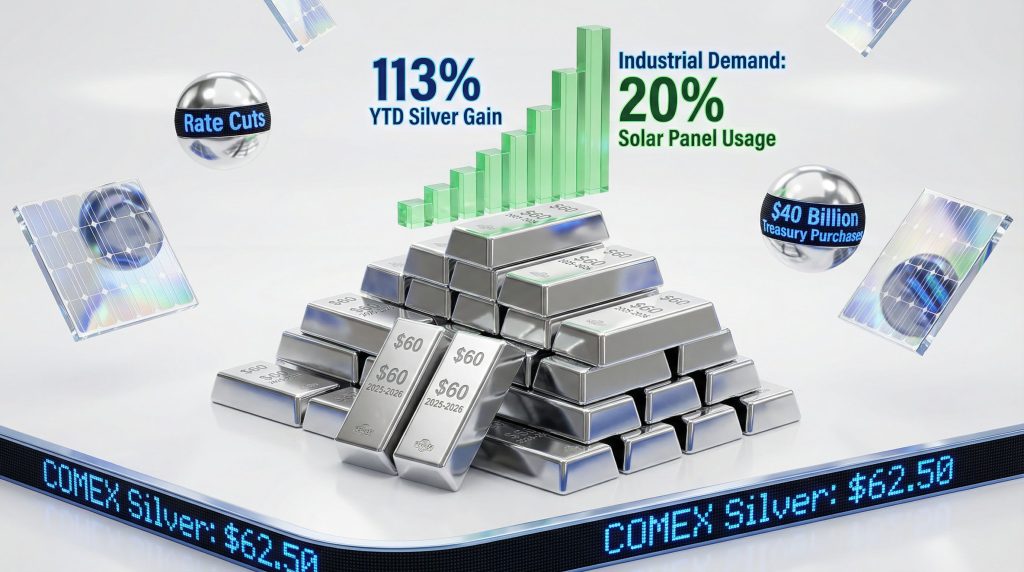
The silver price surge to an all-time high of $62.89 per ounce in December 2025 represents more than cyclical precious metals momentum—it reflects fundamental shifts in global industrial consumption patterns that create price-inelastic demand structures. Solar photovoltaic systems now consume approximately 100-120 million ounces of silver annually, representing the largest industrial end-use application according to the U.S. Geological Survey's 2024 Mineral Commodity Summaries. This consumption pattern differs dramatically from traditional investment demand because manufacturers cannot substitute silver without significant performance degradation in electrical conductivity and corrosion resistance properties.
Electric vehicle production contributes an estimated 2-3% of total silver demand growth through 2024, with acceleration expected as EV adoption increases globally. Modern electric vehicles contain 15-25 grams of silver in battery management systems, power electronics modules, and connectors—approximately three times the silver content found in conventional vehicles. This represents structural demand growth independent of precious metals investment cycles.
The semiconductor industry compounds this industrial necessity, representing approximately 30% of annual industrial silver consumption. A typical commercial solar panel containing 400-500 watts utilises 10-15 grams of silver in electrode contacts and busbars, creating direct correlation between renewable energy expansion and silver consumption. These applications require specific technical properties where silver's superior electrical conductivity cannot be economically substituted without substantial manufacturing process redesigns.
Supply deficits drivers amplify these demand pressures through structural limitations in mining operations. Unlike gold mining, where dedicated operations can respond to price signals, silver extraction remains predominantly a byproduct of copper, lead, and zinc mining. Approximately 70% of annual silver production derives from these base metal mining operations, creating a fundamental disconnect between silver prices and supply response mechanisms.
Global mine production of silver totalled approximately 820 million ounces in 2023, but this production level cannot quickly expand even with dramatic price increases. When copper prices decline, silver byproduct production decreases regardless of silver price strength, creating persistent supply deficits that compound over multiple years. This structural limitation establishes what analysts describe as a "supply ceiling" that conventional market mechanisms cannot easily overcome.
Federal Reserve Monetary Policy Impact on Precious Metals Markets
The Federal Reserve's decision to cut interest rates by 25 basis points in December 2025, bringing the benchmark rate to 3.50%-3.75%, occurred amid deep internal disagreements that signal fundamental uncertainty about optimal monetary policy direction. Three Federal Reserve policymakers dissented from this decision—two opposed any cut while one preferred a 50 basis point reduction—indicating hawk and dove factions within the committee structure.
This policy environment creates cascading effects throughout precious metals markets through multiple transmission mechanisms. Lower interest rates reduce the opportunity cost of holding non-yielding assets like silver, while simultaneously weakening the dollar and increasing inflation expectations. Real interest rates—calculated as nominal rates minus expected inflation—remain constrained with nominal rates at 3.5-3.75% and inflation persistently above the Federal Reserve's 2% target.
Furthermore, the Federal Reserve's announcement of $40 billion in Treasury purchases beginning December 12, 2025, with elevated purchases expected through early 2026, represents a resumption of balance sheet expansion after pausing runoff in October 2025. This policy tool operates independently of benchmark rate decisions by injecting liquidity directly into financial markets and typically weakening currency valuation through monetary base expansion.
Federal Reserve projections indicate only one additional rate cut anticipated for 2026, but this guidance conflicts with political pressure for more aggressive easing. The potential appointment of Kevin Hassett as Federal Reserve Chair—with prediction markets giving him an 86% probability—could signal more accommodative monetary policies. Hassett's stated preference for immediate rate cuts aligns with political demands for borrowing costs potentially as low as 1%.
Historical precedent demonstrates precious metals' sensitivity to these policy combinations. The period 2009-2011 saw similar dynamics of low rates plus quantitative easing, during which silver prices soared past $60 as silver appreciated from $12 to $49 per ounce—a 308% gain over 24 months—while Federal Reserve balance sheet expansion increased systemic liquidity.
Critical Supply-Demand Imbalance Analysis
Physical silver market stress manifests through multiple indicators that suggest persistent supply shortages despite paper market liquidity. COMEX registered silver inventory represents the only readily-available metric for U.S. futures market physical backing, with current levels critically low compared to historical norms. When registered inventory falls below 50 million ounces, borrowing costs typically spike and delivery delays may occur.
| Regional Inventory Status | Current Level | Market Impact | Timeline Horizon |
|---|---|---|---|
| COMEX Registered | Critical Shortage | Extreme | Immediate |
| Chinese Warehouses | Decade-Low Levels | High | Ongoing |
| London Vaults | Moderate Inflows | Medium | Q4 2025 |
| Industrial Stockpiles | Below-Normal | High | 2025-2026 |
Chinese government strategic reserves reached decade-low levels as of December 2025, representing a shift from previous years when China maintained substantial strategic metal inventories. This drawdown occurs simultaneously with increased industrial demand from China's solar panel manufacturing expansion and electric vehicle production growth.
Consequently, silver borrowing rates remain elevated above historical norms, indicating tight physical availability despite futures market liquidity. This disconnect between paper silver trading and physical delivery capacity creates potential for supply disruptions when industrial manufacturers require actual metal delivery rather than financial settlement.
London Bullion Market Association (LBMA) vaults experienced "moderate inflows" in Q4 2025, but market analysts characterise these movements as redistribution from other sources rather than new production expansion. The flow patterns suggest global inventory reallocation rather than fundamental supply improvement.
Market backwardation—where near-month futures trade above deferred contracts—indicates immediate physical scarcity. This pricing structure encourages physical holders to release metal to the market, but sustained backwardation signals severe supply stress that cannot be quickly resolved through normal market mechanisms.
Secondary silver from recycling represents approximately 25-30% of total supply, but current recycling technology faces economic barriers that limit expansion potential. Electronic waste processing, used photographic materials recovery, and industrial scrap recycling require silver prices significantly above current levels to stimulate meaningful supply additions.
How Does Silver's Performance Compare to Gold in 2025?
Silver's extraordinary 113% year-to-date gain through December 2025 compared to gold's 59% increase reflects fundamental differences in market structure and demand drivers. This 54 percentage point outperformance demonstrates silver's consistent leverage characteristics during precious metals bull markets.
The global silver market capitalisation of approximately $1.5-2 trillion represents roughly 10% of the gold market's $15-18 trillion size. This mathematical relationship creates amplified price movements when investment flows shift toward precious metals. Relatively modest capital flows generate outsized percentage impacts in the smaller silver market, establishing what traders describe as a "levered play" on precious metals trends.
Supply elasticity differences compound this leverage effect. Gold supply demonstrates relative elasticity to price signals—dedicated gold mining operations can increase production within 18-24 month timeframes when prices rise substantially. However, silver supply remains structurally inelastic due to its byproduct nature, meaning increased silver prices do not directly stimulate dedicated silver supply expansion.
Moreover, gold-silver ratio analysis reveals silver's dual-nature classification as both industrial commodity and monetary metal provides portfolio diversification benefits that gold cannot match. While gold primarily serves monetary and safe-haven functions, silver's 70% industrial demand creates different market dynamics and multiple demand drivers operating simultaneously.
Historical precedent supports this outperformance pattern. The previous precious metals bull market (2008-2011) saw silver appreciate from $11 to $49—a 345% gain—versus gold's move from $680 to $1,920—a 182% gain. This demonstrates silver's consistent leverage characteristics across different market cycles.
Professional traders increasingly position silver as portfolio amplification for precious metals exposure, concentrating speculative interest in the smaller silver market. This positioning creates both upward momentum during bull markets and potential downside acceleration during corrections, but current supply constraints provide fundamental support that limits downside risks.
Geopolitical Uncertainty and Currency Debasement Dynamics
The U.S. national debt crossing $38 trillion in October 2025 represents the fastest trillion-dollar accumulation outside the pandemic era, creating systemic concerns about currency stability and fiscal sustainability. This debt level equals $112,000 per American citizen and approximately $285,000 per household, with the total matching the combined economies of China, India, Japan, Germany, and the United Kingdom.
Annual interest payments approach $1 trillion, now exceeding both Medicare and defence spending individually. This creates a fiscal trap where rising interest rates increase debt service costs, while lower rates risk reigniting inflation—both scenarios potentially supporting precious metals as hedges against policy-driven currency volatility.
The U.S. government's classification of silver as a critical mineral signals strategic importance beyond traditional market dynamics. This designation influences government stockpiling policies, export restrictions, and domestic production incentives, adding demand layers that operate independently of market forces.
In addition, central bank balance sheet expansion globally creates what economists describe as competitive currency debasement, where nations attempt to maintain export competitiveness through monetary expansion. This environment historically favours hard assets like silver that maintain intrinsic value independent of government policy decisions.
Geopolitical tensions surrounding critical mineral supply chains add another dimension to silver's strategic value. Industrial applications in defence electronics, renewable energy infrastructure, and semiconductor manufacturing create national security implications that transcend traditional commodity market dynamics.
The erosion of Federal Reserve independence—evidenced by political pressure for aggressive rate cuts and specific Fed Chair selection criteria—could lead to more politically-driven monetary policy decisions. Such an environment typically benefits tangible assets as hedges against policy-driven currency instability.
The next major ASX story will hit our subscribers first
Federal Reserve Leadership Transition Impact Analysis
Jerome Powell's term as Federal Reserve Chair expires in May 2026, with Kevin Hassett emerging as the front-runner replacement according to prediction markets assigning him an 86% probability. Hassett's stated position that he would be "cutting rates right now" signals a markedly different Federal Reserve approach focused on growth stimulation rather than inflation control.
This potential leadership change occurs during a critical period for monetary policy effectiveness. The current Federal Reserve faces what Chairman Powell characterises as a *"challenging situation"*—supporting a weakening labour market without reigniting inflation that remains persistently above the 2% target due to tariff impact on silver and other price increases.
Political pressure for aggressive monetary easing—with rate targets potentially as low as **1%**—creates the prospect of Federal Reserve policies prioritising short-term economic stimulus over long-term price stability. Historical precedent suggests such environments generate sustained support for precious metals through negative real interest rates and currency debasement concerns.
The three-way dissent on the December 2025 rate decision indicates fundamental disagreements within the Federal Reserve committee about optimal policy direction. This internal division, combined with external political pressure, suggests continued monetary policy uncertainty that typically benefits safe-haven assets like silver.
Market-based indicators reflect these leadership transition concerns. The resumption of Treasury purchases despite rate cuts signals accommodation beyond benchmark interest rate policy, while prediction market pricing of Fed Chair selection demonstrates investor focus on future policy direction rather than current decisions.
A Hassett-led Federal Reserve could implement more aggressive monetary expansion, creating sustained dollar weakness and negative real interest rates—both historically bullish catalysts for precious metals. This scenario represents a fundamental shift from the current Fed's inflation-fighting mandate toward growth-oriented policies.
Technical Market Structure and Delivery Mechanism Analysis
The disconnect between paper silver trading and physical delivery capacity creates potential for market disruption when industrial buyers require actual metal rather than financial settlement. COMEX silver futures contracts specify delivery of 5,000 troy ounces of .999 pure silver, but registered inventory constraints limit the market's ability to fulfil delivery obligations.
When registered inventory declines relative to open interest, delivery notices accumulate and create potential settlement failures. Current inventory levels relative to industrial demand suggest this delivery mechanism faces increasing strain, particularly during periods of heightened physical demand.
Electronics manufacturers requiring specific silver grades (99.99% purity minimum for semiconductor applications) face limited supplier options when overall market inventory tightens. These industrial buyers cannot accept lower-purity alternatives without component redesign, creating truly inelastic demand that persists regardless of price levels.
Professional speculative positioning concentrates in the smaller silver market, amplifying price movements in both directions. However, current supply constraints provide fundamental downside protection whilst supporting continued upward momentum during periods of increased investment demand.
The London Bullion Market Association (LBMA) clearing system handles the majority of global silver trading, but physical allocation during supply shortages prioritises industrial consumers over investment demand. This creates potential for investment-oriented buying to bid prices substantially higher during periods of physical shortage.
Consequently, market makers face increasing difficulties maintaining bid-ask spreads during volatile periods when physical backing becomes uncertain. This technical factor contributes to price gaps and momentum acceleration that characterises silver's recent price behaviour.
What Are the Price Target Scenarios for Silver?
Technical analysis of silver's price structure suggests multiple resistance and support levels that provide framework for scenario planning. The breakthrough above $60 per ounce establishes new technical support around the $58-60 range, with prior resistance levels now potentially serving as support during any price corrections.
Immediate Technical Resistance Levels:
• $65 per ounce represents psychological resistance where profit-taking may emerge
• $70 per ounce serves as technical extension target based on recent breakout momentum
• $75 per ounce aligns with fundamental supply-demand equilibrium calculations
Support Structure Analysis:
• $58-60 range represents recent breakout zone conversion to support
• $52-55 range marks prior resistance turned support from earlier 2025
• $45-48 range provides major trend line support from the broader bull market
Bull Case Scenario (60% Probability):
Continued supply deficits combined with accelerating industrial demand and sustained monetary easing create conditions for silver prices reaching $75-90 per ounce during 2026. This scenario assumes persistent Federal Reserve accommodation, continued solar panel expansion, and no major supply discoveries.
Base Case Scenario (30% Probability):
Modest supply improvements through increased recycling and steady industrial growth support silver prices in the $55-70 range. This outcome requires mixed monetary policy signals and gradual resolution of current inventory shortages without demand acceleration.
Bear Case Scenario (10% Probability):
Economic recession reducing industrial demand, significant monetary policy tightening, or major supply discoveries could pressure silver toward the $40-55 range. This scenario requires fundamental changes to current supply-demand dynamics.
The asymmetric risk-reward profile favours upside scenarios given structural supply constraints and multiple demand drivers. Industrial necessity provides demand floors that historically did not exist during previous precious metals cycles.
Strategic Portfolio Allocation and Implementation Strategies
Silver's volatility characteristics require careful position sizing within diversified portfolios, with risk-adjusted allocations typically ranging from 2-5% of total portfolio value. Higher allocations become appropriate for investors specifically seeking precious metals exposure or inflation hedging strategies.
Physical Ownership Considerations
Direct physical ownership provides maximum counterparty risk protection but involves storage, insurance, and liquidity costs. Institutional-grade vault storage solutions offer security and insurance coverage whilst maintaining liquidity through allocated ownership structures.
Exchange-Traded Fund Analysis
Silver ETFs offer convenient liquidity and reduced storage complexity but introduce counterparty exposure through fund management structures. Physical-backed ETFs provide better exposure to underlying silver prices compared to futures-based products during contango market conditions.
Mining Equity Considerations
Silver mining stocks provide operational leverage to silver prices but add company-specific risks and correlation with broader equity markets. Pure-play silver miners offer maximum exposure to silver price movements, while diversified miners provide risk mitigation through multiple metal exposures.
Dollar-Cost Averaging Implementation
Systematic accumulation strategies help mitigate silver's inherent volatility whilst building positions during different market conditions. Monthly purchases smooth price volatility and reduce timing risk for long-term strategic allocations.
Risk Management Protocols
Position sizing should account for silver's higher volatility relative to gold, with stop-loss levels set according to individual risk tolerance. Correlation analysis with other portfolio components helps optimise overall risk-adjusted returns.
The strategic allocation decision requires balancing silver's return potential against its volatility characteristics, with emphasis on its role as both industrial commodity and monetary hedge within diversified portfolio construction frameworks.
Conclusion: Navigating the Silver Market Evolution
The silver price surge beyond $62 per ounce represents a fundamental shift in precious metals market dynamics driven by structural supply constraints, accelerating industrial demand, and accommodative monetary policies. These converging forces suggest silver may have permanently transitioned to a higher equilibrium price range, making strategic investment positioning increasingly critical for portfolio diversification and wealth preservation.
The combination of industrial necessity, monetary hedge characteristics, and persistent supply limitations creates compelling long-term investment fundamentals that transcend cyclical precious metals trends. Industrial electrification, renewable energy expansion, and technological advancement generate price-inelastic demand that provides fundamental price support independent of traditional investment cycles.
However, the silver market squeeze requires investors to recognise significant risk factors including potential economic recession, monetary policy tightening, or technological substitutions that could affect silver's industrial applications. The structural nature of current supply-demand imbalances suggests these risks are unlikely to completely reverse the fundamental support mechanisms currently supporting higher price levels.
The silver squeeze transformation offers both inflation hedging and industrial growth exposure, providing diversification benefits unavailable through traditional asset classes. The key to successful silver investment lies in understanding its dual nature as both commodity and monetary asset, with position sizing appropriate for its inherent volatility characteristics whilst recognising its potential for sustained outperformance during periods of monetary uncertainty and industrial expansion.
Strategic portfolio allocation to silver represents not merely a precious metals investment, but rather participation in the broader industrial electrification and monetary transition that characterises the current economic cycle.
Want to Stay Ahead of the Next Silver Breakout?
Discovery Alert's proprietary Discovery IQ model delivers real-time alerts on significant silver and precious metals discoveries across the ASX, instantly empowering subscribers to identify actionable opportunities ahead of the broader market. Understand why historic discoveries can generate substantial returns by exploring Discovery Alert's dedicated discoveries page, showcasing exceptional outcomes like De Grey Mining and WA1 Resources.