
July 31, 2026
Revolutionary Ion Transport Mechanisms in Three-Dimensional Polymer Networks
Conductive smart hydrogels as battery electrolytes represent a breakthrough in electrochemical transport, utilising water-swollen polymer matrices to create highly efficient ionic pathways. These sophisticated materials achieve exceptional conductivity through multiple simultaneous mechanisms that surpass traditional diffusion-limited systems. Furthermore, the battery recycling breakthrough in sustainable manufacturing approaches complements these advanced electrolyte technologies.
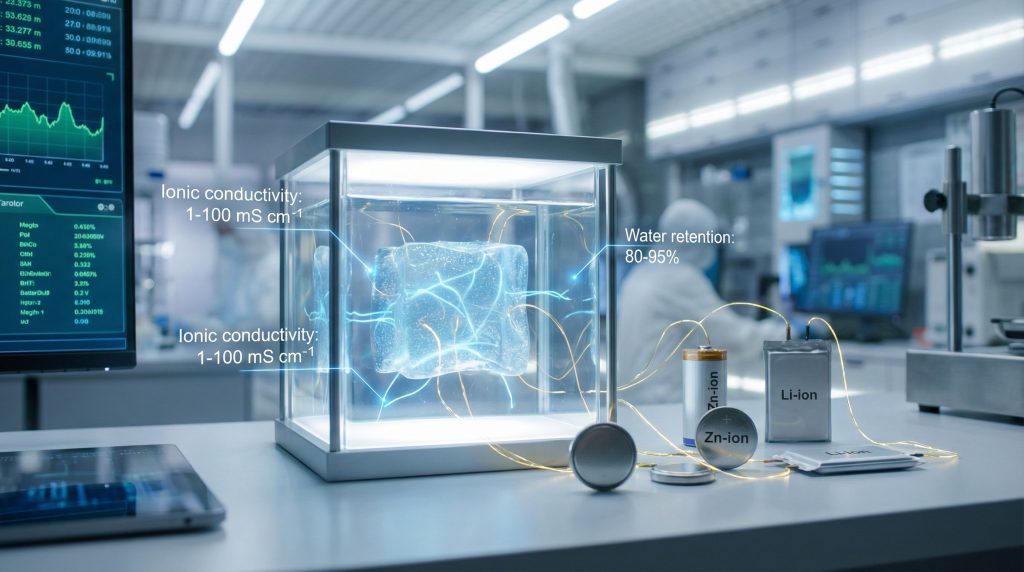
The foundation of hydrogel electrolyte performance lies in their unique three-dimensional architecture. Water molecules form expanded conductive channels within crosslinked polymer networks, while charged functional groups enable Grotthuss diffusion—a molecular-level hopping mechanism that dramatically accelerates ion movement beyond conventional boundaries. Recent systematic analysis of 186 published studies spanning 17 years reveals ionic conductivity ranges of 1-100 mS cm⁻¹ at ambient temperatures, with water retention capacities reaching 80-95% by weight.
Primary Ion Transport Pathways:
- Vehicular Transport (40-60% contribution): Traditional diffusion through water-filled channels
- Grotthuss Hopping (25-35% contribution): Proton relay mechanisms with low activation barriers
- Structural Diffusion (15-25% contribution): Ion movement through polymer network domains
The "smart" designation reflects responsive behaviour to environmental stimuli including temperature fluctuations, mechanical stress, and electrochemical conditions. This adaptability enables autonomous self-healing properties and dynamic performance optimisation during battery operation, characteristics impossible to achieve with conventional electrolyte systems.
Optimisation strategies focus on precise parameter control. Zinc perchlorate concentrations between 1-3 M provide optimal ionic strength, while polymer crosslinking density must balance flexibility against structural integrity. Gradient architectures and double-network designs prevent conductivity bottlenecks that plague uniform systems.
When big ASX news breaks, our subscribers know first
Electrochemical Compatibility Across Battery Chemistries
Zinc-Ion Battery Integration: Superior Performance Metrics
Zinc-ion systems emerge as the premier application for hydrogel electrolyte technology, addressing fundamental challenges that have historically constrained this chemistry's commercial viability. The aqueous nature of hydrogels naturally complements zinc's electrochemical preferences while delivering transformative performance improvements. In addition, the critical minerals for energy transition landscape benefits from zinc's abundance and reduced geopolitical constraints.
Polyacrylamide/sodium alginate (PAM/SA) hydrogel formulations demonstrate remarkable cycling stability, achieving 85% capacity retention after 1,000 cycles at 3 A/g current density. More impressively, these systems maintain stable capacity through 10,000 cycles at 10 A/g, with dendrite formation suppressed by over 95% compared to liquid electrolytes.
The dendrite suppression mechanism represents a critical breakthrough. Traditional zinc-ion batteries suffer from metallic zinc dendrite growth that causes short circuits and capacity fade. Hydrogel networks physically constrain dendrite formation while maintaining uniform current distribution across electrode surfaces.
Key Performance Indicators:
- Rate capability: Stable operation up to 10C discharge rates
- Temperature range: -40°C to 80°C with specialised additives
- Mechanical flexibility: >200% elongation without performance degradation
- Self-healing recovery: Network reformation within minutes of mechanical damage
Lithium-Ion Applications: Overcoming Reactivity Challenges
Despite lithium's inherent reactivity with water-based systems, specialised hydrogel formulations demonstrate compelling performance through protective additive integration and modified polymer architectures. Silicon nanoparticle-polyaniline composite electrodes paired with in-situ polymerised hydrogels achieve remarkable metrics. However, the ongoing development of battery-grade lithium refinery infrastructure remains crucial for supporting these advanced applications.
Lithium-Ion Performance Data:
- Specific capacity: 1,600 mAh/g over 1,000 deep cycles
- Coulombic efficiency: 99.8% average from second cycle onward
- First-cycle efficiency: ~70% (consistent with silicon anode characteristics)
- Voltage stability: Minimal polarisation increase over extended cycling
The silicon-polyaniline composite approach addresses volume expansion issues inherent in high-capacity anodes. The conductive polymer matrix accommodates structural changes while the hydrogel electrolyte provides stable ionic transport pathways that adapt to electrode morphology evolution.
Sodium-Ion Systems: Addressing Ionic Size Constraints
Sodium-ion batteries present unique challenges due to the larger ionic radius of Na⁺ ions, which creates diffusion barriers and potential structural damage in conventional systems. Conductive smart hydrogels as battery electrolytes partially mitigate these limitations through hydrated pathways that reduce activation barriers for ion transport.
The expanded network structures required for sodium accommodation demand careful optimisation of crosslink density and pore architecture. While performance gains are more modest than zinc applications, hydrogel electrolytes offer structural compatibility advantages that reduce mechanical stress on electrode materials during cycling.
Sodium-Ion Considerations:
- Ion size effects requiring expanded polymer networks
- Reduced activation barriers through hydrated diffusion pathways
- Enhanced electrode structural compatibility
- Cost advantages from abundant sodium resources
Safety Revolution Through Water-Based Chemistry
Elimination of Thermal Runaway Risks
The transition from organic to water-based electrolyte chemistry fundamentally eliminates flammability concerns that plague conventional battery systems. This safety transformation addresses critical deployment barriers, particularly for large-scale grid storage installations where fire suppression systems represent substantial cost and complexity burdens.
Safety Parameter Comparison:
| Risk Factor | Organic Electrolyte | Hydrogel Electrolyte |
|---|---|---|
| Flammability | High risk | Non-flammable |
| Thermal runaway contribution | Significant accelerator | Negligible |
| Toxic gas emission | Multiple hazardous compounds | Water vapour only |
| Leakage consequences | Environmental contamination | Self-contained/self-sealing |
The water-based formulation produces only water vapour under thermal stress conditions, eliminating toxic gas emission risks associated with organic electrolyte decomposition. This characteristic enables simplified thermal management systems and reduced insurance premiums for utility-scale installations.
Self-Healing Mechanisms and Structural Integrity
Smart hydrogels demonstrate autonomous repair capabilities when subjected to mechanical damage, maintaining electrolyte integrity and preventing capacity degradation from internal short circuits. This self-healing behaviour stems from reversible crosslinking mechanisms that enable network reformation after disruption.
Self-Healing Mechanisms:
- Reversible crosslinking: Temporary bonds reform after mechanical disruption
- Polymer chain mobility: Network flexibility enables automatic gap closure
- Maintained hydration: Continued ion transport during repair processes
- Stress distribution: Network architecture spreads mechanical loads
The self-repair timeline varies with damage severity, with minor punctures healing within minutes while more extensive damage may require hours for complete restoration. This capability extends operational lifetime and reduces maintenance requirements compared to conventional systems.
Manufacturing Scalability and Economic Viability
Production Challenges and Process Control
Large-scale hydrogel electrolyte manufacturing presents distinct technical hurdles requiring specialised equipment and process control methodologies. Uniform conductive filler distribution, precise water content management, and network integrity preservation during processing represent critical manufacturing parameters. Consequently, the battery metals investment landscape requires adaptation to support these novel processing requirements.
Manufacturing Control Parameters:
- Polymerisation timing and temperature: ±2°C tolerance for consistent crosslinking
- Water content standardisation: ±2% variation for performance repeatability
- Filler dispersion uniformity: <5% coefficient of variation
- Quality assurance: Real-time conductivity monitoring throughout production
The unique processing requirements demand purpose-built facilities rather than retrofitted conventional battery production lines. Investment scaling follows a tiered approach with distinct capital requirements for each development phase.
Investment Scaling Timeline:
- Phase 1: Pilot production (10-100 kWh/year) – $5-10M investment
- Phase 2: Commercial demonstration (1-10 MWh/year) – $25-50M investment
- Phase 3: Large-scale manufacturing (100+ MWh/year) – $100-250M investment
Conductive Filler Integration and Cost Optimisation
High-performance conductive fillers significantly enhance hydrogel conductivity but introduce substantial cost premiums that challenge commercial viability. Strategic filler selection balances performance benefits against economic constraints.
Filler Cost-Performance Analysis:
| Filler Type | Conductivity Enhancement | Cost Multiplier | Production Scalability |
|---|---|---|---|
| Graphene | Excellent (10x improvement) | 10-15x baseline | Limited availability |
| MXenes | Very Good (6-8x improvement) | 8-12x baseline | Emerging supply chain |
| Carbon Nanotubes | Good (4-5x improvement) | 3-5x baseline | Established manufacturing |
| Conductive Polymers | Moderate (2-3x improvement) | 1.5-2x baseline | High scalability |
Alternative approaches utilising hybrid filler systems or conductive polymer networks offer pathways for cost reduction while maintaining acceptable performance levels. Carbon nanotube integration provides the optimal balance of enhancement and economic feasibility for near-term commercialisation.
Performance Limitations and Technical Constraints
Electronic Conductivity and Power Density Challenges
Despite exceptional ionic transport capabilities, hydrogel electrolytes exhibit significantly lower electronic conductivity compared to metallic current collectors or carbon-based systems. This fundamental limitation constrains high-rate performance and maximum power density achievable in practical applications. For instance, advanced research demonstrates these trade-offs between ionic and electronic transport mechanisms.
Performance Constraint Analysis:
- Electronic conductivity: 10⁻⁶ to 10⁻⁴ S/cm (versus 10² S/cm for metals)
- Rate capability limitation: Performance degradation above 5C sustained operation
- Power density: 60-80% of conventional liquid electrolyte systems
- Temperature sensitivity: Significant performance reduction below 0°C
The electronic conductivity limitation becomes particularly problematic for applications requiring rapid charge/discharge cycles, such as frequency regulation or peak shaving services. Mitigation strategies focus on hybrid architectures that combine hydrogel ionic transport with supplementary electronic pathways.
Long-Term Degradation Mechanisms
Extended cycling introduces network fatigue through polymer chain scission and gradual loss of conductive pathways. This degradation mechanism differs fundamentally from conventional electrolyte breakdown, requiring specialised mitigation approaches. Furthermore, the direct lithium extraction technologies being developed could provide more compatible ion sources for hydrogel systems.
Extended operation reveals that polymer networks undergo stress-induced degradation that gradually compromises ionic pathways, necessitating design strategies that account for mechanical fatigue alongside electrochemical stability.
Degradation Mitigation Strategies:
- Double network architectures: Secondary support structures prevent catastrophic failure
- Optimised crosslink density: Balance between operational flexibility and structural durability
- Antioxidant integration: Specialised additives prevent polymer chain oxidation
- Stress relaxation mechanisms: Built-in recovery periods during operational cycling
The degradation timeline varies significantly with operating conditions, with high-temperature operation and deep discharge cycling accelerating network breakdown. Predictive maintenance protocols must account for these unique failure modes.
Commercial Applications and Market Positioning
Grid-Scale Storage: Immediate Market Opportunity
Utility-scale stationary storage represents the most promising near-term application for conductive smart hydrogels as battery electrolytes, where safety advantages provide compelling value propositions that justify performance trade-offs.
Grid Storage Value Propositions:
- Eliminated fire suppression system requirements: $50-100k savings per MWh installed
- Reduced insurance premiums: 30-50% cost reduction for large installations
- Simplified thermal management: Passive cooling sufficient for most applications
- Enhanced urban deployment acceptance: Safety profile enables closer proximity to populated areas
The safety advantages become particularly valuable for utility-scale installations where fire risks create significant operational liabilities and insurance challenges. Urban deployment opportunities expand substantially when thermal runaway risks are eliminated.
Flexible Electronics and Wearable Applications
Mechanical flexibility enables entirely new categories of energy storage devices that conform to curved surfaces and withstand repeated deformation. This capability opens premium markets with tolerance for higher costs.
Flexible Application Specifications:
- Minimum bend radius: <5mm without performance degradation
- Flex cycle durability: >1,000 bend cycles at operational capacity
- Form factor adaptability: Custom geometries and integrated designs
- Substrate integration: Direct embedding in flexible electronics platforms
Wearable electronics, rollable displays, and conformable energy systems represent high-value niche markets where unique performance characteristics command premium pricing that offsets manufacturing cost disadvantages.
The next major ASX story will hit our subscribers first
Economic Analysis and Adoption Timelines
Market Segmentation and Cost Tolerance
Commercial viability varies dramatically across application segments, with premium markets providing pathways for initial technology adoption while cost-sensitive applications require substantial manufacturing optimisation.
Market Segment Timeline Analysis:
| Application Category | Cost Acceptance | Performance Priority | Adoption Timeline |
|---|---|---|---|
| Aerospace/Defence | High premium tolerance | Safety/Reliability focus | 2-3 years |
| Medical Devices | Moderate premium acceptable | Biocompatibility critical | 3-4 years |
| Premium Consumer | Limited premium tolerance | Form factor advantages | 4-5 years |
| Grid Storage | Cost-performance balance | Safety integration benefits | 5-7 years |
| Commodity Applications | Extreme cost sensitivity | Price optimisation critical | 7-10 years |
The adoption pathway follows traditional technology commercialisation patterns, with high-value applications driving initial development while manufacturing scale reduces costs for broader market penetration.
Investment Requirements and Risk Assessment
Technology transition from laboratory demonstration to commercial manufacturing requires substantial capital commitment and risk tolerance for unproven production methodologies. Specialised equipment needs prevent utilisation of existing battery manufacturing infrastructure.
Risk Factor Analysis:
- Technical risk: Moderate – core science demonstrated, scaling challenges remain
- Market risk: Low-moderate – clear safety advantages, performance limitations understood
- Supply chain risk: High – novel materials require new sourcing relationships
- Competitive risk: Low – first-mover advantages in safety-critical applications
Success probability increases significantly for applications where safety benefits justify performance limitations and cost premiums, providing revenue streams during technology optimisation phases.
Future Research Directions and Breakthrough Opportunities
Advanced Network Architectures and Bio-Inspired Design
Next-generation hydrogel development focuses on hierarchical structures that mimic natural ion transport systems, incorporating stimuli-responsive components and gradient architectures that optimise performance across operational conditions.
Emerging Research Frontiers:
- Biomimetic networks: Ion transport mechanisms inspired by cellular processes
- Gradient architectures: Spatially varied properties optimising local performance requirements
- Stimuli-responsive systems: Dynamic adaptation to temperature, stress, and electrochemical conditions
- Hybrid organic-inorganic networks: Ceramic stability combined with polymer flexibility
These advanced architectures promise to address current limitations while introducing functionalities impossible with conventional approaches. Research timeline for practical implementation extends 5-10 years for fundamental breakthroughs.
Integration with Solid-State Technologies
Convergence of hydrogel electrolytes with solid-state battery development creates opportunities for hybrid systems that capture benefits from both approaches while mitigating individual limitations.
Hybrid System Concepts:
- Hydrogel-ceramic interfaces improving solid electrolyte contact issues
- Gradient electrolyte systems transitioning from gel to solid phases
- Composite structures with embedded solid-state ionic domains
- Temperature-responsive phase transitions enabling adaptive performance
These hybrid approaches could address processing challenges of ceramic electrolytes while maintaining safety advantages, potentially accelerating solid-state battery commercialisation timelines.
Market Integration and Technology Positioning
Conductive smart hydrogels as battery electrolytes occupy a unique position in the energy storage technology landscape, offering transformative safety characteristics that enable applications previously constrained by thermal runaway risks. While performance limitations prevent direct replacement of conventional systems in all applications, the safety revolution creates substantial market opportunities where fire risk elimination justifies design trade-offs.
The path forward requires strategic focus on applications where safety benefits provide compelling value propositions during technology maturation phases. Grid-scale storage installations, aerospace applications, and medical devices represent near-term opportunities that can support manufacturing scale development while performance optimisation continues.
Long-term success depends on continued research breakthroughs in electronic conductivity enhancement, manufacturing cost reduction, and hybrid system architectures that combine hydrogel safety with performance capabilities required for broader market adoption. The fundamental safety advantages position this technology as a critical enabler for expanded energy storage deployment across safety-sensitive applications.
This analysis is based on published research findings and represents current understanding of hydrogel electrolyte capabilities. Actual commercial performance may vary based on specific formulations and operating conditions. Investors should conduct independent due diligence before making technology investment decisions.
Ready to Capitalise on Battery Technology Breakthroughs?
Discovery Alert's proprietary Discovery IQ model delivers real-time alerts on significant mineral discoveries across battery metals and critical materials sectors, empowering subscribers to identify actionable opportunities ahead of the broader market. With revolutionary battery technologies like conductive smart hydrogels reshaping energy storage applications, staying informed about battery metals investment opportunities becomes crucial for both short-term traders and long-term investors. Begin your 14-day free trial today to position yourself strategically in the evolving energy transition landscape.