June 25, 2026
The Economics of Scarcity: Why Ionic Clay Rare Earths Are Rewriting the Mining Playbook
Global supply chains for rare earth elements have never been more fragile, or more consequential. The clean energy transition depends on a relatively small group of elements that power electric vehicle motors, offshore wind turbines, and defence-grade electronics. Yet the overwhelming majority of rare earth processing capacity remains concentrated in a single country. For years, Western-aligned mining jurisdictions have been searching for economically viable alternatives. The completion of the Australian Rare Earths Koppamurra PFS represents one of the most credible answers to that search yet produced.
Understanding why this project stands apart requires stepping back from the headline numbers and examining what makes ionic clay rare earth deposits fundamentally different from the conventional hard rock projects that have historically dominated the sector.
When big ASX news breaks, our subscribers know first
What Makes Ionic Clay Deposits Unique in the Rare Earths Sector
Most rare earth projects globally are hosted in hard rock formations, carbonatites, or mineral sands. These deposit types typically require energy-intensive cracking and roasting processes to liberate rare earth elements from their host minerals. Capital costs are elevated, processing chemistry is complex, and the path from ore to oxide is long. Furthermore, the rare earth processing challenges associated with conventional deposit types have historically made project development slower and more expensive than anticipated.
Ionic clay deposits work on an entirely different principle. In these geological settings, rare earth ions are not locked into mineral crystal structures. Instead, they are adsorbed onto the surface of clay minerals, primarily kaolinite and halloysite, and can be released through relatively straightforward ion-exchange chemistry using low-concentration electrolyte solutions. This means the processing flowsheet is dramatically simpler than hard rock equivalents.
The Koppamurra project sits within a lateritic clay profile across the South Australia and Victoria border region. The ore occurs at shallow depths, which eliminates the need for underground mining infrastructure and reduces both capital expenditure and operational complexity. The flat, accessible terrain enables low strip ratios during open-pit extraction, further compressing costs.
Ionic clay deposits of the type found at Koppamurra represent a relatively new category of rare earth resource within Australia. The country's rare earths pipeline has historically been dominated by hard rock and mineral sand-hosted projects. Koppamurra's PFS completion marks the first time an Australian ionic clay project has reached this level of economic validation.
Key Financial Outcomes of the Koppamurra Prefeasibility Study
After-Tax NPV, IRR and Payback Period
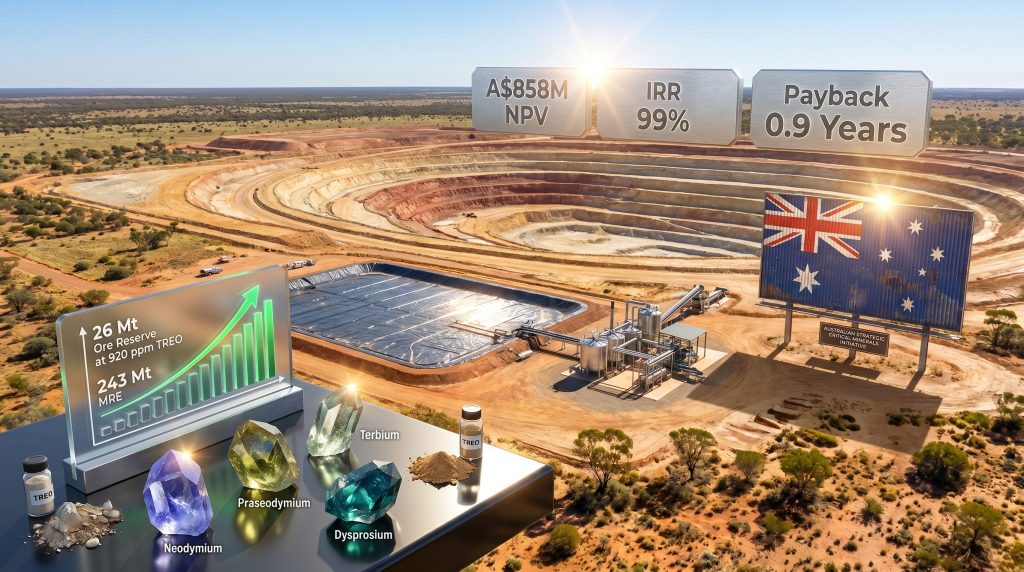
The financial results delivered by the Australian Rare Earths Koppamurra PFS are exceptional by any measure applied across the rare earths development sector.
| Financial Metric | Koppamurra PFS Result |
|---|---|
| After-Tax NPV (8% discount rate) | A$858 million |
| Internal Rate of Return (IRR) | 99% |
| Payback Period | 0.9 years |
| Initial Capital Expenditure | A$178 million |
| Annual TREO Production Target | 1,860 t/y |
| All-In Sustaining Cost (AISC) | US$38.32/kg TREO |
| Initial Mine Life | 12 years |
An after-tax net present value of A$858 million against an initial capital expenditure of only A$178 million produces a capital efficiency ratio that is genuinely rare in the resources sector. To contextualise that relationship: the NPV is approximately 4.8 times the upfront capital, a multiple that most hard rock rare earth projects could not approach even under optimistic commodity price assumptions.
The 99% internal rate of return is the figure that most sharply distinguishes Koppamurra from its peers. IRR measures the annualised return generated by a project's cash flows relative to its cost. A figure approaching 100% reflects both the low capital intensity of the heap leach processing model and the high-value nature of the rare earths basket being recovered.
What a Sub-One-Year Payback Period Means in Practice
A payback period of 0.9 years has significant implications for project financing. Lenders and equity investors in the mining sector typically evaluate projects against payback thresholds of three to five years. A sub-one-year payback materially de-risks the financing structure by reducing the period during which capital is at risk before revenue generation commences.
For a project of this scale, that speed of capital recovery also reduces sensitivity to commodity price volatility. Even in a scenario where rare earth prices were to soften following project commissioning, the capital would already be substantially recovered before any prolonged downturn could threaten project viability.
Disclaimer: PFS-level financial metrics are based on modelled assumptions including commodity price forecasts, capital cost estimates, and processing recovery rates. These figures are subject to change as the project advances through definitive feasibility study and should not be treated as guarantees of future financial performance.
Comparing Capital Efficiency to Sector Benchmarks
Hard rock rare earth projects, particularly those requiring hydrometallurgical cracking circuits, commonly require capital expenditures in the range of A$500 million to over A$1 billion to reach comparable production scales. Against that backdrop, Koppamurra's A$178 million capex estimate for a 1,860 tonne per year TREO operation reflects the fundamental cost advantage of ionic clay processing.
The all-in sustaining cost of US$38.32 per kilogram of TREO is also highly competitive. When benchmarked against the broader cost curve for rare earth oxide producers globally, this positions Koppamurra as a potentially low-cost producer once in operation.
Maiden Ore Reserve and Updated Mineral Resource Estimate
The 26 Mt at 920 ppm TREO Maiden Reserve
The declaration of a maiden ore reserve is a transformative event for any mining project. Unlike a mineral resource estimate, which quantifies material that is geologically defined but not necessarily economically mineable, an ore reserve requires a demonstrated pathway to profitable extraction under specified economic and technical assumptions.
| Resource and Reserve Metric | Figure |
|---|---|
| Maiden Ore Reserve | 26 million tonnes |
| Ore Reserve Grade | 920 ppm TREO |
| Updated Mineral Resource Estimate | 243 million tonnes |
| MRE Grade | 751 ppm TREO |
| MRE Increase vs. September 2024 | +7 million tonnes |
| High-Grade Material (>1,000 ppm TREO) | 68 million tonnes |
The 920 ppm TREO reserve grade is notably 22% higher than the global mineral resource average of 751 ppm TREO across the full Koppamurra deposit. This premium reflects the mine sequencing strategy applied during the PFS, which prioritises extraction of the highest-grade material in the earliest mining stages. For project financiers, this is a deliberate derisking signal: the economics in the early years of operation will benefit from the strongest ore grades in the deposit.
Resource Scale and Mine Life Extension Potential
The updated mineral resource estimate of 243 million tonnes at 751 ppm TREO represents a substantial base of material beyond the 26 million tonnes committed to the initial 12-year mine plan. The resource has grown by 7 million tonnes compared to the September 2024 estimate, demonstrating continued exploration success across the project area.
Critically, the deposit contains approximately 68 million tonnes of high-grade material grading above 1,000 ppm TREO. This high-grade inventory represents a significant option on mine life extension or production rate increases that could be evaluated in future feasibility work.
The Rare Earths Basket: Why Composition Matters as Much as Grade
Heavy and Magnet Rare Earths: The Value Drivers
Not all rare earth oxides command equal market prices. The rare earths sector is often misunderstood by generalist investors who focus purely on total rare earth oxide grades without examining the composition of the basket being produced.
Approximately 48% of Koppamurra's rare earths basket consists of heavy and magnet rare earths. The four elements that primarily drive project economics in this category are:
- Neodymium (Nd) – the primary magnet rare earth, essential for NdFeB permanent magnets used in EV traction motors and wind turbine generators
- Praseodymium (Pr) – typically co-produced with neodymium (as NdPr oxide) and commands similar pricing premiums
- Dysprosium (Dy) – a heavy rare earth used in small concentrations to improve the high-temperature performance of NdFeB magnets; extremely scarce and highly valued
- Terbium (Tb) – another heavy rare earth used in magnet formulations for high-performance applications including defence systems and electric motors
The significance of the heavy rare earth content at Koppamurra cannot be overstated from a market positioning perspective. Global heavy rare earth supply is dominated almost entirely by ionic clay deposits in southern China, particularly in Jiangxi Province. These Chinese deposits are under increasing environmental regulatory pressure, with production controls tightening. Koppamurra's ionic clay geology produces a naturally heavy rare earth-enriched product, making it directly comparable to the Chinese ionic clay operations that currently dominate global heavy rare earth supply.
The market dynamic for heavy rare earths like dysprosium and terbium is structurally different from light rare earths. Supply is far more concentrated, substitutes are limited or non-existent in high-performance magnet applications, and Western-aligned producers capable of delivering consistent volumes remain extremely scarce globally.
In addition, the broader rare earth supply chain context reinforces why projects with this basket composition are receiving heightened attention from governments and end users alike.
How the Koppamurra Mining and Processing Model Works
From Clay to Oxide: The Heap Leach Flowsheet
The operational model at Koppamurra is designed around minimising technical complexity and capital intensity. The simplified processing pathway proceeds as follows:
- Shallow open-pit excavation removes ionic clay ore at low strip ratios, minimising waste movement per tonne of ore processed
- Ore stacking onto engineered heap leach pads where a dilute electrolyte leach solution, typically ammonium sulfate or a similar ion-exchange reagent, is applied
- Ion exchange liberates adsorbed rare earth ions from clay mineral surfaces, with the pregnant leach solution (PLS) collected at the base of the pad
- Impurity removal and purification of the PLS to eliminate unwanted elements before rare earth precipitation
- Precipitation and drying to produce a mixed rare earth carbonate or oxide intermediate product
- Progressive rehabilitation of mined areas concurrent with active operations, reducing the environmental liability footprint throughout the mine life
The heap leach approach eliminates the need for high-temperature roasting kilns, sulfuric acid baking circuits, or solvent extraction plants in the primary extraction phase. This is the core reason the capital estimate remains as low as A$178 million for a meaningful annual production rate.
Progressive Rehabilitation as a Competitive Differentiator
Progressive rehabilitation, conducted in parallel with mining rather than deferred to mine closure, has become increasingly important as a social licence requirement for new mining projects in Australia. It reduces the total disturbance footprint at any given point in time and demonstrates environmental commitment to both regulators and the community. For a project operating on or near agricultural land in the South Australia-Victoria border region, this approach addresses a real community concern in a practical way.
The next major ASX story will hit our subscribers first
ANSTO Partnership and the Significance of Pilot-Scale Processing
Australian Nuclear Science and Technology Organisation (ANSTO) operates Australia's most advanced nuclear and materials science research infrastructure. Its new piloting facility in Sydney represents a world-class capability for rare earth processing development.
The pilot-scale programme being established at ANSTO for Koppamurra ore is significant for several reasons:
- It is the first ionic clay rare earth piloting programme conducted in Australia, establishing a domestic technical precedent for this deposit type
- Pilot plant outputs will generate mixed rare earth oxide samples that can be provided to potential customers and strategic partners for qualification testing
- The programme will validate processing recoveries and product quality at a scale that bridges the gap between laboratory testwork and commercial operations
- Results will directly underpin the Definitive Feasibility Study (DFS) processing assumptions, improving the reliability of capital and operating cost estimates
- Customer sample availability is a prerequisite for offtake agreement negotiations, making the pilot programme the critical enabler for commercial partnerships
For investors tracking the project's progress, the commencement of pilot-scale operations at ANSTO represents a concrete, observable milestone that moves Koppamurra from a study-stage project toward active product development.
Government Grant Structure and Project Funding Context
Australian Rare Earths has received funding through the International Partnerships in Critical Minerals grant programme administered by the Australian Government. The structure of that grant is as follows:
| Grant Tranche | Amount | Purpose |
|---|---|---|
| First Tranche | Previously received | Initial metallurgical testwork |
| Second Tranche | A$1 million | Advanced metallurgical testwork ahead of PFS |
| Remaining Balance | A$3.25 million | Expected release in 2026 |
| Total Grant Value | A$5 million | De-risking pre-production programme |
It is important to note that this grant represents co-investment in technical de-risking work and should not be interpreted as a government endorsement of the project, a designation of strategic status, or accelerated permitting approval. The grant programme is administered on competitive merit criteria applied across multiple applicants in the Australia critical minerals sector. Furthermore, the growing critical minerals demand driven by the energy transition continues to draw government attention toward projects of this type.
Regulatory and Environmental Pathway
The Koppamurra project straddles the South Australia and Victoria border, creating a dual-jurisdiction regulatory environment. The approval of a Scoping Report in 2024 is a meaningful procedural step, as it defines the scope of environmental impact studies required before a mining lease application can be assessed. The South Australian government's developing projects register provides further context on the project's official status within the state's mining approval framework.
Key regulatory milestones remaining before the project can enter production include:
- Completion of environmental baseline studies covering fauna, flora, hydrology, and land use
- Mining lease application submission, expected to occur during 2026
- Environmental impact assessment and public consultation processes across both jurisdictions
- Native title and heritage consultation requirements
- Water licence applications covering heap leach solution management
The project's location in an agricultural region means community engagement around land use co-existence will be an ongoing requirement. The heap leach model, with its relatively modest above-ground infrastructure footprint compared to conventional milling operations, is a practical advantage in this regard.
Development Roadmap: From PFS to First Production
Milestones completed:
- Mineral Resource Estimate updated to 243 Mt at 751 ppm TREO
- Maiden Ore Reserve declared at 26 Mt grading 920 ppm TREO
- PFS completed, returning A$858M NPV, 99% IRR and 0.9-year payback
- ANSTO pilot plant partnership formalised
Milestones in progress:
- Pilot-scale operations commencing at ANSTO Sydney facility
- Offtake discussions advancing with potential strategic partners
Milestones ahead:
- Mining lease application (2026 target)
- Definitive Feasibility Study completion
- Final Investment Decision and project financing
- Construction and commissioning
- First TREO production
Koppamurra vs. Other Australian Rare Earth Development Approaches
| Project Attribute | Ionic Clay (Koppamurra) | Hard Rock or Carbonatite |
|---|---|---|
| Mining Method | Shallow open-pit | Underground or deep open-pit |
| Processing Chemistry | Low-reagent ion exchange | High-temperature cracking/roasting |
| Capital Intensity | Lower | Significantly higher |
| Heavy REE Content | Naturally enriched | Variable, often lower |
| Processing Complexity | Low | High |
| Rehabilitation Complexity | Lower | Higher |
| Time to First Production | Potentially shorter | Longer lead times |
Australia's rare earths development pipeline covers a range of deposit types, from the monazite-bearing mineral sands of Western Australia to the carbonatite-hosted systems in Queensland. Koppamurra occupies a distinct position as an ionic clay project, and its PFS is the most advanced study-level work completed for this deposit category in the country. Consequently, the evolving landscape of rare earth geopolitics is accelerating interest in precisely this kind of Western-aligned, non-Chinese ionic clay supply.
Frequently Asked Questions About the Koppamurra PFS
What is a Prefeasibility Study and why does it matter?
A prefeasibility study is a formal engineering and economic evaluation conducted to a level of accuracy typically within plus or minus 25%. It examines mining methods, processing flowsheets, infrastructure requirements, capital and operating costs, and project economics in sufficient detail to support a decision on whether to proceed to a full Definitive Feasibility Study. For investors, PFS completion represents a transition from geological exploration to economic validation.
What is TREO and how is it measured?
TREO stands for Total Rare Earth Oxide. It is the standard metric used to express the combined content of all rare earth elements in a sample or deposit, expressed as oxide equivalents. Grade is reported in parts per million (ppm) or as a percentage. The TREO figure alone does not capture the full value picture; basket composition, specifically the proportion of high-value magnet and heavy rare earths, is equally important.
What does an AISC of US$38.32/kg TREO imply?
All-in sustaining cost represents the total cost of producing one kilogram of TREO including mining, processing, site overhead, royalties, and sustaining capital. At US$38.32/kg, Koppamurra would sit in the lower portion of the global cost curve for rare earth producers, providing meaningful margin protection if market prices were to decline from current levels.
What is the difference between an ore reserve and a mineral resource?
A mineral resource is a geological estimate of mineralised material with reasonable prospects for eventual economic extraction. An ore reserve is a subset of the mineral resource that has been demonstrated to be economically extractable under defined technical and economic assumptions. Ore reserves require the input of a Competent Person and represent the highest confidence classification in the JORC Code reporting system used in Australia.
What rare earth elements matter most for EV and clean energy demand?
Neodymium and praseodymium are the primary drivers of demand growth, given their role in the NdFeB permanent magnets used in EV traction motors and direct-drive wind turbine generators. Dysprosium and terbium are added in smaller quantities to improve magnet performance at elevated temperatures. Demand growth projections for all four elements are closely tied to the pace of electric vehicle adoption and wind energy deployment globally.
Investment Perspective: Reading the Koppamurra Numbers in Context
The Australian Rare Earths Koppamurra PFS arrives at a moment when the structural case for non-Chinese rare earth supply has never been more clearly articulated by policymakers, end users, and investors across Western markets. The combination of an economically compelling PFS result, a maiden ore reserve demonstrating resource quality, a natural heavy rare earth enrichment profile, and a first-of-its-kind pilot programme at a nationally recognised research facility creates a multi-layered investment proposition.
The capital efficiency ratio of approximately 4.8 times NPV to capex, a sub-one-year payback, and a 99% IRR are metrics that would attract attention in any commodity sector. In rare earths specifically, where the development of new supply outside China has consistently proven more difficult and expensive than anticipated, these numbers carry additional weight. Indeed, recent coverage from Mining.com.au provides further context on how the project has been tracking toward this milestone.
However, investors should recognise that the distance between a compelling PFS and commercial production remains substantial. Regulatory approvals across two Australian jurisdictions, a definitive feasibility study, project financing, and construction all lie between the current milestone and first TREO production. Each step introduces execution risk, and commodity price assumptions embedded in the PFS may not reflect market conditions at the time of production.
This article is intended for informational purposes only and does not constitute financial advice. Readers should conduct their own due diligence and consult a licensed financial adviser before making investment decisions.
Want to Stay Ahead of the Next Major Mineral Discovery on the ASX?
Discovery Alert's proprietary Discovery IQ model delivers real-time alerts on significant ASX mineral discoveries — including critical minerals like rare earths — instantly translating complex data into actionable insights for investors at every level. Explore how historic discoveries have generated substantial returns on Discovery Alert's dedicated discoveries page, and begin your 14-day free trial today to position yourself ahead of the broader market.