July 29, 2026
When Geography Becomes Destiny: The Strait That Holds the World Hostage
There is a narrow body of water, barely 33 kilometres wide at its tightest point, that exercises more influence over global energy prices than any central bank, cartel meeting, or climate policy ever could. The Strait of Hormuz sits between Iran and the Oman peninsula, and its strategic significance is almost impossible to overstate. Every time military tensions flare between the United States and Iran, traders across every time zone return to the same fundamental question: could this be the event that closes the strait?
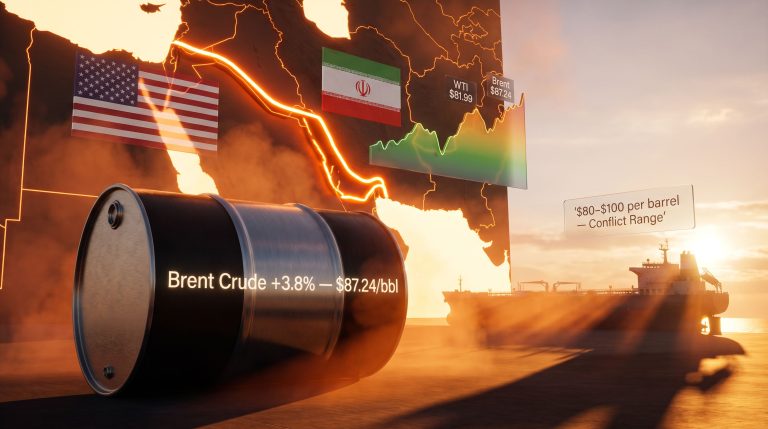
That question surged back to the top of every trading desk on 29 July 2026, when Islamic Revolutionary Guard Corps forces launched multiple ballistic missiles from Iranian territory in what U.S. Central Command described as a surprise attack targeting U.S. military positions in the Middle East. The missiles were intercepted. Physical damage was unconfirmed. Yet crude oil price trends showed an immediate sharp upward movement, because commodity markets do not wait for damage assessments before pricing in the possibility of disruption.
Understanding why the Iran surprise attack on U.S. forces sent oil prices higher requires looking beyond the immediate military exchange and into the deeper architecture of global energy supply, the psychology of commodity trading, and the compounding geopolitical pressures now converging simultaneously across multiple supply corridors.
When big ASX news breaks, our subscribers know first
Why Commodity Markets Price Risk Before It Materialises
A common misconception among investors unfamiliar with energy markets is that crude prices rise only when physical supply is actually disrupted. In practice, oil futures markets operate as real-time probability machines, continuously discounting scenarios across a range of likelihood. The moment a credible escalation event occurs, traders begin repricing not for what has happened, but for the full distribution of outcomes that could happen next.
Several dynamics made the July 2026 attack particularly significant in market terms:
-
The attack followed a two-day pause in hostilities, meaning markets had partially priced out risk during that brief window. The resumption of strikes after an apparent de-escalation period carries a larger psychological shock than continuous conflict.
-
Ballistic missile use represents a qualitative escalation above drone strikes or proxy engagements. It signals direct state-level military action, which traders treat as a different category of risk.
-
The fact that missiles were intercepted reduces but does not eliminate the risk premium. Markets apply what analysts sometimes call the intercepted attack discount, acknowledging that absent infrastructure damage, the spike will partially fade. However, residual uncertainty about follow-on action sustains a floor under prices for days to weeks.
-
Historical pattern data reinforces this behaviour. Iran-related escalation events have triggered crude price spikes ranging from 5% to 13% in prior episodes, with the magnitude determined primarily by whether physical supply assets were threatened.
The Strait of Hormuz: One Chokepoint, Twenty Percent of the World's Oil
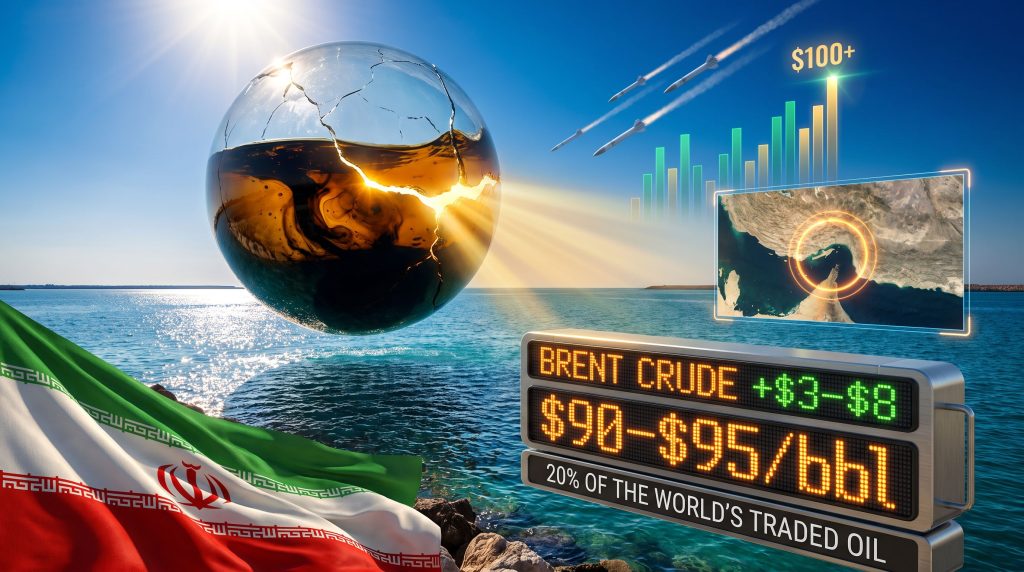
No single geographic feature defines global energy vulnerability more completely than the Strait of Hormuz. Approximately 17 to 21 million barrels of crude oil and petroleum products transit this corridor daily under normal operating conditions, representing roughly 20% of the world's total traded oil volume.
The nations whose export economics depend directly on unimpeded Hormuz passage include Saudi Arabia, the United Arab Emirates, Iraq, Kuwait, and Iran itself. This creates a structural paradox: Iran's most potent geopolitical weapon is also the artery through which its own crude exports must flow if sanctions were ever to be lifted.
Are Alternative Routes Adequate?
Alternative routing options exist but are fundamentally inadequate for handling diverted volume at scale:
-
The East-West Pipeline across Saudi Arabia can move roughly 5 million barrels per day, covering only a fraction of normal Hormuz throughput.
-
The Abu Dhabi Crude Oil Pipeline has a capacity of approximately 1.5 million barrels per day.
-
Suez Canal routing adds significant transit time and cannot absorb Gulf export volumes at meaningful scale.
A full closure of the Strait of Hormuz would therefore represent the largest single supply shock in the modern history of oil markets, dwarfing the 1973 Arab oil embargo and the disruptions caused by the Iraqi invasion of Kuwait in 1990.
Three Escalation Scenarios and Their Price Implications
Sophisticated energy market analysis does not reduce geopolitical market risks to a binary outcome. Instead, it maps probability-weighted scenario pathways against price corridors. The current Iran-U.S. situation admits three distinct scenarios, each with materially different implications for crude benchmarks.
| Scenario | Description | Brent Price Range | Duration |
|---|---|---|---|
| Contained Incident | Missiles intercepted, no follow-on strikes, diplomatic channels remain open | $85-$88/bbl | Spike fades within 48-72 hours |
| Sustained Exchange | Continued strikes without direct tanker targeting; shipping insurance premiums rise | $90-$100/bbl | Weeks; gasoline lags by 2-4 weeks |
| Hormuz Disruption | Mining, blockade, or credible threat to tanker passage | $100+/bbl | Indefinite; SPR releases likely |
Scenario 1 (Contained) represents the base case for most current analyst positioning. The interception success and absence of confirmed infrastructure damage support a view that the price spike partially retraces once the initial shock absorbs. However, the residual risk premium persists as long as military postures remain elevated.
Scenario 2 (Sustained Exchange) would trigger secondary market effects beyond crude itself. Shipping war risk insurance premiums would rise sharply, some operators would reroute around the Arabian Sea entirely, and retail gasoline prices in major importing nations would begin reflecting the supply anxiety with a typical two to four week lag behind the crude move.
Scenario 3 (Hormuz Disruption) is classified as a tail risk but not an impossible one. Energy analysts have cited projections exceeding $100 per barrel for Brent in a sustained disruption scenario. Strategic petroleum reserve releases by the United States, European nations, and International Energy Agency members would likely be coordinated, but reserve volumes are finite and the economic contagion effects would extend well beyond energy markets.
The Russia Sanctions Variable: A Second Pressure Point
What distinguishes the current episode from prior Iran-U.S. confrontations is the simultaneous emergence of a second supply-side risk variable. The U.S. Senate agreed to vote on a sanctions bill against Russia named for the late Senator Lindsey Graham of South Carolina. This legislation would introduce a package of sanctions and tariff authority specifically targeting Russian oil sales in international markets.
The compounding dynamic here is meaningful. Furthermore, the convergence of these pressures creates a particularly challenging environment for energy traders:
-
Iranian supply risk raises the geopolitical premium on crude from the Gulf.
-
Russian export friction, if the sanctions package advances, reduces available supply from a second major producing nation simultaneously.
-
OPEC's market influence through spare capacity, while real, is not unlimited. Saudi Arabia and the UAE hold the majority of the cartel's buffer production, and deploying it to offset both Iranian and Russian supply pressure simultaneously would represent an extraordinary demand on that buffer.
Adding further complexity, Ukraine's President Volodymyr Zelenskyy met with U.S. President Donald Trump at the White House during the same period, suggesting the diplomatic landscape around both the Russia conflict and broader Middle East tensions remained actively fluid. Multiple geopolitical variables converging in the same short window amplify the uncertainty premium embedded in crude prices.
What History Actually Shows About Oil Price Spikes
Pattern recognition is a useful discipline when assessing the durability of geopolitical oil price moves. The historical record offers important calibration:
| Event | Year | Market Response | Persistence |
|---|---|---|---|
| Tanker War (Iran-Iraq conflict) | 1987-88 | Severe Gulf shipping disruption | Months |
| Soleimani Assassination | January 2020 | Approximately 4% crude spike | 3-5 days before retracement |
| Houthi Red Sea Campaign (Iran-linked) | 2024 | Sustained shipping rerouting premium | Weeks to months |
| IRGC Ballistic Missile Strike | July 2026 | Sharp initial spike; trajectory pending | Dependent on follow-on action |
Several patterns emerge consistently across these episodes:
-
Initial spike magnitude correlates strongly with the perceived novelty and severity of the escalation method.
-
Retracement speed correlates inversely with confirmed physical damage. No damage means faster fade.
-
The cry wolf effect is real but limited. Repeated Iranian threats without infrastructure damage gradually reduce per-incident price sensitivity, but this discount evaporates entirely the moment any tanker is actually struck or Hormuz passage is credibly threatened.
-
Sustained premiums require sustained uncertainty, not just a single incident. The 2024 Houthi campaign demonstrated that when geopolitical actors commit to persistent interdiction campaigns rather than isolated strikes, markets sustain elevated risk premiums for extended periods.
The critical insight from historical analysis is that the intercepted attack is never truly discounted to zero. As long as the capability to repeat the attack exists and military postures remain elevated, energy traders keep a non-trivial probability weight on the escalation scenario, and that weight has a price.
The next major ASX story will hit our subscribers first
Downstream Ripple Effects: Beyond the Crude Price
The Iran surprise attack on U.S. forces does not affect only crude oil futures. The transmission mechanism through the broader economy operates across several channels simultaneously. Consequently, this oil market disruption reverberates well beyond the energy sector itself.
Retail Gasoline: Pump prices typically lag the crude market by two to four weeks due to inventory cycles and refining lead times. Consumers in major importing nations will feel the geopolitical event well after traders have partially moved on.
LNG Shipping: Liquefied natural gas vessels transiting the Arabian Sea face indirect exposure to any extended conflict scenario. Rerouting adds voyage time and cost, which feeds through to spot LNG prices in Asian import markets.
Petrochemicals: Crude is the primary feedstock for a vast range of industrial chemicals and plastics. Margin compression in petrochemical manufacturing follows elevated crude prices with a relatively short lag, affecting industries from packaging to pharmaceuticals.
Emerging Market Currencies: Nations that are significant net oil importers face a particularly uncomfortable dynamic during Middle East escalation events. Rising crude prices widen their current account deficits, pressure their currencies downward, and import inflationary pressure simultaneously, creating a compounding economic headwind.
How Investors Typically Position Around Middle East Escalation
For investors seeking to navigate geopolitical oil price risk, the asset class responses during Middle East escalation events follow reasonably consistent historical patterns, though past behaviour never guarantees future outcomes.
Historically Responsive Asset Classes During Escalation
-
Crude oil futures (Brent and WTI): Most direct exposure; high short-term volatility around conflict news flow.
-
Energy sector equities and ETFs: Broader exposure with diversification across producers; less sensitive to a single-event spike but participates in sustained price elevation.
-
Gold: Safe-haven gold typically rallies alongside oil during geopolitical crises, driven by flight-to-safety demand and inflation hedging behaviour.
-
U.S. Treasuries: Flight-to-quality demand increases during escalation as investors rotate away from risk assets.
-
Defence sector equities: Historically attract a bid during Middle East escalation events due to anticipated military spending implications.
Key Risk Management Considerations
-
Geopolitical risk premiums are among the most difficult to sustain in commodity markets. Physical supply data ultimately exerts greater pricing influence than political narrative once the initial shock cycle completes.
-
Options markets typically see implied volatility spike sharply immediately after surprise attack events, making options strategies expensive but potentially useful for hedging tail-risk scenarios.
-
Position sizing relative to the scenario distribution matters significantly. The Hormuz closure scenario is low probability but high consequence; sizing positions as though it is the base case introduces asymmetric risk to the downside if the situation de-escalates.
FAQ: Iran's Surprise Attack and What It Means for Oil
Why Did the Iran Surprise Attack on U.S. Forces Push Oil Prices Higher Even Though the Missiles Were Intercepted?
Commodity markets price probability distributions, not just confirmed outcomes. The interception reduced but did not eliminate the risk premium, because the capability and willingness to repeat the attack remain, and the Strait of Hormuz remains vulnerable to any sustained escalation. Furthermore, reports of fighting reigniting across the region reinforced trader concerns about a broader conflict.
What Is the Realistic Near-Term Price Ceiling for Brent Crude in a Sustained-but-Contained Scenario?
Most energy market analysts place the realistic ceiling at approximately $90 to $95 per barrel for a sustained but contained military exchange, with $100 and above reserved for scenarios involving direct Hormuz disruption.
How Does the Russia Sanctions Bill Interact With the Iran Oil Price Risk?
If the Russia sanctions package advances to a vote and passes, it introduces export friction on Russian crude simultaneously with Middle East supply uncertainty. Dual supply-side pressure from both corridors would compound the upward price dynamic in a way that OPEC+ spare capacity would struggle to fully offset.
How Long Do These Price Spikes Typically Last?
When no physical infrastructure damage is confirmed, historical episodes suggest the initial spike fades within three to seven days as physical supply data reasserts its pricing influence. Sustained elevation requires either confirmed damage or persistent military activity that keeps the probability of escalation meaningfully elevated.
Which Economies Are Most Vulnerable to This Kind of Oil Price Shock?
Emerging market economies that are significant net oil importers face the sharpest exposure, particularly those with limited foreign currency reserves to absorb currency depreciation and imported inflation simultaneously.
This article is intended for informational purposes only and does not constitute financial or investment advice. Oil price forecasts and scenario projections involve significant uncertainty and may not reflect actual market outcomes. Readers should conduct their own research and consult qualified financial advisors before making investment decisions.
Want to Stay Ahead of the Next Major Commodity Discovery Before the Market Reacts?
While geopolitical shocks like the Iran-U.S. escalation dominate energy market headlines, significant mineral discoveries on the ASX can generate equally dramatic price movements — and Discovery Alert's proprietary Discovery IQ model delivers real-time alerts the moment those discoveries are announced, ensuring subscribers can act before the broader market catches on. Explore historic examples of what major discoveries can return and begin your 14-day free trial at Discovery Alert to secure a genuine market-leading edge.