August 5, 2026
When Energy Security Becomes a National Security Imperative
The history of energy markets is punctuated by moments when a single geopolitical event permanently redraws the map of how governments think about fuel supply. The 1973 Arab oil embargo forced the first serious reckoning with import dependency. The 1979 Iranian Revolution triggered a second wave of strategic energy planning. Each shock produced lasting structural changes that outlived the immediate crisis by decades.
The 2026 disruption of the Strait of Hormuz is following the same pattern, but with one crucial difference: this time, the policy response is converging on nuclear power not as a climate solution but as a sovereignty instrument. That shift is not rhetorical. It is being expressed through concrete legislative timelines, reactor restart approvals, and enrichment agreements that carry long-term uranium demand consequences no previous geopolitical cycle has produced at this scale.
For investors navigating the intersection of Iran conflict and Western uranium supply constraints, understanding the mechanics of why a Middle East war matters to nuclear fuel markets requires separating two distinct but reinforcing risk vectors. Iran's direct relevance to uranium supply chains is minimal. The country has never been a meaningful exporter of nuclear fuel to Western utilities. What matters is the cascade effect of the Strait of Hormuz closure, which disrupted roughly 20% of global seaborne oil flows and forced energy security out of long-range planning and into immediate ministerial action across Europe, East Asia, and the Gulf Cooperation Council. Furthermore, uranium supply-demand volatility has only deepened as geopolitical pressures mount across multiple supply corridors simultaneously.
When big ASX news breaks, our subscribers know first
From Climate Tool to Strategic Infrastructure: How the Iran Conflict Rewired Nuclear Policy
The Strait of Hormuz Effect on Energy Diversification Timelines
Prior to the 2026 disruption, nuclear power's policy case was largely constructed around decarbonisation targets. That framing carried political headwinds in several major economies. Post-disruption, the framing shifted entirely. Energy security was elevated to national security status, a threshold that unlocks different categories of political capital, faster regulatory pathways, and bipartisan legislative support that climate rationales alone rarely achieve.
IEA Executive Director Fatih Birol, speaking at the 2026 World Economic Forum, stated that energy security warranted elevation to the level of national security priority, a public positioning that reflected emergency energy diversification reviews already underway across multiple governments. The practical policy responses that followed included:
- South Korea accelerating reactor restart approvals that had been stalled in domestic political debate
- Germany advancing its planning timeline for new nuclear capacity, reversing a trajectory that had defined its energy politics for over a decade
- Saudi Arabia reportedly conditioning its ceasefire mediation role on receiving US agreement to domestic uranium enrichment rights, a development with significant long-term regional demand implications
The Sprott Physical Uranium Trust's purchase of more than 5 million pounds of uranium in Q1 2026, following over USD 386 million raised in the first 28 days of the year, illustrated how rapidly institutional capital repositioned ahead of the demand inflection these policy shifts represent.
The Proliferation Dimension: A Separate but Compounding Risk Layer
The Iran conflict introduces a second analytical layer that operates independently of supply chain disruption but reinforces the same investor conclusion. Prior to the coordinated US and Israeli strikes on Iranian enrichment facilities in late February 2026, Iran held an estimated 440.9 kg of uranium enriched to 60% U-235, sufficient for approximately nine weapons if further processed, with centrifuge capacity at Natanz and Fordow reducing breakout time to under two weeks for five to six weapons.
The 2015 Joint Comprehensive Plan of Action had capped enrichment at 3.67% and limited stockpiles to 202 kg, extending breakout time to approximately 12 months. Every constraint was exceeded following the US withdrawal from that agreement in 2018.
Post-strike, the proliferation picture became genuinely unverifiable. IAEA inspectors lost access to all declared enrichment facilities for more than eight months as of early 2026. Iran's March 2026 offer to down-blend its 60% stockpile under international supervision could not be verified under active conflict conditions. Stockpile location and centrifuge operational status remained unknown.
| Metric | Pre-2025 Strikes | Post-2025 Strikes (Early 2026) |
|---|---|---|
| 60% Enriched Uranium Stockpile | Location and status unverifiable | |
| Estimated Breakout Time | Under 2 weeks (5-6 weapons) | Unknown; enrichment capacity unclear |
| IAEA Facility Access | Limited but operational | Zero access for 8+ months |
| JCPOA Constraints | Exceeded since 2018 | Irrelevant under active conflict |
The investor interpretation of this proliferation uncertainty is not direct. It operates through a broader geopolitical logic: when states perceive the post-Cold War security architecture as unreliable, nuclear power, which delivers decades of baseload capacity from a compact fuel inventory, becomes the primary instrument of energy sovereignty. The 11th Nuclear Non-Proliferation Treaty Review Conference, which opened at United Nations Headquarters on April 27, 2026, reinforced this reading. UN Secretary-General Antonio Guterres acknowledged that hard-won non-proliferation norms are eroding among nuclear-armed states, a statement the investment community interprets as a demand signal for countries accelerating domestic nuclear programmes in response to perceived security norm fragility.
The Supply Deficit That Existed Before Anyone Fired a Shot
A Production Gap Measured in Tens of Millions of Pounds
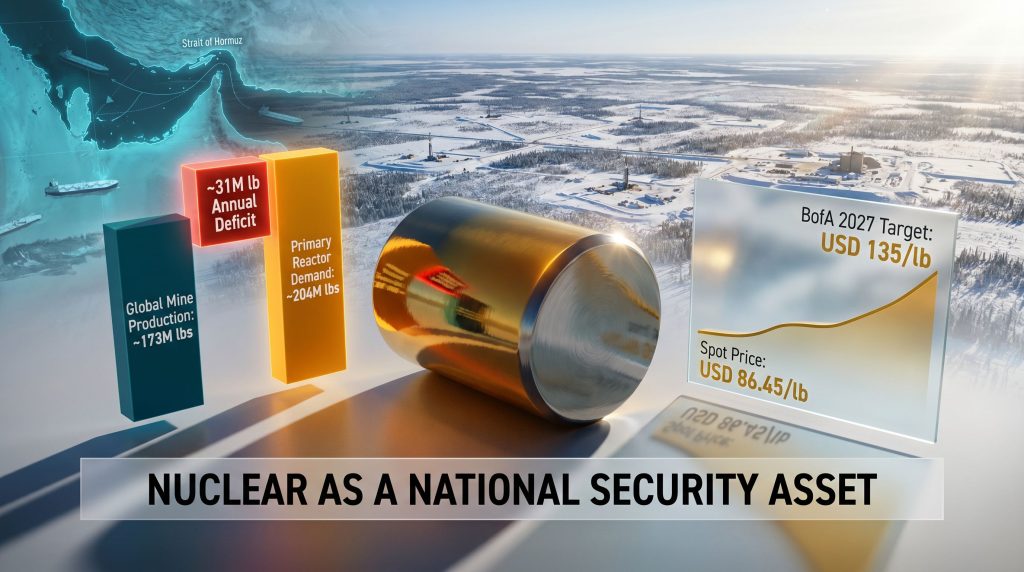
The Iran conflict accelerated a demand story that was already structurally compelling before the first strike. Global uranium mine production reached approximately 173 million pounds in 2025, falling roughly 31 million pounds short of primary reactor demand of approximately 204 million pounds, according to the World Nuclear Association Nuclear Fuel Report 2025. Secondary supply sources, including inventory drawdowns and recycled material, are currently bridging that gap, however the WNA expects those finite sources to become unsustainable before 2030.
The longer-term arithmetic is more challenging. The WNA projects the annual supply gap widening to 212 million pounds per year by 2040 against all currently identified mine sources combined. That is not a forecast subject to rapid revision based on price signals. It is a function of mine development physics. Consequently, the uranium supply deficit represents one of the most structurally significant imbalances in the critical minerals space today.
| Metric | Figure | Source |
|---|---|---|
| Global Mine Production (2025) | ~173 million lbs | World Nuclear Association |
| Primary Reactor Demand (2025) | ~204 million lbs | World Nuclear Association |
| Annual Production Deficit (2025) | ~31 million lbs | Derived |
| Projected Annual Gap by 2040 | ~212 million lbs | WNA Nuclear Fuel Report 2025 |
| IEA Nuclear Investment (Current) | ~USD 65 billion/year | IEA |
| IEA Nuclear Investment (2030 Target) | ~USD 120 billion/year | IEA Announced Pledges Scenario |
Three Structural Constraints Shrinking Western-Accessible Supply
The headline global production figure overstates the uranium actually available to Western utilities. Three concurrent structural forces compress the accessible pool in ways that do not resolve with price signals alone.
Force 1: The Russian Import Prohibition
The US currently sources approximately 44% of its uranium from Russia, Kazakhstan, and Uzbekistan, a concentration the US Energy Information Administration classifies as a national security vulnerability. The Russian uranium import ban, formalised through the Prohibiting Russian Uranium Imports Act signed in May 2024, removes all Russian-origin material from the US supply chain by January 1, 2028. That deadline is approaching faster than new mine development cycles can compensate, creating a structural price premium for domestically produced and allied-nation uranium.
Force 2: Chinese Strategic Procurement
China absorbed approximately 70 million pounds of uranium in the most recent reporting period, equivalent to roughly 40% of global primary mine production, according to Investing News Network's Q1 2026 uranium price review. This is not market-driven spot buying. It reflects a state-directed strategic stockpiling programme that systematically reduces the volume available to Western utility buyers regardless of price.
Force 3: Kazakhstani Transit Route Risk
Kazakhstan contributed approximately 38% of global mine output in 2024 (World Nuclear Association). The majority of that material exports via Russian logistics infrastructure. Western sanctions on Russia create compounding logistical and political risk for this supply corridor, meaning headline Kazakhstani production figures substantially overstate the volume reliably accessible to Western buyers.
The combination of the Russian import ban, Chinese strategic absorption of roughly 40% of global output, and Kazakhstani transit route uncertainty means the pool of uranium genuinely accessible to Western utilities is materially smaller than global production statistics suggest. This structural gap cannot be corrected by price signals alone.
Why Mine Development Timelines Are the Most Important Number in This Market
The 7-to-12-Year Constraint and Its 2026 Implications
A new uranium mine requires between 7 and 12 years from discovery to first commercial production, encompassing permitting, feasibility studies, construction, and commissioning phases. This timeline is not compressible in most Western jurisdictions regardless of uranium price. It is determined by regulatory processes, environmental assessment requirements, and the physical constraints of mine engineering.
The strategic consequence is direct: capital deployed in exploration and development in 2026 determines whether the mid-2030s supply position is manageable or critical. The WNA projects secondary supply sources becoming unsustainable before 2030, meaning the window between secondary supply exhaustion and the first meaningful new mine production from projects funded today is precisely the period of maximum supply pressure.
The uranium mine development pathway, step by step:
- Discovery and initial resource definition through geophysical surveys and maiden drill programmes
- Resource expansion drilling via infill and step-out programmes to establish NI 43-101 or JORC confidence categories
- Preliminary Economic Assessment providing first economic modelling of extraction scenarios
- Pre-Feasibility Study refining capital and operating cost estimates with metallurgical testing
- Environmental Impact Assessment and permitting, typically the longest phase at 3 to 7 years in most Western jurisdictions
- Feasibility Study and financing, requiring a bankable study for project debt and equity or strategic partnership
- Construction and commissioning over 2 to 4 years depending on project scale and extraction method
- First commercial production contributing to the supply curve
Why ISR Mining Changes the Near-Term Calculus
In-situ recovery mining represents a meaningfully different risk-return profile within this development framework. The method injects oxygenated groundwater to dissolve uranium in place within the orebody, then pumps the uranium-bearing solution to surface for processing, with no physical excavation of the host rock.
The capital efficiency advantage is substantial: average capital expenditure for ISR operations runs at less than 15% of conventional hard-rock uranium mining. The surface disturbance footprint is dramatically smaller, which supports faster permitting acceptance in US states where regulatory agencies prioritise environmental impact minimisation.
enCore Energy Corp, one of the active ISR operators in the US, retains more than 50% of planned production through 2033 for spot market exposure, positioning it to capture price appreciation directly as the supply gap widens. The company's Executive Chairman and Founder has described the fundamental difference between ISR and legacy uranium extraction methods as comparable to the difference between entirely separate industries, noting the environmental credentials and compressed reclamation timelines that distinguish ISR from conventional approaches.
Where Western Supply Is Actually Being Built: A Jurisdiction-by-Jurisdiction View
United States: Domestic Production Margins and the Regulatory Advantage
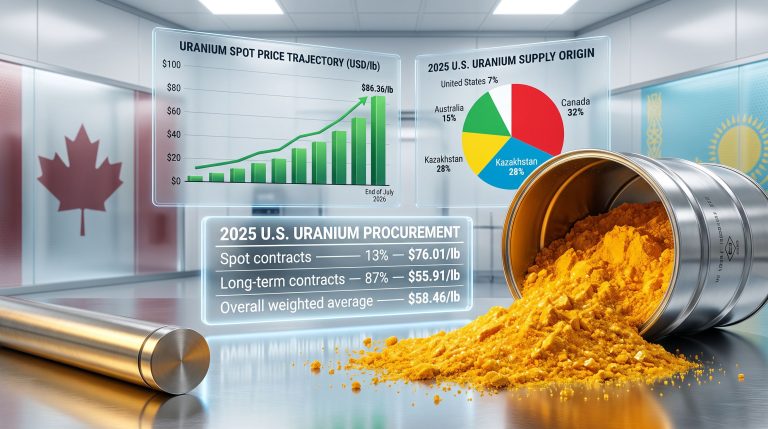
The Prohibiting Russian Uranium Imports Act creates a structural floor under domestically produced uranium that operates independently of the spot price. With the uranium spot price at USD 86.45 per pound as of April 28, 2026 against a long-term contract price of USD 90 per pound at a 14-year high, and Bank of America's 2027 price target of USD 135 per pound, the operating margin environment for domestic US producers is among the most favourable in the sector's history.
Energy Fuels Inc. produced 1.72 million pounds in 2025, exceeding its own revised guidance, and is targeting 2.0 to 2.5 million pounds in 2026. Production costs at the Pinyon Plain Mine in Arizona of USD 23 to USD 30 per pound generate an operating margin of USD 56 to USD 63 per pound at current spot prices, a level that directly funds the company's rare earth oxide expansion targeting commercial production by mid-2027.
| Metric | Figure |
|---|---|
| Spot Price (April 28, 2026) | USD 86.45/lb |
| Long-Term Contract Price | USD 90/lb (14-year high) |
| Bank of America 2027 Price Target | USD 135/lb |
| Conventional Mine Production Cost (Arizona) | USD 23-30/lb |
| Implied Operating Margin (at spot) | USD 56-63/lb |
Mark S. Chalmers, President and Chief Executive Officer of Energy Fuels, has described the financial logic connecting uranium production margins to the company's broader critical minerals strategy: production costs of USD 23 to USD 30 per pound against a selling price well above USD 75 per pound generates substantial cash flow per pound that, multiplied across 1.5 to 2 million pounds of annual production, provides the capital to fund the company's multi-commodity expansion programme.
Canada's Athabasca Basin: Grade Dominance and Infrastructure Leverage
The Athabasca Basin in Saskatchewan remains the world's highest-grade uranium district, with operating mine grades exceeding the global average of below 1% U3O8 by multiples of 10 to 30 times at established deposits.
IsoEnergy Ltd. holds what has been characterised as the highest-grade published uranium resource in Canada: the Hurricane deposit in Saskatchewan's Athabasca Basin, containing 48.6 million pounds at 34.5% U3O8 confirmed under National Instrument 43-101. To contextualise that grade: the average global operating mine grade sits below 1% U3O8, meaning Hurricane exceeds the global benchmark by more than 30 times. The deposit sits at workable depth with no overlying water body, 40 kilometres from an already-licensed, operating processing facility, eliminating the standalone processing capital requirement that inflates development costs for isolated projects.
A 2026 winter drill programme completed approximately 6,800 metres across 17 holes, intersecting strong radioactivity along a newly identified fault zone, with laboratory assay results pending as a near-term re-rating catalyst.
The depth of institutional conviction in Athabasca Basin assets was demonstrated concretely in IsoEnergy's recent equity raise. The company targeted a CAD 50 million raise and received more than CAD 300 million in demand, more than six times oversubscribed, with participation from new global institutional investors committing large-format capital allocations. Philip Williams, Chief Executive Officer and Director of IsoEnergy, described the book as representing names that were entirely new to the company, with institutional investors demonstrating very large appetites for exposure to the sector at precisely the moment development-stage assets require long-duration financing.
African Uranium: Heap-Leach Economics and Western Diversification
Zambia and Namibia are emerging as strategically significant uranium supply jurisdictions for Western utilities seeking diversification away from Russian and Kazakhstani material. The geological endowment and processing economics of both regions support competitive cost structures at scale.
Atomic Eagle is advancing the Muntanga Uranium Project in Zambia, which holds 58.8 million pounds at 309 parts per million following a 24% resource upgrade in March 2026, alongside a confirmed probable ore reserve of 39.6 million pounds. The project uses an acid heap-leach process with recoveries exceeding 90% at approximately 20 kilograms of acid per tonne of ore treated.
The capital efficiency rationale for scaling African uranium operations is compelling. As the Chief Executive Officer of Atomic Eagle has explained, the development strategy prioritises growing the resource base to underpin a substantially larger mining operation than previously contemplated. Furthermore, Bannerman Energy's Etango project in Namibia provides a comparable benchmark: Bannerman's capital expenditure is approximately 20% higher than the previous Muntanga feasibility study configuration but supports plant throughput that is more than twice as large, demonstrating that significant production increases can be achieved for modest incremental capital.
Bannerman Energy's Etango project received a strategic valuation of approximately AUD 1 billion in early 2025, establishing a market reference point for large-scale African uranium development assets at current uranium price levels. Atomic Eagle's 30,000-metre 2026 drill programme commenced April 28, 2026, targeting infill and maiden drilling across a property not meaningfully explored since 2007.
Discovery-Stage Exploration: The Longest-Duration Bet on the 2040 Supply Gap
District-Scale Positions in Underexplored Canadian Basins
The most speculative but potentially highest-returning position in the uranium supply curve is district-scale exploration in basins where the geological thesis points toward Athabasca Basin-style mineralisation but where systematic modern drilling has not yet been conducted.
ATHA Energy Corp controls 100% of the Angikuni Basin in southern Nunavut and holds 6.8 million acres across Canada's most prominent uranium basins. The 2025 programme produced five new uranium showings. The RIB North maiden drill hole intersected 34.7 metres of composite mineralisation at a peak grade of 8.16% U3O8 over 0.5 metres, more than eight times the company's own high-grade threshold.
Troy Boisjoli, Chief Executive Officer of ATHA Energy, has drawn an explicit geological benchmark comparison to established Athabasca Basin deposits, noting that the grades and thicknesses being encountered are analogous to Athabasca Basin-style mineralisation, that mineralisation has been confirmed over 12 kilometres of strike length across tested holes without a single miss, and that the project is unlike anything encountered in the uranium space in terms of its consistency and scale.
A CAD 63 million treasury closed in February 2026 funds three simultaneous diamond drill rigs operational as of late April 2026, targeting a trend mineralised across that 12-kilometre strike length. At discovery stage, the risk profile is substantially higher than producing assets or advanced developers. The return profile, if geological projections prove correct, reflects that asymmetry.
Disclaimer: This article contains forward-looking statements and projections based on information available as of April 2026. Uranium price forecasts, supply gap projections, and development timelines represent estimates from third-party sources and are subject to material revision. This article does not constitute financial advice. Investors should conduct independent due diligence and consult a qualified financial adviser before making investment decisions. Exploration results, resource estimates, and feasibility study outcomes carry inherent uncertainty and actual results may differ materially from those projected.
The next major ASX story will hit our subscribers first
Is the Current Uranium Price Re-Rating Structural or Cyclical?
Three Signals That Distinguish This Cycle From Previous Sentiment Recoveries
Uranium has experienced multiple false dawns since the post-Fukushima price collapse. The 2016 to 2018 recovery, the 2021 Sprott-driven spot price surge, and several junior exploration cycles all generated investor enthusiasm that proved temporary. In contrast, the current re-rating carries three distinguishing characteristics that analysts and institutional allocators cite when arguing for a structural rather than cyclical interpretation.
-
Long-term contract pricing at a 14-year high of USD 90 per pound. These prices are set by utility buyers with procurement horizons of 10 years or more, not by short-term speculators. A long-term price at this level reflects utility conviction that elevated prices will persist across the full contract lifecycle.
-
Institutional price target modelling above spot. Bank of America's USD 135 per pound target for 2027 incorporates demand growth projections extending well beyond the current geopolitical cycle, including reactor buildout pipelines across Europe, Asia, and the Gulf that were under development before the Iran conflict and have since accelerated.
-
Physical supply constraints driven by production physics. The WNA-projected supply gap is not a function of sentiment. It reflects mine development timelines, grade depletion at existing operations, and capital underinvestment across the prior decade. These constraints respond to capital deployment, not price signals, and the capital commitment cycle required to address them has not yet been fully funded.
The institutional investor base for uranium has broadened materially beyond dedicated commodity funds. New institutional names with large capital allocations are entering the sector at precisely the moment that development-stage assets require long-duration financing, a coincidence that previous uranium cycles notably lacked.
The IEA projects nuclear investment rising from approximately USD 65 billion annually to USD 120 billion by 2030 under its Announced Pledges Scenario. That trajectory, combined with the Prohibiting Russian Uranium Imports Act's January 2028 deadline and Chinese strategic procurement absorbing approximately 40% of global primary mine output, means the consequential question is not whether a supply deficit will materialise. Rather, understanding the broader uranium market dynamics now shaping the sector is essential for investors assessing where across the supply curve — from active US production through advanced Canadian and African development to discovery-stage Nunavut exploration — capital is positioned to capture the value the energy security imperative is now permanently embedding in nuclear fuel markets. In addition, a detailed analysis of Iran's conflict impact on long-term nuclear fuel deficits further reinforces why the Iran conflict and Western uranium supply constraints represent a defining structural force for the decade ahead.
Ready to Capitalise on the Next Major Uranium Discovery Before the Market Moves?
Discovery Alert's proprietary Discovery IQ model delivers real-time alerts on significant ASX mineral discoveries — including uranium and critical minerals — instantly transforming complex geological data into actionable investment insights for both short-term traders and long-term investors. Explore why historic mineral discoveries have generated extraordinary returns on Discovery Alert's dedicated discoveries page, and begin your 14-day free trial today to position yourself ahead of the next major find.