June 29, 2026
The Single-Point Failure That Keeps India's Energy Planners Awake at Night
Every major energy-importing nation has a vulnerability it cannot fully hedge. For India, that vulnerability has a name and a precise location: the Strait of Hormuz. Stretching just 33 kilometres at its narrowest point between the Omani coast and Iranian territory, this chokepoint channels an estimated 20% of the world's seaborne oil trade on any given day. For a country that imports more than 85% of its crude oil requirements, a disruption of even a few weeks carries consequences that ripple from refinery gate to retail petrol pump.
The events of mid-2026 made that vulnerability impossible to ignore. More than 30 India-bound vessels were reported stranded across the Strait of Hormuz during the disruption window, held in a maritime holding pattern that threatened refinery throughput schedules and domestic fuel pricing stability. Most of those vessels have since cleared the chokepoint, with 12 remaining in transit as of late June 2026 and expected to complete their passage within days. The immediate crisis is easing, but the structural lesson it delivered cannot be quietly filed away.
The timing of the maritime normalisation has coincided with a development that could, over the medium term, fundamentally reshape how India sources its crude. Iran is actively and formally signalling its readiness to resume Iran crude exports to India following the lifting of US-led sanctions.
When big ASX news breaks, our subscribers know first
Why Iran's Re-entry Into the Market Is Not Simply a Commercial Story
The narrative around Iran crude exports to India tends to default to a transactional framing: cheaper barrels, discounted pricing, bilateral trade value. That framing captures part of the picture but misses the more consequential strategic logic operating beneath it. Furthermore, the crude oil trade geopolitics at play here extend well beyond a simple buyer-seller arrangement.
Between 2019 and 2026, following the reimposition of US sanctions, China emerged as the near-exclusive buyer of Iranian crude. This concentration of demand gave Beijing extraordinary pricing leverage in bilateral negotiations with Tehran. When one buyer controls the majority of your export volume, you do not negotiate on equal terms. Iran has consequently been selling into a buyer's market of one.
Tehran's outreach to India is therefore not merely a revenue-maximisation exercise. It is a calculated effort to break that monopsony dynamic and restore competitive tension to Iranian crude pricing. Adding a major buyer like India to the mix would give Iran the ability to benchmark competing offers, walk away from unfavourable Chinese terms, and gradually reclaim export pricing sovereignty.
India re-entering the Iranian crude market would not just benefit New Delhi through lower import costs. It would structurally alter the balance of negotiating power between Tehran and Beijing in ways that carry implications far beyond the energy sector.
How Significant Was the Pre-Sanctions Trade Relationship?
To understand what restoration of full trade would mean, it helps to quantify what was lost. Before the 2019 sanctions enforcement, Iran held a meaningful and growing position in India's crude import basket. According to India's crude oil imports from Iran, the relationship represented a strategically important supply corridor for New Delhi.
| Metric | Data Point |
|---|---|
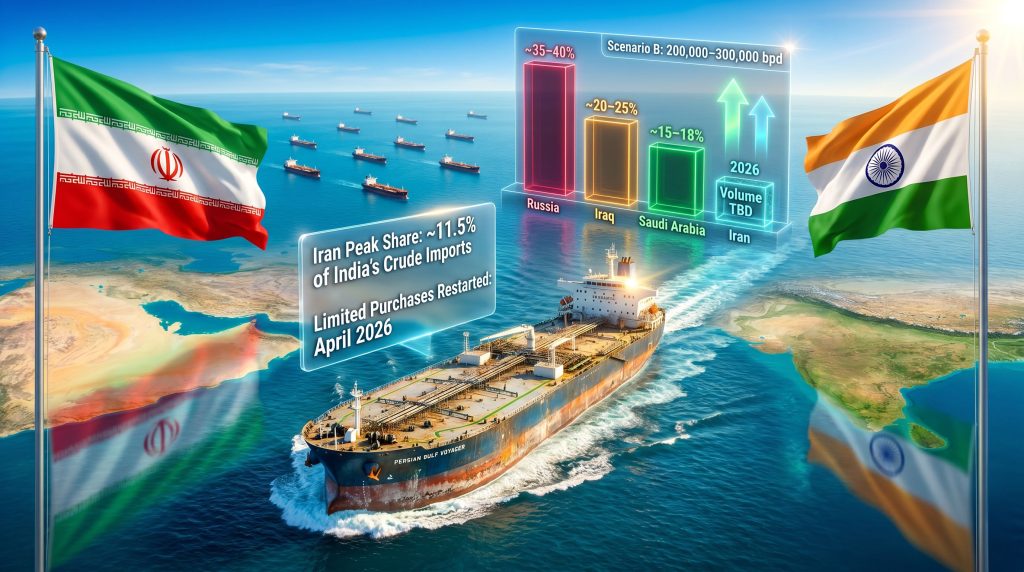
| Iran's peak share of India's crude imports | ~11.5% of total import volume |
| Estimated bilateral trade value at peak | Exceeding USD $20 billion |
| Year significant trade was suspended | 2019 (US sanctions enforcement) |
| Year limited purchases tentatively resumed | April 2026 |
| Duration of near-total trade gap | Approximately seven years |
The financial logic of restoring that relationship is straightforward. Iranian crude has historically been priced at a discount to Brent, a structural feature of the market that reflects both the sanctions risk premium buyers must absorb and Tehran's need to compete aggressively for a constrained buyer pool. For Indian refiners operating on thin margin structures, that discount is not a minor advantage. It is a meaningful variable in annual procurement economics.
Since 2022, India has demonstrated its willingness to purchase discounted crude from geopolitically constrained sellers, having dramatically expanded its intake of Russian crude following Western sanctions on Moscow. Russian oil now accounts for an estimated 35 to 40% of India's crude import mix, a concentration that creates its own set of secondary sanctions exposure risks. Iranian crude, if resumed at scale, would provide diversification within the discounted crude segment itself.
The Current Sanctions Landscape: Carefully Optimistic, Not Openly Celebratory
Indian refiners and energy planners are proceeding with deliberate caution despite Iran's overtures. The reason is structural: a reported 60-day temporary sanctions waiver is categorically insufficient to justify the restructuring of long-term procurement contracts, shipping arrangements, and payment infrastructure. Large-scale crude procurement decisions require multi-year policy certainty, not short-cycle exemptions that could evaporate with a change in Washington's foreign policy calculus.
Several specific operational obstacles remain unresolved:
Payment Architecture Challenges
- The rupee-rial payment mechanism that previously facilitated India-Iran crude trade collapsed under sanctions pressure and has not been rebuilt
- Iran has adopted a new policy permitting crude payment settlements in any currency, which is a meaningful concession, but its implementation at commercial scale remains untested
- Indian financial institutions remain wary of processing Iran-linked transactions due to the risk of secondary sanctions penalties from US regulators
- The import tax structure in India adds further complexity to the financial architecture required for a resumption of large-scale trade
Shipping and Insurance Gaps
- Western Protection and Indemnity (P&I) clubs continue to decline insurance coverage for vessels carrying Iranian crude
- The so-called shadow fleet currently serving Iran's China-bound export routes operates outside conventional maritime insurance frameworks
- It remains unclear whether Indian ports and refiners would accept cargoes arriving under non-standard insurance arrangements
Sanctions Duration Uncertainty
- Without a comprehensive, durable easing of the US sanctions framework, Indian buyers cannot commit capital or restructure logistics systems
- India's own experience managing the complex payment arrangements required for Russian crude purchases since 2022 has made its energy planners acutely aware of what happens when payment infrastructure is improvised under political pressure
The BRICS Forum and the Diplomatic Architecture Behind the Outreach
The venue through which Iran chose to re-engage India on crude oil is itself instructive. Iranian Petroleum Minister Mohsen Paknejad met Indian Petroleum and Natural Gas Minister Hardeep Singh Puri on the sidelines of the BRICS energy ministers' meeting, a multilateral forum that operates outside the formal architecture of Western diplomatic frameworks.
The choice of BRICS as the platform for this engagement was not incidental. It provided both parties with a strategically neutral setting in which to conduct substantive energy discussions without the direct optics of a bilateral India-Iran summit. Tehran has simultaneously pursued India through formal foreign ministry diplomatic channels, indicating that the outreach operates on multiple tracks and reflects a sustained strategic intent rather than an opportunistic approach.
India's diplomatic relationship with Iran has, against expectations, remained resilient through the West Asia crisis of 2026. New Delhi facilitated docking access for Iranian naval vessels and assisted in the repatriation of Iranian maritime personnel during the conflict period. These were not trivial gestures. India is also expected to send senior-level representation to the state funeral of Ayatollah Ali Khamenei, and Tehran has extended a formal invitation to Prime Minister Narendra Modi for an official state visit.
A Modi visit to Tehran would represent the most significant high-level engagement between the two countries in years. The signals such a visit would send to Washington, Beijing, and Gulf Arab capitals simultaneously would make it one of the more consequential diplomatic events of India's recent foreign policy calendar.
Mapping India's Current Import Mix Against the Iranian Opportunity
Understanding what Iranian crude could displace or complement in India's existing import basket requires a clear view of where India currently sources its oil. In addition, the broader dynamics of trade wars and supply chains have made supply diversification a pressing priority for Indian energy planners.
| Supply Source | Estimated Share of India Imports (2025-26) | Key Advantage | Key Risk |
|---|---|---|---|
| Russia | ~35-40% | Deep discount pricing | Secondary sanctions exposure |
| Iraq | ~20-25% | Geographic proximity, established logistics | OPEC+ production constraints |
| Saudi Arabia | ~15-18% | Grade consistency, long-term contracts | Price premium vs. discounted sources |
| UAE | ~8-10% | Refinery compatibility | Limited discount potential |
| Iran (pre-2019 peak) | ~11.5% | Competitive pricing, established refinery fit | Sanctions risk, payment complexity |
| Iran (2026 potential) | Early-stage, volume TBD | Diversification, pricing leverage | Sanctions uncertainty, insurance gaps |
Note: Import share figures are approximate and based on publicly available trade data and industry estimates. These should not be relied upon as precise measurements.
One consideration that receives less attention in public discussions is refinery compatibility. Not all Indian refineries are configured to process the specific crude grades that Iran produces. Iranian crude grades such as Iranian Heavy and Iranian Light have known refinery compatibility profiles with several Indian state-owned refiners, particularly those that historically processed Iranian feedstock before 2019. The capital required to reconfigure incompatible refineries for new crude grades is a non-trivial consideration in procurement decisions.
The next major ASX story will hit our subscribers first
Three Scenarios for Iran's Role in India's Energy Mix Through 2027
Projecting the trajectory of Iran crude exports to India requires scenario analysis rather than point forecasts. Three distinct pathways are plausible based on current conditions.
Scenario A: Cautious Incremental Resumption
The 60-day waiver is extended modestly but no comprehensive sanctions removal occurs. India purchases trial volumes through select refiners with established Iranian crude processing capacity. No large-scale procurement commitments are made.
- Estimated volume: 50,000 to 100,000 barrels per day
- Probability driver: US maintains sanctions architecture with limited carve-outs
Scenario B: Structured Bilateral Framework
The US grants India a formal waiver similar in structure to exemptions issued to several Asian buyers between 2012 and 2018, or sanctions are substantially eased. India and Iran establish a government-to-government procurement framework with a workable payment mechanism.
- Estimated volume: 200,000 to 300,000 barrels per day
- Probability driver: Successful nuclear negotiations or US geopolitical recalibration in West Asia
Scenario C: Full Market Re-entry
Comprehensive sanctions removal occurs and Iran reintegrates into global oil markets on conventional commercial terms. Iran competes openly against Russian, Iraqi, and Saudi suppliers for Indian refinery contracts.
- Estimated volume: Potential restoration of ~11.5% share of India's import basket
- Broader impact: Downward pressure on global crude benchmarks; reduced pricing power for OPEC+ swing producers. OPEC's market influence would consequently face renewed pressure from a re-energised Iranian export programme
Frequently Asked Questions: Iran Crude Exports to India
Has India already started buying Iranian crude oil again?
Limited purchases of Iranian crude were reported to have restarted in April 2026, marking the first significant re-engagement in approximately seven years. However, large-scale procurement remains contingent on clearer and more durable sanctions relief than currently exists. Tracking data from Iran's exports to India suggests volumes remain modest at this stage.
Why did India stop buying Iranian crude in 2019?
India suspended significant Iranian crude imports following the reimposition of US-led sanctions, which exposed Indian banks, refiners, and shipping companies to the risk of secondary sanctions penalties from US regulators.
How does Iranian crude pricing compare to what India currently pays?
Iranian crude has historically traded at a discount to benchmark prices, a structure analogous to the discounted Russian crude India has been purchasing in large volumes since 2022. If Iranian supply resumes at scale, it would introduce further competitive pressure among discounted crude suppliers seeking access to Indian refinery contracts.
What role does BRICS play in India-Iran energy diplomacy?
The BRICS energy ministers' forum has functioned as a strategically convenient multilateral platform for India and Iran to conduct high-level energy discussions in a setting that carries less direct diplomatic sensitivity than a formal bilateral summit. This matters when both parties need to manage their respective relationships with Washington carefully. Furthermore, the broader context of US-China trade war impacts has reinforced why multilateral energy diplomacy outside Western-led frameworks has gained renewed appeal for both New Delhi and Tehran.
The Deeper Strategic Calculus for India
India's engagement with the prospect of resuming Iranian crude imports reflects a broader truth about how the country approaches energy security: it does not operate from a single strategic doctrine. It operates from a philosophy of deliberate optionality, maintaining relationships and supply channels across multiple geopolitical fault lines simultaneously.
The Hormuz disruption of mid-2026 reinforced why that philosophy is not merely pragmatic but essential. An energy import strategy that concentrates excessively in any single corridor, supplier bloc, or pricing arrangement is an energy strategy with embedded fragility. Iran, whatever the complications of its geopolitical position, represents a supply source that could restore competitive balance to India's crude procurement economics and reduce the structural overweight in both Gulf conventional supply and Russian discounted supply.
Whether that potential translates into material trade volumes in 2026 and 2027 depends on variables that sit largely outside New Delhi's direct control: the durability of any US sanctions relief, the success or failure of broader Iran nuclear negotiations, and the willingness of global shipping and insurance markets to re-engage with Iranian cargo. What India can control is the pace and depth of its diplomatic groundwork, and the signals coming from multiple channels in late June 2026 suggest that groundwork is proceeding with notable seriousness.
Disclaimer: This article contains forward-looking scenario analysis and projections based on publicly available information as of late June 2026. Import share figures, volume estimates, and scenario outcomes are indicative only and should not be relied upon for investment or commercial decision-making purposes. Readers should conduct independent verification of all data points referenced herein.
For ongoing coverage of India's oil and gas sector developments, ET EnergyWorld's Oil & Gas section at energy.economictimes.indiatimes.com provides comprehensive reporting on energy trade, policy, and market dynamics.
Want to Stay Ahead of the Next Major Resource Discovery Reshaping Global Markets?
While the geopolitics of crude oil trade continue to evolve, significant mineral discoveries on the ASX can offer equally compelling investment opportunities — Discovery Alert's proprietary Discovery IQ model delivers real-time alerts the moment a major discovery is announced, turning complex data across 30-plus commodities into clear, actionable insights. Explore historic discoveries and their exceptional market returns, then begin your 14-day free trial to position yourself ahead of the broader market.